Pennsylvania: Emergencies and special situations — Part 5 Practice Test
Questions in this part include: “About how far off the ground should the jack raise the tire when changing it?” · “What commonly causes a dangerous "drop-off," where a vehicle's tire leaves the pavement onto a lower shoulder?”
Independent educational site · not affiliated with any government agency or DMV
Ready? Test yourself
- Instant feedback with an explanation
- Every answer cites its source in the manual
- Your best score is saved on this device
Questions are original and based on the official manual "Pennsylvania Driver's Manual" (Pub 95), Pennsylvania Department of Transportation (PennDOT), Bureau of Driver Licensing.
All 18 questions in this practice test
Take the test above first, then use this list to study. Tap “Show answer” to see the correct answer and explanation.
Show the questions and answersHide the questions
-
About how far off the ground should the jack raise the tire when changing it?
- Approximately 18 inches
- Approximately 6 inches
- Approximately 1 inch
- Approximately 12 inches
Show answer
Correct answer: Approximately 6 inches
Raise the vehicle with the jack until the tire is approximately 6 inches off the ground.
Source: Pennsylvania Driver's Manual (Pub 95), page 63 · Open this page in the manual (Manual page 63)
-
When installing the spare tire's lug nuts, what does the manual instruct before the vehicle is lowered?
- Fully torque the lug nuts to the final specification
- Leave the lug nuts loose until the next service
- Tighten with minimal pressure; do not fully torque yet
- Skip tightening until after driving away
Show answer
Correct answer: Tighten with minimal pressure; do not fully torque yet
After threading the lug nuts on by hand, the lug wrench may be used to tighten them, but only use minimal pressure - do not fully torque the nuts until after the vehicle is lowered.
Source: Pennsylvania Driver's Manual (Pub 95), page 63 · Open this page in the manual (Manual page 63)
-
What commonly causes a dangerous "drop-off," where a vehicle's tire leaves the pavement onto a lower shoulder?
- Driving too slowly on a straight road
- Using cruise control on a highway
- Following too closely behind another vehicle
- Driving too close to the edge or too fast in a curve
Show answer
Correct answer: Driving too close to the edge or too fast in a curve
A "drop-off" can happen if you are driving too close to the edge of the road or too fast through a curve, allowing your front tire to drift off the road.
Source: Pennsylvania Driver's Manual (Pub 95), page 64 · Open this page in the manual (Manual page 64)
-
If your vehicle drifts off the pavement onto the shoulder, what are the two most important things to remember?
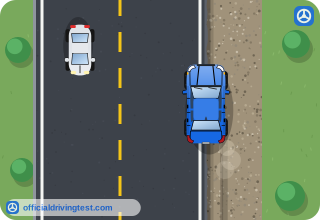
- Do not steer sharply and do not brake suddenly
- Accelerate and honk your horn
- Turn off the engine and steer sharply back
- Brake hard and steer sharply back onto the road
Show answer
Correct answer: Do not steer sharply and do not brake suddenly
The most important things to remember after a drop-off are: do not steer sharply, and do not brake suddenly.
Source: Pennsylvania Driver's Manual (Pub 95), page 64 · Open this page in the manual (Manual page 64)
-
Why is it dangerous to turn the wheel sharply to get back onto the road after a drop-off?
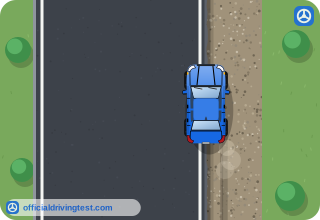
- It can damage the tires immediately
- It can make the vehicle whip sideways into oncoming traffic
- It will trigger the anti-lock brakes unnecessarily
- It has no real danger, it is simply discouraged
Show answer
Correct answer: It can make the vehicle whip sideways into oncoming traffic
Turning the wheel sharply to get back onto the road can cause the vehicle to whip sideways and cross into oncoming traffic.
Source: Pennsylvania Driver's Manual (Pub 95), page 64 · Open this page in the manual (Manual page 64)
-
Why is braking hard dangerous when two wheels are on the pavement and two are on a soft shoulder?
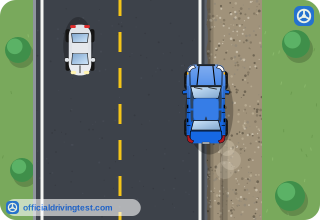
- It will overheat the brakes
- It voids the vehicle's warranty
- The vehicle will probably skid out of control
- It has no additional danger compared to normal braking
Show answer
Correct answer: The vehicle will probably skid out of control
If you brake hard with two wheels on the pavement and two wheels on a soft shoulder, the vehicle will probably skid out of control.
Source: Pennsylvania Driver's Manual (Pub 95), page 64 · Open this page in the manual (Manual page 64)
-
What is the first step to take when your two right-side wheels go off the pavement?
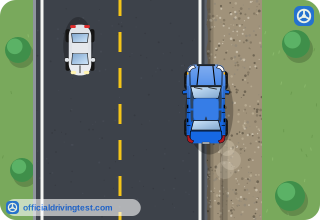
- Brake suddenly to stop as quickly as possible
- Accelerate to get back on the road faster
- Turn the wheel sharply back onto the roadway
- Ease off the gas pedal, without braking suddenly
Show answer
Correct answer: Ease off the gas pedal, without braking suddenly
Ease off of the gas pedal to slow down when your two wheels go off the pavement; do not brake suddenly.
Source: Pennsylvania Driver's Manual (Pub 95), page 64 · Open this page in the manual (Manual page 64)
-
While straddling the drop-off edge with a firm grip on the wheel, how should you steer?
- Parallel to the roadway
- Sharply toward the roadway
- Directly away from the roadway
- In a zigzag pattern to test traction
Show answer
Correct answer: Parallel to the roadway
Keep a tight grip on the steering wheel and steer parallel to the roadway, with two wheels on the roadway and two off, keeping the tires from scraping the pavement edge.
Source: Pennsylvania Driver's Manual (Pub 95), page 64 · Open this page in the manual (Manual page 64)
-
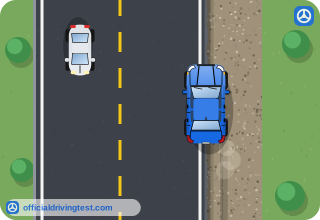
How slow should you get your vehicle before trying to steer back onto the pavement after a drop-off?
- Exactly the posted speed limit
- Less than 25 mph, preferably closer to 10 mph
- Less than 45 mph
- It does not matter, as long as you are steady
Show answer
Correct answer: Less than 25 mph, preferably closer to 10 mph
Continue to slow gradually until you are traveling very slowly - less than 25 mph and preferably closer to 10 mph - and you have your vehicle under control.
Source: Pennsylvania Driver's Manual (Pub 95), page 64 · Open this page in the manual (Manual page 64)
-
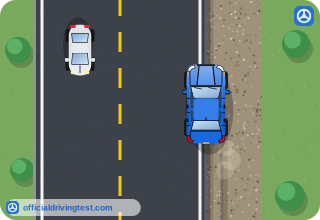
Before steering back onto the pavement after a drop-off, what should you check and signal?
- Check your fuel gauge and turn on your headlights
- Check your mirrors for tailgaters and turn on your right turn signal
- Check for traffic approaching from the rear and turn on your left turn signal
- Nothing; signaling is unnecessary in this situation
Show answer
Correct answer: Check for traffic approaching from the rear and turn on your left turn signal
Check for traffic approaching from the rear in the lane you will reenter, and turn on your left turn signal.
Source: Pennsylvania Driver's Manual (Pub 95), page 64 · Open this page in the manual (Manual page 64)
-
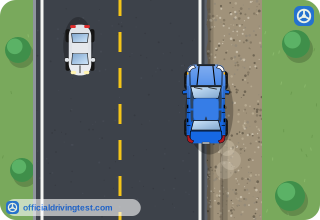
How should you bring your right wheels back onto the pavement after a drop-off, once it is clear?
- Steer sharply left, then hold the wheel steady
- Brake firmly while turning left
- Accelerate hard while turning right
- Gently steer left, then gently right to straighten out
Show answer
Correct answer: Gently steer left, then gently right to straighten out
Gently steer left to ease the right wheels onto the pavement when it is clear; as soon as you feel the wheels come back onto the road, gently steer right to straighten out.
Source: Pennsylvania Driver's Manual (Pub 95), page 64 · Open this page in the manual (Manual page 64)
-
If another vehicle is approaching you head-on in your lane, what should you do first?
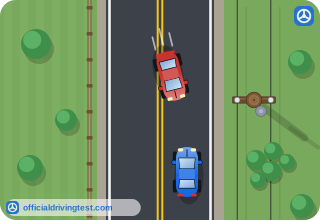
- Honk your horn to attract attention
- Swerve left immediately
- Brake as hard as possible
- Flash your high beams repeatedly
Show answer
Correct answer: Honk your horn to attract attention
If another vehicle is approaching head-on in your lane, first honk your horn to attract attention.
Source: Pennsylvania Driver's Manual (Pub 95), page 64 · Open this page in the manual (Manual page 64)
-
If the other driver does not move over when a head-on collision threatens, which direction should you try to escape, if possible?
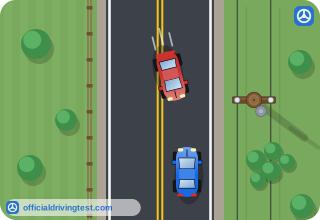
- Left, into the oncoming lane
- Right
- Straight ahead without changing direction
- It does not matter which direction
Show answer
Correct answer: Right
If the other driver does not move over, try to escape to the right, if possible.
Source: Pennsylvania Driver's Manual (Pub 95), page 64 · Open this page in the manual (Manual page 64)
-
Why should you avoid swerving left to avoid a head-on collision?
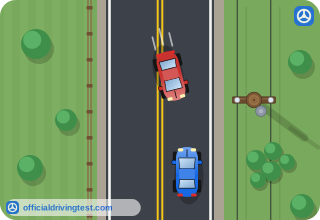
- It is illegal in every case
- It will automatically trigger your airbags
- If the other driver corrects late, you will still crash
- Left turns always take longer than right turns
Show answer
Correct answer: If the other driver corrects late, you will still crash
If you swerve left and the other driver corrects at the last instant, you will still crash.
Source: Pennsylvania Driver's Manual (Pub 95), page 64 · Open this page in the manual (Manual page 64)
-
If a head-on collision becomes unavoidable, what should you do, and why?
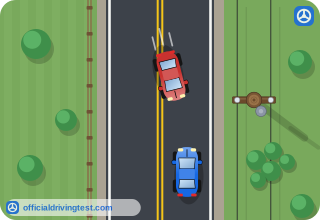
- Accelerate to get past the other vehicle faster
- Release the brakes completely and coast
- Close your eyes and hold the wheel straight
- Brake firmly and steadily to reduce the impact
Show answer
Correct answer: Brake firmly and steadily to reduce the impact
If a collision is unavoidable, brake firmly and steadily - every mile per hour you slow down will reduce the impact.
Source: Pennsylvania Driver's Manual (Pub 95), page 64 · Open this page in the manual (Manual page 64)
-
If you have a tire blowout, what should you do?
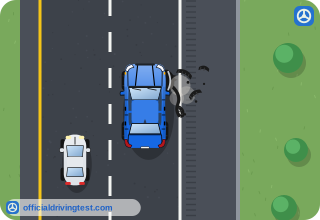
- Let the car slow to a stop
- Brake hard to stop the car immediately
- Continue driving until you reach a garage
- Allow the steering wheel to move freely
Show answer
Correct answer: Let the car slow to a stop
After a blowout, stay off the brake (if you must brake, press gently) and let the vehicle slow to a stop. You can ride on the flat tire as long as you need to in order to reach a safe spot to pull over and change it.
Source: Pennsylvania Driver's Manual (Pub 95), page 63 · Open this page in the manual (Manual page 63)
-
If your car breaks down on a Pennsylvania highway, what should you do?
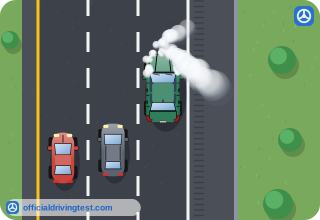
- Sound your horn at passing motorists
- Use your four-way flashers to warn other drivers
- Sit in your car and wait for help without taking further action
- Flash your headlights at oncoming traffic
Show answer
Correct answer: Use your four-way flashers to warn other drivers
If your vehicle breaks down on the highway, signal, carefully exit the roadway, and put on your hazard (four-way) flashers to warn other drivers.
Source: Pennsylvania Driver's Manual (Pub 95), page 44 · Open this page in the manual (Manual page 44)
-
If an oncoming driver is heading toward you in your lane, what should you do?
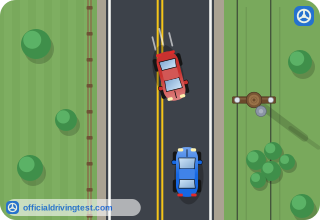
- Stay in the center of your lane, blow your horn, and brake
- Steer left, blow your horn, and brake
- Steer right, blow your horn, and brake
- Steer right, blow your horn, and accelerate
Show answer
Correct answer: Steer right, blow your horn, and brake
Steer right, blow your horn, and brake - trying to escape to the right while alerting the other driver and slowing down.
Source: Pennsylvania Driver's Manual (Pub 95), page 64 · Open this page in the manual (Manual page 64)