Pennsylvania: Freeway driving — Part 3 Practice Test
Questions in this part include: “What is the purpose of an acceleration lane at a highway entrance?” · “What is 'highway hypnosis'?”
Independent educational site · not affiliated with any government agency or DMV
Ready? Test yourself
- Instant feedback with an explanation
- Every answer cites its source in the manual
- Your best score is saved on this device
Questions are original and based on the official manual "Pennsylvania Driver's Manual" (Pub 95), Pennsylvania Department of Transportation (PennDOT), Bureau of Driver Licensing.
All 16 questions in this practice test
Take the test above first, then use this list to study. Tap “Show answer” to see the correct answer and explanation.
Show the questions and answersHide the questions
-
If you see a white line on your right and a yellow line on your left as you head onto a ramp, what does this tell you?
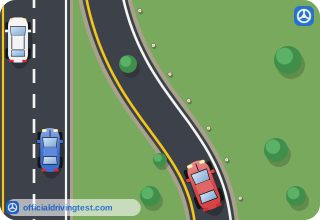
- The ramp is closed
- You are on an exit ramp
- You are headed the wrong way
- You are headed the right way
Show answer
Correct answer: You are headed the right way
A white line on the right and a yellow line on the left tell you that you are headed in the right direction onto the highway.
Source: Pennsylvania Driver's Manual (Pub 95), page 52 · Open this page in the manual (Manual page 52)
-
In a 'weaving lane' shared by traffic entering and exiting a highway, who must yield?
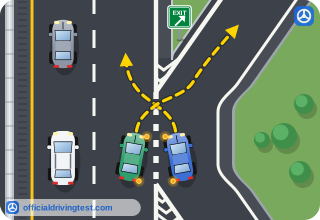
- Whichever driver is on the left
- The entering driver must yield to the exiting driver
- Both drivers may proceed at the same time
- The exiting driver must yield to the entering driver
Show answer
Correct answer: The entering driver must yield to the exiting driver
When highway entrances and exits are close together and share a weaving lane, the driver entering the highway must yield to the exiting driver.
Source: Pennsylvania Driver's Manual (Pub 95), page 52 · Open this page in the manual (Manual page 52)
-
What is the purpose of an acceleration lane at a highway entrance?
- To provide extra parking near the highway
- To let you make a U-turn safely
- To let you reach traffic speed before entering
- To allow trucks to weigh their loads
Show answer
Correct answer: To let you reach traffic speed before entering
Acceleration lanes run beside the main traffic lanes and should be long enough to let you reach the speed of traffic before entering the highway.
Source: Pennsylvania Driver's Manual (Pub 95), page 52 · Open this page in the manual (Manual page 52)
-
When looking for a gap while driving on a highway entrance ramp, what should you do?
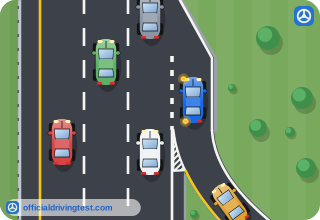
- Look only in your rearview mirror
- Look over your shoulder and in your side mirror
- Look only straight ahead
- Look only at the speedometer
Show answer
Correct answer: Look over your shoulder and in your side mirror
The manual advises looking over your shoulder and in your side mirror when looking for a gap on an entrance ramp.
Source: Pennsylvania Driver's Manual (Pub 95), page 52 · Open this page in the manual (Manual page 52)
-
According to the manual, when should you slow down while preparing to exit a highway?
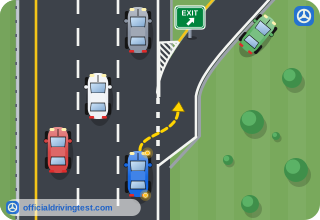
- As soon as you see the exit sign
- Only after you have moved into the exit lane
- You should never slow down until you leave the ramp
- Before you move into the exit lane
Show answer
Correct answer: Only after you have moved into the exit lane
The manual instructs drivers to get into the proper lane well in advance and not slow down until after moving into the exit lane.
Source: Pennsylvania Driver's Manual (Pub 95), page 52 · Open this page in the manual (Manual page 52)
-
What should you do if you miss your highway exit?
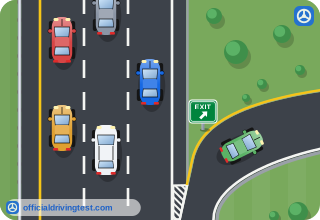
- Cross the median to turn around
- Back up on the shoulder to reach it
- Take the next exit
- Stop on the highway and wait for a gap
Show answer
Correct answer: Take the next exit
The manual is clear: if you miss your exit, take the next one. Backing up, stopping, or crossing the median are described as illegal and hazardous.
Source: Pennsylvania Driver's Manual (Pub 95), page 52 · Open this page in the manual (Manual page 52)
-
What do exit ramp warning signs let you know?
- The location of the nearest gas station
- The maximum safe speed for the ramp
- The distance to the next rest stop
- The number of lanes ahead
Show answer
Correct answer: The maximum safe speed for the ramp
Exit ramps have a warning sign that lets you know the maximum safe speed for taking the ramp.
Source: Pennsylvania Driver's Manual (Pub 95), page 52 · Open this page in the manual (Manual page 52)
-
About how many feet per second does a vehicle traveling 65 mph cover?
- About 50 feet per second
- About 100 feet per second
- About 25 feet per second
- About 200 feet per second
Show answer
Correct answer: About 100 feet per second
The manual notes that 65 mph is almost 100 feet per second, meaning it takes less than one second to run off of the road.
Source: Pennsylvania Driver's Manual (Pub 95), page 52 · Open this page in the manual (Manual page 52)
-
According to the manual, about how much of the fatal crashes on highways involve vehicles that ran off the road due to speeding and/or driver fatigue?
- Nearly all
- About half
- About one tenth
- About one quarter
Show answer
Correct answer: About half
The manual states that half of the fatal crashes on highways involve vehicles that ran off the road as a result of speeding and/or driver fatigue.
Source: Pennsylvania Driver's Manual (Pub 95), page 52 · Open this page in the manual (Manual page 52)
-
When changing lanes to pass a slower vehicle on a highway, how many lanes should you move at a time?
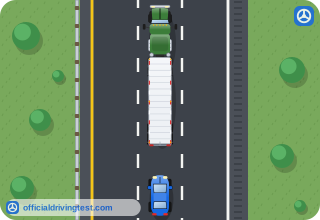
- As many as needed in one motion
- Three lanes at once
- Two lanes at once
- One lane at a time
Show answer
Correct answer: One lane at a time
The manual instructs drivers to change lanes only one lane at a time when passing a slower vehicle on a highway.
Source: Pennsylvania Driver's Manual (Pub 95), page 52 · Open this page in the manual (Manual page 52)
-
When changing lanes on a highway, when should you turn on your turn signal?
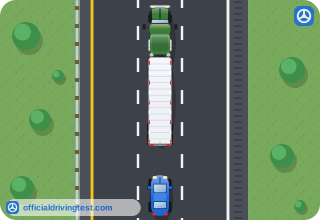
- In plenty of time for other drivers to see it
- Only if another vehicle is directly behind you
- You are not required to signal on a highway
- Only after you have completed the lane change
Show answer
Correct answer: In plenty of time for other drivers to see it
The manual says to use your turn signal every time you change lanes, turning it on in plenty of time for other drivers to see it.
Source: Pennsylvania Driver's Manual (Pub 95), page 52 · Open this page in the manual (Manual page 52)
-
As a courtesy when you see a vehicle about to enter the highway from an on-ramp, what does the manual suggest, after first checking it is clear around your vehicle?
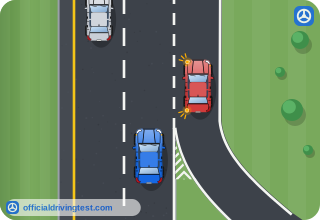
- Stop on the highway to let the driver in
- Speed up so the driver cannot merge
- Change lanes to let the driver enter easily
- Flash your high beams repeatedly
Show answer
Correct answer: Change lanes to let the driver enter easily
As a common courtesy, changing lanes (after checking it is clear) to let an entering driver merge more easily helps keep traffic moving smoothly.
Source: Pennsylvania Driver's Manual (Pub 95), page 52 · Open this page in the manual (Manual page 52)
-
Even though a courteous driver may make room for a merging vehicle, who is actually required by law to yield the right-of-way when entering a highway?
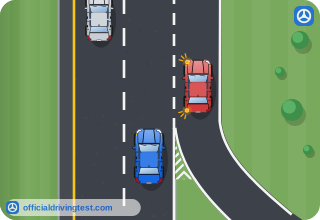
- The driver already on the highway
- The entering driver
- Neither driver
- Whichever driver arrives first
Show answer
Correct answer: The entering driver
The manual notes that the entering driver is required to yield the right-of-way to traffic already on the highway, even though other drivers may courteously make room.
Source: Pennsylvania Driver's Manual (Pub 95), page 52 · Open this page in the manual (Manual page 52)
-
What is 'highway hypnosis'?
- Inattention from staring straight ahead for long periods
- A medical condition requiring a doctor's note
- A legal requirement to stay in one highway lane
- A type of headlight glare
Show answer
Correct answer: Inattention from staring straight ahead for long periods
Highway hypnosis happens when you stare straight ahead for long periods and stop actively scanning ahead, behind, and around your vehicle.
Source: Pennsylvania Driver's Manual (Pub 95), page 52 · Open this page in the manual (Manual page 52)
-
Of fatal crashes on highways, about what percent involve rear-end collisions?
- 5 percent
- 20 percent
- 50 percent
- 80 percent
Show answer
Correct answer: 20 percent
The manual states that 20 percent of fatal highway crashes involve rear-end collisions, mostly due to driver inattention and following too closely.
Source: Pennsylvania Driver's Manual (Pub 95), page 52 · Open this page in the manual (Manual page 52)
-
What does the manual say accounts for most rear-end collision fatalities on highways?
- Poor road lighting at night
- Faulty or burned-out brake lights
- Inattention and following too closely
- Heavy rain and wet pavement
Show answer
Correct answer: Inattention and following too closely
Driver inattention and following too closely are identified as the main causes of most rear-end collisions on highways.
Source: Pennsylvania Driver's Manual (Pub 95), page 52 · Open this page in the manual (Manual page 52)