Combination Vehicles: Coupling and uncoupling
The steps for coupling and uncoupling a tractor and semitrailer, and other couplings: the pintle hook, the drawbar and the gooseneck hitch. Split into 6 shorter tests so you're not stuck in one long quiz.
Independent educational site · not affiliated with any government agency or DMV
Choose a part
Coupling and uncoupling — Part 1
Questions in this part include: “The general coupling steps differ a little from one rig to another. What should a driver do about that?”
Coupling and uncoupling — Part 2
Questions in this part include: “From the cab, how do you send air to the trailer brake system?”
Coupling and uncoupling — Part 3
Questions in this part include: “After you plug the electrical cord into the trailer, what is the next thing to do with the plug?”
Coupling and uncoupling — Part 4
Questions in this part include: “On a loaded trailer, what is the benefit of the few extra crank turns in low gear?”
Coupling and uncoupling — Part 5
Questions in this part include: “What can happen if the pintle hook latch is not locked correctly?”
Coupling and uncoupling — Part 6
Questions in this part include: “After the guard disk gap has been set, how is the adjustment screw setting held?”
Questions are written in our own words from the CDL manual; they are not the real test's questions. With your state chosen, every answer gives its page in your state's CDL manual. Without a state, answers cite the CDL manual, national model as printed by New Jersey (July 2017).
All 104 Coupling and uncoupling questions with answers
Choose a part above to take a practice test, or study every question and answer here.
Show the questions and answersHide the questions
1Part 118 questions
-
The general coupling steps differ a little from one rig to another. What should a driver do about that?
- Use the general steps alone, since they fit every rig
- Learn the coupling details of the trucks he or she will operate
- Learn only the uncoupling steps, since coupling is the same on all rigs
Show answer
Correct answer: Learn the coupling details of the trucks he or she will operate
Rigs differ, so the general steps are only a base. A driver must learn the exact coupling and uncoupling details of the trucks he or she drives.
Source: CDL manual, national model as printed by New Jersey, Section 6 (July 2017)
-
What problem can a dry, ungreased fifth wheel plate cause?
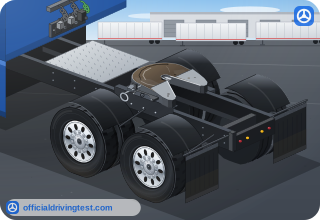
- Slow air build-up in the trailer air tanks
- Weak signals from the trailer electrical cord
- Steering trouble caused by friction
Show answer
Correct answer: Steering trouble caused by friction
Rubbing between the tractor and the trailer on a dry plate can make the rig hard to steer, so the plate must be greased as required.
Source: CDL manual, national model as printed by New Jersey, Section 6 (July 2017)
-
When you prepare to couple, how should the fifth wheel be tilted?
- Up toward the cab of the tractor
- Down toward the rear of the tractor
- Level with the frame, with no tilt at all
Show answer
Correct answer: Down toward the rear of the tractor
A fifth wheel ready for coupling is tilted down toward the rear of the tractor.
Source: CDL manual, national model as printed by New Jersey, Section 6 (July 2017)
-
Where should the fifth wheel safety unlocking handle be before you back under a trailer?
- Taken off and stored in the cab
- In the automatic lock position
- Held down with a separate locking pin
Show answer
Correct answer: In the automatic lock position
Before coupling, the safety unlocking handle must already be in the automatic lock position.
Source: CDL manual, national model as printed by New Jersey, Section 6 (July 2017)
-
Before coupling, what do you make sure about the surroundings?
- The area around the vehicle is level and paved
- The area around the vehicle is clear
- The area around the vehicle has room to turn a full circle
Show answer
Correct answer: The area around the vehicle is clear
Before coupling, confirm that nothing and no one is in the area around the vehicle.
Source: CDL manual, national model as printed by New Jersey, Section 6 (July 2017)
-
Before the tractor backs toward the trailer, what must keep the trailer from rolling?
- Its landing gear lowered and its air-lines connected
- Its service brakes held on with the hand valve
- Chocks at its wheels, or its spring brakes applied
Show answer
Correct answer: Chocks at its wheels, or its spring brakes applied
The trailer must not move while you couple, so its wheels are chocked or its spring brakes are on.
Source: CDL manual, national model as printed by New Jersey, Section 6 (July 2017)
-
What do you check about the cargo before the tractor is coupled to the trailer?
- That it is packed toward the front of the trailer
- That it is weighed and the weight is on the load sheet
- That it is secured so it cannot shift when the tractor couples
Show answer
Correct answer: That it is secured so it cannot shift when the tractor couples
Coupling can jolt the trailer, so any cargo has to be secured against movement first.
Source: CDL manual, national model as printed by New Jersey, Section 6 (July 2017)
-
Why should you never back a tractor under a trailer at an angle?
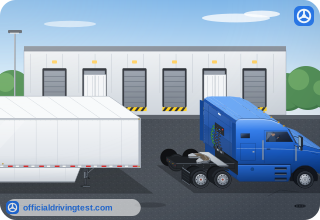
- The trailer could be pushed sideways and its landing gear broken
- The air-lines could be torn off the trailer glad hands
- The fifth wheel jaws could close too early on the kingpin
Show answer
Correct answer: The trailer could be pushed sideways and its landing gear broken
Backing in at an angle can shove the trailer sideways and break its landing gear, so put the tractor directly in front of it.
Source: CDL manual, national model as printed by New Jersey, Section 6 (July 2017)
-
How do you check that the tractor is lined up with the trailer before backing?
- Look down both sides of the trailer in the outside mirrors
- Watch the trailer landing gear through the rear window
- Line up the bumper with the front corners of the trailer
Show answer
Correct answer: Look down both sides of the trailer in the outside mirrors
Use the outside mirrors and look along both sides of the trailer to confirm the tractor is straight in front of it.
Source: CDL manual, national model as printed by New Jersey, Section 6 (July 2017)
-
During the first slow back-up toward the trailer, how far do you back?
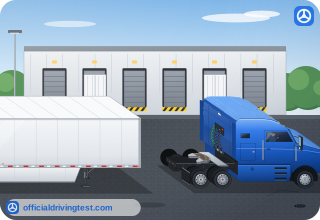
- Until the fifth wheel just touches the trailer
- Until the tractor frame is fully under the trailer
- Until the trailer nose touches the back of the cab
Show answer
Correct answer: Until the fifth wheel just touches the trailer
Back only until the fifth wheel just touches the trailer, and do not hit it.
Source: CDL manual, national model as printed by New Jersey, Section 6 (July 2017)
-
After backing the tractor up to the trailer, how do you secure it?
- Apply the parking brake and put the transmission in neutral
- Release the parking brake and put the transmission in low gear
- Apply the parking brake and put the transmission in reverse
Show answer
Correct answer: Apply the parking brake and put the transmission in neutral
Set the parking brake and shift the transmission to neutral so the tractor stays put.
Source: CDL manual, national model as printed by New Jersey, Section 6 (July 2017)
-
How high should the trailer be set before the tractor backs under it?
- Low enough that the tractor lifts it a little as it goes under
- Level with the top of the tractor tires
- High enough that the tractor slides under without touching it
Show answer
Correct answer: Low enough that the tractor lifts it a little as it goes under
The trailer should sit low enough that the tractor raises it slightly when backing under. Raise or lower the trailer to get that.
Source: CDL manual, national model as printed by New Jersey, Section 6 (July 2017)
-
What can happen if the trailer is set too low when you back under it?
- The kingpin may snap off inside the fifth wheel
- The tractor may hit and damage the nose of the trailer
- The landing gear may fold up on its own
Show answer
Correct answer: The tractor may hit and damage the nose of the trailer
A trailer that is too low can be struck and damaged at the nose by the tractor.
Source: CDL manual, national model as printed by New Jersey, Section 6 (July 2017)
-
What can happen if the trailer is set too high when you back under it?
- The landing gear may drag on the ground
- The coupling may not work correctly
- The air-lines may be pulled out of the glad hands
Show answer
Correct answer: The coupling may not work correctly
A trailer that is too high may not couple correctly, so raise or lower it as needed.
Source: CDL manual, national model as printed by New Jersey, Section 6 (July 2017)
-
Along with the trailer height, what alignment do you check before connecting the air-lines?
- That the trailer nose and the cab roof line up
- That the kingpin and the fifth wheel line up
- That the landing gear and the tractor frame line up
Show answer
Correct answer: That the kingpin and the fifth wheel line up
Make sure the kingpin and the fifth wheel line up so the coupling will seat properly.
Source: CDL manual, national model as printed by New Jersey, Section 6 (July 2017)
-
How are the tractor air-lines matched to the glad hands on the trailer?
- Emergency to emergency and service to service
- Emergency to service and service to emergency
- Either way, once both seals are checked
Show answer
Correct answer: Emergency to emergency and service to service
The emergency line goes to the trailer emergency glad hand, and the service line goes to the service glad hand.
Source: CDL manual, national model as printed by New Jersey, Section 6 (July 2017)
-
Before joining the tractor service air-line to the trailer service glad hand, what do you check?
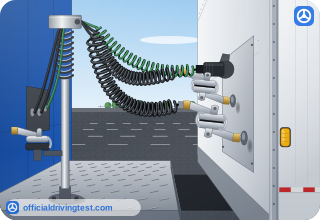
- The trailer air tank drain valves
- The cut-out cock on the back of the trailer
- The seals on the glad hands
Show answer
Correct answer: The seals on the glad hands
Check the glad hand seals before connecting, so the connection will not leak.
Source: CDL manual, national model as printed by New Jersey, Section 6 (July 2017)
-
Why must the air-lines be supported before the tractor backs under the trailer?
- So the trailer brakes stay released during the back-up
- So they will not be crushed or caught while the tractor moves
- So moisture cannot reach the seals during the back-up
Show answer
Correct answer: So they will not be crushed or caught while the tractor moves
Loose lines can be crushed or snagged as the tractor goes under, so hold them up and clear.
Source: CDL manual, national model as printed by New Jersey, Section 6 (July 2017)
2Part 218 questions
-
From the cab, how do you send air to the trailer brake system?
- Push in the air supply knob
- Pull out the air supply knob
- Set the tractor protection valve control to emergency
Show answer
Correct answer: Push in the air supply knob
Pushing the air supply knob in (or moving the valve control to normal) feeds air to the trailer brakes.
Source: CDL manual, national model as printed by New Jersey, Section 6 (July 2017)
-
After supplying air to the trailer, what do you wait for before testing the trailer brakes?
- For the tractor protection valve to close
- For the air pressure to reach normal
- For the low air warning signal to come on
Show answer
Correct answer: For the air pressure to reach normal
Let the air pressure build up to normal before you test the trailer brakes.
Source: CDL manual, national model as printed by New Jersey, Section 6 (July 2017)
-
Once the trailer has been supplied, what problem do you check its brake system for?
- A sticking brake pedal
- Crossed air-lines
- Worn brake drums
Show answer
Correct answer: Crossed air-lines
Once the trailer has air, check that the service and emergency air-lines were not swapped.
Source: CDL manual, national model as printed by New Jersey, Section 6 (July 2017)
-
Why do you shut the engine off while you test the trailer brakes by applying and releasing them?
- So the air pressure cannot rise during the test
- So the tractor cannot roll while the brakes are off
- So engine noise does not cover the sounds of the brakes
Show answer
Correct answer: So engine noise does not cover the sounds of the brakes
With the engine off you can hear the trailer brakes working.
Source: CDL manual, national model as printed by New Jersey, Section 6 (July 2017)
-
With the engine off, what should you hear as you apply and release the trailer brakes?
- A steady hiss both while applying and while releasing
- Air escaping when applied and the brakes moving when released
- The brakes moving when applied and air escaping when released
Show answer
Correct answer: The brakes moving when applied and air escaping when released
Applying the brakes should make them move, and releasing them should let air out.
Source: CDL manual, national model as printed by New Jersey, Section 6 (July 2017)
-
While you test the trailer brakes, what problem are you watching the gauge for?
- A major air loss
- Pressure climbing above the normal level
- Pressure staying exactly where it was
Show answer
Correct answer: A major air loss
Watch the air brake system pressure gauge during the test, because a large air loss shows up there.
Source: CDL manual, national model as printed by New Jersey, Section 6 (July 2017)
-
When do you start the engine again after testing the trailer brakes?
- As soon as the air-lines are connected
- Right after the kingpin locks in
- Once you are sure the trailer brakes work
Show answer
Correct answer: Once you are sure the trailer brakes work
Restart the engine only after the test shows the trailer brakes work.
Source: CDL manual, national model as printed by New Jersey, Section 6 (July 2017)
-
Before backing under the trailer, how do you lock the trailer brakes?
- Push in the air supply knob
- Hold the trailer hand valve on
- Pull out the air supply knob
Show answer
Correct answer: Pull out the air supply knob
Pulling the air supply knob out (or moving the valve control to emergency) locks the trailer brakes before the tractor backs under.
Source: CDL manual, national model as printed by New Jersey, Section 6 (July 2017)
-
Which gear do you use to back the tractor under the trailer?
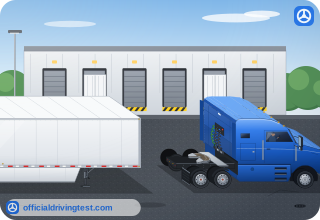
- The lowest reverse gear
- The highest reverse gear
- A middle reverse gear
Show answer
Correct answer: The lowest reverse gear
Use the lowest reverse gear so the tractor moves slowly under the trailer.
Source: CDL manual, national model as printed by New Jersey, Section 6 (July 2017)
-
Why do you back slowly under the trailer?
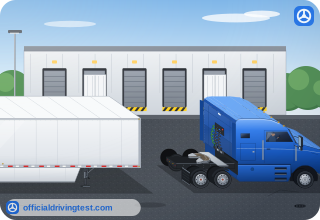
- To avoid hitting the kingpin too hard
- To let the landing gear settle on the ground
- To keep the air pressure from dropping
Show answer
Correct answer: To avoid hitting the kingpin too hard
A slow approach keeps the tractor from slamming into the kingpin.
Source: CDL manual, national model as printed by New Jersey, Section 6 (July 2017)
-
When do you stop backing under the trailer?
- When the landing gear touches the ground
- When the trailer touches the back of the cab
- When the kingpin has locked into the fifth wheel
Show answer
Correct answer: When the kingpin has locked into the fifth wheel
Back until the kingpin locks into the fifth wheel, then stop.
Source: CDL manual, national model as printed by New Jersey, Section 6 (July 2017)
-
To test the connection, what do you do with the landing gear first?
- Leave it resting firmly on the ground
- Lift it a little off the ground
- Crank it halfway up and lock the handle
Show answer
Correct answer: Lift it a little off the ground
Lift the landing gear slightly off the ground before the pull test of the connection.
Source: CDL manual, national model as printed by New Jersey, Section 6 (July 2017)
-
How do you test that the trailer is really locked onto the tractor?
- Back up hard against the trailer with its brakes released
- Pull gently forward with the trailer brakes still locked
- Rock the trailer sideways with the landing gear down
Show answer
Correct answer: Pull gently forward with the trailer brakes still locked
A gentle forward pull against the locked trailer brakes shows whether the coupling holds.
Source: CDL manual, national model as printed by New Jersey, Section 6 (July 2017)
-
Why do you take the key with you when you go under the trailer?
- So no one can drive the truck while you are underneath
- So the fifth wheel stays locked while you look at it
- So the air pressure cannot drop while you check it
Show answer
Correct answer: So no one can drive the truck while you are underneath
Keeping the key prevents anyone else from moving the truck while you are beneath the trailer.
Source: CDL manual, national model as printed by New Jersey, Section 6 (July 2017)
-
After coupling, what might a visible gap between the upper and lower fifth wheel mean?
- The fifth wheel plate needs more grease added
- The trailer is correctly seated and safe for towing
- The kingpin may be sitting on top of the closed jaws
Show answer
Correct answer: The kingpin may be sitting on top of the closed jaws
There should be no gap. A gap can mean the kingpin rests on top of the closed jaws, so the trailer could come loose easily.
Source: CDL manual, national model as printed by New Jersey, Section 6 (July 2017)
-
Looking into the back of the fifth wheel, where should the jaws have closed?
- Around the glide plate on the trailer
- Around the head of the kingpin
- Around the shank of the kingpin
Show answer
Correct answer: Around the shank of the kingpin
The jaws must have closed around the kingpin shank. You check this by going under the trailer and looking in.
Source: CDL manual, national model as printed by New Jersey, Section 6 (July 2017)
-
On some fifth wheels, what must the driver do by hand during the final coupling inspection?
- Place the safety catch over the lever
- Screw the locking lever down tight
- Close the jaws around the kingpin
Show answer
Correct answer: Place the safety catch over the lever
The safety latch must sit over the locking lever, and on some fifth wheels the driver has to place it manually.
Source: CDL manual, national model as printed by New Jersey, Section 6 (July 2017)
-
What do you do if the coupling inspection shows the coupling is not right?
- Drive slowly to the nearest shop
- Drive on, but keep watching the mirrors
- Do not drive it until it is fixed
Show answer
Correct answer: Do not drive it until it is fixed
A faulty coupling is dangerous, so the unit stays parked until the coupling is repaired.
Source: CDL manual, national model as printed by New Jersey, Section 6 (July 2017)
3Part 317 questions
-
After you plug the electrical cord into the trailer, what is the next thing to do with the plug?
- Tape it to the glad hand
- Coil the cord around the air-lines
- Fasten its safety catch
Show answer
Correct answer: Fasten its safety catch
Plug in the electrical cord and fasten its safety catch so it stays connected.
Source: CDL manual, national model as printed by New Jersey, Section 6 (July 2017)
-
After fastening the plug's safety catch, what else do you check for damage besides both air-lines?
- The electrical line
- The trailer mud flaps
- The tractor fuel lines
Show answer
Correct answer: The electrical line
Look over both air-lines and the electrical line for any damage.
Source: CDL manual, national model as printed by New Jersey, Section 6 (July 2017)
-
What do you make sure of about the air and electrical lines before driving away?
- That they cannot hit any moving parts of the vehicle
- That they hang down loosely below the frame
- That they are pulled tight between tractor and trailer
Show answer
Correct answer: That they cannot hit any moving parts of the vehicle
The lines must be routed so they never strike any moving part of the vehicle.
Source: CDL manual, national model as printed by New Jersey, Section 6 (July 2017)
-
How do you use the gear ranges of the landing gear crank when raising it?
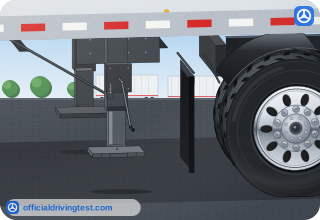
- Start in low range, then switch to high once free of weight
- Stay in low range until it is all the way up
- Start in high range, then switch to low once free of weight
Show answer
Correct answer: Start in low range, then switch to high once free of weight
Low range starts the lift under load. When the weight is off, high range raises it faster.
Source: CDL manual, national model as printed by New Jersey, Section 6 (July 2017)
-
What is the danger of driving with the landing gear only partly raised?
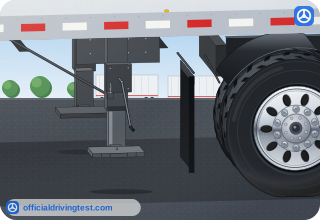
- It can pull the kingpin out of the fifth wheel
- It can snag on rails or other objects
- It can scrape the trailer tires
Show answer
Correct answer: It can snag on rails or other objects
Landing gear that is not fully up can catch on railroad tracks or other objects, so raise it completely.
Source: CDL manual, national model as printed by New Jersey, Section 6 (July 2017)
-
What do you do with the crank handle after the landing gear is up?
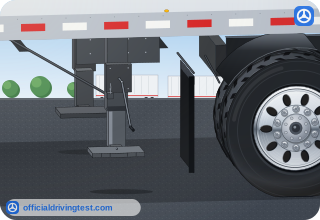
- Remove it and store it inside the cab
- Secure it safely so it stays in place
- Leave it on the shaft in low gear range
Show answer
Correct answer: Secure it safely so it stays in place
After the landing gear is up, the crank handle has to be secured safely so that it stays in place.
Source: CDL manual, national model as printed by New Jersey, Section 6 (July 2017)
-
With the full trailer weight on the tractor, what must not happen when the tractor turns sharply?
- The trailer nose must not touch the fifth wheel latch
- The air-lines must not touch the tractor tires
- The rear of the tractor frame must not hit the landing gear
Show answer
Correct answer: The rear of the tractor frame must not hit the landing gear
There must be enough room between the rear of the tractor frame and the landing gear for sharp turns.
Source: CDL manual, national model as printed by New Jersey, Section 6 (July 2017)
-
Which clearance do you check between the tractor tires and the trailer once its weight is on the tractor?
- Between the top of the tires and the nose of the trailer
- Between the tire sidewalls and the trailer side panels
- Between the front of the tires and the landing gear
Show answer
Correct answer: Between the top of the tires and the nose of the trailer
Check that the tops of the tractor tires have enough space below the trailer nose.
Source: CDL manual, national model as printed by New Jersey, Section 6 (July 2017)
-
After the coupling is finished, what do you do with the trailer wheel chocks?
- Leave them under the wheels until the first stop
- Remove them and store them in a safe place
- Move them to the front of the trailer wheels
Show answer
Correct answer: Remove them and store them in a safe place
Take the chocks away from the trailer wheels and put them in a safe spot.
Source: CDL manual, national model as printed by New Jersey, Section 6 (July 2017)
-
Before you start to uncouple, what must you confirm about the parking area?
- The ground is free of oil and gravel
- The area has no other parked trailers
- The ground can carry the trailer's weight
Show answer
Correct answer: The ground can carry the trailer's weight
The surface has to be strong enough to hold the trailer's weight once the tractor leaves.
Source: CDL manual, national model as printed by New Jersey, Section 6 (July 2017)
-
Why should the tractor stay lined up with the trailer when it pulls out?
- It keeps the air hoses from being pulled tight
- Pulling out at an angle can damage the landing gear
- It stops the trailer brakes from locking up
Show answer
Correct answer: Pulling out at an angle can damage the landing gear
Leaving at an angle can bend or break the landing gear, so keep the rig straight.
Source: CDL manual, national model as printed by New Jersey, Section 6 (July 2017)
-
At the start of uncoupling, what should you do with the trailer air supply?
- Shut it off so the trailer brakes lock
- Leave it on so the trailer brakes stay released
- Drain the trailer tanks completely first
Show answer
Correct answer: Shut it off so the trailer brakes lock
Closing the trailer air supply applies the trailer brakes, which holds the trailer in place.
Source: CDL manual, national model as printed by New Jersey, Section 6 (July 2017)
-
Why do you back the tractor up gently before releasing the fifth wheel lock?
- It pushes the kingpin deeper so the jaws grip harder
- It warms the grease on the fifth wheel plate
- It takes load off the jaws so the lever releases more easily
Show answer
Correct answer: It takes load off the jaws so the lever releases more easily
Backing gently against the kingpin relieves pressure on the locking jaws, so the locking lever can be released.
Source: CDL manual, national model as printed by New Jersey, Section 6 (July 2017)
-
When do you set the tractor parking brakes while easing pressure on the jaws?
- While the tractor is still pushing against the kingpin
- After the tractor has rolled out from under the trailer
- Only once the fifth wheel is fully unlocked
Show answer
Correct answer: While the tractor is still pushing against the kingpin
Setting the brakes while the tractor pushes on the kingpin keeps the rig still with the jaws unloaded.
Source: CDL manual, national model as printed by New Jersey, Section 6 (July 2017)
-
When should you chock the trailer wheels before uncoupling?
- Only when the trailer is carrying a heavy load of cargo
- When the trailer lacks spring brakes, or you are unsure
- Only when the parking lot slopes downhill steeply
Show answer
Correct answer: When the trailer lacks spring brakes, or you are unsure
Without spring brakes, air can leak from the trailer tank and release the emergency brakes, so the trailer could roll. Chock the wheels in that case or when in doubt.
Source: CDL manual, national model as printed by New Jersey, Section 6 (July 2017)
-
How far do you lower the landing gear of an empty trailer?
- Until it lifts the trailer off the fifth wheel
- Halfway, so the tractor still carries the nose
- Until it touches the ground firmly
Show answer
Correct answer: Until it touches the ground firmly
With an empty trailer, the landing gear just needs to reach the ground and make firm contact.
Source: CDL manual, national model as printed by New Jersey, Section 6 (July 2017)
-
The landing gear of a loaded trailer has touched the ground. What do you do next?
- Crank in high gear until the trailer rises clear of the fifth wheel
- Turn the crank a few more times in low gear to take some weight off the tractor
- Stop cranking and let the gear rest lightly on the ground
Show answer
Correct answer: Turn the crank a few more times in low gear to take some weight off the tractor
A few extra turns in low gear move some weight off the tractor, which makes unlatching easier and the next coupling easier. The trailer must stay on the fifth wheel.
Source: CDL manual, national model as printed by New Jersey, Section 6 (July 2017)
4Part 417 questions
-
On a loaded trailer, what is the benefit of the few extra crank turns in low gear?
- The trailer brakes release faster after the tractor pulls out
- The fifth wheel is easier to unlatch, and easier to couple next time
- The kingpin slides out of the jaws without any backing up
Show answer
Correct answer: The fifth wheel is easier to unlatch, and easier to couple next time
Taking some weight off the tractor makes the fifth wheel easier to unlatch now and the next coupling easier, without lifting the trailer off the fifth wheel.
Source: CDL manual, national model as printed by New Jersey, Section 6 (July 2017)
-
After you disconnect the air-lines from the trailer, what do you do with the glad hands?
- Leave them hanging loose on the ground below the cab
- Wrap them around the fifth wheel release handle
- Hook them to dummy couplers or join them together
Show answer
Correct answer: Hook them to dummy couplers or join them together
Attaching them to dummy couplers, or joining them to each other, keeps dirt and water out of the air-lines.
Source: CDL manual, national model as printed by New Jersey, Section 6 (July 2017)
-
How should the trailer electrical cable hang once it is disconnected?
- With the plug pointing down, to keep moisture out
- With the plug up, so the pins stay off the ground
- Coiled tightly over the trailer glad hands
Show answer
Correct answer: With the plug pointing down, to keep moisture out
A plug that points down does not collect water, so moisture stays out of the connector.
Source: CDL manual, national model as printed by New Jersey, Section 6 (July 2017)
-
Why do you support the air and electrical lines after disconnecting them?
- So they are not damaged while the tractor drives away
- So they do not block the view in the side mirrors
- So they stay within reach for the next coupling
Show answer
Correct answer: So they are not damaged while the tractor drives away
Supported lines are not damaged while you drive the tractor away.
Source: CDL manual, national model as printed by New Jersey, Section 6 (July 2017)
-
How do you unlock the fifth wheel?
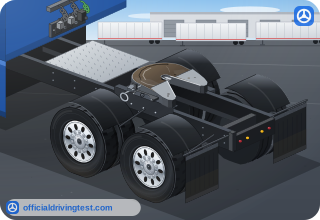
- Pull the handle down and push the air supply knob in
- Raise the handle lock, then pull the handle to open
- Push the handle in and turn the crank in low gear
Show answer
Correct answer: Raise the handle lock, then pull the handle to open
First lift the release handle lock, then pull the release handle to its open position.
Source: CDL manual, national model as printed by New Jersey, Section 6 (July 2017)
-
While you pull the fifth wheel release handle, where should your legs and feet be?
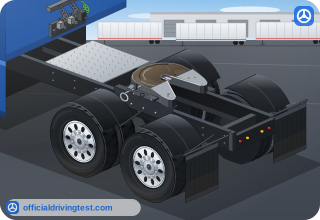
- Standing beside the landing gear crank handle
- Crouched under the front of the trailer
- Out of the way of the rear tractor wheels
Show answer
Correct answer: Out of the way of the rear tractor wheels
The vehicle might move, so legs and feet must stay clear of the rear tractor wheels to prevent serious injury.
Source: CDL manual, national model as printed by New Jersey, Section 6 (July 2017)
-
When you pull the tractor forward partly clear of the trailer, where do you stop?
- With the tractor completely free of the trailer
- With the fifth wheel just behind the kingpin
- With the tractor frame still under the trailer
Show answer
Correct answer: With the tractor frame still under the trailer
Stopping with the frame under the trailer catches the trailer if the landing gear sinks or collapses.
Source: CDL manual, national model as printed by New Jersey, Section 6 (July 2017)
-
After pulling the tractor partly clear, how do you secure it?
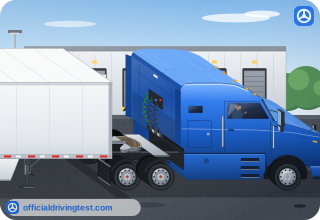
- Apply the parking brake and select the lowest gear
- Apply the parking brake and put the transmission in neutral
- Release the parking brake and shut off the trailer air
Show answer
Correct answer: Apply the parking brake and put the transmission in neutral
Set the parking brake and place the transmission in neutral before you inspect the trailer supports.
Source: CDL manual, national model as printed by New Jersey, Section 6 (July 2017)
-
Once the tractor is partly clear, what do you inspect under the trailer?
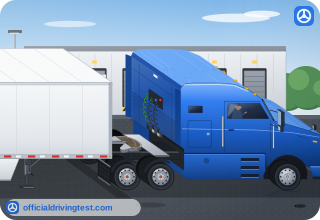
- The fifth wheel grease and the kingpin condition
- The ground under the trailer and the landing gear
- The trailer lights and the tire pressure level
Show answer
Correct answer: The ground under the trailer and the landing gear
Check that the ground holds up the trailer and that the landing gear is not damaged.
Source: CDL manual, national model as printed by New Jersey, Section 6 (July 2017)
-
What do you do just before you drive the tractor completely clear of the trailer?
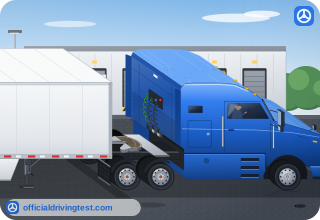
- Reverse a little more to ease the fifth wheel jaws
- Look over the area around you, then drive forward
- Pull the trailer air supply knob out
Show answer
Correct answer: Look over the area around you, then drive forward
Release the parking brakes, look around to make sure the way is clear, and then drive forward until the tractor is free.
Source: CDL manual, national model as printed by New Jersey, Section 6 (July 2017)
-
What do you check on a pintle hook before you operate it?
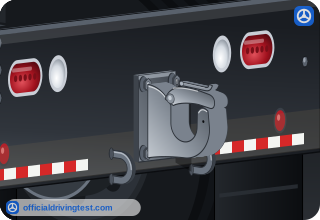
- Whether the latch and horn are painted a bright color
- For worn, damaged or missing parts, and for a secure mount
- Whether the safety chains are the right length
Show answer
Correct answer: For worn, damaged or missing parts, and for a secure mount
Inspect the hook for wear, damage and absent parts, and confirm the mount holds firmly.
Source: CDL manual, national model as printed by New Jersey, Section 6 (July 2017)
-
What could happen if a pintle hook is not secured to its mounting surface?
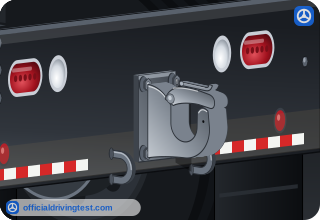
- The drawbar eye would wear out sooner than normal use
- The hook could separate, causing death or serious injury
- The trailer brakes would stay locked on after parking
Show answer
Correct answer: The hook could separate, causing death or serious injury
A loose mount lets the hook come away from the vehicle, which can cause death or serious injury.
Source: CDL manual, national model as printed by New Jersey, Section 6 (July 2017)
-
What is the first thing to do when you open the pintle hook, if it has a pin?
- Unlock and remove the tethered lock pin
- Lower the drawbar eye onto the horn
- Push the latch closed
Show answer
Correct answer: Unlock and remove the tethered lock pin
Take out the tethered lock pin, if there is one, before you can open the latch.
Source: CDL manual, national model as printed by New Jersey, Section 6 (July 2017)
-
How do you open the latch of a pintle hook?
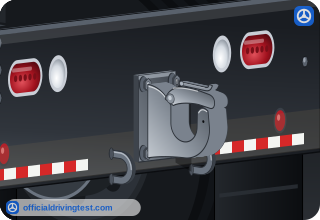
- Slide the latch sideways until it clicks
- Lift the lock handle clear, then rotate the latch fully upright
- Push the lock handle toward the vehicle and drop the latch
Show answer
Correct answer: Lift the lock handle clear, then rotate the latch fully upright
Raise the lock handle until it clears its seat, then swing the latch assembly to its most upright position.
Source: CDL manual, national model as printed by New Jersey, Section 6 (July 2017)
-
How is the drawbar eye placed on the pintle hook?
- Over the horn, then lowered into place
- Under the horn, then lifted into place
- Beside the horn, then pushed sideways
Show answer
Correct answer: Over the horn, then lowered into place
The eye goes above the horn of the hook and is then lowered onto it.
Source: CDL manual, national model as printed by New Jersey, Section 6 (July 2017)
-
How can you tell that a pintle hook latch is properly locked?
- The lock handle sticks out well above the latch
- The lock handle sits level with the latch top
- The lock handle hangs down below the hook body
Show answer
Correct answer: The lock handle sits level with the latch top
After you close the latch, a correct lock shows the lock handle turned and raised level with the top of the latch.
Source: CDL manual, national model as printed by New Jersey, Section 6 (July 2017)
-
After the latch is closed on a pintle hook, what do you do with the tethered lock pin?
- Keep it stored in the cab
- Fix it to the drawbar eye with the safety chain
- Run it through the latch and lock holes
Show answer
Correct answer: Run it through the latch and lock holes
The pin goes through the holes in the latch and lock, and the wire pin is closed, where this part is fitted.
Source: CDL manual, national model as printed by New Jersey, Section 6 (July 2017)
5Part 517 questions
-
What can happen if the pintle hook latch is not locked correctly?
- The trailer lights and brakes will stop working
- The drawbar eye can bind and be very hard to open later
- The trailer can separate, risking death or serious injury
Show answer
Correct answer: The trailer can separate, risking death or serious injury
A latch that is not properly locked can let the trailer come off the vehicle, which can kill or seriously injure people.
Source: CDL manual, national model as printed by New Jersey, Section 6 (July 2017)
-
At the start of uncoupling a pintle hook, where is the trailer parked and what is done to its tires?
- On firm ground with a slight downhill slope, tires blocked
- On a firm, level surface, with the tires blocked
- On a firm, level surface, with the tires left free to roll
Show answer
Correct answer: On a firm, level surface, with the tires blocked
The trailer is parked on firm, level ground and its tires are blocked.
Source: CDL manual, national model as printed by New Jersey, Section 6 (July 2017)
-
When uncoupling a pintle hook, what is done with the breakaway brake switch lanyard?
- It stays hooked up until the tow vehicle moves
- It is disconnected from the tow vehicle
- It is tied to the safety chains for the move
Show answer
Correct answer: It is disconnected from the tow vehicle
The lanyard is unhooked, together with the electrical connector and the safety chains, before the trailer is separated from the tow vehicle.
Source: CDL manual, national model as printed by New Jersey, Section 6 (July 2017)
-
What is done with the safety chains while uncoupling a pintle hook trailer?
- They are unhooked from the tow vehicle
- They are wrapped around the trailer tongue
- They stay attached until the jack is raised
Show answer
Correct answer: They are unhooked from the tow vehicle
The safety chains are taken off the tow vehicle along with the electrical connector and the breakaway switch lanyard.
Source: CDL manual, national model as printed by New Jersey, Section 6 (July 2017)
-
In the pintle hook uncoupling steps, what is done to the coupler before the jack is extended?
- It is left locked until the jack takes the weight
- It is unlocked and opened
- It is lifted above the tow vehicle hitch
Show answer
Correct answer: It is unlocked and opened
After the connectors, lanyard and safety chains are off, the coupler is unlocked and opened.
Source: CDL manual, national model as printed by New Jersey, Section 6 (July 2017)
-
What must the driver confirm about the ground before the trailer jack is extended?
- That it can hold the weight of the trailer tongue
- That it slopes slightly toward the tow vehicle
- That it is dry enough for the tires to grip
Show answer
Correct answer: That it can hold the weight of the trailer tongue
The jack pad will carry the tongue weight, so the surface under it has to be able to hold that load without sinking.
Source: CDL manual, national model as printed by New Jersey, Section 6 (July 2017)
-
What does turning the jack handle accomplish while uncoupling a pintle hook?
- It locks the coupler onto the hitch
- It moves the tongue weight onto the jack
- It releases the trailer brakes
Show answer
Correct answer: It moves the tongue weight onto the jack
Extending the jack makes it take over the load that the tow vehicle's hitch was carrying.
Source: CDL manual, national model as printed by New Jersey, Section 6 (July 2017)
-
Before the tow vehicle can leave, how far must the trailer coupler be raised?
- Until it clears the tow vehicle hitch
- Just level with the hitch
- Only until the hitch is unloaded
Show answer
Correct answer: Until it clears the tow vehicle hitch
The coupler must sit higher than the tow vehicle's hitch so nothing catches when the vehicle pulls away.
Source: CDL manual, national model as printed by New Jersey, Section 6 (July 2017)
-
Which of these actions is the final step when uncoupling a pintle hook?
- Driving the tow vehicle forward
- Disconnecting the safety chains
- Unlocking and opening the coupler
Show answer
Correct answer: Driving the tow vehicle forward
After the coupler has been raised above the hitch, the last step is to drive the tow vehicle forward.
Source: CDL manual, national model as printed by New Jersey, Section 6 (July 2017)
-
When coupling a drawbar, how far is the adjustment screw backed out at the first step?
- At most two turns
- At least five turns
- About three turns
Show answer
Correct answer: At least five turns
At the first step the adjustment screw is turned out at least five turns, before the safety cover bar is swung open.
Source: CDL manual, national model as printed by New Jersey, Section 6 (July 2017)
-
Before backing the truck toward a drawbar ball, where must the safety cover bar be?
- Swung inward and locked in its housing
- Swung outward until fully open
- Taken off the coupling altogether
Show answer
Correct answer: Swung outward until fully open
The cover bar has to be turned all the way out of the way so the drawbar eye can settle over the ball.
Source: CDL manual, national model as printed by New Jersey, Section 6 (July 2017)
-
Before you lift the trailer drawbeam off the coupling ball, what do you do with the safety cover bar?
- Swing it outward until it is fully open
- Leave it closed and tighten its screws
- Slide it along the drawbeam
Show answer
Correct answer: Swing it outward until it is fully open
The safety cover bar is turned outward until it is completely open, then the drawbeam is lifted off the ball.
Source: CDL manual, national model as printed by New Jersey, Section 6 (July 2017)
-
How is the truck reversed when lining up a drawbar coupling, and where does it stop?
- Very slowly, until the drawbar eye is exactly above the ball
- At a moderate pace, until the drawbar eye touches the ball
- Very slowly, until the drawbar eye is beside the ball
Show answer
Correct answer: Very slowly, until the drawbar eye is exactly above the ball
The truck creeps back so that the eye ends up directly over the coupling ball before the drawbeam is lowered.
Source: CDL manual, national model as printed by New Jersey, Section 6 (July 2017)
-
How far is the drawbeam lowered onto the coupling ball?
- Until the eye rests on the top edge of the ball
- Until the eye covers half of the ball
- Until the eye fully covers the ball
Show answer
Correct answer: Until the eye fully covers the ball
The drawbeam goes down until the drawbar eye surrounds the coupling ball completely.
Source: CDL manual, national model as printed by New Jersey, Section 6 (July 2017)
-
Once the drawbeam is down over the coupling ball, what is done with the safety cover bar?
- It is swung back in and fixed with the lock screw and nut
- It is left open so the ball stays in view
- It is turned back in and held only by the drawbeam weight
Show answer
Correct answer: It is swung back in and fixed with the lock screw and nut
The cover bar is turned back in over the ball and fastened with its safety lock screw and self-locking nut.
Source: CDL manual, national model as printed by New Jersey, Section 6 (July 2017)
-
What torque is used to tighten the two lock screws and their self-locking nuts on a drawbar coupling?
- 350 to 400 Nm
- 150 to 200 Nm
- 500 to 550 Nm
Show answer
Correct answer: 350 to 400 Nm
Both lock screws are tightened with a torque wrench set to 350 to 400 Nm.
Source: CDL manual, national model as printed by New Jersey, Section 6 (July 2017)
-
What vertical gap is set between the guard disk and the ball cup with the adjustment screw?
- 1.0 to 1.5 mm
- 0.3 to 0.5 mm
- 3 to 5 mm
Show answer
Correct answer: 0.3 to 0.5 mm
The adjustment screw is turned until only a very small gap of 0.3 to 0.5 mm remains, and then it is locked with the counter nut.
Source: CDL manual, national model as printed by New Jersey, Section 6 (July 2017)
6Part 617 questions
-
After the guard disk gap has been set, how is the adjustment screw setting held?
- With a cotter pin
- With the counter nut
- With the safety lock screw
Show answer
Correct answer: With the counter nut
The counter nut is tightened to keep the adjustment screw from moving off its setting.
Source: CDL manual, national model as printed by New Jersey, Section 6 (July 2017)
-
On a drawbar coupling, what applies if the safety cover bar will not fit properly into its seat?
- Drive slowly to a repair shop
- The combination must not travel at all
- Driving is allowed only on quiet roads
Show answer
Correct answer: The combination must not travel at all
A cover bar that does not seat correctly means the coupling is not secure, so the rig must not be moved.
Source: CDL manual, national model as printed by New Jersey, Section 6 (July 2017)
-
What covers the part of the drawbar coupling ball that still shows after coupling?
- A metal guard welded to the drawbeam
- A rubber bellows cover fitted against the ball
- A steel cap bolted to the safety cover bar
Show answer
Correct answer: A rubber bellows cover fitted against the ball
A rubber bellows cover keeps dust off the exposed ball, with its edge fixed tightly onto the ball.
Source: CDL manual, national model as printed by New Jersey, Section 6 (July 2017)
-
How is the inside of the drawbar eye lubricated?
- By spraying oil over the outside of the ball
- Through the grease nipple
- By taking the eye off and wiping it with grease
Show answer
Correct answer: Through the grease nipple
Grease is pumped in through the nipple, so the inner cup of the eye gets lubricated without taking anything apart.
Source: CDL manual, national model as printed by New Jersey, Section 6 (July 2017)
-
What is the first thing to confirm when you begin to uncouple a drawbar trailer?
- The trailer brake is applied
- The tow vehicle's engine is shut off
- The trailer brake line is removed
Show answer
Correct answer: The trailer brake is applied
The first step of uncoupling a drawbar is to make sure the trailer brake is on.
Source: CDL manual, national model as printed by New Jersey, Section 6 (July 2017)
-
Early in uncoupling a drawbar, what do you do with the adjustment screw and its counter nut?
- Tighten them further
- Remove them and fit new ones
- Loosen them
Show answer
Correct answer: Loosen them
After the rubber cover is taken off, the adjustment screw and the counter nut are both loosened.
Source: CDL manual, national model as printed by New Jersey, Section 6 (July 2017)
-
The drawbeam is lifted and the coupling ball can be seen fully. How do you move the tow vehicle to pull away from the trailer?
- Forward, at normal speed
- Backward, very slowly
- Forward, very slowly
Show answer
Correct answer: Forward, very slowly
Once the ball is fully visible, the tow vehicle moves forward very slowly to clear the drawbar.
Source: CDL manual, national model as printed by New Jersey, Section 6 (July 2017)
-
After the tow vehicle has pulled clear of the trailer, what happens to the safety cover bar?
- It is left open until you hook up again
- It is removed and kept in the cab
- It is turned back into its housing
Show answer
Correct answer: It is turned back into its housing
Once the vehicle has moved away, the bar is turned back inward until it settles into its housing.
Source: CDL manual, national model as printed by New Jersey, Section 6 (July 2017)
-
At the end of uncoupling a drawbar, what do you do with the safety lock screw and its nut?
- Leave them off so the bar stays open
- Store them in the cab until the next trip
- Put the screw back in and tighten the nut
Show answer
Correct answer: Put the screw back in and tighten the nut
The last step is to fit the safety lock screw back and tighten its self-locking nut.
Source: CDL manual, national model as printed by New Jersey, Section 6 (July 2017)
-
Before you lower a trailer onto a gooseneck hitch, what must you confirm about the ball?
- It is clean and dry
- It is set to its lowest height
- It is properly lubricated
Show answer
Correct answer: It is properly lubricated
With the clamp latch open, check that the gooseneck ball has the proper lubrication.
Source: CDL manual, national model as printed by New Jersey, Section 6 (July 2017)
-
When you hook up a gooseneck trailer, where must the coupler be before you lower the trailer?
- Just in front of the ball
- Slightly to one side of the ball
- Straight above the ball
Show answer
Correct answer: Straight above the ball
The coupler goes directly over the ball. Then the trailer is lowered and the clamp is latched.
Source: CDL manual, national model as printed by New Jersey, Section 6 (July 2017)
-
Which statement about safety chains on a trailer hooked to a gooseneck hitch is correct?
- Only loaded trailers need them
- Only trailers without brakes need them
- Every trailer must have them
Show answer
Correct answer: Every trailer must have them
The law requires safety chains on all trailers, so you attach them when you couple.
Source: CDL manual, national model as printed by New Jersey, Section 6 (July 2017)
-
After you plug the trailer light wiring into the tow vehicle, what should you do?
- Test only the turn signals
- Test only the lights at the rear corners
- Test all the lights, brake lights included
Show answer
Correct answer: Test all the lights, brake lights included
Connecting the wiring is followed by a check of every light, including the brake lights.
Source: CDL manual, national model as printed by New Jersey, Section 6 (July 2017)
-
What is done with the trailer jacks as the last step of coupling a gooseneck hitch?
- They stay halfway down to share the weight
- They are left on the ground as a support
- They are lowered all the way and stowed
Show answer
Correct answer: They are lowered all the way and stowed
The jacks are fully lowered and stowed, so the trailer's weight rests on the tow vehicle.
Source: CDL manual, national model as printed by New Jersey, Section 6 (July 2017)
-
What is the first step when you uncouple a gooseneck hitch?
- Raise the trailer off the ball
- Take out the safety pin and clip
- Disconnect the trailer light wiring
Show answer
Correct answer: Take out the safety pin and clip
You begin by removing the safety pin and its clip. Then the handle is turned and the trailer is raised off the ball.
Source: CDL manual, national model as printed by New Jersey, Section 6 (July 2017)
-
After the trailer is raised off the ball of a gooseneck hitch, what happens to the coupler?
- You must reset it by hand
- It stays open until you close it again
- It goes back to load position alone
Show answer
Correct answer: It goes back to load position alone
Once the trailer is lifted clear, the coupler goes back to the load position by itself.
Source: CDL manual, national model as printed by New Jersey, Section 6 (July 2017)
-
What is the final step when uncoupling a gooseneck hitch?
- Hook up the safety chains again
- Put the safety pin and clip back in
- Lower the trailer jacks to the ground
Show answer
Correct answer: Put the safety pin and clip back in
The procedure ends by installing the safety pin and clip again.
Source: CDL manual, national model as printed by New Jersey, Section 6 (July 2017)