Combination Vehicles: Inspecting a combination vehicle
What to check on a combination besides a single vehicle, and the brake checks for a combination.
Independent educational site · not affiliated with any government agency or DMV
Ready? Test yourself
Answer to start, or tap Start below:
How much gap should you see between the upper and lower fifth wheel when you inspect a coupled rig?
- Instant feedback with an explanation
- Every answer cites its source in the manual
- Your best score is saved on this device
- Keyboard: press 1 to 3 to answer and Enter for the next question
Questions are written in our own words from the CDL manual; they are not the real test's questions. With your state chosen, every answer gives its page in your state's CDL manual. Without a state, answers cite the CDL manual, national model as printed by New Jersey (July 2017).
All 20 questions in this practice test
Take the test above first, then use this list to study. Tap “Show answer” to see the correct answer and explanation.
Show the questions and answersHide the questions
-
How much gap should you see between the upper and lower fifth wheel when you inspect a coupled rig?
- No gap at all
- A small gap, about the width of a hand
- A gap just big enough to slip a flashlight in
Show answer
Correct answer: No gap at all
The upper and lower fifth wheel must sit tight together with nothing visible between them.
Source: CDL manual, national model as printed by New Jersey, Section 6 (July 2017)
-
When you look at the lower fifth wheel during a walk-around, where should the locking jaws be closed?
- Around the head of the kingpin
- Around the shank of the kingpin
- Around the top of the kingpin, against the plate
Show answer
Correct answer: Around the shank of the kingpin
The jaws must close around the shank of the kingpin, not its head.
Source: CDL manual, national model as printed by New Jersey, Section 6 (July 2017)
-
How should the air-lines between the tractor and trailer be connected and held?
- Taped to the frame along their full length
- Pulled tight so they cannot swing
- Secured, with enough slack for turns
Show answer
Correct answer: Secured, with enough slack for turns
Air-lines must be properly connected, free of leaks, secured, and left with enough slack for turns.
Source: CDL manual, national model as printed by New Jersey, Section 6 (July 2017)
-
What should you check about the position of a sliding fifth wheel?
- That it sits far enough back for a level trailer
- That it is slid fully to the rear for every trip
- That it is not so far forward that parts hit in turns
Show answer
Correct answer: That it is not so far forward that parts hit in turns
A fifth wheel set too far forward can let the tractor frame strike the landing gear or the cab strike the trailer when turning.
Source: CDL manual, national model as printed by New Jersey, Section 6 (July 2017)
-
On a walk-around of a coupled combination, what position should the landing gear be in?
- Raised about halfway, to clear the road
- Fully raised
- Raised just high enough to clear the pavement
Show answer
Correct answer: Fully raised
Landing gear must be fully up, with no parts missing and nothing bent or damaged.
Source: CDL manual, national model as printed by New Jersey, Section 6 (July 2017)
-
What is the right way to test the brakes on a rig pulling doubles or triples?
- The same way as any other combination vehicle
- With a longer, separate procedure for each trailer
- Only at the first trailer, since the rest follow
Show answer
Correct answer: The same way as any other combination vehicle
Doubles and triples get the same brake check as any other combination vehicle.
Source: CDL manual, national model as printed by New Jersey, Section 6 (July 2017)
-
Before you start the air flow check on a combination vehicle, how do you keep the rig from moving?
- Set the tractor parking brake or chock the wheels
- Pull the trailer air supply knob all the way out
- Rely on the trailer air tanks to hold it still
Show answer
Correct answer: Set the tractor parking brake or chock the wheels
The rig is held with the tractor parking brake, wheel chocks, or both while the check is done.
Source: CDL manual, national model as printed by New Jersey, Section 6 (July 2017)
-
During the air flow check, at what point do you operate the red supply knob?
- As soon as the engine starts, before pressure builds
- After the pressure has dropped to its lowest range
- Once air pressure has reached its normal level
Show answer
Correct answer: Once air pressure has reached its normal level
You let the pressure build to normal first, and only then push the knob in to feed air to the emergency lines.
Source: CDL manual, national model as printed by New Jersey, Section 6 (July 2017)
-
When you check that air flows to all trailers, what does pushing in the red trailer air supply knob do?
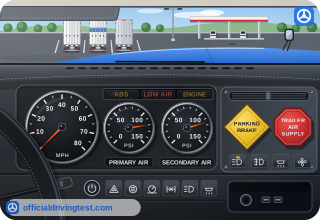
- It sends air into the service line only
- It sends air into the emergency (supply) lines
- It applies the trailer spring brakes
Show answer
Correct answer: It sends air into the emergency (supply) lines
Pushing the knob in feeds air to the emergency (supply) lines, which charge the trailer air tanks.
Source: CDL manual, national model as printed by New Jersey, Section 6 (July 2017)
-
During the air flow check, how do you put air into the service line?
- Push the trailer air supply knob in
- Pump the tractor parking brake control
- Apply the trailer handbrake
Show answer
Correct answer: Apply the trailer handbrake
Applying the trailer handbrake, or pressing the service brake pedal, is what puts air into the service line for this check.
Source: CDL manual, national model as printed by New Jersey, Section 6 (July 2017)
-
At the back of the last trailer, you open the emergency line shut-off valve. What tells you the system is charged?
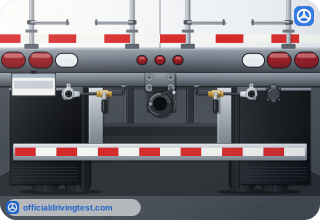
- The air gauge in the cab rises
- You hear air escaping
- The trailer brakes release with a click
Show answer
Correct answer: You hear air escaping
Air coming out of the open valve at the rear shows that air has reached the end of the whole system.
Source: CDL manual, national model as printed by New Jersey, Section 6 (July 2017)
-
After closing the rear emergency line valve, what do you do at the back of the rig next?
- Reopen the emergency valve and listen for air once more
- Open the service valve and leave the emergency valve open too
- Open the service valve, confirm pressure in every trailer, close it
Show answer
Correct answer: Open the service valve, confirm pressure in every trailer, close it
Opening the service line valve at the rear shows that service pressure passes through all trailers, and then you close it again.
Source: CDL manual, national model as printed by New Jersey, Section 6 (July 2017)
-
You open the rear line valves but hear no air from either line. What should you check?
- That dummy couplers are fitted on the glad hands
- That the landing gear is fully raised up
- That the trailer and dolly shut-off valves are open
Show answer
Correct answer: That the trailer and dolly shut-off valves are open
A closed shut-off valve in the middle of the rig blocks air. All the brakes need air all the way to the back.
Source: CDL manual, national model as printed by New Jersey, Section 6 (July 2017)
-
When testing the tractor protection valve, how do you bring the air pressure down?
- Engine off, then press the brake pedal repeatedly
- Open the drain valve on each air tank
- Pull the trailer air supply knob out by hand
Show answer
Correct answer: Engine off, then press the brake pedal repeatedly
With the engine off, repeated brake applications use up the stored air so you can see whether the control pops out as the pressure falls.
Source: CDL manual, national model as printed by New Jersey, Section 6 (July 2017)
-
In the tractor protection valve test, the air supply control should pop out when pressure falls into about what range?
- 80 to 100 psi
- 20 to 45 psi
- 5 to 15 psi
Show answer
Correct answer: 20 to 45 psi
The control normally pops out between 20 and 45 psi, or the range the manufacturer gives.
Source: CDL manual, national model as printed by New Jersey, Section 6 (July 2017)
-
Why is a faulty tractor protection valve dangerous?
- The trailer wheels would lock and never release
- A trailer leak could drain the tractor's air too
- The air compressor would stop building pressure
Show answer
Correct answer: A trailer leak could drain the tractor's air too
Without a working valve, a leaking hose or trailer brake can let all the tractor's air escape, and the emergency brakes may come on with possible loss of control.
Source: CDL manual, national model as printed by New Jersey, Section 6 (July 2017)
-
What do you check before you pull out the trailer air supply control to test the trailer emergency brakes?
- That the trailer landing gear is cranked down firmly onto the ground
- That the trailer rolls freely once the air brake system is charged
- That the tractor protection valve has already closed itself
Show answer
Correct answer: That the trailer rolls freely once the air brake system is charged
First build up air in the trailer system and see that the trailer moves without drag. Only then stop and pull the control out to test.
Source: CDL manual, national model as printed by New Jersey, Section 6 (July 2017)
-
After pulling out the trailer air supply control, how do you confirm the trailer emergency brakes are on?
- Watch the air gauge for a sudden drop
- Pull gently against the trailer with the tractor
- Back up slowly with the trailer brakes released
Show answer
Correct answer: Pull gently against the trailer with the tractor
A gentle tug with the tractor shows whether the trailer is being held by its emergency brakes.
Source: CDL manual, national model as printed by New Jersey, Section 6 (July 2017)
-
How do you test the trailer service brakes?
- Roll forward slowly, use the hand control, feel the brakes
- Park on a hill and release the tractor parking brake
- Hold the rig still with chocks and listen at each wheel
Show answer
Correct answer: Roll forward slowly, use the hand control, feel the brakes
Moving slowly and applying the trailer brakes with the hand control lets you feel that they are connected and working.
Source: CDL manual, national model as printed by New Jersey, Section 6 (July 2017)
-
In normal driving, what should you use to control the trailer brakes?
- The hand valve
- The foot pedal
- The trailer air supply knob
Show answer
Correct answer: The foot pedal
The hand valve is only for testing. While driving, the foot pedal sends air to the service brakes on every wheel.
Source: CDL manual, national model as printed by New Jersey, Section 6 (July 2017)