Combination Vehicles: Coupling and uncoupling — Part 4
Questions in this part include: “On a loaded trailer, what is the benefit of the few extra crank turns in low gear?” · “Once the tractor is partly clear, what do you inspect under the trailer?”
Independent educational site · not affiliated with any government agency or DMV
Ready? Test yourself
Answer to start, or tap Start below:
On a loaded trailer, what is the benefit of the few extra crank turns in low gear?
- Instant feedback with an explanation
- Every answer cites its source in the manual
- Your best score is saved on this device
- Keyboard: press 1 to 3 to answer and Enter for the next question
Questions are written in our own words from the CDL manual; they are not the real test's questions. With your state chosen, every answer gives its page in your state's CDL manual. Without a state, answers cite the CDL manual, national model as printed by New Jersey (July 2017).
All 17 questions in this practice test
Take the test above first, then use this list to study. Tap “Show answer” to see the correct answer and explanation.
Show the questions and answersHide the questions
-
On a loaded trailer, what is the benefit of the few extra crank turns in low gear?
- The trailer brakes release faster after the tractor pulls out
- The fifth wheel is easier to unlatch, and easier to couple next time
- The kingpin slides out of the jaws without any backing up
Show answer
Correct answer: The fifth wheel is easier to unlatch, and easier to couple next time
Taking some weight off the tractor makes the fifth wheel easier to unlatch now and the next coupling easier, without lifting the trailer off the fifth wheel.
Source: CDL manual, national model as printed by New Jersey, Section 6 (July 2017)
-
After you disconnect the air-lines from the trailer, what do you do with the glad hands?
- Leave them hanging loose on the ground below the cab
- Wrap them around the fifth wheel release handle
- Hook them to dummy couplers or join them together
Show answer
Correct answer: Hook them to dummy couplers or join them together
Attaching them to dummy couplers, or joining them to each other, keeps dirt and water out of the air-lines.
Source: CDL manual, national model as printed by New Jersey, Section 6 (July 2017)
-
How should the trailer electrical cable hang once it is disconnected?
- With the plug pointing down, to keep moisture out
- With the plug up, so the pins stay off the ground
- Coiled tightly over the trailer glad hands
Show answer
Correct answer: With the plug pointing down, to keep moisture out
A plug that points down does not collect water, so moisture stays out of the connector.
Source: CDL manual, national model as printed by New Jersey, Section 6 (July 2017)
-
Why do you support the air and electrical lines after disconnecting them?
- So they are not damaged while the tractor drives away
- So they do not block the view in the side mirrors
- So they stay within reach for the next coupling
Show answer
Correct answer: So they are not damaged while the tractor drives away
Supported lines are not damaged while you drive the tractor away.
Source: CDL manual, national model as printed by New Jersey, Section 6 (July 2017)
-
How do you unlock the fifth wheel?
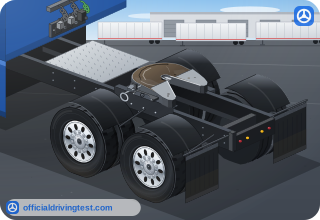
- Pull the handle down and push the air supply knob in
- Raise the handle lock, then pull the handle to open
- Push the handle in and turn the crank in low gear
Show answer
Correct answer: Raise the handle lock, then pull the handle to open
First lift the release handle lock, then pull the release handle to its open position.
Source: CDL manual, national model as printed by New Jersey, Section 6 (July 2017)
-
While you pull the fifth wheel release handle, where should your legs and feet be?
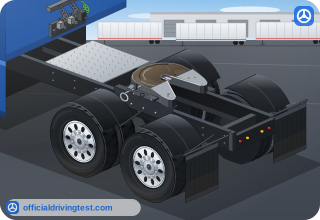
- Standing beside the landing gear crank handle
- Crouched under the front of the trailer
- Out of the way of the rear tractor wheels
Show answer
Correct answer: Out of the way of the rear tractor wheels
The vehicle might move, so legs and feet must stay clear of the rear tractor wheels to prevent serious injury.
Source: CDL manual, national model as printed by New Jersey, Section 6 (July 2017)
-
When you pull the tractor forward partly clear of the trailer, where do you stop?
- With the tractor completely free of the trailer
- With the fifth wheel just behind the kingpin
- With the tractor frame still under the trailer
Show answer
Correct answer: With the tractor frame still under the trailer
Stopping with the frame under the trailer catches the trailer if the landing gear sinks or collapses.
Source: CDL manual, national model as printed by New Jersey, Section 6 (July 2017)
-
After pulling the tractor partly clear, how do you secure it?
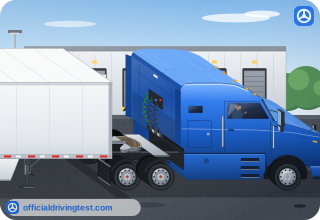
- Apply the parking brake and select the lowest gear
- Apply the parking brake and put the transmission in neutral
- Release the parking brake and shut off the trailer air
Show answer
Correct answer: Apply the parking brake and put the transmission in neutral
Set the parking brake and place the transmission in neutral before you inspect the trailer supports.
Source: CDL manual, national model as printed by New Jersey, Section 6 (July 2017)
-
Once the tractor is partly clear, what do you inspect under the trailer?
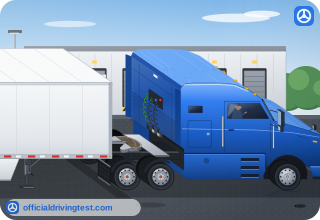
- The fifth wheel grease and the kingpin condition
- The ground under the trailer and the landing gear
- The trailer lights and the tire pressure level
Show answer
Correct answer: The ground under the trailer and the landing gear
Check that the ground holds up the trailer and that the landing gear is not damaged.
Source: CDL manual, national model as printed by New Jersey, Section 6 (July 2017)
-
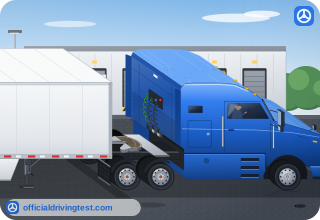
What do you do just before you drive the tractor completely clear of the trailer?
- Reverse a little more to ease the fifth wheel jaws
- Look over the area around you, then drive forward
- Pull the trailer air supply knob out
Show answer
Correct answer: Look over the area around you, then drive forward
Release the parking brakes, look around to make sure the way is clear, and then drive forward until the tractor is free.
Source: CDL manual, national model as printed by New Jersey, Section 6 (July 2017)
-
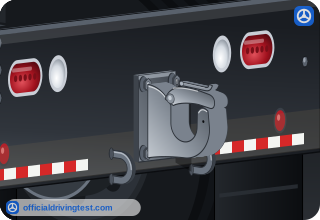
What do you check on a pintle hook before you operate it?
- Whether the latch and horn are painted a bright color
- For worn, damaged or missing parts, and for a secure mount
- Whether the safety chains are the right length
Show answer
Correct answer: For worn, damaged or missing parts, and for a secure mount
Inspect the hook for wear, damage and absent parts, and confirm the mount holds firmly.
Source: CDL manual, national model as printed by New Jersey, Section 6 (July 2017)
-
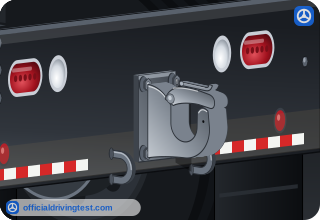
What could happen if a pintle hook is not secured to its mounting surface?
- The drawbar eye would wear out sooner than normal use
- The hook could separate, causing death or serious injury
- The trailer brakes would stay locked on after parking
Show answer
Correct answer: The hook could separate, causing death or serious injury
A loose mount lets the hook come away from the vehicle, which can cause death or serious injury.
Source: CDL manual, national model as printed by New Jersey, Section 6 (July 2017)
-
What is the first thing to do when you open the pintle hook, if it has a pin?
- Unlock and remove the tethered lock pin
- Lower the drawbar eye onto the horn
- Push the latch closed
Show answer
Correct answer: Unlock and remove the tethered lock pin
Take out the tethered lock pin, if there is one, before you can open the latch.
Source: CDL manual, national model as printed by New Jersey, Section 6 (July 2017)
-
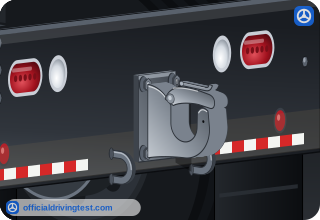
How do you open the latch of a pintle hook?
- Slide the latch sideways until it clicks
- Lift the lock handle clear, then rotate the latch fully upright
- Push the lock handle toward the vehicle and drop the latch
Show answer
Correct answer: Lift the lock handle clear, then rotate the latch fully upright
Raise the lock handle until it clears its seat, then swing the latch assembly to its most upright position.
Source: CDL manual, national model as printed by New Jersey, Section 6 (July 2017)
-
How is the drawbar eye placed on the pintle hook?
- Over the horn, then lowered into place
- Under the horn, then lifted into place
- Beside the horn, then pushed sideways
Show answer
Correct answer: Over the horn, then lowered into place
The eye goes above the horn of the hook and is then lowered onto it.
Source: CDL manual, national model as printed by New Jersey, Section 6 (July 2017)
-
How can you tell that a pintle hook latch is properly locked?
- The lock handle sticks out well above the latch
- The lock handle sits level with the latch top
- The lock handle hangs down below the hook body
Show answer
Correct answer: The lock handle sits level with the latch top
After you close the latch, a correct lock shows the lock handle turned and raised level with the top of the latch.
Source: CDL manual, national model as printed by New Jersey, Section 6 (July 2017)
-
After the latch is closed on a pintle hook, what do you do with the tethered lock pin?
- Keep it stored in the cab
- Fix it to the drawbar eye with the safety chain
- Run it through the latch and lock holes
Show answer
Correct answer: Run it through the latch and lock holes
The pin goes through the holes in the latch and lock, and the wire pin is closed, where this part is fitted.
Source: CDL manual, national model as printed by New Jersey, Section 6 (July 2017)