Combination Vehicles: Coupling and uncoupling — Part 3
Questions in this part include: “After you plug the electrical cord into the trailer, what is the next thing to do with the plug?” · “After the coupling is finished, what do you do with the trailer wheel chocks?”
Independent educational site · not affiliated with any government agency or DMV
Ready? Test yourself
Answer to start, or tap Start below:
After you plug the electrical cord into the trailer, what is the next thing to do with the plug?
- Instant feedback with an explanation
- Every answer cites its source in the manual
- Your best score is saved on this device
- Keyboard: press 1 to 3 to answer and Enter for the next question
Questions are written in our own words from the CDL manual; they are not the real test's questions. With your state chosen, every answer gives its page in your state's CDL manual. Without a state, answers cite the CDL manual, national model as printed by New Jersey (July 2017).
All 17 questions in this practice test
Take the test above first, then use this list to study. Tap “Show answer” to see the correct answer and explanation.
Show the questions and answersHide the questions
-
After you plug the electrical cord into the trailer, what is the next thing to do with the plug?
- Tape it to the glad hand
- Coil the cord around the air-lines
- Fasten its safety catch
Show answer
Correct answer: Fasten its safety catch
Plug in the electrical cord and fasten its safety catch so it stays connected.
Source: CDL manual, national model as printed by New Jersey, Section 6 (July 2017)
-
After fastening the plug's safety catch, what else do you check for damage besides both air-lines?
- The electrical line
- The trailer mud flaps
- The tractor fuel lines
Show answer
Correct answer: The electrical line
Look over both air-lines and the electrical line for any damage.
Source: CDL manual, national model as printed by New Jersey, Section 6 (July 2017)
-
What do you make sure of about the air and electrical lines before driving away?
- That they cannot hit any moving parts of the vehicle
- That they hang down loosely below the frame
- That they are pulled tight between tractor and trailer
Show answer
Correct answer: That they cannot hit any moving parts of the vehicle
The lines must be routed so they never strike any moving part of the vehicle.
Source: CDL manual, national model as printed by New Jersey, Section 6 (July 2017)
-
How do you use the gear ranges of the landing gear crank when raising it?
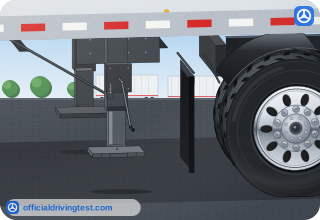
- Start in low range, then switch to high once free of weight
- Stay in low range until it is all the way up
- Start in high range, then switch to low once free of weight
Show answer
Correct answer: Start in low range, then switch to high once free of weight
Low range starts the lift under load. When the weight is off, high range raises it faster.
Source: CDL manual, national model as printed by New Jersey, Section 6 (July 2017)
-
What is the danger of driving with the landing gear only partly raised?
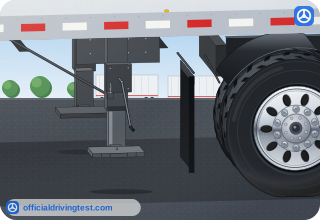
- It can pull the kingpin out of the fifth wheel
- It can snag on rails or other objects
- It can scrape the trailer tires
Show answer
Correct answer: It can snag on rails or other objects
Landing gear that is not fully up can catch on railroad tracks or other objects, so raise it completely.
Source: CDL manual, national model as printed by New Jersey, Section 6 (July 2017)
-
What do you do with the crank handle after the landing gear is up?
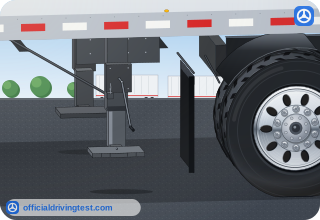
- Remove it and store it inside the cab
- Secure it safely so it stays in place
- Leave it on the shaft in low gear range
Show answer
Correct answer: Secure it safely so it stays in place
After the landing gear is up, the crank handle has to be secured safely so that it stays in place.
Source: CDL manual, national model as printed by New Jersey, Section 6 (July 2017)
-
With the full trailer weight on the tractor, what must not happen when the tractor turns sharply?
- The trailer nose must not touch the fifth wheel latch
- The air-lines must not touch the tractor tires
- The rear of the tractor frame must not hit the landing gear
Show answer
Correct answer: The rear of the tractor frame must not hit the landing gear
There must be enough room between the rear of the tractor frame and the landing gear for sharp turns.
Source: CDL manual, national model as printed by New Jersey, Section 6 (July 2017)
-
Which clearance do you check between the tractor tires and the trailer once its weight is on the tractor?
- Between the top of the tires and the nose of the trailer
- Between the tire sidewalls and the trailer side panels
- Between the front of the tires and the landing gear
Show answer
Correct answer: Between the top of the tires and the nose of the trailer
Check that the tops of the tractor tires have enough space below the trailer nose.
Source: CDL manual, national model as printed by New Jersey, Section 6 (July 2017)
-
After the coupling is finished, what do you do with the trailer wheel chocks?
- Leave them under the wheels until the first stop
- Remove them and store them in a safe place
- Move them to the front of the trailer wheels
Show answer
Correct answer: Remove them and store them in a safe place
Take the chocks away from the trailer wheels and put them in a safe spot.
Source: CDL manual, national model as printed by New Jersey, Section 6 (July 2017)
-
Before you start to uncouple, what must you confirm about the parking area?
- The ground is free of oil and gravel
- The area has no other parked trailers
- The ground can carry the trailer's weight
Show answer
Correct answer: The ground can carry the trailer's weight
The surface has to be strong enough to hold the trailer's weight once the tractor leaves.
Source: CDL manual, national model as printed by New Jersey, Section 6 (July 2017)
-
Why should the tractor stay lined up with the trailer when it pulls out?
- It keeps the air hoses from being pulled tight
- Pulling out at an angle can damage the landing gear
- It stops the trailer brakes from locking up
Show answer
Correct answer: Pulling out at an angle can damage the landing gear
Leaving at an angle can bend or break the landing gear, so keep the rig straight.
Source: CDL manual, national model as printed by New Jersey, Section 6 (July 2017)
-
At the start of uncoupling, what should you do with the trailer air supply?
- Shut it off so the trailer brakes lock
- Leave it on so the trailer brakes stay released
- Drain the trailer tanks completely first
Show answer
Correct answer: Shut it off so the trailer brakes lock
Closing the trailer air supply applies the trailer brakes, which holds the trailer in place.
Source: CDL manual, national model as printed by New Jersey, Section 6 (July 2017)
-
Why do you back the tractor up gently before releasing the fifth wheel lock?
- It pushes the kingpin deeper so the jaws grip harder
- It warms the grease on the fifth wheel plate
- It takes load off the jaws so the lever releases more easily
Show answer
Correct answer: It takes load off the jaws so the lever releases more easily
Backing gently against the kingpin relieves pressure on the locking jaws, so the locking lever can be released.
Source: CDL manual, national model as printed by New Jersey, Section 6 (July 2017)
-
When do you set the tractor parking brakes while easing pressure on the jaws?
- While the tractor is still pushing against the kingpin
- After the tractor has rolled out from under the trailer
- Only once the fifth wheel is fully unlocked
Show answer
Correct answer: While the tractor is still pushing against the kingpin
Setting the brakes while the tractor pushes on the kingpin keeps the rig still with the jaws unloaded.
Source: CDL manual, national model as printed by New Jersey, Section 6 (July 2017)
-
When should you chock the trailer wheels before uncoupling?
- Only when the trailer is carrying a heavy load of cargo
- When the trailer lacks spring brakes, or you are unsure
- Only when the parking lot slopes downhill steeply
Show answer
Correct answer: When the trailer lacks spring brakes, or you are unsure
Without spring brakes, air can leak from the trailer tank and release the emergency brakes, so the trailer could roll. Chock the wheels in that case or when in doubt.
Source: CDL manual, national model as printed by New Jersey, Section 6 (July 2017)
-
How far do you lower the landing gear of an empty trailer?
- Until it lifts the trailer off the fifth wheel
- Halfway, so the tractor still carries the nose
- Until it touches the ground firmly
Show answer
Correct answer: Until it touches the ground firmly
With an empty trailer, the landing gear just needs to reach the ground and make firm contact.
Source: CDL manual, national model as printed by New Jersey, Section 6 (July 2017)
-
The landing gear of a loaded trailer has touched the ground. What do you do next?
- Crank in high gear until the trailer rises clear of the fifth wheel
- Turn the crank a few more times in low gear to take some weight off the tractor
- Stop cranking and let the gear rest lightly on the ground
Show answer
Correct answer: Turn the crank a few more times in low gear to take some weight off the tractor
A few extra turns in low gear move some weight off the tractor, which makes unlatching easier and the next coupling easier. The trailer must stay on the fifth wheel.
Source: CDL manual, national model as printed by New Jersey, Section 6 (July 2017)