Combination Vehicles: Coupling and uncoupling — Part 1
Questions in this part include: “The general coupling steps differ a little from one rig to another. What should a driver do about that?” · “During the first slow back-up toward the trailer, how far do you back?”
Independent educational site · not affiliated with any government agency or DMV
Ready? Test yourself
Answer to start, or tap Start below:
The general coupling steps differ a little from one rig to another. What should a driver do about that?
- Instant feedback with an explanation
- Every answer cites its source in the manual
- Your best score is saved on this device
- Keyboard: press 1 to 3 to answer and Enter for the next question
Questions are written in our own words from the CDL manual; they are not the real test's questions. With your state chosen, every answer gives its page in your state's CDL manual. Without a state, answers cite the CDL manual, national model as printed by New Jersey (July 2017).
All 18 questions in this practice test
Take the test above first, then use this list to study. Tap “Show answer” to see the correct answer and explanation.
Show the questions and answersHide the questions
-
The general coupling steps differ a little from one rig to another. What should a driver do about that?
- Use the general steps alone, since they fit every rig
- Learn the coupling details of the trucks he or she will operate
- Learn only the uncoupling steps, since coupling is the same on all rigs
Show answer
Correct answer: Learn the coupling details of the trucks he or she will operate
Rigs differ, so the general steps are only a base. A driver must learn the exact coupling and uncoupling details of the trucks he or she drives.
Source: CDL manual, national model as printed by New Jersey, Section 6 (July 2017)
-
What problem can a dry, ungreased fifth wheel plate cause?
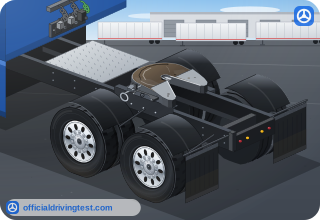
- Slow air build-up in the trailer air tanks
- Weak signals from the trailer electrical cord
- Steering trouble caused by friction
Show answer
Correct answer: Steering trouble caused by friction
Rubbing between the tractor and the trailer on a dry plate can make the rig hard to steer, so the plate must be greased as required.
Source: CDL manual, national model as printed by New Jersey, Section 6 (July 2017)
-
When you prepare to couple, how should the fifth wheel be tilted?
- Up toward the cab of the tractor
- Down toward the rear of the tractor
- Level with the frame, with no tilt at all
Show answer
Correct answer: Down toward the rear of the tractor
A fifth wheel ready for coupling is tilted down toward the rear of the tractor.
Source: CDL manual, national model as printed by New Jersey, Section 6 (July 2017)
-
Where should the fifth wheel safety unlocking handle be before you back under a trailer?
- Taken off and stored in the cab
- In the automatic lock position
- Held down with a separate locking pin
Show answer
Correct answer: In the automatic lock position
Before coupling, the safety unlocking handle must already be in the automatic lock position.
Source: CDL manual, national model as printed by New Jersey, Section 6 (July 2017)
-
Before coupling, what do you make sure about the surroundings?
- The area around the vehicle is level and paved
- The area around the vehicle is clear
- The area around the vehicle has room to turn a full circle
Show answer
Correct answer: The area around the vehicle is clear
Before coupling, confirm that nothing and no one is in the area around the vehicle.
Source: CDL manual, national model as printed by New Jersey, Section 6 (July 2017)
-
Before the tractor backs toward the trailer, what must keep the trailer from rolling?
- Its landing gear lowered and its air-lines connected
- Its service brakes held on with the hand valve
- Chocks at its wheels, or its spring brakes applied
Show answer
Correct answer: Chocks at its wheels, or its spring brakes applied
The trailer must not move while you couple, so its wheels are chocked or its spring brakes are on.
Source: CDL manual, national model as printed by New Jersey, Section 6 (July 2017)
-
What do you check about the cargo before the tractor is coupled to the trailer?
- That it is packed toward the front of the trailer
- That it is weighed and the weight is on the load sheet
- That it is secured so it cannot shift when the tractor couples
Show answer
Correct answer: That it is secured so it cannot shift when the tractor couples
Coupling can jolt the trailer, so any cargo has to be secured against movement first.
Source: CDL manual, national model as printed by New Jersey, Section 6 (July 2017)
-
Why should you never back a tractor under a trailer at an angle?
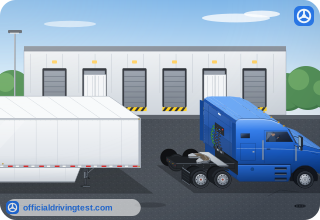
- The trailer could be pushed sideways and its landing gear broken
- The air-lines could be torn off the trailer glad hands
- The fifth wheel jaws could close too early on the kingpin
Show answer
Correct answer: The trailer could be pushed sideways and its landing gear broken
Backing in at an angle can shove the trailer sideways and break its landing gear, so put the tractor directly in front of it.
Source: CDL manual, national model as printed by New Jersey, Section 6 (July 2017)
-
How do you check that the tractor is lined up with the trailer before backing?
- Look down both sides of the trailer in the outside mirrors
- Watch the trailer landing gear through the rear window
- Line up the bumper with the front corners of the trailer
Show answer
Correct answer: Look down both sides of the trailer in the outside mirrors
Use the outside mirrors and look along both sides of the trailer to confirm the tractor is straight in front of it.
Source: CDL manual, national model as printed by New Jersey, Section 6 (July 2017)
-
During the first slow back-up toward the trailer, how far do you back?
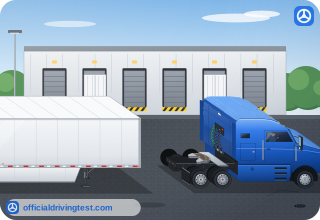
- Until the fifth wheel just touches the trailer
- Until the tractor frame is fully under the trailer
- Until the trailer nose touches the back of the cab
Show answer
Correct answer: Until the fifth wheel just touches the trailer
Back only until the fifth wheel just touches the trailer, and do not hit it.
Source: CDL manual, national model as printed by New Jersey, Section 6 (July 2017)
-
After backing the tractor up to the trailer, how do you secure it?
- Apply the parking brake and put the transmission in neutral
- Release the parking brake and put the transmission in low gear
- Apply the parking brake and put the transmission in reverse
Show answer
Correct answer: Apply the parking brake and put the transmission in neutral
Set the parking brake and shift the transmission to neutral so the tractor stays put.
Source: CDL manual, national model as printed by New Jersey, Section 6 (July 2017)
-
How high should the trailer be set before the tractor backs under it?
- Low enough that the tractor lifts it a little as it goes under
- Level with the top of the tractor tires
- High enough that the tractor slides under without touching it
Show answer
Correct answer: Low enough that the tractor lifts it a little as it goes under
The trailer should sit low enough that the tractor raises it slightly when backing under. Raise or lower the trailer to get that.
Source: CDL manual, national model as printed by New Jersey, Section 6 (July 2017)
-
What can happen if the trailer is set too low when you back under it?
- The kingpin may snap off inside the fifth wheel
- The tractor may hit and damage the nose of the trailer
- The landing gear may fold up on its own
Show answer
Correct answer: The tractor may hit and damage the nose of the trailer
A trailer that is too low can be struck and damaged at the nose by the tractor.
Source: CDL manual, national model as printed by New Jersey, Section 6 (July 2017)
-
What can happen if the trailer is set too high when you back under it?
- The landing gear may drag on the ground
- The coupling may not work correctly
- The air-lines may be pulled out of the glad hands
Show answer
Correct answer: The coupling may not work correctly
A trailer that is too high may not couple correctly, so raise or lower it as needed.
Source: CDL manual, national model as printed by New Jersey, Section 6 (July 2017)
-
Along with the trailer height, what alignment do you check before connecting the air-lines?
- That the trailer nose and the cab roof line up
- That the kingpin and the fifth wheel line up
- That the landing gear and the tractor frame line up
Show answer
Correct answer: That the kingpin and the fifth wheel line up
Make sure the kingpin and the fifth wheel line up so the coupling will seat properly.
Source: CDL manual, national model as printed by New Jersey, Section 6 (July 2017)
-
How are the tractor air-lines matched to the glad hands on the trailer?
- Emergency to emergency and service to service
- Emergency to service and service to emergency
- Either way, once both seals are checked
Show answer
Correct answer: Emergency to emergency and service to service
The emergency line goes to the trailer emergency glad hand, and the service line goes to the service glad hand.
Source: CDL manual, national model as printed by New Jersey, Section 6 (July 2017)
-
Before joining the tractor service air-line to the trailer service glad hand, what do you check?
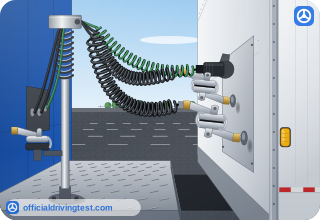
- The trailer air tank drain valves
- The cut-out cock on the back of the trailer
- The seals on the glad hands
Show answer
Correct answer: The seals on the glad hands
Check the glad hand seals before connecting, so the connection will not leak.
Source: CDL manual, national model as printed by New Jersey, Section 6 (July 2017)
-
Why must the air-lines be supported before the tractor backs under the trailer?
- So the trailer brakes stay released during the back-up
- So they will not be crushed or caught while the tractor moves
- So moisture cannot reach the seals during the back-up
Show answer
Correct answer: So they will not be crushed or caught while the tractor moves
Loose lines can be crushed or snagged as the tractor goes under, so hold them up and clear.
Source: CDL manual, national model as printed by New Jersey, Section 6 (July 2017)