Combination Vehicles: Coupling and uncoupling — Part 2
Questions in this part include: “From the cab, how do you send air to the trailer brake system?” · “Why do you back slowly under the trailer?”
Independent educational site · not affiliated with any government agency or DMV
Ready? Test yourself
Answer to start, or tap Start below:
From the cab, how do you send air to the trailer brake system?
- Instant feedback with an explanation
- Every answer cites its source in the manual
- Your best score is saved on this device
- Keyboard: press 1 to 3 to answer and Enter for the next question
Questions are written in our own words from the CDL manual; they are not the real test's questions. With your state chosen, every answer gives its page in your state's CDL manual. Without a state, answers cite the CDL manual, national model as printed by New Jersey (July 2017).
All 18 questions in this practice test
Take the test above first, then use this list to study. Tap “Show answer” to see the correct answer and explanation.
Show the questions and answersHide the questions
-
From the cab, how do you send air to the trailer brake system?
- Push in the air supply knob
- Pull out the air supply knob
- Set the tractor protection valve control to emergency
Show answer
Correct answer: Push in the air supply knob
Pushing the air supply knob in (or moving the valve control to normal) feeds air to the trailer brakes.
Source: CDL manual, national model as printed by New Jersey, Section 6 (July 2017)
-
After supplying air to the trailer, what do you wait for before testing the trailer brakes?
- For the tractor protection valve to close
- For the air pressure to reach normal
- For the low air warning signal to come on
Show answer
Correct answer: For the air pressure to reach normal
Let the air pressure build up to normal before you test the trailer brakes.
Source: CDL manual, national model as printed by New Jersey, Section 6 (July 2017)
-
Once the trailer has been supplied, what problem do you check its brake system for?
- A sticking brake pedal
- Crossed air-lines
- Worn brake drums
Show answer
Correct answer: Crossed air-lines
Once the trailer has air, check that the service and emergency air-lines were not swapped.
Source: CDL manual, national model as printed by New Jersey, Section 6 (July 2017)
-
Why do you shut the engine off while you test the trailer brakes by applying and releasing them?
- So the air pressure cannot rise during the test
- So the tractor cannot roll while the brakes are off
- So engine noise does not cover the sounds of the brakes
Show answer
Correct answer: So engine noise does not cover the sounds of the brakes
With the engine off you can hear the trailer brakes working.
Source: CDL manual, national model as printed by New Jersey, Section 6 (July 2017)
-
With the engine off, what should you hear as you apply and release the trailer brakes?
- A steady hiss both while applying and while releasing
- Air escaping when applied and the brakes moving when released
- The brakes moving when applied and air escaping when released
Show answer
Correct answer: The brakes moving when applied and air escaping when released
Applying the brakes should make them move, and releasing them should let air out.
Source: CDL manual, national model as printed by New Jersey, Section 6 (July 2017)
-
While you test the trailer brakes, what problem are you watching the gauge for?
- A major air loss
- Pressure climbing above the normal level
- Pressure staying exactly where it was
Show answer
Correct answer: A major air loss
Watch the air brake system pressure gauge during the test, because a large air loss shows up there.
Source: CDL manual, national model as printed by New Jersey, Section 6 (July 2017)
-
When do you start the engine again after testing the trailer brakes?
- As soon as the air-lines are connected
- Right after the kingpin locks in
- Once you are sure the trailer brakes work
Show answer
Correct answer: Once you are sure the trailer brakes work
Restart the engine only after the test shows the trailer brakes work.
Source: CDL manual, national model as printed by New Jersey, Section 6 (July 2017)
-
Before backing under the trailer, how do you lock the trailer brakes?
- Push in the air supply knob
- Hold the trailer hand valve on
- Pull out the air supply knob
Show answer
Correct answer: Pull out the air supply knob
Pulling the air supply knob out (or moving the valve control to emergency) locks the trailer brakes before the tractor backs under.
Source: CDL manual, national model as printed by New Jersey, Section 6 (July 2017)
-
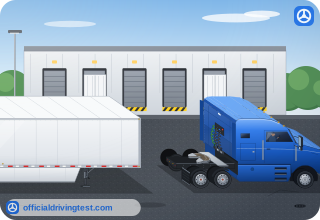
Which gear do you use to back the tractor under the trailer?
- The lowest reverse gear
- The highest reverse gear
- A middle reverse gear
Show answer
Correct answer: The lowest reverse gear
Use the lowest reverse gear so the tractor moves slowly under the trailer.
Source: CDL manual, national model as printed by New Jersey, Section 6 (July 2017)
-
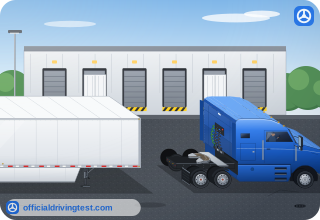
Why do you back slowly under the trailer?
- To avoid hitting the kingpin too hard
- To let the landing gear settle on the ground
- To keep the air pressure from dropping
Show answer
Correct answer: To avoid hitting the kingpin too hard
A slow approach keeps the tractor from slamming into the kingpin.
Source: CDL manual, national model as printed by New Jersey, Section 6 (July 2017)
-
When do you stop backing under the trailer?
- When the landing gear touches the ground
- When the trailer touches the back of the cab
- When the kingpin has locked into the fifth wheel
Show answer
Correct answer: When the kingpin has locked into the fifth wheel
Back until the kingpin locks into the fifth wheel, then stop.
Source: CDL manual, national model as printed by New Jersey, Section 6 (July 2017)
-
To test the connection, what do you do with the landing gear first?
- Leave it resting firmly on the ground
- Lift it a little off the ground
- Crank it halfway up and lock the handle
Show answer
Correct answer: Lift it a little off the ground
Lift the landing gear slightly off the ground before the pull test of the connection.
Source: CDL manual, national model as printed by New Jersey, Section 6 (July 2017)
-
How do you test that the trailer is really locked onto the tractor?
- Back up hard against the trailer with its brakes released
- Pull gently forward with the trailer brakes still locked
- Rock the trailer sideways with the landing gear down
Show answer
Correct answer: Pull gently forward with the trailer brakes still locked
A gentle forward pull against the locked trailer brakes shows whether the coupling holds.
Source: CDL manual, national model as printed by New Jersey, Section 6 (July 2017)
-
Why do you take the key with you when you go under the trailer?
- So no one can drive the truck while you are underneath
- So the fifth wheel stays locked while you look at it
- So the air pressure cannot drop while you check it
Show answer
Correct answer: So no one can drive the truck while you are underneath
Keeping the key prevents anyone else from moving the truck while you are beneath the trailer.
Source: CDL manual, national model as printed by New Jersey, Section 6 (July 2017)
-
After coupling, what might a visible gap between the upper and lower fifth wheel mean?
- The fifth wheel plate needs more grease added
- The trailer is correctly seated and safe for towing
- The kingpin may be sitting on top of the closed jaws
Show answer
Correct answer: The kingpin may be sitting on top of the closed jaws
There should be no gap. A gap can mean the kingpin rests on top of the closed jaws, so the trailer could come loose easily.
Source: CDL manual, national model as printed by New Jersey, Section 6 (July 2017)
-
Looking into the back of the fifth wheel, where should the jaws have closed?
- Around the glide plate on the trailer
- Around the head of the kingpin
- Around the shank of the kingpin
Show answer
Correct answer: Around the shank of the kingpin
The jaws must have closed around the kingpin shank. You check this by going under the trailer and looking in.
Source: CDL manual, national model as printed by New Jersey, Section 6 (July 2017)
-
On some fifth wheels, what must the driver do by hand during the final coupling inspection?
- Place the safety catch over the lever
- Screw the locking lever down tight
- Close the jaws around the kingpin
Show answer
Correct answer: Place the safety catch over the lever
The safety latch must sit over the locking lever, and on some fifth wheels the driver has to place it manually.
Source: CDL manual, national model as printed by New Jersey, Section 6 (July 2017)
-
What do you do if the coupling inspection shows the coupling is not right?
- Drive slowly to the nearest shop
- Drive on, but keep watching the mirrors
- Do not drive it until it is fixed
Show answer
Correct answer: Do not drive it until it is fixed
A faulty coupling is dangerous, so the unit stays parked until the coupling is repaired.
Source: CDL manual, national model as printed by New Jersey, Section 6 (July 2017)