West Virginia: Hazardous conditions and emergencies
Night, rain, flooding, snow and fog, vehicle failures, skids, fires, first aid, crashes and the Courtesy Patrol. Split into 5 shorter tests so you're not stuck in one long quiz.
Independent educational site · not affiliated with any government agency or DMV
Choose a part
Hazardous conditions and emergencies — Part 1
Questions in this part include: “Within how long must a crash resulting in injury or death be reported?”
Hazardous conditions and emergencies — Part 2
Questions in this part include: “What do the 8 simple steps say you should familiarize yourself with?”
Hazardous conditions and emergencies — Part 3
Questions in this part include: “If you suddenly lose steering control, what should you do first?”
Hazardous conditions and emergencies — Part 4
Questions in this part include: “After you turn off the engine because the oil pressure light came on, what should you check?”
Hazardous conditions and emergencies — Part 5
Questions in this part include: “Under the Good Samaritan Law, who is not liable for civil damages for giving emergency care at the scene of a crash?”
Questions are original and based on the official manual "West Virginia Driver's Licensing Handbook" (Revised July 2026), West Virginia Division of Motor Vehicles (DMV).
All 92 Hazardous conditions and emergencies questions with answers
Choose a part above to take a practice test, or study every question and answer here.
Show the questions and answersHide the questions
1Part 119 questions
-
Within how long must a crash resulting in injury or death be reported?
- Within 24 hours
- Within 10 days
- Within 30 days
- Within five days
Show answer
Correct answer: Within five days
A crash with injury or death must be reported within five days, by the quickest means possible.
Source: West Virginia Driver's Licensing Handbook (Revised July 2026), page 16 · Open this page in the manual (Manual page 16)
-
By what means must a crash that has to be reported be reported to the police within five days?
- By the quickest means possible, oral or written
- Only in person at the nearest regional office of the DMV
- Only by certified letter sent to the Commissioner
- Only through an online form on the DMV website
Show answer
Correct answer: By the quickest means possible, oral or written
The report can be oral or written, by the quickest means possible.
Source: West Virginia Driver's Licensing Handbook (Revised July 2026), page 16 · Open this page in the manual (Manual page 16)
-
To whom must a reportable crash be reported if it occurs outside a municipality?
- The local police department in the nearest municipality
- The regional office of the DMV that serves the county
- The county sheriff or the nearest West Virginia State Police office
- The insurance company that covers the vehicle in the crash
Show answer
Correct answer: The county sheriff or the nearest West Virginia State Police office
Outside a municipality, the crash goes to the county sheriff or the nearest West Virginia State Police office.
Source: West Virginia Driver's Licensing Handbook (Revised July 2026), page 16 · Open this page in the manual (Manual page 16)
-
To whom must a reportable crash be reported if it occurs within a municipality?
- The local police department
- The county circuit clerk's office
- The nearest DMV regional office
- The Commissioner of Motor Vehicles
Show answer
Correct answer: The local police department
Within a municipality, a reportable crash is reported to the local police department.
Source: West Virginia Driver's Licensing Handbook (Revised July 2026), page 16 · Open this page in the manual (Manual page 16)
-
A crash that causes no injury must be reported when property damage is more than what amount?
- $500
- $2,500
- $1,000
- $5,000
Show answer
Correct answer: $1,000
Crashes with property damage in excess of $1,000 must be reported, as must crashes with injury or death.
Source: West Virginia Driver's Licensing Handbook (Revised July 2026), page 16 · Open this page in the manual (Manual page 16)
-
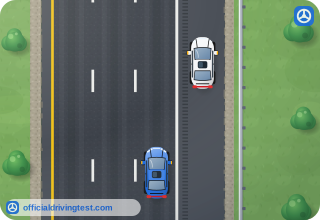
If your vehicle becomes disabled on an interstate, which lights should you turn on to show it is stopped?
- Your high beams
- Your parking lights
- Your four-way flashers
- Your turn signal on the traffic side
Show answer
Correct answer: Your four-way flashers
A disabled vehicle should have its four-way flashers on to show that it is stopped.
Source: West Virginia Driver's Licensing Handbook (Revised July 2026), page 60 · Open this page in the manual (Manual page 60)
-
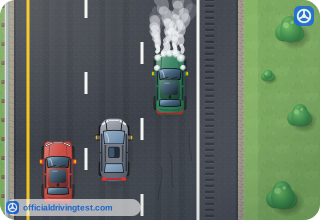
If your vehicle becomes disabled on an interstate, how far off the road should you move it?
- Just onto the edge line
- Only far enough to clear the through lane
- To the median crossover
- As far off the road as possible
Show answer
Correct answer: As far off the road as possible
You should move a disabled vehicle as far off the road as possible.
Source: West Virginia Driver's Licensing Handbook (Revised July 2026), page 60 · Open this page in the manual (Manual page 60)
-
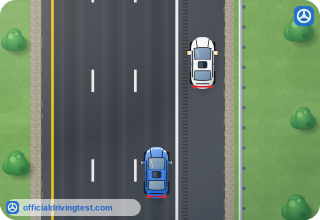
When you put out flares behind a disabled vehicle, where should the flare closest to your vehicle go?
- About 300 feet back from your own vehicle
- Directly beside your driver-side door
- About one vehicle length behind your vehicle
- On the roof of your vehicle
Show answer
Correct answer: About one vehicle length behind your vehicle
The first flare goes about one vehicle length behind the vehicle and the second about 300 feet back.
Source: West Virginia Driver's Licensing Handbook (Revised July 2026), page 60 · Open this page in the manual (Manual page 60)
-
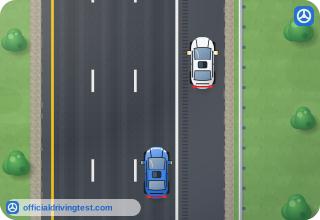
When you put out flares behind a disabled vehicle, how far back should the flare farther from your vehicle be placed?
- About 300 feet back
- About 100 feet back
- About 500 feet back
- About one vehicle length back
Show answer
Correct answer: About 300 feet back
The second flare goes about 300 feet back from the vehicle.
Source: West Virginia Driver's Licensing Handbook (Revised July 2026), page 60 · Open this page in the manual (Manual page 60)
-
Where should each flare be placed behind a disabled vehicle?
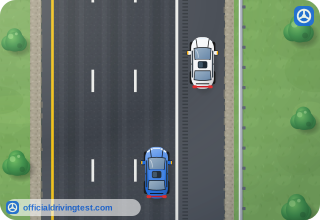
- In the middle of the lane you are driving in
- On the median
- Against the guardrail far from traffic
- On the shoulder near the edge of the through lane
Show answer
Correct answer: On the shoulder near the edge of the through lane
Each flare is placed on the shoulder near the edge of the through lane.
Source: West Virginia Driver's Licensing Handbook (Revised July 2026), page 60 · Open this page in the manual (Manual page 60)
-
If fog on the interstate is very dense, what may be better?
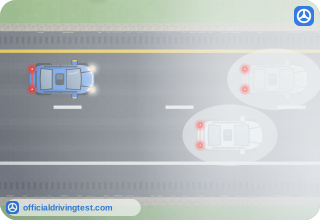
- Driving faster to get out of it quickly
- Leaving the interstate and using slower roads
- Stopping in the left lane until it clears
- Following a truck closely
Show answer
Correct answer: Leaving the interstate and using slower roads
If fog is very dense, it may be better to leave the interstate and take slower roads to your destination.
Source: West Virginia Driver's Licensing Handbook (Revised July 2026), page 60 · Open this page in the manual (Manual page 60)
-
If you are involved in a crash in heavy fog, what should you try to do?
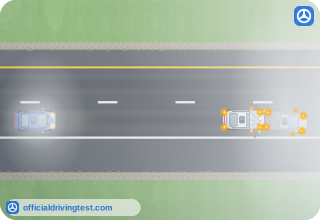
- Leave it in the road so others can see it
- Get your vehicle off the road as far as possible
- Wait in the through lane until police arrive
- Move it to the median crossover
Show answer
Correct answer: Get your vehicle off the road as far as possible
Leaving a vehicle on the road until the police arrive invites further crashes.
Source: West Virginia Driver's Licensing Handbook (Revised July 2026), page 60 · Open this page in the manual (Manual page 60)
-
What does the handbook say about driving across a flooded roadway?
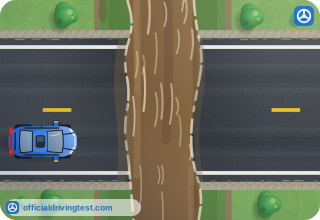
- Cross slowly in a low gear
- Cross only in the middle of the road
- Never attempt to drive across it
- Cross only if the water is below the doors
Show answer
Correct answer: Never attempt to drive across it
Flooded roadways are extremely hazardous, so you should never attempt to drive across one.
Source: West Virginia Driver's Licensing Handbook (Revised July 2026), page 63 · Open this page in the manual (Manual page 63)
-
As little as how much water can float some smaller vehicles?
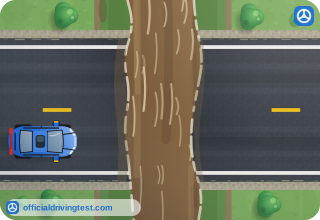
- Two inches
- Six inches
- Eighteen inches
- Three feet
Show answer
Correct answer: Six inches
As little as six inches of water can float some smaller vehicles.
Source: West Virginia Driver's Licensing Handbook (Revised July 2026), page 63 · Open this page in the manual (Manual page 63)
-
As little as how much water can carry away most vehicles?
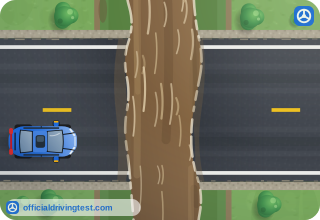
- One foot
- Three feet
- Four feet
- Two feet
Show answer
Correct answer: Two feet
Two feet of water will carry away most vehicles.
Source: West Virginia Driver's Licensing Handbook (Revised July 2026), page 63 · Open this page in the manual (Manual page 63)
-
Why are flooded roadways especially dangerous at night?
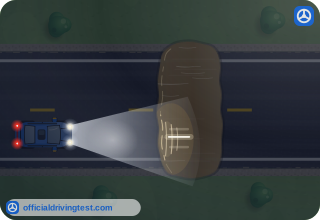
- It is much harder to recognize flooding conditions
- Water is always deeper at night than in the day
- Fewer drivers are on the road to offer any help
- Headlights make water look like dry pavement
Show answer
Correct answer: It is much harder to recognize flooding conditions
At night it is much harder to see that a road is flooded.
Source: West Virginia Driver's Licensing Handbook (Revised July 2026), page 63 · Open this page in the manual (Manual page 63)
-
If your vehicle stalls in a flooded roadway, what should you do?
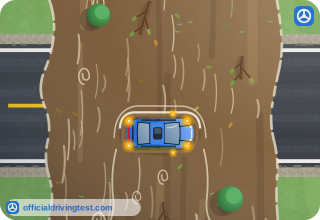
- Stay inside and wait for help
- Leave it immediately and seek higher ground
- Restart the engine repeatedly
- Close the windows and wait for the water to drop
Show answer
Correct answer: Leave it immediately and seek higher ground
The handbook says to leave a stalled vehicle in a flooded roadway immediately and seek higher ground.
Source: West Virginia Driver's Licensing Handbook (Revised July 2026), page 63 · Open this page in the manual (Manual page 63)
-
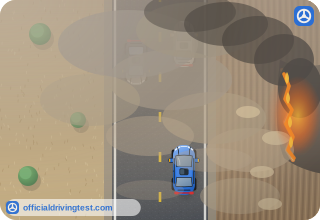
If fog or smoke impairs your vision, what does the handbook say to do?
- Stop in the travel lane with your lights off
- Keep driving at the same speed with your high beams on
- Turn off your headlights and use only your hazard lights
- Pull off and stop, leaving your lights and hazard lights on
Show answer
Correct answer: Pull off and stop, leaving your lights and hazard lights on
You pull off to the side of the road and stop, leaving your lights on and turning your hazard lights on too.
Source: West Virginia Driver's Licensing Handbook (Revised July 2026), page 64 · Open this page in the manual (Manual page 64)
-
What do the 8 simple steps to safe and happy driving say about your vehicle's doors and windows when driving or when parked?
- Keep the doors unlocked and the windows down
- Lock the doors but open the windows slightly
- Keep the doors locked and the windows up
- Keep the windows up but leave the doors unlocked
Show answer
Correct answer: Keep the doors locked and the windows up
The first of the 8 simple steps advises keeping the vehicle doors locked and the windows up when driving or when parked.
Source: West Virginia Driver's Licensing Handbook (Revised July 2026), page 69 · Open this page in the manual (Manual page 69)
2Part 219 questions
-
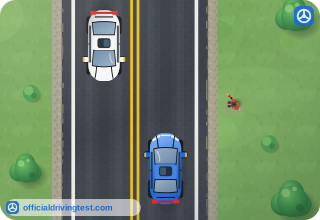
What do the 8 simple steps say to do about hitchhikers?
- Pick them up only in well-lit, populated places
- Avoid them, however innocent or needy they may appear
- Give them a ride only if they appear needy or innocent
- Stop for them only if they are standing near a service station
Show answer
Correct answer: Avoid them, however innocent or needy they may appear
The handbook warns that hitchhikers can mean bad news, no matter how innocent or needy they may appear, and says to avoid them.
Source: West Virginia Driver's Licensing Handbook (Revised July 2026), page 69 · Open this page in the manual (Manual page 69)
-
What do the 8 simple steps say you should familiarize yourself with?
- The opening hours of the nearest service stations
- The routes of the local public bus lines
- The names of all the roads in your area
- Your vehicle's controls and safety equipment
Show answer
Correct answer: Your vehicle's controls and safety equipment
One of the 8 simple steps is to know your vehicle by familiarizing yourself with its controls and safety equipment.
Source: West Virginia Driver's Licensing Handbook (Revised July 2026), page 69 · Open this page in the manual (Manual page 69)
-
Where do the 8 simple steps say to lock purses, wallets, luggage and valuables?
- Under the driver's seat, out of sight
- On the back seat, covered with a coat
- In the trunk or glove compartment
- In the center console, out of sight
Show answer
Correct answer: In the trunk or glove compartment
The steps say to hide valuables by locking them in the trunk or glove compartment.
Source: West Virginia Driver's Licensing Handbook (Revised July 2026), page 69 · Open this page in the manual (Manual page 69)
-
If you become lost, what do the 8 simple steps say you should do?
- Pull over on the side of the road to study your map
- Drive to the nearest well-lit, populated, public place
- Drive to a dark, quiet street to read your directions
- Pull into an empty parking lot to read your directions
Show answer
Correct answer: Drive to the nearest well-lit, populated, public place
Rather than pulling over on the side of the road, drive to a well-lit, populated, public place such as a service station or restaurant, and lock your vehicle and take the keys.
Source: West Virginia Driver's Licensing Handbook (Revised July 2026), page 69 · Open this page in the manual (Manual page 69)
-
Where do the 8 simple steps say you should always park?
- Near the lot's edge
- Beside a large truck
- At the back of lots
- In well-lit areas
Show answer
Correct answer: In well-lit areas
The steps say to always park in well-lit areas.
Source: West Virginia Driver's Licensing Handbook (Revised July 2026), page 69 · Open this page in the manual (Manual page 69)
-
What do the 8 simple steps say you should have in hand when approaching your vehicle?
- Your keys
- Your phone
- Your registration
- Your license
Show answer
Correct answer: Your keys
The steps advise having your keys in hand when you approach your vehicle.
Source: West Virginia Driver's Licensing Handbook (Revised July 2026), page 69 · Open this page in the manual (Manual page 69)
-
Before entering your vehicle, what do the 8 simple steps say to check?
- The tire pressure and the fuel level
- Only the trunk and the glove compartment
- Inside and underneath the vehicle
- The dashboard warning lights
Show answer
Correct answer: Inside and underneath the vehicle
Before entering, be sure to check inside and underneath your vehicle.
Source: West Virginia Driver's Licensing Handbook (Revised July 2026), page 69 · Open this page in the manual (Manual page 69)
-
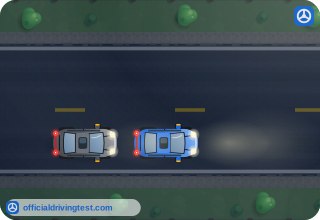
If you feel you are being followed, what do the 8 simple steps say to do?
- Pull over on the roadside and wait for the vehicle to pass
- Proceed to a well-lit populated area and call the police
- Drive home as quickly as possible and park in the driveway
- Stop at the nearest place and confront the other driver
Show answer
Correct answer: Proceed to a well-lit populated area and call the police
The steps say to go to a well-lit populated area and call the police.
Source: West Virginia Driver's Licensing Handbook (Revised July 2026), page 69 · Open this page in the manual (Manual page 69)
-
A tire blows out. What should you do to regain control of the vehicle?
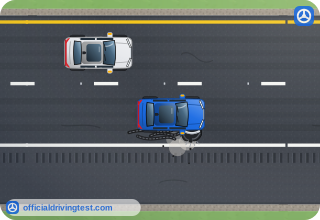
- Hold the wheel tightly, steer straight, and ease off the gas
- Brake as hard as you can and steer sharply toward the shoulder
- Turn the wheel toward the shoulder and press the brake pedal
- Shift into neutral and coast while steering from side to side
Show answer
Correct answer: Hold the wheel tightly, steer straight, and ease off the gas
After a blowout you hold the wheel tightly, steer straight ahead and ease up on the accelerator.
Source: West Virginia Driver's Licensing Handbook (Revised July 2026), page 70 · Open this page in the manual (Manual page 70)
-
After a tire blowout, when should you brake?
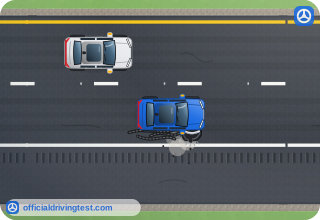
- Immediately, as hard as you possibly can
- As soon as you feel the tire collapse
- Only after the vehicle is under control
- Before you steer straight ahead, to slow down
Show answer
Correct answer: Only after the vehicle is under control
After a blowout, do not brake until the vehicle is under control; then pull all the way off the road into a safe area.
Source: West Virginia Driver's Licensing Handbook (Revised July 2026), page 70 · Open this page in the manual (Manual page 70)
-
After a blowout, it is impossible to get off the road immediately. What should you do?
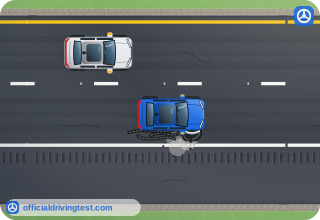
- Stop in your lane and turn on your headlights
- Continue driving slowly with your emergency flashers on
- Keep driving at normal speed with your headlights on
- Speed up to reach the nearest exit ramp
Show answer
Correct answer: Continue driving slowly with your emergency flashers on
If you cannot leave the road at once, you keep driving slowly with the emergency flashers on to warn others.
Source: West Virginia Driver's Licensing Handbook (Revised July 2026), page 70 · Open this page in the manual (Manual page 70)
-
Which of these is one of the most common causes of blowouts?
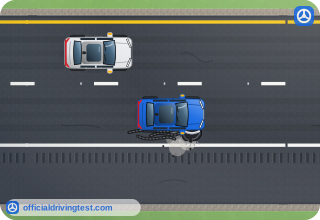
- Tires with deep tread
- Cold brake fluid
- A loose gas cap
- Under-inflated tires
Show answer
Correct answer: Under-inflated tires
The handbook names under-inflated tires as one of the most common causes of blowouts, so tire air should be checked often.
Source: West Virginia Driver's Licensing Handbook (Revised July 2026), page 70 · Open this page in the manual (Manual page 70)
-
If your brakes fail, what should you do with the brake pedal?
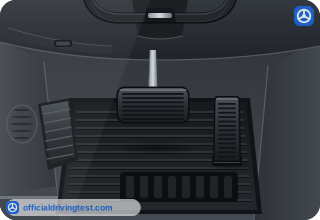
- Press it slowly and hold it steady
- Stay off it and rely on the horn
- Pump the brake pedal quickly
- Press it once and then release it
Show answer
Correct answer: Pump the brake pedal quickly
When the brakes fail, the first step the handbook gives is to pump the pedal quickly.
Source: West Virginia Driver's Licensing Handbook (Revised July 2026), page 71 · Open this page in the manual (Manual page 71)
-
If your brakes fail, what should you do with the transmission?
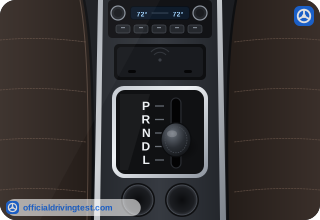
- Shift to a lower gear
- Shift into neutral
- Shift into reverse
- Shift to a higher gear
Show answer
Correct answer: Shift to a lower gear
A lower gear helps slow the vehicle while you look for a place to stop off the roadway.
Source: West Virginia Driver's Licensing Handbook (Revised July 2026), page 71 · Open this page in the manual (Manual page 71)
-
When your brakes fail and you look for a place to stop off the roadway, how should you warn other drivers?
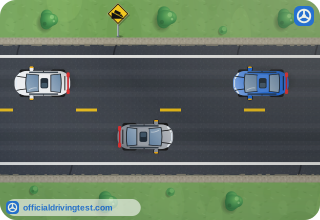
- Roll down the window and wave an arm
- Turn off your headlights to avoid glare
- Stay quiet and keep your lights off until stopped
- Use your horn and lights
Show answer
Correct answer: Use your horn and lights
The handbook says to use your horn and lights to warn other drivers when your brakes fail.
Source: West Virginia Driver's Licensing Handbook (Revised July 2026), page 71 · Open this page in the manual (Manual page 71)
-
If your brakes fail and you use the parking brake, what should you do with the brake release?
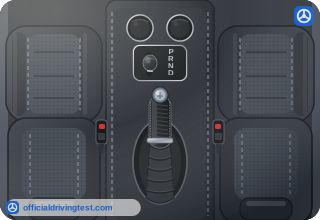
- Keep it locked down so the parking brake stays fully on
- Hold it so you can ease up if the rear wheels lock and cause a skid
- Leave it alone, since the parking brake releases by itself
- Hold it only after the vehicle has stopped completely
Show answer
Correct answer: Hold it so you can ease up if the rear wheels lock and cause a skid
Holding the release lets you ease up on the parking brake if the rear wheels lock and the vehicle starts to skid.
Source: West Virginia Driver's Licensing Handbook (Revised July 2026), page 71 · Open this page in the manual (Manual page 71)
-
How can you prevent your engine from overheating in slow-moving traffic?
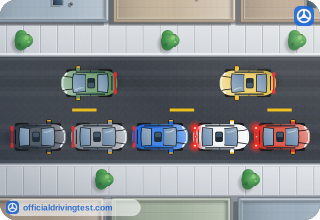
- Turn off the engine every time you stop and restart it
- Shift into neutral and race the engine briefly during stops
- Keep your foot on the brake with the engine in drive
- Shift into park and hold the brake pedal down
Show answer
Correct answer: Shift into neutral and race the engine briefly during stops
Shifting into neutral and racing the engine briefly speeds up the fan and the water pump.
Source: West Virginia Driver's Licensing Handbook (Revised July 2026), page 71 · Open this page in the manual (Manual page 71)
-
The warning light or gauge shows that your engine is overheating. What should you do?
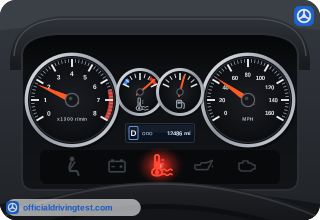
- Keep driving until the engine stops by itself
- Pull off the road and remove the radiator cap right away
- Shift into neutral and keep driving slowly
- Pull off the road and turn the engine off
Show answer
Correct answer: Pull off the road and turn the engine off
An overheating engine means you pull off the road and turn the engine off.
Source: West Virginia Driver's Licensing Handbook (Revised July 2026), page 71 · Open this page in the manual (Manual page 71)
-
When may you remove the radiator cap of an overheated engine?
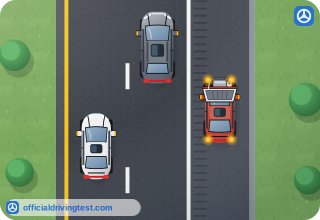
- After the engine has cooled off
- As soon as the engine is turned off
- As soon as the warning light goes out
- Only while the engine is still running
Show answer
Correct answer: After the engine has cooled off
The cap should stay on until the engine has cooled off.
Source: West Virginia Driver's Licensing Handbook (Revised July 2026), page 71 · Open this page in the manual (Manual page 71)
3Part 318 questions
-
Your vehicle begins to skid. When should you use your brakes?
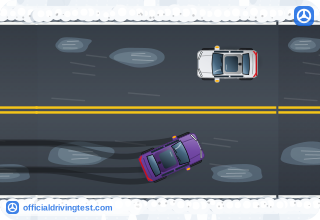
- Immediately, as hard as you can
- As soon as the rear of the vehicle moves sideways
- Only if you are in danger of hitting something
- Only after the vehicle has completely stopped skidding
Show answer
Correct answer: Only if you are in danger of hitting something
In a skid you concentrate on steering and do not use the brakes unless you are in danger of hitting something.
Source: West Virginia Driver's Licensing Handbook (Revised July 2026), page 71 · Open this page in the manual (Manual page 71)
-
What is the first step to steer out of a skid?
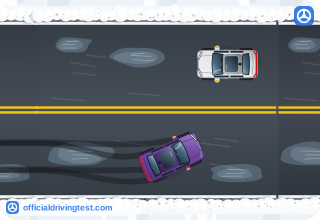
- Press the brake pedal firmly
- Press the accelerator to power out
- Shift into neutral
- Take your foot off the gas pedal
Show answer
Correct answer: Take your foot off the gas pedal
The first step the handbook lists for steering out of a skid is to take your foot off the gas pedal.
Source: West Virginia Driver's Licensing Handbook (Revised July 2026), page 71 · Open this page in the manual (Manual page 71)
-
The rear of your vehicle is skidding to the right. Which way should you turn the steering wheel?
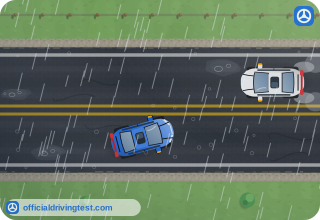
- To the left
- To the right
- Hold it straight and brake
- Turn it sharply left, then right
Show answer
Correct answer: To the right
You turn the steering wheel in the direction of the skid, so a skid to the right means turning right.
Source: West Virginia Driver's Licensing Handbook (Revised July 2026), page 71 · Open this page in the manual (Manual page 71)
-
Your gas pedal sticks. What should you concentrate on?
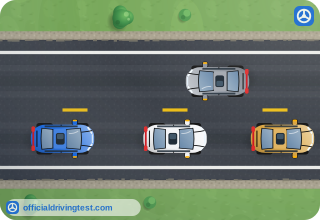
- Pumping the brake pedal as fast as you can
- Shifting into park as soon as the pedal sticks
- Steering and keeping your eyes on the road
- Sounding the horn to warn all other drivers
Show answer
Correct answer: Steering and keeping your eyes on the road
With a stuck gas pedal you keep steering and keep your eyes on the road while you deal with the pedal.
Source: West Virginia Driver's Licensing Handbook (Revised July 2026), page 71 · Open this page in the manual (Manual page 71)
-
Your gas pedal is stuck and you cannot free it with your foot. What should you do?
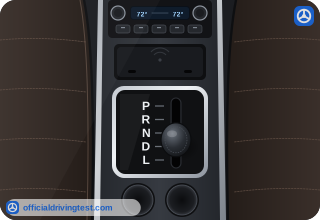
- Push in the clutch or shift into neutral
- Shift into reverse
- Shift into park
- Stomp on the gas pedal harder to free it
Show answer
Correct answer: Push in the clutch or shift into neutral
If the pedal cannot be freed with your foot, you disconnect the engine from the wheels by pushing in the clutch or shifting into neutral.
Source: West Virginia Driver's Licensing Handbook (Revised July 2026), page 71 · Open this page in the manual (Manual page 71)
-
With a stuck gas pedal, after you push in the clutch or shift into neutral, what should you do?
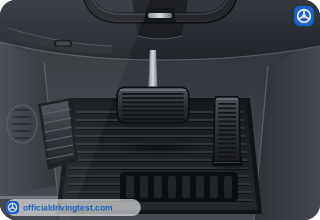
- Use your brakes, stop at the nearest safe place, and turn off the ignition
- Shift back into drive and continue to your destination slowly
- Pump the brake pedal quickly and stop in the middle of the lane
- Wait in the lane for the engine to slow down on its own
Show answer
Correct answer: Use your brakes, stop at the nearest safe place, and turn off the ignition
The last steps are to brake, stop at the nearest safe place and turn off the ignition.
Source: West Virginia Driver's Licensing Handbook (Revised July 2026), page 71 · Open this page in the manual (Manual page 71)
-
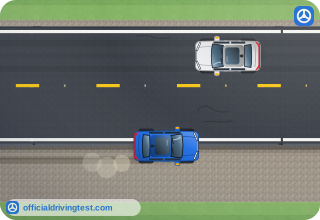
If you run off the road, what should you do with the accelerator and where should you stay?
- Steer sharply back onto the pavement at once and speed up
- Brake hard to stop on the shoulder as quickly as possible
- Stay on the shoulder and ease off the accelerator
- Stay off the shoulder and press the accelerator
Show answer
Correct answer: Stay on the shoulder and ease off the accelerator
After gripping the wheel, you stay on the shoulder and ease off the accelerator.
Source: West Virginia Driver's Licensing Handbook (Revised July 2026), page 71 · Open this page in the manual (Manual page 71)
-
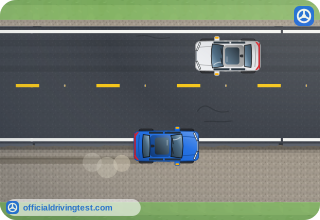
If your wheels run off the road, how should you brake?
- Hard, to stop as quickly as possible
- Gently, and slow gradually
- Not at all until you reach the pavement
- In short, rapid pumps
Show answer
Correct answer: Gently, and slow gradually
The handbook tells you to brake gently and slow gradually after running off the road.
Source: West Virginia Driver's Licensing Handbook (Revised July 2026), page 71 · Open this page in the manual (Manual page 71)
-
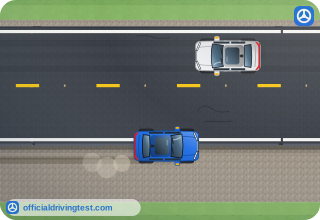
After you have slowed down with your wheels off the road, what should you check?
- Only the road ahead for traffic
- Your tires for damage before moving
- Whether the engine is still running
- Behind you, as well as ahead, for traffic
Show answer
Correct answer: Behind you, as well as ahead, for traffic
Once speed is reduced you look behind as well as ahead before returning to the pavement.
Source: West Virginia Driver's Licensing Handbook (Revised July 2026), page 71 · Open this page in the manual (Manual page 71)
-
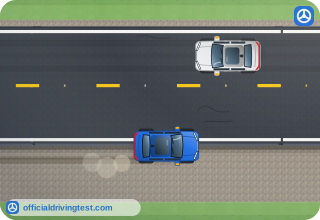
After you have reduced speed with your wheels off the road, how should you turn the wheels onto the pavement?
- Gradually, drifting onto the pavement
- Straight, with the wheels not turned
- Sharply
- Slowly, in short steps
Show answer
Correct answer: Sharply
The handbook says to turn the wheels sharply onto the pavement once the speed has been reduced.
Source: West Virginia Driver's Licensing Handbook (Revised July 2026), page 71 · Open this page in the manual (Manual page 71)
-
As soon as your wheels hit the edge of the pavement after you ran off the road, what should you do?
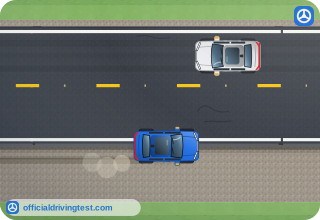
- Turn them the other way to keep your vehicle from heading across the highway
- Keep them turned sharply until you are in the center of the lane
- Brake hard with the wheels still turned toward the road
- Straighten them at once and press the accelerator hard
Show answer
Correct answer: Turn them the other way to keep your vehicle from heading across the highway
Turning the wheels back the other way keeps the vehicle from heading across the highway.
Source: West Virginia Driver's Licensing Handbook (Revised July 2026), page 71 · Open this page in the manual (Manual page 71)
-
If you suddenly lose steering control, what should you do first?
- Press the brake pedal as hard as you can
- Shift into reverse
- Shift into park
- Ease up on the accelerator
Show answer
Correct answer: Ease up on the accelerator
The handbook's first step when steering fails is to ease up on the accelerator.
Source: West Virginia Driver's Licensing Handbook (Revised July 2026), page 72 · Open this page in the manual (Manual page 72)
-
You lose steering control, but your vehicle stays in its lane. What should you do?
- Apply the brakes quickly, using maximum pressure
- Wait until it slows down, then gently apply the brakes
- Shift to a lower gear and turn the wheel hard
- Speed up to regain control by momentum
Show answer
Correct answer: Wait until it slows down, then gently apply the brakes
While the vehicle stays in its lane, you let it slow down and then brake gently so that it does not change direction.
Source: West Virginia Driver's Licensing Handbook (Revised July 2026), page 72 · Open this page in the manual (Manual page 72)
-
You lose steering control and your vehicle starts off the road or toward a pedestrian or another vehicle. What should you do?
- Wait until the vehicle slows down by itself
- Apply the brakes quickly, using maximum pressure
- Gently apply the brakes to avoid changing direction
- Ease up on the accelerator and do nothing else
Show answer
Correct answer: Apply the brakes quickly, using maximum pressure
When the vehicle is heading toward danger, you brake quickly using maximum pressure.
Source: West Virginia Driver's Licensing Handbook (Revised July 2026), page 72 · Open this page in the manual (Manual page 72)
-
Your headlights fail on a lighted highway. What should you do?
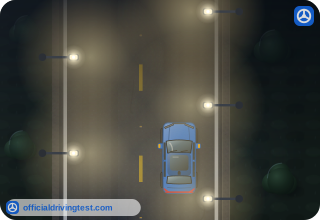
- Keep driving at normal speed until you reach the next exit
- Stay in your lane and slow down until the lights come back
- Turn on your parking lights and continue driving normally
- Get off the roadway onto the shoulder as soon and safely as possible
Show answer
Correct answer: Get off the roadway onto the shoulder as soon and safely as possible
On a lighted highway you can leave the roadway for the shoulder or other available space as soon and as safely as possible.
Source: West Virginia Driver's Licensing Handbook (Revised July 2026), page 72 · Open this page in the manual (Manual page 72)
-
Your headlights fail on a dark highway. What should you try?
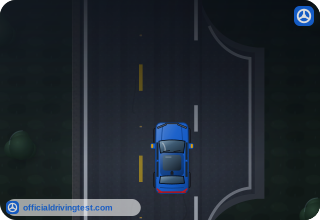
- Your parking lights, direction signals, or emergency flashers
- Your horn, your wipers and your interior dome light
- Your brake lights held on with your foot on the pedal
- Your fog lights and your interior dome light
Show answer
Correct answer: Your parking lights, direction signals, or emergency flashers
On a dark highway the handbook says to try the parking lights, direction signals or emergency flashers while you get off the roadway.
Source: West Virginia Driver's Licensing Handbook (Revised July 2026), page 72 · Open this page in the manual (Manual page 72)
-
All of your vehicle's lights fail. What should you do?
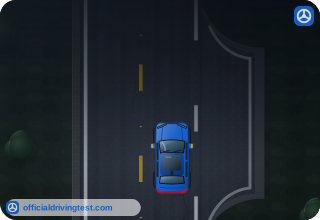
- Stop immediately in your lane and wait for daylight or help
- Pull onto the shoulder at once without slowing down
- Stay on the roadway and slow down enough to pull off safely
- Speed up to reach a lighted section of highway quickly
Show answer
Correct answer: Stay on the roadway and slow down enough to pull off safely
If every light fails, you stay on the roadway and slow down enough to pull off the roadway safely.
Source: West Virginia Driver's Licensing Handbook (Revised July 2026), page 72 · Open this page in the manual (Manual page 72)
-
Smoke comes from under the hood of your vehicle. What should you do?
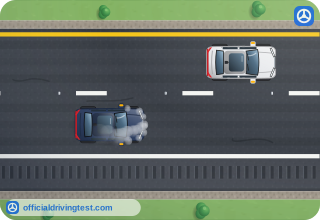
- Keep driving to the nearest repair shop
- Stay on the roadway and pour water on the hood
- Keep driving until the smoke clears, then stop
- Get off the roadway and turn off the ignition
Show answer
Correct answer: Get off the roadway and turn off the ignition
With smoke from under the hood, you leave the roadway and turn off the ignition.
Source: West Virginia Driver's Licensing Handbook (Revised July 2026), page 72 · Open this page in the manual (Manual page 72)
4Part 418 questions
-
If you have no chemical fire extinguisher, what can you use to smother a vehicle fire?
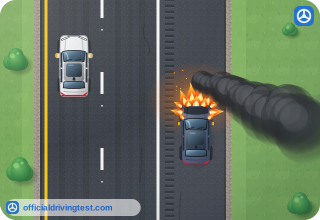
- Water
- Dirt or sand
- Motor oil
- A floor mat
Show answer
Correct answer: Dirt or sand
The handbook says to use dirt or sand to smother the fire when no chemical extinguisher is available.
Source: West Virginia Driver's Licensing Handbook (Revised July 2026), page 72 · Open this page in the manual (Manual page 72)
-
Why should you not use water on a vehicle fire?
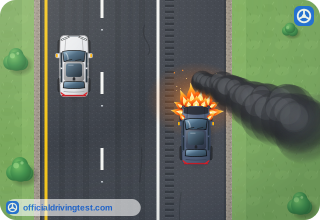
- Water would make the gas tank explode immediately
- Water freezes on a hot engine and cracks it
- Burning gasoline floats on water and spreads the fire
- Water is needed to cool the radiator instead
Show answer
Correct answer: Burning gasoline floats on water and spreads the fire
Gasoline floats on top of water, so water carries the burning fuel and spreads the fire.
Source: West Virginia Driver's Licensing Handbook (Revised July 2026), page 72 · Open this page in the manual (Manual page 72)
-
If a fire in your vehicle gets out of control, how far away from the vehicle should you move?
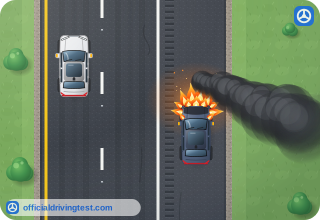
- At least 100 feet
- At least 25 feet
- At least 50 feet
- At least 300 feet
Show answer
Correct answer: At least 100 feet
The gas tank may explode, so you move at least 100 feet away from the vehicle.
Source: West Virginia Driver's Licensing Handbook (Revised July 2026), page 72 · Open this page in the manual (Manual page 72)
-
A vehicle is coming toward you in your lane. What should you do?
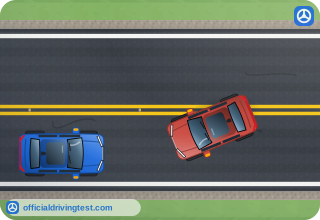
- Move to the right, slow down, sound your horn, and flash your headlights
- Stop in your lane and turn off your headlights to avoid glare
- Speed up and move to the left to pass the vehicle quickly
- Turn into the lane the vehicle has left and sound your horn
Show answer
Correct answer: Move to the right, slow down, sound your horn, and flash your headlights
You move to the right, slow down, and warn the other driver with your horn and headlights.
Source: West Virginia Driver's Licensing Handbook (Revised July 2026), page 72 · Open this page in the manual (Manual page 72)
-
A vehicle is coming toward you in your lane. Why should you not turn into the lane it has left?
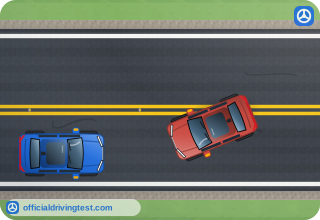
- Your headlights would not light up that lane for the other driver
- That lane has a lower speed limit than yours
- The driver may realize the mistake and turn back into that lane
- You could not sound your horn from that lane
Show answer
Correct answer: The driver may realize the mistake and turn back into that lane
The other driver may realize the mistake and turn back into the proper lane.
Source: West Virginia Driver's Licensing Handbook (Revised July 2026), page 72 · Open this page in the manual (Manual page 72)
-
The oil pressure light comes on. What should you do?
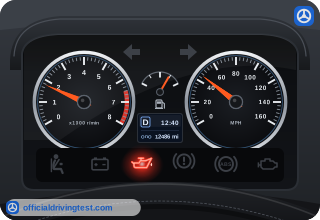
- Keep driving until the light goes out on its own
- Pull over and keep the engine idling for several minutes
- Check the tire pressure and keep driving slowly
- Get the vehicle off the road and immediately turn off the engine
Show answer
Correct answer: Get the vehicle off the road and immediately turn off the engine
An oil pressure warning means you get off the road and turn off the engine right away.
Source: West Virginia Driver's Licensing Handbook (Revised July 2026), page 72 · Open this page in the manual (Manual page 72)
-
After you turn off the engine because the oil pressure light came on, what should you check?
- The tread depth of the tires
- The wiper fluid container
- The engine oil level
- The battery vent wells
Show answer
Correct answer: The engine oil level
You check the engine oil level and add oil if it is needed.
Source: West Virginia Driver's Licensing Handbook (Revised July 2026), page 72 · Open this page in the manual (Manual page 72)
-
You are jump starting a vehicle from another vehicle's battery. What should you do with the vent caps?
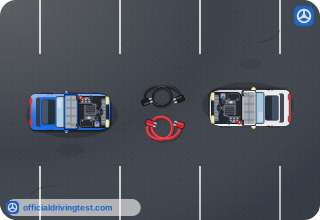
- Take them off both batteries and put a cloth over the open vent wells
- Take them off the live battery only and leave the dead one capped
- Take them off both batteries and leave the vent wells uncovered
- Leave them on both batteries and cover the hood with a cloth
Show answer
Correct answer: Take them off both batteries and put a cloth over the open vent wells
The handbook says to remove the vent caps from both batteries and cover the open vent wells with a cloth.
Source: West Virginia Driver's Licensing Handbook (Revised July 2026), page 72 · Open this page in the manual (Manual page 72)
-
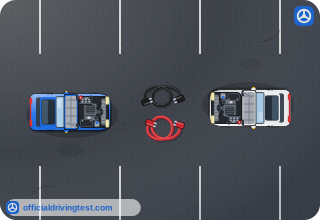
What should you turn off before jump starting a vehicle?
- Nothing; leave everything on to help the battery
- Only the radio
- The engine of the vehicle giving the jump
- Lights, heater, air conditioner, and radio
Show answer
Correct answer: Lights, heater, air conditioner, and radio
Lights, heater, air conditioner and radio should all be off before you connect the cables.
Source: West Virginia Driver's Licensing Handbook (Revised July 2026), page 72 · Open this page in the manual (Manual page 72)
-
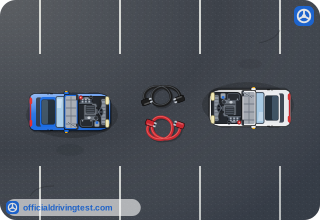
When jump starting, to which post do you connect the positive post of the dead battery?
- The negative post of the live battery
- The positive post of the live battery
- The engine block of the dead vehicle
- The frame of the live vehicle
Show answer
Correct answer: The positive post of the live battery
Positive goes to positive: the dead battery's positive post connects to the live battery's positive post.
Source: West Virginia Driver's Licensing Handbook (Revised July 2026), page 72 · Open this page in the manual (Manual page 72)
-
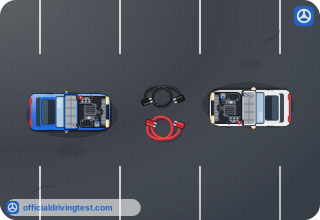
When jump starting, where do you connect the negative post of the live battery?
- To the positive post of the dead battery, next to the cable
- To the engine block or frame of the vehicle with the dead battery
- To the frame of the vehicle that is giving you the jump
- To the negative post of the dead battery
Show answer
Correct answer: To the engine block or frame of the vehicle with the dead battery
The negative cable from the live battery goes to the engine block or frame of the vehicle with the dead battery.
Source: West Virginia Driver's Licensing Handbook (Revised July 2026), page 72 · Open this page in the manual (Manual page 72)
-
After connecting the jumper cables, what should you make sure of before starting the vehicle giving the jump?
- Both engines are already running
- Both vehicles are in drive
- The hoods of both vehicles are closed
- The two vehicles are not touching
Show answer
Correct answer: The two vehicles are not touching
The two vehicles must not touch each other while you jump start.
Source: West Virginia Driver's Licensing Handbook (Revised July 2026), page 72 · Open this page in the manual (Manual page 72)
-
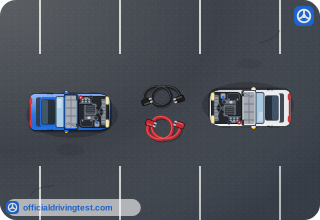
When jump starting a vehicle, which vehicle do you start first?
- The vehicle giving the jump
- The vehicle with the dead battery
- Both vehicles at the same time
- Whichever vehicle is closer to the road
Show answer
Correct answer: The vehicle giving the jump
You start the vehicle giving the jump, let it run for a few minutes, and then start the other vehicle.
Source: West Virginia Driver's Licensing Handbook (Revised July 2026), page 72 · Open this page in the manual (Manual page 72)
-
In what order do you take off jumper cables after jump starting?
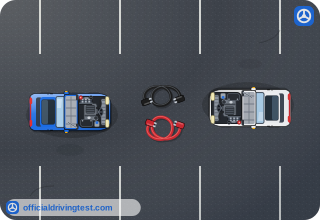
- In the same order in which you originally connected them
- In any order you like, as long as both vehicles keep running
- In the opposite order from the one in which you connected them
- Positive cables first, then negative cables
Show answer
Correct answer: In the opposite order from the one in which you connected them
The cables come off in the opposite order, and then the vent caps are replaced.
Source: West Virginia Driver's Licensing Handbook (Revised July 2026), page 72 · Open this page in the manual (Manual page 72)
-
Battery acid gets on your skin, eyes, or vehicle. What should you do?
- Wipe it off with a dry cloth and leave it
- Let it dry and then brush it off
- Cover it with a cloth until you reach home
- Wash it off immediately with water
Show answer
Correct answer: Wash it off immediately with water
Battery acid on skin, eyes or a vehicle should be washed off immediately with water.
Source: West Virginia Driver's Licensing Handbook (Revised July 2026), page 72 · Open this page in the manual (Manual page 72)
-
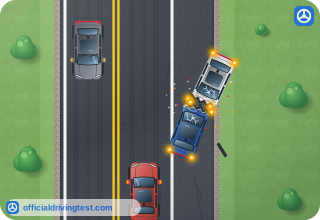
According to the handbook's general rules for giving first aid, what should you do about moving a crash victim?
- Move the victim into a vehicle to keep them warm and dry
- Always sit the victim upright against your vehicle's wheel
- Do not move the victim unless there is danger of further injury
- Always move the victim to the shoulder of the road
Show answer
Correct answer: Do not move the victim unless there is danger of further injury
Stay calm and do not move the victim unless there is danger of further injury.
Source: West Virginia Driver's Licensing Handbook (Revised July 2026), page 73 · Open this page in the manual (Manual page 73)
-
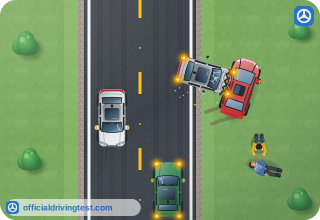
When you give first aid in order, what comes first?
- Restore breathing
- Control bleeding
- Treat for shock
- Protect broken bones
Show answer
Correct answer: Control bleeding
The handbook's first aid order starts with controlling bleeding.
Source: West Virginia Driver's Licensing Handbook (Revised July 2026), page 73 · Open this page in the manual (Manual page 73)
-
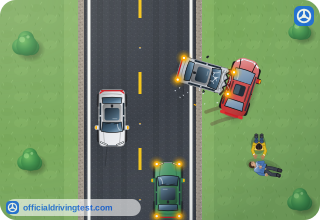
In the handbook's first aid order, what comes right after restoring breathing?
- Control bleeding
- Protect broken bones
- Move the victim to the shoulder
- Treat for shock
Show answer
Correct answer: Treat for shock
The order is control bleeding, restore breathing, treat for shock, then protect broken bones.
Source: West Virginia Driver's Licensing Handbook (Revised July 2026), page 73 · Open this page in the manual (Manual page 73)
5Part 518 questions
-
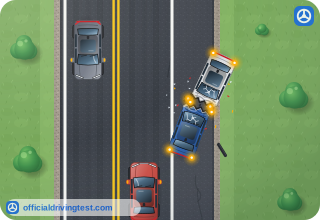
In what position does the handbook say to keep a crash victim?
- Sitting upright against a wall
- Standing with support
- Lying down and comfortable
- Walking slowly to stay warm
Show answer
Correct answer: Lying down and comfortable
The handbook's note says to keep the victim lying down and comfortable.
Source: West Virginia Driver's Licensing Handbook (Revised July 2026), page 73 · Open this page in the manual (Manual page 73)
-
When does the handbook say you should administer first aid?
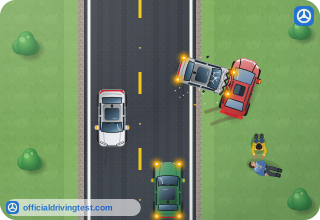
- If you think a delay in emergency care could cause death or further injury
- Only when you are licensed to practice medicine, dentistry, or nursing
- Only after the injured person has been moved safely off the road
- Only when the injured person asks you for help in a clear voice
Show answer
Correct answer: If you think a delay in emergency care could cause death or further injury
First aid should be given when waiting for emergency care could lead to death or further injury.
Source: West Virginia Driver's Licensing Handbook (Revised July 2026), page 73 · Open this page in the manual (Manual page 73)
-
Under the Good Samaritan Law, who is not liable for civil damages for giving emergency care at the scene of a crash?
- Only people licensed to practice medicine or dentistry
- Only police officers, firefighters, and ambulance crews
- Only people who have completed a first aid course
- Anyone who helps in good faith and without pay
Show answer
Correct answer: Anyone who helps in good faith and without pay
The law protects any person, even those licensed in medicine or dentistry, who gives emergency care at a crash scene in good faith and without pay.
Source: West Virginia Driver's Licensing Handbook (Revised July 2026), page 74 · Open this page in the manual (Manual page 74)
-
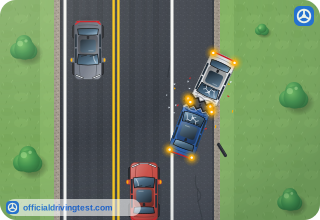
You are involved in a crash. What is the first thing you should do?
- Call your insurance company
- Stop immediately
- Drive to the nearest police station
- Look for witnesses
Show answer
Correct answer: Stop immediately
Stopping immediately is the first step the handbook lists for a driver involved in a crash.
Source: West Virginia Driver's Licensing Handbook (Revised July 2026), page 74 · Open this page in the manual (Manual page 74)
-
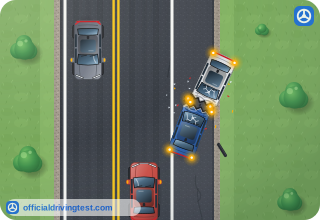
Why should you turn off the ignition after stopping at a crash?
- To keep the battery from going dead
- To prevent the danger of fire
- To keep the engine from overheating
- To keep the airbags from deploying
Show answer
Correct answer: To prevent the danger of fire
Turning off the ignition lowers the danger of fire.
Source: West Virginia Driver's Licensing Handbook (Revised July 2026), page 74 · Open this page in the manual (Manual page 74)
-
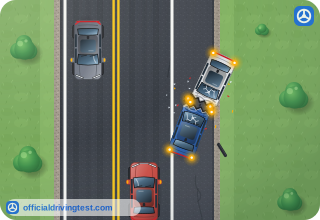
What should you do to protect the scene of a crash?
- Park your vehicle across the lane so traffic must stop
- Leave the scene quickly so that traffic can clear
- Leave all vehicles exactly where they are, with no warning
- Use flares, a flagman, or other means to prevent further crashes
Show answer
Correct answer: Use flares, a flagman, or other means to prevent further crashes
Flares, a flagman or other means warn approaching traffic and help prevent further crashes.
Source: West Virginia Driver's Licensing Handbook (Revised July 2026), page 74 · Open this page in the manual (Manual page 74)
-
After a crash with injured people, whom should you send for?
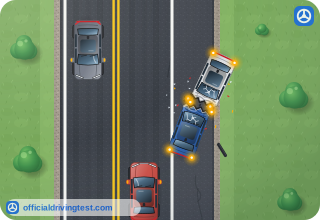
- An ambulance and/or law enforcement
- Only a tow truck
- Your insurance agent and the DMV
- Only a Courtesy Patrol driver
Show answer
Correct answer: An ambulance and/or law enforcement
The handbook says to send for necessary aid, meaning an ambulance and/or law enforcement.
Source: West Virginia Driver's Licensing Handbook (Revised July 2026), page 74 · Open this page in the manual (Manual page 74)
-
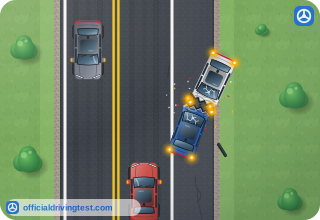
What should you do about spectators at a crash scene where people are injured?
- Ask them to move the injured onto the shoulder
- Have them gather close around the injured
- Keep them away from the injured
- Ask them to direct traffic without any signals
Show answer
Correct answer: Keep them away from the injured
The handbook says to keep spectators away from the injured.
Source: West Virginia Driver's Licensing Handbook (Revised July 2026), page 74 · Open this page in the manual (Manual page 74)
-
If a crash results in injury or death of any person, whom must you notify?
- Only your insurance company
- The nearest DMV regional office
- The West Virginia Courtesy Patrol
- The nearest law enforcement agency
Show answer
Correct answer: The nearest law enforcement agency
A crash with injury or death must be reported to the nearest law enforcement agency.
Source: West Virginia Driver's Licensing Handbook (Revised July 2026), page 74 · Open this page in the manual (Manual page 74)
-
Which of these should be exchanged by persons involved in a traffic crash?
- Employer's name and work address
- Motor vehicle insurance information
- Social Security number and birth date
- Vehicle identification number and color
Show answer
Correct answer: Motor vehicle insurance information
Name, address, license plate number and motor vehicle insurance information are the items the handbook says to exchange.
Source: West Virginia Driver's Licensing Handbook (Revised July 2026), page 74 · Open this page in the manual (Manual page 74)
-
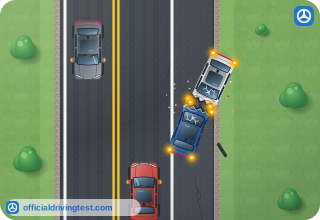
When should you stop at a crash scene?
- Whenever traffic slows down so you can watch what happened
- Always, as a courtesy to the people involved in the crash
- Only if you are involved or can render assistance
- Only when a law enforcement officer waves you onto the shoulder
Show answer
Correct answer: Only if you are involved or can render assistance
You should not stop at a crash scene unless you are involved or can help.
Source: West Virginia Driver's Licensing Handbook (Revised July 2026), page 74 · Open this page in the manual (Manual page 74)
-
What does unnecessary stopping at a crash scene create?
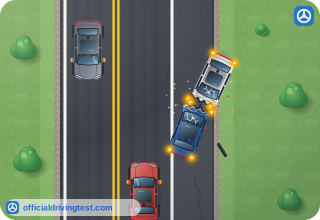
- Additional hazards at the scene
- Fewer injuries to people involved
- Better access for emergency vehicles
- A faster return to normal traffic
Show answer
Correct answer: Additional hazards at the scene
Stopping without a reason adds hazards at the scene.
Source: West Virginia Driver's Licensing Handbook (Revised July 2026), page 74 · Open this page in the manual (Manual page 74)
-
If you strike an unattended vehicle, what should you try to do first?
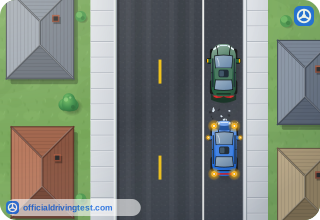
- Locate the owner
- Report it only to your insurance company
- Move the vehicle to a parking space
- Wait one hour and then leave
Show answer
Correct answer: Locate the owner
The handbook says to try to locate the owner of an unattended vehicle you strike.
Source: West Virginia Driver's Licensing Handbook (Revised July 2026), page 74 · Open this page in the manual (Manual page 74)
-
Which of these belongs in the written notice you leave on an unattended vehicle that you struck?
- Your Social Security number
- Your employer's name and phone number
- The circumstances of the crash
- Your date of birth
Show answer
Correct answer: The circumstances of the crash
The notice should contain your name, address, license plate number, insurance information and the circumstances of the crash.
Source: West Virginia Driver's Licensing Handbook (Revised July 2026), page 74 · Open this page in the manual (Manual page 74)
-
Which service does the West Virginia Courtesy Patrol provide?
- Issuing citations to drivers who break down
- Changing a flat tire
- Issuing driver's licenses at the roadside
- Collecting tolls on the interstate highways
Show answer
Correct answer: Changing a flat tire
The Courtesy Patrol assists stranded motorists, including by changing a flat tire or providing gas or directions.
Source: West Virginia Driver's Licensing Handbook (Revised July 2026), page 75 · Open this page in the manual (Manual page 75)
-
By removing hazards from the roadway, what does the West Virginia Courtesy Patrol reduce?
- The number of speeding tickets
- The price of gas for travelers
- The need for road signs
- The chance of secondary crashes
Show answer
Correct answer: The chance of secondary crashes
Removing hazards from the roadway reduces the chance of secondary crashes.
Source: West Virginia Driver's Licensing Handbook (Revised July 2026), page 75 · Open this page in the manual (Manual page 75)
-
Which group does the West Virginia Courtesy Patrol work alongside?
- The county health departments
- The Public Service Commission
- The State Police
- The Division of Natural Resources
Show answer
Correct answer: The State Police
The handbook says the Courtesy Patrol works alongside the State Police, 911 Centers and other emergency and highway personnel.
Source: West Virginia Driver's Licensing Handbook (Revised July 2026), page 75 · Open this page in the manual (Manual page 75)
-
If at all possible, from which side of your vehicle will a Courtesy Patrol driver approach you?
- The driver side
- The passenger side
- The front
- The rear
Show answer
Correct answer: The passenger side
The handbook says the driver will approach on the passenger side if at all possible.
Source: West Virginia Driver's Licensing Handbook (Revised July 2026), page 75 · Open this page in the manual (Manual page 75)