West Virginia: Emergency vehicles and work zones Practice Test
Yielding to emergency vehicles, construction zones, flaggers and work zone devices.
Independent educational site · not affiliated with any government agency or DMV
Ready? Test yourself
Answer to start, or tap Start below:
Which vehicles may have red and/or blue flashing lights?
- Instant feedback with an explanation
- Every answer cites its source in the manual
- Your best score is saved on this device
- Keyboard: press 1 to 4 to answer and Enter for the next question
Questions are original and based on the official manual "West Virginia Driver's Licensing Handbook" (Revised July 2026), West Virginia Division of Motor Vehicles (DMV).
All 18 questions in this practice test
Take the test above first, then use this list to study. Tap “Show answer” to see the correct answer and explanation.
Show the questions and answersHide the questions
-
Which vehicles may have red and/or blue flashing lights?
- Any vehicle with a valid inspection sticker
- Any vehicle owned by the state
- Any vehicle whose owner has a special DMV permit
- Only authorized emergency vehicles
Show answer
Correct answer: Only authorized emergency vehicles
Red and/or blue flashing lights are illegal equipment except on authorized emergency vehicles.
Source: West Virginia Driver's Licensing Handbook (Revised July 2026), page 25 · Open this page in the manual (Manual page 25)
-
What are construction and maintenance signs used for?
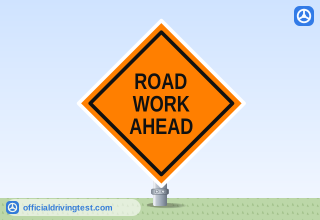
- To notify drivers of unusual or potentially dangerous conditions in or near work areas
- To tell workers where to park their equipment and supplies in the work area
- To guide drivers to the nearest rest stop beyond the work area
- To show drivers the speed limit that applies after the work area
Show answer
Correct answer: To notify drivers of unusual or potentially dangerous conditions in or near work areas
These signs notify drivers of unusual or potentially dangerous conditions in or near work areas.
Source: West Virginia Driver's Licensing Handbook (Revised July 2026), page 37 · Open this page in the manual (Manual page 37)
-
What shape are most signs in work areas?
- Octagon-shaped
- Pentagon-shaped
- Diamond-shaped
- Round
Show answer
Correct answer: Diamond-shaped
Most signs in work areas are diamond-shaped, and a few are rectangular.
Source: West Virginia Driver's Licensing Handbook (Revised July 2026), page 37 · Open this page in the manual (Manual page 37)
-
What is the basic color of traffic control devices used in construction and maintenance work areas?
- Green
- Orange
- Blue
- White
Show answer
Correct answer: Orange
Orange is the basic color for these work zone devices.
Source: West Virginia Driver's Licensing Handbook (Revised July 2026), page 37 · Open this page in the manual (Manual page 37)
-
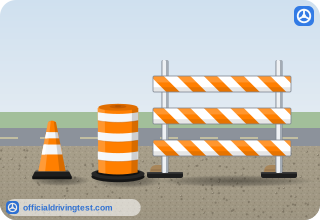
At night, channeling devices such as barricades, drums and cones are often equipped with what?
- Bells that sound as vehicles pass
- Spotlights aimed at drivers
- Flags that glow in the dark
- Flashing or steady-burn lights
Show answer
Correct answer: Flashing or steady-burn lights
At night, channeling devices are often equipped with flashing or steady-burn lights.
Source: West Virginia Driver's Licensing Handbook (Revised July 2026), page 37 · Open this page in the manual (Manual page 37)
-
What are channeling devices such as barricades, vertical panels, drums, cones and tubes used for?
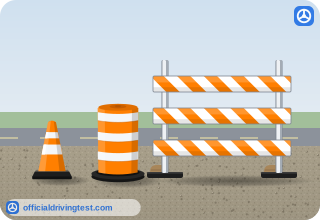
- To alert drivers to unusual or potentially dangerous conditions and guide them safely
- To show drivers where workers will park their equipment inside the work zone area
- To collect fees from drivers who enter the work zone
- To mark the end of the posted speed limit for the work zone
Show answer
Correct answer: To alert drivers to unusual or potentially dangerous conditions and guide them safely
These devices alert drivers to unusual or potentially dangerous conditions and guide them safely through the work zone.
Source: West Virginia Driver's Licensing Handbook (Revised July 2026), page 37 · Open this page in the manual (Manual page 37)
-
Diagonal stripes on a barricade or vertical panel slope downward to the right. What should the driver do?
- Bear to the left
- Stop and wait for a flagger
- Bear to the right
- Slow to 15 m.p.h. and stay in lane
Show answer
Correct answer: Bear to the right
Stripes sloping downward to the right mean the driver should bear to the right.
Source: West Virginia Driver's Licensing Handbook (Revised July 2026), page 37 · Open this page in the manual (Manual page 37)
-
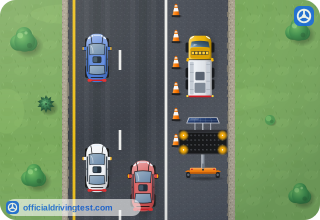
What do large flashing or sequencing arrow panels do in work zones?
- Warn drivers that a flagger is stopped farther along the road ahead of them
- Guide drivers into certain lanes and inform them that part of the road ahead is closed
- Tell drivers the speed limit that applies in the work zone
- Show drivers where the work zone ends and normal traffic resumes
Show answer
Correct answer: Guide drivers into certain lanes and inform them that part of the road ahead is closed
Arrow panels guide drivers into certain traffic lanes and tell them part of the road or street ahead is closed.
Source: West Virginia Driver's Licensing Handbook (Revised July 2026), page 37 · Open this page in the manual (Manual page 37)
-
What do flaggers do in highway and street work zones?
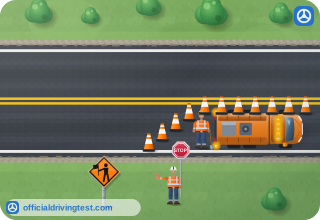
- Collect tolls from vehicles that pass the work area
- Direct only pedestrians through the work area
- Check each driver’s license before entering the area
- Stop, slow, or guide traffic safely through the area
Show answer
Correct answer: Stop, slow, or guide traffic safely through the area
Flaggers stop, slow, or guide traffic safely through the work area.
Source: West Virginia Driver's Licensing Handbook (Revised July 2026), page 37 · Open this page in the manual (Manual page 37)
-
What do flaggers wear?
- Orange vests, shirts, or jackets
- Yellow raincoats with white trim
- Blue vests with silver stripes
- Red coats with white stripes
Show answer
Correct answer: Orange vests, shirts, or jackets
Flaggers wear orange vests, shirts, or jackets.
Source: West Virginia Driver's Licensing Handbook (Revised July 2026), page 37 · Open this page in the manual (Manual page 37)
-
What do flaggers use to direct traffic through work zones?
- Green flags or go paddles
- Blue flags or flashing lanterns
- Red-orange flags or stop/slow paddles
- White flags and whistles
Show answer
Correct answer: Red-orange flags or stop/slow paddles
Flaggers use red-orange flags or stop/slow paddles to direct traffic through work zones.
Source: West Virginia Driver's Licensing Handbook (Revised July 2026), page 37 · Open this page in the manual (Manual page 37)
-
Under what condition may authorized emergency vehicles exceed the posted speed limits?
- Whenever the driver is on duty and the vehicle's headlights are on
- Only on interstates, as long as the road is dry and traffic is light
- On emergency duty with signals operating, if others are not endangered
- Only in business or residential areas when no children are present
Show answer
Correct answer: On emergency duty with signals operating, if others are not endangered
They may exceed the limits only when on emergency duty with emergency signal equipment operating and without endangering other road users.
Source: West Virginia Driver's Licensing Handbook (Revised July 2026), page 42 · Open this page in the manual (Manual page 42)
-
An ambulance with its siren sounding and warning lights flashing is approaching. What must you do?
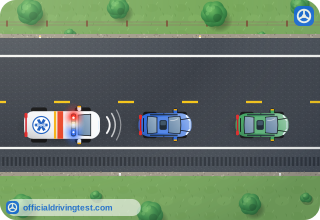
- Pull to the left edge of the road, clear of the intersection, and stop
- Stop right where you are, even if you are in the middle of the intersection
- Slow down, stay in your lane, and keep driving until it has passed
- Pull over to the right edge of the road, clear of the intersection, and stop
Show answer
Correct answer: Pull over to the right edge of the road, clear of the intersection, and stop
You must yield to an emergency vehicle by pulling over to the right edge of the road, clear of the intersection, and stopping until it has passed.
Source: West Virginia Driver's Licensing Handbook (Revised July 2026), page 49 · Open this page in the manual (Manual page 49)
-
Why does the handbook say to keep your foot on the brake when you have stopped for an emergency vehicle?
- So your vehicle cannot roll into the intersection
- So the emergency driver knows you are stopped
- So your brake lights warn drivers behind you to pass
- So you can restart quickly when the siren stops
Show answer
Correct answer: So the emergency driver knows you are stopped
Keeping your foot on the brake lets the emergency driver know that you are stopped.
Source: West Virginia Driver's Licensing Handbook (Revised July 2026), page 49 · Open this page in the manual (Manual page 49)
-
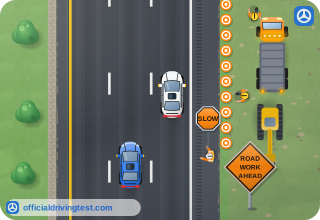
What do construction or maintenance zones on an interstate frequently require?
- That all lanes be closed
- That the speed limit be raised
- That one or more lanes be closed
- That drivers use the median crossover
Show answer
Correct answer: That one or more lanes be closed
These zones frequently require one or more lanes to be closed and may cause traffic to slow or stop.
Source: West Virginia Driver's Licensing Handbook (Revised July 2026), page 60 · Open this page in the manual (Manual page 60)
-
In a construction or maintenance zone on an interstate, what should you observe and obey?
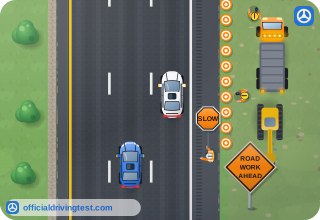
- Special speed limits, traffic control signs, and flaggers
- Only the flaggers, and not the special speed limits
- Only the normal speed limit posted before the zone
- Only the traffic control signs, not the flaggers
Show answer
Correct answer: Special speed limits, traffic control signs, and flaggers
You should observe and obey special speed limits, traffic control signs, and flaggers in these zones.
Source: West Virginia Driver's Licensing Handbook (Revised July 2026), page 60 · Open this page in the manual (Manual page 60)
-
When a lane is closed ahead in a construction zone, what should you do?
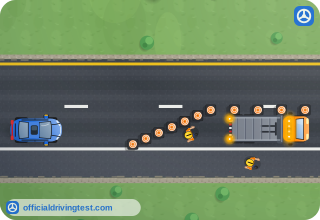
- Stay in the closed lane until the last minute
- Drive on the shoulder past the lane closure
- Move over to the open lane as soon as possible
- Stop and wait for a flagger to wave you over
Show answer
Correct answer: Move over to the open lane as soon as possible
Signs are posted well in advance, so you should move over early instead of waiting until the last minute.
Source: West Virginia Driver's Licensing Handbook (Revised July 2026), page 60 · Open this page in the manual (Manual page 60)
-
Which of these is often true in construction zones?
- The road is usually smoother than on the normal route
- A different route and large equipment close to your vehicle
- The route is the same one you drove before
- Workers stay well back from the traffic they are near
Show answer
Correct answer: A different route and large equipment close to your vehicle
In construction zones the route is often different, the road rougher, and large equipment and workers are in close proximity.
Source: West Virginia Driver's Licensing Handbook (Revised July 2026), page 60 · Open this page in the manual (Manual page 60)