West Virginia: Cheat Sheet
Key facts and numbers from the driver's manual, on two printable pages — free to print or save.
Independent educational site · not affiliated with any government agency or DMV
Driving Test Practiceofficialdrivingtest.com
Road signs
- Guide signs used on main highways show the distance to places and routes.
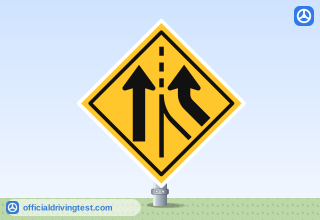 A yellow diamond sign with a straight arrow and a second arrow joining beside it advises you of an added lane.
- Where a through lane is removed, the change usually occurs at a fork or an exit, and a black and yellow panel under the green and white guide sign usually marks it.
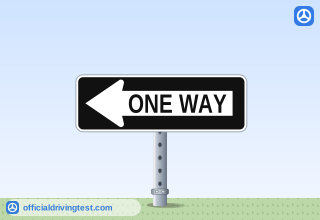 The One Way Street sign tells you when a cross street has traffic running in one direction only.
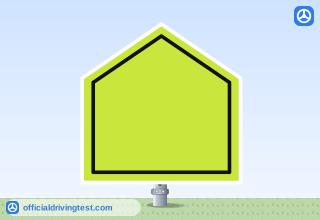 The pentagon warns of a school zone ahead or marks a school zone crossing.
- The handbook says warning signs are among the signs you typically see without identifying text; they often have pictures instead.
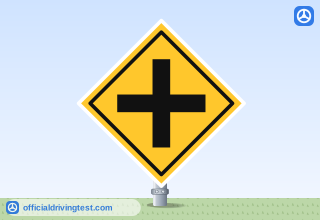 A crossroads or side roads sign tells you to watch for other vehicles entering or leaving the highway.
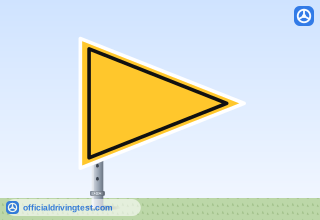 The pennant-shaped sign marks the beginning of a no-passing zone.
Sign shapes and colors
- The right side up triangle has a reflective red border and a fluorescent orange center.
- Motorist services signs are white on blue.
Traffic signals
- Signals placed in flashing operation act the same as intersection flashers.
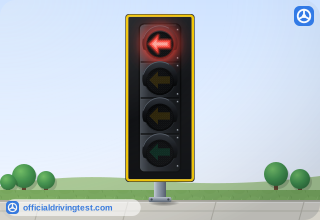 A red arrow means come to a complete stop before the intersection, stop line, or crosswalk and stay stopped while it is red.
- The directions of a police officer overrule the message of any sign, signal or road marking.
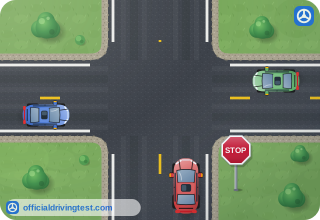 With no stop line or crosswalk, you stop before your vehicle enters the intersection.
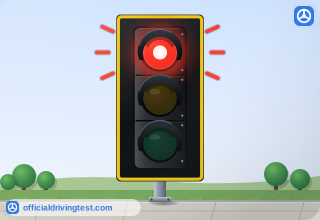 Intersection flashers are installed to supplement or replace stop signs.
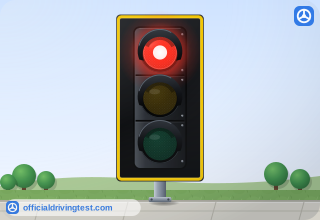 Traffic facing a steady circular red must stop unless it is making a movement a green arrow permits.
Right-of-way, turning and passing
- The handbook says to always finish turning in the proper lane.
- Turns on red may be made only after yielding to all other traffic and pedestrians, and if no sign prohibits them.
- You should come to a smooth, complete stop without skidding behind the stop line, crosswalk, or stop sign.
- At night you can also blink your headlights to signal that you are about to pass.
- Safety comes before right-of-way, so you give the right-of-way even when the other driver does not follow the rules.
- The handbook says to stop at a place where you can see traffic coming from all directions.
- You search left and right for hazards wherever traffic intersects, such as intersections, driveways, store entrances, and railroad tracks.
Alcohol and drugs
- West Virginia’s DUI penalties list a minimum revocation of 1 year for a second DUI offense.
- The handbook says a designated driver should always be appointed before any activity involving alcohol begins.
- The Interlock Program is mandatory for a driver revoked for two or more DUIs or related offenses within a ten-year period.
- First-time applicants complete the short DUI awareness course after they pass the road skills test.
- DUI means driving any motor vehicle while under the influence of alcohol, drugs, or controlled substances.
- Exercise, black coffee, fresh air, and cold showers do not effectively help someone sober up; only time does.
Speed and space
- Going over the speed limit in order to pass is illegal, and if you must speed to pass you probably do not need to pass.
- You should keep up with the flow of traffic without exceeding the posted speed limit.
- Without anti-lock brakes you cannot steer unless you pump the brakes until the vehicle is under complete control.
- The handbook lists approaching the top of a hill as a time to slow down.
- Reaching the object before you finish the count means you are driving too closely.
- A safe gap is to stop where you can see the rear tires of the vehicle ahead of you.
- In adverse conditions you should keep an adequate following distance and adjust your speed so a safe stop is possible.
Licensing basics
- A driver is any person who drives, operates, or is in physical control of a motor vehicle in a place open to the public for traffic.
- A Class F license is motorcycle-only, so the holder cannot drive any other type of motor vehicle.
- Failing to follow any traffic control device or a lawful direction by the driver examiner disqualifies you.
- During the examination you should concentrate on your driving and not on your errors.
Vehicle controls and equipment
- The handbook states that it is against the law to remove the inspection sticker.
- Smoking and open flames are dangerous near the engine, so the handbook says not to use them under the hood.
- Headlights turned on early make you easier for other drivers to see.
- More than two side cowl or fender lights is illegal equipment.
Pavement markings
- Driving in a reversible lane is the only case where a driver may drive for any distance to the left of a yellow line.
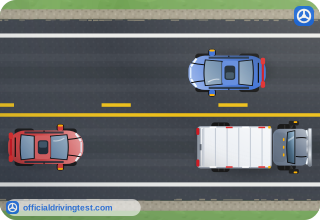 A solid yellow line on your side of the road means you must not pass.
- White lines separate traffic lanes moving in the same direction.
- Many pedestrian crosswalks are marked by solid white lines.
Interstate driving
- Interstate driving is high-speed driving, so the driver needs complete awareness and constant alertness.
- Because entering the traffic stream from a stop is hazardous, stopping on the shoulder beyond the acceleration lane is only a last resort.
- The exit gore is the triangular area between the through lane and the exit ramp.
Parking rules
- You must have a doctor certify your condition on a form provided by the DMV.
- You may not stop, stand or park within 20 feet of a crosswalk at an intersection.
- Stopping, standing or parking is not allowed beside or opposite any street excavation or obstruction where it would obstruct traffic.
- At that point you quickly turn the steering wheel all the way to the left and back slowly toward the vehicle behind.
Railroad crossings
- The handbook says you must yield to all trains.
- West Virginia drivers may not pass within 100 feet of any railroad crossing.
Pedestrians
- You should be extra watchful for children who may have run behind the vehicle when backing in or out of a driveway.
- Pedestrians on a road with no sidewalk must walk on the left side facing oncoming traffic, on the shoulder if possible.
- Crosswalks at intersections and in school zones show you are in a high pedestrian traffic zone, where being alert reduces crash risk.
Sharing the road
- The handbook says holiday periods also produce an increase in the number of drunk drivers.
- The truck safety DON'Ts say never to slam on your brakes in front of a truck.
- On all highways, streets, parking lots, private roads and driveways, traffic in both directions must stop before reaching a school bus that has its red lights flashing and is receiving or discharging students.
- Bicyclists must ride in the same direction as other vehicles.
Seat belts and child safety
- A lap belt should fit snugly and comfortably over the lower part of the hips, which still allows normal bending of the body.
- A slight backward tilt and as much distance as possible from the air bag give it room to deploy before it contacts front-seat occupants.
- The permit holder must require all occupants to adhere to the safety belt law.
Distracted and drowsy driving
- Fatigue, alcohol, emotional state, and defective eyesight or hearing are the common driver conditions.
- The handbook's definition lists a laptop computer, along with cell phones, pagers, electronic games and portable computing devices.
- Falling asleep at stop lights is one of the handbook’s signs that you are drowsy while driving.
- Bad driving habits result from laziness, impatience, inattention, arrogance, and aggressiveness.
Hazardous conditions and emergencies
- After a blowout, do not brake until the vehicle is under control; then pull all the way off the road into a safe area.
- The negative cable from the live battery goes to the engine block or frame of the vehicle with the dead battery.
- The handbook says to try to locate the owner of an unattended vehicle you strike.
Emergency vehicles and work zones
- You should observe and obey special speed limits, traffic control signs, and flaggers in these zones.
- You must yield to an emergency vehicle by pulling over to the right edge of the road, clear of the intersection, and stopping until it has passed.
Insurance and financial responsibility
- Failing to provide proof of insurance results in suspension of both the driver's license and the vehicle registration.
- The minimum liability coverage is $25,000 for one death or injury.
Penalties and points
- Each conviction restarts the 6-month window from the date of that conviction.
- PDPS is a national driver registry designed to track violations and suspensions from state to state.