West Virginia: 30 Hardest Driving Test Questions
Questions that need a second thought, picked for close numbers, exceptions and easy-to-confuse rules. Take your time.
Independent educational site · not affiliated with any government agency or DMV
Ready? Test yourself
Answer to start, or tap Start below:
A child under 8 years of age must be at least how tall for a safety belt to be sufficient instead of a child passenger safety device?
- Instant feedback with an explanation
- Every answer cites its source in the manual
- Your best score is saved on this device
- Keyboard: press 1 to 4 to answer and Enter for the next question
Questions are original and based on the official manual "West Virginia Driver's Licensing Handbook" (Revised July 2026), West Virginia Division of Motor Vehicles (DMV).
All 30 questions in this practice test
Take the test above first, then use this list to study. Tap “Show answer” to see the correct answer and explanation.
Show the questions and answersHide the questions
-
A child under 8 years of age must be at least how tall for a safety belt to be sufficient instead of a child passenger safety device?
- 4 feet 0 inches
- 4 feet 9 inches
- 4 feet 5 inches
- 5 feet 0 inches
Show answer
Correct answer: 4 feet 9 inches
West Virginia law says a safety belt is sufficient when the child is under 8 but at least 4 feet 9 inches tall.
Source: West Virginia Driver's Licensing Handbook (Revised July 2026), page 67 · Open this page in the manual (Manual page 67)
-
A school zone includes any street or highway abutting the school grounds and extending how far along the street or highway from the school grounds?
- 125 feet
- 75 feet
- 200 feet
- 250 feet
Show answer
Correct answer: 125 feet
The school zone covers school property plus the street or highway that abuts it, for 125 feet from the school grounds.
Source: West Virginia Driver's Licensing Handbook (Revised July 2026), page 42 · Open this page in the manual (Manual page 42)
-
When you parallel park on a two-way street, how close should the right-hand wheels be to the right curb?
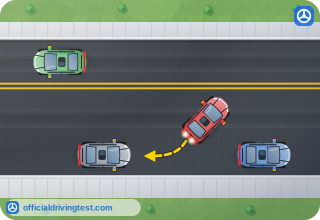
- Within 12 inches
- Within 18 inches
- Within 24 inches
- Within 30 inches
Show answer
Correct answer: Within 18 inches
For parallel parking on a two-way street, the right-hand wheels are parallel to and within 18 inches of the right curb.
Source: West Virginia Driver's Licensing Handbook (Revised July 2026), page 47 · Open this page in the manual (Manual page 47)
-
For riding after dark, a bicycle must have a white headlight visible for at least what distance to the front?
- 100 feet
- 200 feet
- 500 feet
- 1,000 feet
Show answer
Correct answer: 500 feet
For riding after dark, a bicycle needs a white headlight that is visible for at least 500 feet to the front.
Source: West Virginia Driver's Licensing Handbook (Revised July 2026), page 54 · Open this page in the manual (Manual page 54)
-
Within what distance of an approaching vehicle should you dim your headlights?
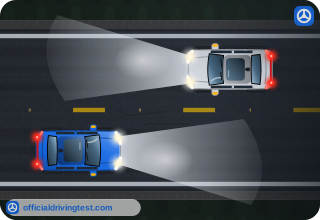
- 200 feet
- 500 feet
- 100 feet
- 1,000 feet
Show answer
Correct answer: 500 feet
When driving at night you should dim your headlights within 500 feet of an approaching vehicle.
Source: West Virginia Driver's Licensing Handbook (Revised July 2026), page 51 · Open this page in the manual (Manual page 51)
-
Stopping, standing or parking is not allowed within how many feet of a mailbox served by a carrier using a motor vehicle for daily deliveries?
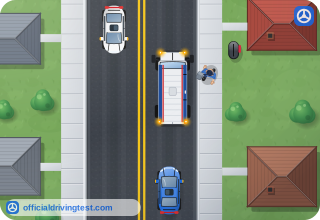
- 20 feet
- 5 feet
- 10 feet
- 40 feet
Show answer
Correct answer: 20 feet
The prohibited-parking list includes within 20 feet of any mailbox served by a carrier using a motor vehicle for daily deliveries.
Source: West Virginia Driver's Licensing Handbook (Revised July 2026), page 46 · Open this page in the manual (Manual page 46)
-
Stopping, standing or parking is not allowed within how many feet of any stop sign or traffic control signal?
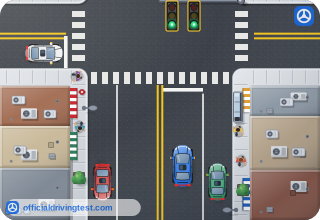
- 30 feet
- 10 feet
- 25 feet
- 40 feet
Show answer
Correct answer: 30 feet
The list of prohibited places includes within 30 feet of any stop sign or traffic control signal.
Source: West Virginia Driver's Licensing Handbook (Revised July 2026), page 45 · Open this page in the manual (Manual page 45)
-
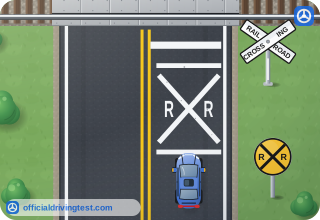
Stopping, standing or parking is not allowed within how many feet of the nearest rail of a railroad crossing?
- 10 feet
- 25 feet
- 50 feet
- 75 feet
Show answer
Correct answer: 50 feet
You may not stop, stand or park within 50 feet of the nearest rail of a railroad crossing.
Source: West Virginia Driver's Licensing Handbook (Revised July 2026), page 45 · Open this page in the manual (Manual page 45)
-
Passing is prohibited within how many feet of an intersection?
- 100 feet
- 25 feet
- 50 feet
- 200 feet
Show answer
Correct answer: 100 feet
Passing is prohibited within 100 feet of an intersection.
Source: West Virginia Driver's Licensing Handbook (Revised July 2026), page 48 · Open this page in the manual (Manual page 48)
-
Passing is prohibited within how many feet of a bridge, viaduct, tunnel, or underpass?
- 50 feet
- 200 feet
- 100 feet
- 500 feet
Show answer
Correct answer: 100 feet
You may not pass within 100 feet of a bridge, viaduct, tunnel, or underpass.
Source: West Virginia Driver's Licensing Handbook (Revised July 2026), page 49 · Open this page in the manual (Manual page 49)
-
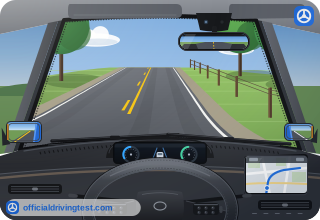
It is against the law to turn your vehicle around near the crest of a hill where you cannot be seen by another vehicle approaching within how many feet in either direction?
- 100 feet
- 500 feet
- 200 feet
- 300 feet
Show answer
Correct answer: 500 feet
Turning around is unlawful near a hill crest where you cannot be seen by a vehicle approaching within 500 feet in either direction.
Source: West Virginia Driver's Licensing Handbook (Revised July 2026), page 45 · Open this page in the manual (Manual page 45)
-
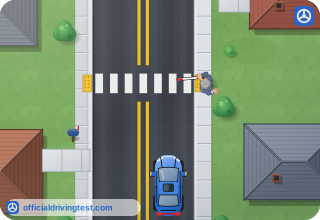
A blind person on foot using a guide dog or other service animal, or carrying a white cane or walking stick, has the right-of-way when?
- Only when they are crossing within a marked crosswalk
- On a highway, street, or road, whether or not in a crosswalk
- Only at intersections with traffic signals
- Only when crossing in front of stopped traffic
Show answer
Correct answer: On a highway, street, or road, whether or not in a crosswalk
Such a pedestrian has the right-of-way on a highway, street, or road regardless of whether they are in a crosswalk or not.
Source: West Virginia Driver's Licensing Handbook (Revised July 2026), page 40 · Open this page in the manual (Manual page 40)
-
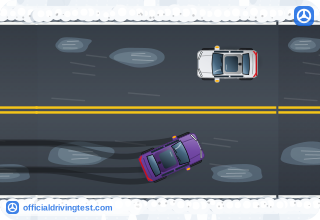
Your vehicle begins to skid. When should you use your brakes?
- Immediately, as hard as you can
- As soon as the rear of the vehicle moves sideways
- Only if you are in danger of hitting something
- Only after the vehicle has completely stopped skidding
Show answer
Correct answer: Only if you are in danger of hitting something
In a skid you concentrate on steering and do not use the brakes unless you are in danger of hitting something.
Source: West Virginia Driver's Licensing Handbook (Revised July 2026), page 71 · Open this page in the manual (Manual page 71)
-
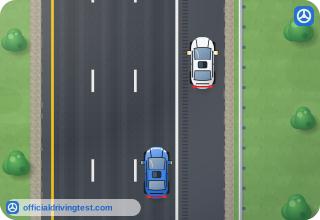
When you put out flares behind a disabled vehicle, how far back should the flare farther from your vehicle be placed?
- About 300 feet back
- About 100 feet back
- About 500 feet back
- About one vehicle length back
Show answer
Correct answer: About 300 feet back
The second flare goes about 300 feet back from the vehicle.
Source: West Virginia Driver's Licensing Handbook (Revised July 2026), page 60 · Open this page in the manual (Manual page 60)
-
According to the handbook, which persons are the legal exception to wearing a safety belt in a passenger vehicle?
- Persons 18 years or older riding in the back seat of a vehicle
- Persons 16 years or older riding in the back seat of a vehicle
- Persons 18 years or older riding in the front passenger seat
- Persons of any age riding in the back seat of a vehicle
Show answer
Correct answer: Persons 18 years or older riding in the back seat of a vehicle
The only legal exception named is for persons 18 or older riding in the back seat.
Source: West Virginia Driver's Licensing Handbook (Revised July 2026), page 67 · Open this page in the manual (Manual page 67)
-
What is the lowest light transmission a window tint may have without being illegal equipment?
- 15 percent
- 35 percent
- 50 percent
- 70 percent
Show answer
Correct answer: 35 percent
Windows tinted to less than 35 percent light transmission are illegal equipment.
Source: West Virginia Driver's Licensing Handbook (Revised July 2026), page 25 · Open this page in the manual (Manual page 25)
-
Treating the steering wheel as the face of a clock, where does the handbook say your hands are best placed?
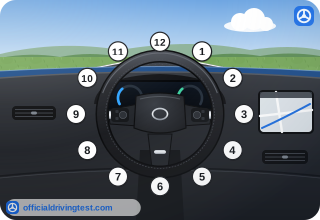
- Left hand at 8 o'clock and right hand at 4 o'clock
- Left hand at 10 o'clock and right hand at 2 o'clock
- Left hand at 9 o'clock and right hand at 3 o'clock
- Left hand at 6 o'clock and right hand at 12 o'clock
Show answer
Correct answer: Left hand at 8 o'clock and right hand at 4 o'clock
The handbook puts the left hand at about 8 o'clock and the right at 4 o'clock, which gives maximum control and reduces the chance a deploying air bag knocks your hands off.
Source: West Virginia Driver's Licensing Handbook (Revised July 2026), page 43 · Open this page in the manual (Manual page 43)
-
After being awake for how many hours are driving skills comparable to those of someone under the influence of drugs or alcohol (time varies)?
- 8 hours
- 12 hours
- 18 hours
- 4 hours
Show answer
Correct answer: 18 hours
After about 18 hours awake, driving skills are comparable to those of someone under the influence, although the time varies.
Source: West Virginia Driver's Licensing Handbook (Revised July 2026), page 23 · Open this page in the manual (Manual page 23)
-
What penalty applies to a third and subsequent offense of using an electronic communications device that is not hands-free while driving?
- A $300 fine and zero points
- A $200 fine and three points
- A $500 fine and six points
- A $300 fine and three points
Show answer
Correct answer: A $300 fine and three points
Third and subsequent offenses carry a $300 fine and three points on the driving record.
Source: West Virginia Driver's Licensing Handbook (Revised July 2026), page 17 · Open this page in the manual (Manual page 17)
-
In a standard passenger vehicle, at about what speed does partial hydroplaning occur?
- 25 mph
- 45 mph
- 35 mph
- 65 mph
Show answer
Correct answer: 35 mph
Partial hydroplaning occurs at about 35 mph in a standard passenger vehicle.
Source: West Virginia Driver's Licensing Handbook (Revised July 2026), page 63 · Open this page in the manual (Manual page 63)
-
As much as how many times the normal distance can it take to stop on snow or ice compared with dry pavement?
- 12 times
- 3 times
- 6 times
- 9 times
Show answer
Correct answer: 12 times
Stopping on snow or ice can take as much as 12 times the distance needed on dry pavement.
Source: West Virginia Driver's Licensing Handbook (Revised July 2026), page 63 · Open this page in the manual (Manual page 63)
-
From about what speed do tires ride totally on top of the water, according to the handbook?
- 45 mph
- 55 mph
- 65 mph
- 75 mph
Show answer
Correct answer: 55 mph
At 55 mph the tires ride totally on top of the water.
Source: West Virginia Driver's Licensing Handbook (Revised July 2026), page 63 · Open this page in the manual (Manual page 63)
-
What is the minimum driver's license suspension for a first offense of passing a stopped school bus?
- 30 days
- 60 days
- 90 days
- 180 days
Show answer
Correct answer: 60 days
The penalty for passing a stopped school bus is a minimum of 60 days of driver's license suspension.
Source: West Virginia Driver's Licensing Handbook (Revised July 2026), page 50 · Open this page in the manual (Manual page 50)
-
Under West Virginia law, when can your driver’s license be revoked for alcohol?
- Only if your BAC is 0.08 percent or more
- Only if your BAC is 0.15 percent or more
- Even if your BAC is less than 0.08 percent
- Only if you are involved in a crash
Show answer
Correct answer: Even if your BAC is less than 0.08 percent
West Virginia law allows a license to be revoked even when the BAC is below 0.08 percent.
Source: West Virginia Driver's Licensing Handbook (Revised July 2026), page 21 · Open this page in the manual (Manual page 21)
-
To qualify for a Level 2 GDL intermediate driver's license, how long must the applicant have driven conviction-free at Level 1 GDL immediately before applying?
- A minimum of 90 consecutive days
- A minimum of 60 consecutive days
- A minimum of 270 consecutive days
- A minimum of 180 consecutive days
Show answer
Correct answer: A minimum of 180 consecutive days
Level 2 requires at least 180 consecutive days of conviction-free driving at Level 1 right before the application.
Source: West Virginia Driver's Licensing Handbook (Revised July 2026), page 10 · Open this page in the manual (Manual page 10)
-
How many points are assessed for speeding in a school zone?
- 3
- 5
- 8
- 6
Show answer
Correct answer: 6
Speeding in a school zone carries 6 points.
Source: West Virginia Driver's Licensing Handbook (Revised July 2026), page 20 · Open this page in the manual (Manual page 20)
-
What is the jail term for a first DUI offense with alcohol or drugs and a BAC of .15 or higher?
- Up to 6 months
- 24 hours to 12 months
- 2 days to 6 months
- 48 hours to 12 months
Show answer
Correct answer: 2 days to 6 months
West Virginia’s DUI penalties list jail of 2 days to 6 months for a first DUI offense with a BAC of .15 or higher.
Source: West Virginia Driver's Licensing Handbook (Revised July 2026), page 22 · Open this page in the manual (Manual page 22)
-
Under West Virginia’s zero tolerance law for drivers under 21, what is the minimum revocation period for a second offense?
- 30 days or until the 18th birthday, whichever is greater
- 60 days or until the 18th birthday, whichever is greater
- 60 days or until the 21st birthday, whichever is greater
- 60 days or until the 18th birthday, whichever is shorter
Show answer
Correct answer: 60 days or until the 18th birthday, whichever is greater
A second zero tolerance offense carries a minimum revocation of 60 days or until the 18th birthday, whichever is greater.
Source: West Virginia Driver's Licensing Handbook (Revised July 2026), page 22 · Open this page in the manual (Manual page 22)
-
A Level 2 GDL intermediate driver's license holder is cited for using a cell phone while driving. What happens to the conviction-free time period?
- The period is cut to 6 months from the conviction
- The period continues unchanged
- The 12-month period must begin over
- The period is cut to 90 days
Show answer
Correct answer: The 12-month period must begin over
A citation for cell phone use makes the holder begin the conviction-free time period over: 12 months for Level 2.
Source: West Virginia Driver's Licensing Handbook (Revised July 2026), page 11 · Open this page in the manual (Manual page 11)
-
What is the result of a second conviction for a moving violation on a Level 2 GDL intermediate driver's license?
- A 90-day suspension, then an automatic Level 3 GDL at the age of 17
- A return to Level 1 for 6 months with no retest
- Another driver improvement program with no other penalty
- Revocation until age 18, then retesting as a first-time applicant
Show answer
Correct answer: Revocation until age 18, then retesting as a first-time applicant
A second moving violation conviction revokes the driving privilege until age 18, and the driver must retest as a first-time applicant.
Source: West Virginia Driver's Licensing Handbook (Revised July 2026), page 11 · Open this page in the manual (Manual page 11)