West Virginia: Exam Simulator
25 random questions from every topic, like a mini exam.
Independent educational site · not affiliated with any government agency or DMV
Ready? Test yourself
Like the real test: 25 questions; pass with 19 correct.
- Instant feedback with an explanation
- Every answer cites its source in the manual
- Your best score is saved on this device
- Keyboard: press 1 to 4 to answer and Enter for the next question
Questions are original and based on the official manual "West Virginia Driver's Licensing Handbook" (Revised July 2026), West Virginia Division of Motor Vehicles (DMV).
Sample questions
The exam simulator picks 25 random questions from every topic each time you start. Here are a few examples.
Show the questions and answersHide the questions
-
In the handbook’s definitions, an antique vehicle is a motor vehicle over how many years old that is owned solely as a collector’s item?
- 15 years
- 20 years
- 25 years
- 30 years
Show answer
Correct answer: 25 years
An antique vehicle is defined as over 25 years old and owned solely as a collector’s item, not for general transportation.
Source: West Virginia Driver's Licensing Handbook (Revised July 2026)
-
What must the applicant know about all of the vehicle’s safety equipment, including the parking/emergency brake?
- Its manufacturer and warranty terms
- Its repair history and installation date
- Its location and function
- Its replacement cost and expected lifespan
Show answer
Correct answer: Its location and function
The applicant must know the location and function of all safety equipment, including the parking/emergency brake.
Source: West Virginia Driver's Licensing Handbook (Revised July 2026), page 25 · Open this page in the manual (Manual page 25)
-
What are pavement markings used for?
- To measure vehicle speeds
- To mark the edge of every sidewalk
- To show where police officers may park
- To warn, regulate, and inform traffic
Show answer
Correct answer: To warn, regulate, and inform traffic
Pavement markings are used like highway signs to warn, regulate, and inform traffic.
Source: West Virginia Driver's Licensing Handbook (Revised July 2026), page 41 · Open this page in the manual (Manual page 41)
-
In the handbook’s definitions, what is an acceleration lane?
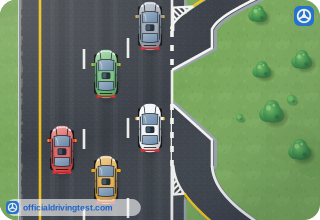
- A lane next to the regular lanes that lets vehicles leaving the highway reduce speed
- An extra lane on the side of a high-speed highway that lets you pick up speed before merging
- A passing lane on a two-lane highway reserved for vehicles traveling faster than traffic
- A lane at the left side of the highway reserved for vehicles merging from the right
Show answer
Correct answer: An extra lane on the side of a high-speed highway that lets you pick up speed before merging
An acceleration lane lets you enter a high-speed highway and pick up speed before merging with through traffic.
Source: West Virginia Driver's Licensing Handbook (Revised July 2026)
-
Which exercise does the handbook describe as one of the best indicators that you have the basic skills necessary to safely operate a motor vehicle?
- Parallel parking
- Three-point turnabout
- Forward two-point turnabout
- Reverse two-point turnabout
Show answer
Correct answer: Parallel parking
Parallel parking is described as one of the best indicators of the basic skills needed to operate a vehicle safely.
Source: West Virginia Driver's Licensing Handbook (Revised July 2026), page 27 · Open this page in the manual (Manual page 27)
-
If fading light, fog, rain, snow, or darkness make the letters on a sign hard to see, what should applicants still know?
- How to recognize the sign and respond to it
- Only the sign’s printed letters and their order
- The name of the agency that posted the sign
- The exact distance to the next intersection
Show answer
Correct answer: How to recognize the sign and respond to it
The handbook says applicants should still know how to recognize a sign and respond accordingly, because its shape and color have meaning.
Source: West Virginia Driver's Licensing Handbook (Revised July 2026), page 34 · Open this page in the manual (Manual page 34)
-
What may the examiner ask you about traffic signs during the road test?
- To name every sign shown in the handbook
- To draw a sign from memory
- What sign you just passed
- To read aloud the number of each sign
Show answer
Correct answer: What sign you just passed
The examiner may ask what sign you just passed, and you should be able to tell the examiner.
Source: West Virginia Driver's Licensing Handbook (Revised July 2026), page 30 · Open this page in the manual (Manual page 30)
-
When stopping at a stop sign or traffic signal, which of these must you NOT do?
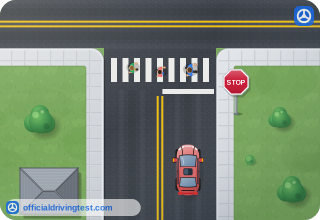
- Stop where you can see the rear wheels of the vehicle ahead
- Stop before your vehicle enters the intersection when there is no stop line
- Stop behind the marked stop line
- Stop over a marked stop line, pedestrian crosswalk, or sidewalk
Show answer
Correct answer: Stop over a marked stop line, pedestrian crosswalk, or sidewalk
You must not stop over a marked stop line, pedestrian crosswalk, sidewalk, or other marker.
Source: West Virginia Driver's Licensing Handbook (Revised July 2026), page 31 · Open this page in the manual (Manual page 31)
-
In the handbook’s definitions, what is an intersection?
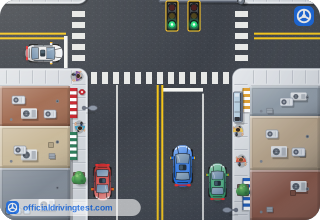
- The area common to two or more highways that meet at or near right angles
- The area where a driveway, alley, or parking lot meets a highway or street
- Only the area where one highway crosses another exactly at right angles
- Only the area where two roadways meet at a traffic signal or stop sign
Show answer
Correct answer: The area common to two or more highways that meet at or near right angles
An intersection is the area common to two or more highways that meet at or near right angles, whether or not one crosses the other.
Source: West Virginia Driver's Licensing Handbook (Revised July 2026)
-
What does a round yellow-and-black sign give advance warning of?

- A railroad crossing ahead
- A school zone ahead
- A slow moving vehicle
- A lane that ends ahead
Show answer
Correct answer: A railroad crossing ahead
The yellow-and-black circle gives advance warning of a railroad crossing ahead.
Source: West Virginia Driver's Licensing Handbook (Revised July 2026), page 34 · Open this page in the manual (Manual page 34)