Washington: Vehicle controls and equipment — Part 6 Practice Test
Questions in this part include: “How should you secure a load in your vehicle or trailer?” · “If you are taken into custody for any reason, what can an officer do about animals in your vehicle?”
Independent educational site · not affiliated with any government agency or DMV
Ready? Test yourself
Answer to start, or tap Start below:
How should you secure a load in your vehicle or trailer?
- Instant feedback with an explanation
- Every answer cites its source in the manual
- Your best score is saved on this device
- Keyboard: press 1 to 4 to answer and Enter for the next question
Questions are original and based on the official manual "Washington Driver Guide" (© 2025), Washington State Department of Licensing (DOL).
All 17 questions in this practice test
Take the test above first, then use this list to study. Tap “Show answer” to see the correct answer and explanation.
Show the questions and answersHide the questions
-
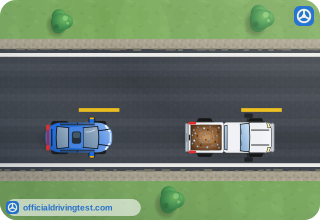
What does the law say about driving with an unsecured load?
- It is allowed if the load is light and short
- It is legal if you drive slowly and carefully
- It is against the law and extremely dangerous
- It is allowed on local roads at low speeds
Show answer
Correct answer: It is against the law and extremely dangerous
An unsecured load is both illegal and extremely dangerous.
Source: Washington Driver Guide (© 2025), page 151 · Open this page in the manual (Manual page 151)
-
How should you secure a load in your vehicle or trailer?
- Stack the items so they press against each other
- Tie everything down with rope, netting, or straps
- Rest the items loosely in the cargo area
- Pile light items on top of heavy ones
Show answer
Correct answer: Tie everything down with rope, netting, or straps
Rope, netting or straps keep items from sliding, shifting or falling onto the road.
Source: Washington Driver Guide (© 2025), page 151 · Open this page in the manual (Manual page 151)
-
Where should large objects be tied?
- To the other items in the load
- To each other, not to the vehicle
- To the tailgate only
- Directly to your vehicle or trailer
Show answer
Correct answer: Directly to your vehicle or trailer
Large objects should be tied directly to the vehicle or trailer.
Source: Washington Driver Guide (© 2025), page 151 · Open this page in the manual (Manual page 151)
-
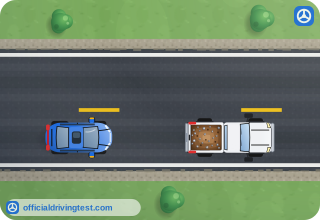
What should you pack in your vehicle or trailer?
- Anything that fits, if you drive slowly
- Any items, if the heaviest are placed on top
- Only items you can safely and securely carry
- Any items that you cover with a tarp
Show answer
Correct answer: Only items you can safely and securely carry
You should pack only items you can carry safely and securely.
Source: Washington Driver Guide (© 2025), page 151 · Open this page in the manual (Manual page 151)
-
It is illegal to transport an animal outside a vehicle, such as in the bed of a truck, without what?
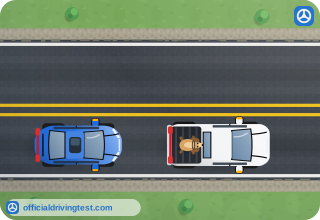
- A protective harness or enclosure
- A warning sign on the tailgate
- A permit from the Department of Licensing
- A water bowl secured in the bed
Show answer
Correct answer: A protective harness or enclosure
The animal needs a protective harness or enclosure so it cannot jump or fall out.
Source: Washington Driver Guide (© 2025), page 151 · Open this page in the manual (Manual page 151)
-
Transporting animals in a way that poses a risk to the animal or public safety is what kind of offense?
- A felony
- A civil infraction
- Only a warning
- A misdemeanor
Show answer
Correct answer: A misdemeanor
Such transport is a misdemeanor under Washington’s Prevention of Cruelty to Animals laws.
Source: Washington Driver Guide (© 2025), page 151 · Open this page in the manual (Manual page 151)
-
If you are taken into custody for any reason, what can an officer do about animals in your vehicle?
- Leave them locked in the vehicle
- Take charge of them
- Release them at the roadside
- Give them to any bystander
Show answer
Correct answer: Take charge of them
An officer can take charge of any animals in the vehicle if you are taken into custody.
Source: Washington Driver Guide (© 2025), page 151 · Open this page in the manual (Manual page 151)
-
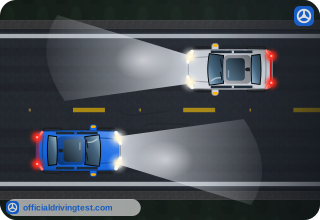
What should you avoid doing when oncoming headlights shine at you at night?
- Searching the road in front of your vehicle
- Looking directly into the oncoming headlights
- Glancing occasionally to the sides
- Looking for dark shapes on the roadway
Show answer
Correct answer: Looking directly into the oncoming headlights
The guide says to avoid looking straight into oncoming lights and to keep your eyes searching the road ahead.
Source: Washington Driver Guide (© 2025), page 167 · Open this page in the manual (Manual page 167)
-
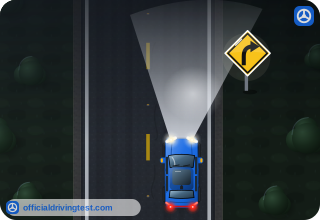
When driving at night, what should you look for beyond your headlight beams?
- Reflections from the sun on the pavement
- Brake lights from vehicles two blocks away
- Dark shapes or shadows on the roadway
- Bright flashes from oncoming traffic
Show answer
Correct answer: Dark shapes or shadows on the roadway
Searching past your beams lets you spot dark shapes or shadows that may be hazards.
Source: Washington Driver Guide (© 2025), page 167 · Open this page in the manual (Manual page 167)
-
Why should you glance occasionally to the sides when driving at night?
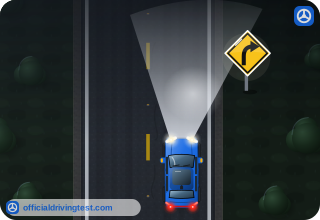
- To find the edge of the pavement and spot hazards from the sides
- To check whether other drivers have their headlights on
- To rest your eyes from the glare of your own lights
- To read road signs that are hard to see ahead
Show answer
Correct answer: To find the edge of the pavement and spot hazards from the sides
Side glances help you locate the pavement edge and notice hazards coming from the sides.
Source: Washington Driver Guide (© 2025), page 167 · Open this page in the manual (Manual page 167)
-
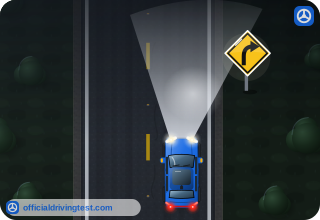
Why should you not wear sunglasses or colored lenses when driving at night?
- They make oncoming headlights brighter
- Tinted or colored lenses reduce your vision
- They cause your eyes to dry out
- They make it harder to hear sirens
Show answer
Correct answer: Tinted or colored lenses reduce your vision
The guide says tinted or colored lenses reduce vision, so they should not be worn at night or on overcast days.
Source: Washington Driver Guide (© 2025), page 167 · Open this page in the manual (Manual page 167)
-
If a vehicle comes toward you with its high beams on, where should you look?
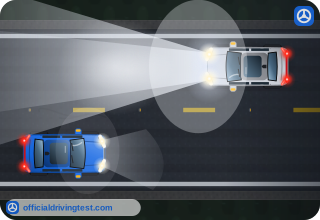
- Toward the right side of the road
- Toward the left side of the road
- Straight at the oncoming headlights
- Down at your dashboard
Show answer
Correct answer: Toward the right side of the road
Looking toward the right side of the road keeps you from being distracted by the glare.
Source: Washington Driver Guide (© 2025), page 167 · Open this page in the manual (Manual page 167)
-
As you approach a curve, where should you position your vehicle in your lane?
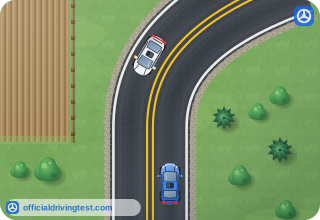
- Slightly to the outside of the lane
- Slightly to the inside of the lane
- Exactly on the lane marking
- In the center of the road
Show answer
Correct answer: Slightly to the outside of the lane
The outside lane position gives more room to maneuver and better visibility around the curve.
Source: Washington Driver Guide (© 2025), page 168 · Open this page in the manual (Manual page 168)
-
How should you steer through a curve?
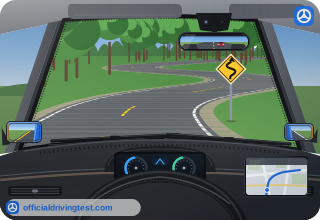
- With quick, sharp movements
- Smoothly and gradually
- By turning the wheel as far as it will go
- By letting go of the wheel briefly
Show answer
Correct answer: Smoothly and gradually
Jerky steering or oversteering can make the vehicle skid, so steer gently.
Source: Washington Driver Guide (© 2025), page 168 · Open this page in the manual (Manual page 168)
-
Why should you check your mirrors as you exit a curve?
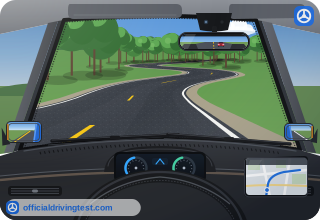
- To see whether your headlights are aimed correctly
- To confirm that no one is following too far behind
- To make sure you have space to merge or change lanes
- To check the condition of your tires
Show answer
Correct answer: To make sure you have space to merge or change lanes
Mirrors tell you whether there is adequate space to merge or change lanes after the curve.
Source: Washington Driver Guide (© 2025), page 168 · Open this page in the manual (Manual page 168)
-
What does inertia do if you suddenly turn the steering wheel in a curve?
- It pulls the car harder into the turn
- It makes the tires grip more firmly
- It stops the car at once
- It tries to keep the car moving straight
Show answer
Correct answer: It tries to keep the car moving straight
Inertia resists the change of direction, which is why you must steer carefully and smoothly.
Source: Washington Driver Guide (© 2025), page 169 · Open this page in the manual (Manual page 169)
-
What is friction, as the guide describes it for driving?
- The force that keeps a moving vehicle going in a straight line
- The force between the tires and the road that grips the surface
- The tilt of a vehicle as it turns
- The energy created by higher speeds
Show answer
Correct answer: The force between the tires and the road that grips the surface
Friction between tires and road lets you slow down, speed up, or turn safely.
Source: Washington Driver Guide (© 2025), page 169 · Open this page in the manual (Manual page 169)