Washington: Vehicle controls and equipment — Part 2 Practice Test
Questions in this part include: “Where is the Tire and Loading Information label that shows the proper tire inflation pressure?” · “What should you do if your dashboard shows a "lamp out" symbol?”
Independent educational site · not affiliated with any government agency or DMV
Ready? Test yourself
Answer to start, or tap Start below:
Where is the Tire and Loading Information label that shows the proper tire inflation pressure?
- Instant feedback with an explanation
- Every answer cites its source in the manual
- Your best score is saved on this device
- Keyboard: press 1 to 4 to answer and Enter for the next question
Questions are original and based on the official manual "Washington Driver Guide" (© 2025), Washington State Department of Licensing (DOL).
All 17 questions in this practice test
Take the test above first, then use this list to study. Tap “Show answer” to see the correct answer and explanation.
Show the questions and answersHide the questions
-
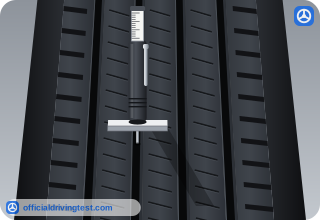
What can worn tires cause, especially if the road is wet?
- Overheated brakes
- Slipping and sliding
- Engine stalling
- Windshield fogging
Show answer
Correct answer: Slipping and sliding
Worn tires can slip and slide, particularly on wet roads.
Source: Washington Driver Guide (© 2025), page 48 · Open this page in the manual (Manual page 48)
-
What can low tire pressure affect?
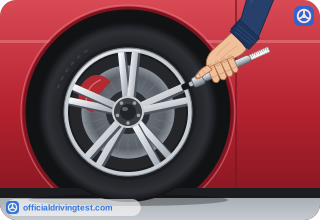
- Your car's handling and speed
- Your car's headlight brightness
- Your brake light color
- Your window washer fluid level
Show answer
Correct answer: Your car's handling and speed
Low tire pressure can change how the car handles and affect its speed.
Source: Washington Driver Guide (© 2025), page 48 · Open this page in the manual (Manual page 48)
-
Where is the Tire and Loading Information label that shows the proper tire inflation pressure?
- On the vehicle registration document
- On the rear license plate
- On the driver's side door edge
- On the windshield wiper blade
Show answer
Correct answer: On the driver's side door edge
The proper inflation pressure is on the Tire and Loading Information label on the driver's side door edge, or in the owner's manual.
Source: Washington Driver Guide (© 2025), page 48 · Open this page in the manual (Manual page 48)
-
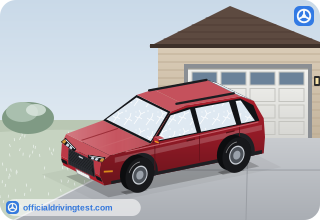
Before driving, what should you do about snow, ice, or frost on your windows?
- Clear only the windshield
- Completely clear it from all windows
- Clear a small area in front of the driver
- Clear it only if it is covering the mirrors
Show answer
Correct answer: Completely clear it from all windows
All windows should be completely cleared of snow, ice, or frost before you drive.
Source: Washington Driver Guide (© 2025), page 48 · Open this page in the manual (Manual page 48)
-
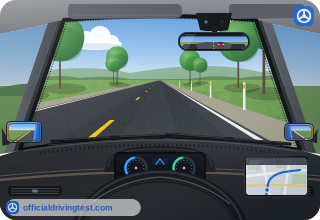
Which of these does the guide say you should avoid to keep your view clear?
- Keeping the window washer fluid full
- Cleaning the windshield inside and outside
- Replacing wipers as the manufacturer recommends
- Hanging things from your mirror
Show answer
Correct answer: Hanging things from your mirror
The guide advises against hanging things from the mirror or cluttering windows with items that block your view.
Source: Washington Driver Guide (© 2025), page 48 · Open this page in the manual (Manual page 48)
-
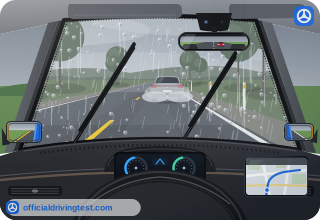
What should you follow when replacing your wipers?
- Your insurance company's recommendations
- A fixed schedule of once every year
- Your vehicle manufacturer's recommendations
- The advice on the Tire and Loading Information label
Show answer
Correct answer: Your vehicle manufacturer's recommendations
The guide says to follow the vehicle manufacturer's recommendations for replacing wipers.
Source: Washington Driver Guide (© 2025), page 48 · Open this page in the manual (Manual page 48)
-
If you are stopping or slowing down where the person behind you might not expect it, what does the guide suggest?
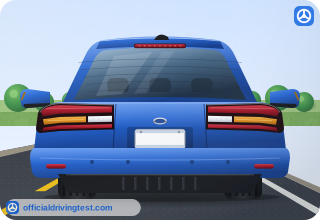
- Tap your brake pedal three or four times quickly
- Press the brake pedal once and hold it down firmly
- Flash your high beams at the vehicle behind you
- Sound your horn three or four times quickly
Show answer
Correct answer: Tap your brake pedal three or four times quickly
A few quick taps on the brake pedal alert the driver behind you that you are about to slow or stop.
Source: Washington Driver Guide (© 2025), page 49 · Open this page in the manual (Manual page 49)
-
According to Washington law, when do you need to have your headlights on?
- From one hour after sunset to one hour before sunrise
- From a half hour before sunset to a half hour after sunrise
- Only when it is raining, snowing, foggy, or smoky
- From a half hour after sunset to a half hour before sunrise
Show answer
Correct answer: From a half hour after sunset to a half hour before sunrise
Washington law requires headlights from a half hour after sunset until a half hour before sunrise.
Source: Washington Driver Guide (© 2025), page 49 · Open this page in the manual (Manual page 49)
-
Which statement about daytime running lights is true?
- They are as bright as headlights
- They don't activate your taillights
- They also turn on your taillights
- They turn on only when it gets dark
Show answer
Correct answer: They don't activate your taillights
Daytime running lights are not as bright as headlights and do not activate the taillights.
Source: Washington Driver Guide (© 2025), page 49 · Open this page in the manual (Manual page 49)
-
What should you do if your dashboard shows a "lamp out" symbol?
- Replace the bulbs
- Turn on your hazard lights
- Check your tire pressure
- Add window washer fluid
Show answer
Correct answer: Replace the bulbs
A lamp out symbol on the dashboard means it is time to replace the bulbs.
Source: Washington Driver Guide (© 2025), page 49 · Open this page in the manual (Manual page 49)
-
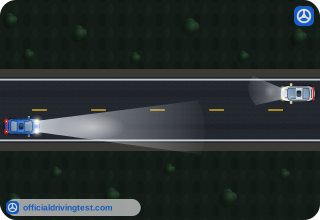
When using high beams, how far in front of an oncoming vehicle should you switch back to regular headlights?
- 250 feet
- 750 feet
- 500 feet
- 1,000 feet
Show answer
Correct answer: 500 feet
You should switch back to regular headlights when you are 500 feet in front of an oncoming vehicle.
Source: Washington Driver Guide (© 2025), page 50 · Open this page in the manual (Manual page 50)
-
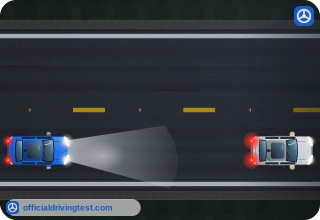
When using high beams, how far behind another vehicle should you switch back to regular headlights?
- 150 feet
- 300 feet
- 600 feet
- 1,000 feet
Show answer
Correct answer: 300 feet
You should switch back to regular headlights when you are 300 feet behind another vehicle.
Source: Washington Driver Guide (© 2025), page 50 · Open this page in the manual (Manual page 50)
-
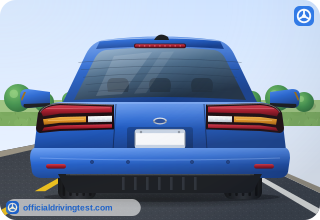
From how far away must your red brake lights be clearly visible?
- 50 feet
- 200 feet
- 500 feet
- 100 feet
Show answer
Correct answer: 100 feet
Brake lights must be clearly visible from 100 feet away.
Source: Washington Driver Guide (© 2025), page 50 · Open this page in the manual (Manual page 50)
-
If your brake lights aren't working, how can you tell the vehicle behind you to slow down and prepare to stop?
- Tap your horn
- Flash your high beams
- Use hand signals
- Turn on your daytime running lights
Show answer
Correct answer: Use hand signals
When the brake lights fail, hand signals take their place.
Source: Washington Driver Guide (© 2025), page 50 · Open this page in the manual (Manual page 50)
-
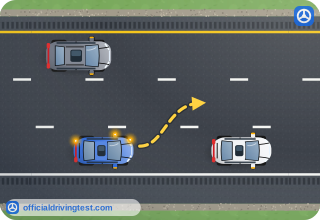
How far before you make your move should you signal?
- 100 feet
- 25 feet
- 50 feet
- 75 feet
Show answer
Correct answer: 100 feet
The guide says to signal 100 feet before you make your move.
Source: Washington Driver Guide (© 2025), page 50 · Open this page in the manual (Manual page 50)
-
After you make a turn, what should you make sure of about your turn signal?
- That it keeps blinking for a few seconds
- That it is switched to your hazard lights
- That your brake lights come on
- That it stops blinking
Show answer
Correct answer: That it stops blinking
The signal should not keep blinking once the turn is finished.
Source: Washington Driver Guide (© 2025), page 50 · Open this page in the manual (Manual page 50)
-
When should you signal before you change direction?
- Only when you can see other vehicles nearby
- Always, even when you don't see anyone else around
- Only at intersections with traffic signals
- Only when a pedestrian or bicyclist is nearby
Show answer
Correct answer: Always, even when you don't see anyone else around
The guide says to make a habit of always signaling before you change direction, even with no one around.
Source: Washington Driver Guide (© 2025), page 50 · Open this page in the manual (Manual page 50)