Washington: Vehicle controls and equipment
Steering and braking methods, mirrors and blind zones, turn and hand signals, headlights, vehicle technology, maintenance and secure loads. Split into 6 shorter tests so you're not stuck in one long quiz.
Independent educational site · not affiliated with any government agency or DMV
Choose a part
Vehicle controls and equipment — Part 1
Questions in this part include: “What does the guide say is important to do for every vehicle you drive?”
Vehicle controls and equipment — Part 2
Questions in this part include: “Where is the Tire and Loading Information label that shows the proper tire inflation pressure?”
Vehicle controls and equipment — Part 3
Questions in this part include: “When should you use hand signals?”
Vehicle controls and equipment — Part 4
Questions in this part include: “How many levels of braking does the guide describe?”
Vehicle controls and equipment — Part 5
Questions in this part include: “Whose responsibility is it to be aware of everything in your blind zones?”
Vehicle controls and equipment — Part 6
Questions in this part include: “How should you secure a load in your vehicle or trailer?”
Questions are original and based on the official manual "Washington Driver Guide" (© 2025), Washington State Department of Licensing (DOL).
All 103 Vehicle controls and equipment questions with answers
Choose a part above to take a practice test, or study every question and answer here.
Show the questions and answersHide the questions
1Part 118 questions
-
What does the guide say is important to do for every vehicle you drive?
- Read the manual for that vehicle
- Have it inspected by the Department of Licensing
- Register it in your own name
- Replace its tires before you drive it
Show answer
Correct answer: Read the manual for that vehicle
Vehicles differ in size, engine, safety devices and technology, so you should read the manual of each one you drive.
Source: Washington Driver Guide (© 2025), page 44 · Open this page in the manual (Manual page 44)
-
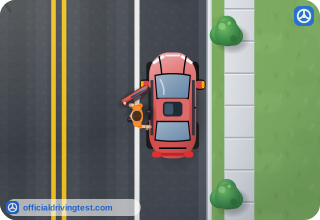
Every time you get into a vehicle, which items do you need to adjust so you have good visibility?
- The headlights, horn, and wipers
- The radio, vents, and window tint
- The tire pressure, gauges, and pedals
- The steering wheel, seat, and mirrors
Show answer
Correct answer: The steering wheel, seat, and mirrors
You adjust the steering wheel, seat, and mirrors for good visibility each time you get in.
Source: Washington Driver Guide (© 2025), page 44 · Open this page in the manual (Manual page 44)
-
Even with vehicle safety technology (VST) and advanced driver assistance systems (ADAS), who is still fully responsible for the operation of your vehicle?
- The vehicle manufacturer
- You, the driver
- The vehicle's safety systems
- The dealership that sold the vehicle
Show answer
Correct answer: You, the driver
These systems assist healthy driving habits but do not replace them, so the driver stays fully responsible.
Source: Washington Driver Guide (© 2025), page 45 · Open this page in the manual (Manual page 45)
-
According to the guide, what might a blind spot alert system fail to detect?
- A vehicle two lanes over that is also preparing to merge
- A vehicle in the adjacent lane
- A vehicle in your blind spot
- A vehicle in your blind spot during a lane change
Show answer
Correct answer: A vehicle two lanes over that is also preparing to merge
The guide says these systems can alert you to a vehicle in your blind spot but cannot detect a vehicle two lanes over that is also preparing to merge.
Source: Washington Driver Guide (© 2025), page 45 · Open this page in the manual (Manual page 45)
-
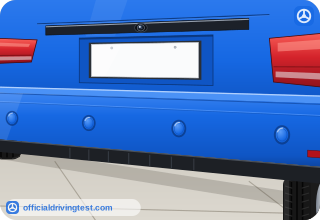
What can make it difficult for vehicle safety technology to function properly?
- Clean sensors and clear lane markings
- Having the features turned on all the time
- Dirty sensors or faded road markings
- Driving a vehicle with a manual transmission
Show answer
Correct answer: Dirty sensors or faded road markings
Sensors that get dirty or road markings that fade make it hard for the technology to work properly.
Source: Washington Driver Guide (© 2025), page 45 · Open this page in the manual (Manual page 45)
-
Under what condition does the guide say you might turn off VST and ADAS features?
- You are driving on a familiar road in light traffic
- Weather is so severe that alerts become a distraction
- You are driving at night on an unlit open road
- You feel confident and alert and want full control
Show answer
Correct answer: Weather is so severe that alerts become a distraction
The guide says to leave the features on unless severe weather makes their notifications a distraction.
Source: Washington Driver Guide (© 2025), page 45 · Open this page in the manual (Manual page 45)
-
What does adaptive cruise control (ACC) do?
- Monitors lane markings and gives steering input if the vehicle drifts out of its lane
- Uses cameras to read traffic signs and show speed limits to the driver
- Warns of approaching traffic from the side when backing out of a parking space
- Maintains a set speed but adjusts it based on the distance to the vehicle ahead
Show answer
Correct answer: Maintains a set speed but adjusts it based on the distance to the vehicle ahead
Adaptive cruise control keeps a set speed but changes it according to the gap to the vehicle in front, keeping a safe following distance.
Source: Washington Driver Guide (© 2025), page 46 · Open this page in the manual (Manual page 46)
-
What does lane keeping assistance do?
- Adjusts headlight brightness based on oncoming traffic and surrounding conditions
- Alerts the driver if there is a vehicle in the adjacent lane
- Gives steering input or alerts if the vehicle drifts out of its lane
- Alerts the driver if signs of drowsiness or distraction are detected
Show answer
Correct answer: Gives steering input or alerts if the vehicle drifts out of its lane
Lane keeping assistance watches lane markings and steers or alerts you if the vehicle starts to leave its lane.
Source: Washington Driver Guide (© 2025), page 46 · Open this page in the manual (Manual page 46)
-
Which vehicle technology can include automatic parallel parking?
- Parking assistance
- Cross traffic alert
- Lane keeping assistance
- Adaptive cruise control
Show answer
Correct answer: Parking assistance
Parking assistance uses sensors and cameras to guide you and can include automatic parallel parking.
Source: Washington Driver Guide (© 2025), page 46 · Open this page in the manual (Manual page 46)
-
What does traffic sign recognition help the driver stay aware of?
- Tire pressure and the fuel level in the tank
- The distance to the vehicle behind you
- Nearby parking spaces and garage exits
- Speed limits and other road regulations
Show answer
Correct answer: Speed limits and other road regulations
Traffic sign recognition uses cameras to read signs and helps you keep track of speed limits and other regulations.
Source: Washington Driver Guide (© 2025), page 46 · Open this page in the manual (Manual page 46)
-
What does a driver monitoring system alert you to?
- A vehicle in the adjacent lane
- Signs of drowsiness or distraction
- Low tire pressure
- Approaching traffic from the side
Show answer
Correct answer: Signs of drowsiness or distraction
Driver monitoring watches the driver's behavior and warns of drowsiness or distraction.
Source: Washington Driver Guide (© 2025), page 46 · Open this page in the manual (Manual page 46)
-
What does cross traffic alert warn you about?
- Approaching traffic from the side
- A vehicle two lanes over
- Signs of drowsiness
- A vehicle following too closely
Show answer
Correct answer: Approaching traffic from the side
Cross traffic alert warns of traffic approaching from the side, such as when you back out of a parking space.
Source: Washington Driver Guide (© 2025), page 46 · Open this page in the manual (Manual page 46)
-
Which of these is an example of a feature included in collision avoidance systems?
- Automatic parallel parking
- Traffic sign recognition
- Forward collision warning
- Automatic high beam control
Show answer
Correct answer: Forward collision warning
Collision avoidance systems include automatic emergency braking, forward collision warning, and lane departure warning.
Source: Washington Driver Guide (© 2025), page 46 · Open this page in the manual (Manual page 46)
-
What does automatic high beam control adjust?
- The brightness of the dashboard gauges
- Headlight brightness
- The volume of warning sounds
- The height of the headlights
Show answer
Correct answer: Headlight brightness
Automatic high beam control changes headlight brightness to suit oncoming traffic and conditions.
Source: Washington Driver Guide (© 2025), page 47 · Open this page in the manual (Manual page 47)
-
What does a collision mitigation system do?
- Detects obstacles and warns the driver to prevent collisions
- Maintains a safe following distance at a set speed
- Alerts the driver when drifting out of the lane
- Minimizes the impact if a collision is unavoidable
Show answer
Correct answer: Minimizes the impact if a collision is unavoidable
Collision mitigation goes beyond avoidance and works to reduce the impact when a collision cannot be avoided.
Source: Washington Driver Guide (© 2025), page 47 · Open this page in the manual (Manual page 47)
-
Where does the guide say to look for suggested routine maintenance for your vehicle?
- Your driver license card
- Your vehicle registration
- Your vehicle owner's manual
- Your Certificate of Ownership
Show answer
Correct answer: Your vehicle owner's manual
The guide says to consult the vehicle owner's manual for suggested routine maintenance.
Source: Washington Driver Guide (© 2025), page 47 · Open this page in the manual (Manual page 47)
-
Who is responsible for making sure your vehicle is safe to drive?
- You are
- The Department of Licensing
- The dealership that sold it
- The vehicle manufacturer
Show answer
Correct answer: You are
The guide states that making sure the vehicle is safe to drive is the driver's own responsibility.
Source: Washington Driver Guide (© 2025), page 47 · Open this page in the manual (Manual page 47)
-
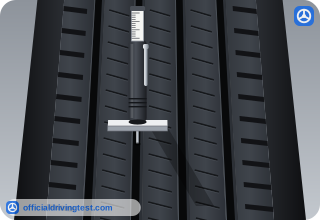
What is the minimum tire tread the guide says you should have?
- 1/32 of an inch
- 4/32 of an inch
- 1/4 of an inch
- 2/32 of an inch
Show answer
Correct answer: 2/32 of an inch
Tire tread should not be less than 2/32 of an inch.
Source: Washington Driver Guide (© 2025), page 48 · Open this page in the manual (Manual page 48)
2Part 217 questions
-
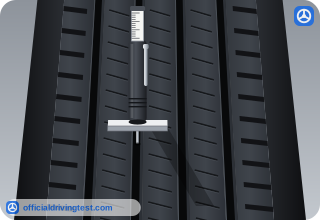
What can worn tires cause, especially if the road is wet?
- Overheated brakes
- Slipping and sliding
- Engine stalling
- Windshield fogging
Show answer
Correct answer: Slipping and sliding
Worn tires can slip and slide, particularly on wet roads.
Source: Washington Driver Guide (© 2025), page 48 · Open this page in the manual (Manual page 48)
-
What can low tire pressure affect?
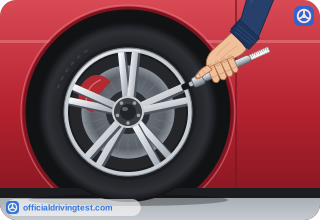
- Your car's handling and speed
- Your car's headlight brightness
- Your brake light color
- Your window washer fluid level
Show answer
Correct answer: Your car's handling and speed
Low tire pressure can change how the car handles and affect its speed.
Source: Washington Driver Guide (© 2025), page 48 · Open this page in the manual (Manual page 48)
-
Where is the Tire and Loading Information label that shows the proper tire inflation pressure?
- On the vehicle registration document
- On the rear license plate
- On the driver's side door edge
- On the windshield wiper blade
Show answer
Correct answer: On the driver's side door edge
The proper inflation pressure is on the Tire and Loading Information label on the driver's side door edge, or in the owner's manual.
Source: Washington Driver Guide (© 2025), page 48 · Open this page in the manual (Manual page 48)
-
Before driving, what should you do about snow, ice, or frost on your windows?
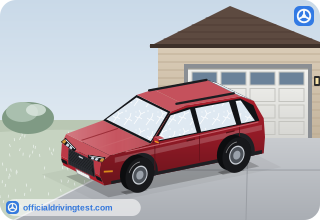
- Clear only the windshield
- Completely clear it from all windows
- Clear a small area in front of the driver
- Clear it only if it is covering the mirrors
Show answer
Correct answer: Completely clear it from all windows
All windows should be completely cleared of snow, ice, or frost before you drive.
Source: Washington Driver Guide (© 2025), page 48 · Open this page in the manual (Manual page 48)
-
Which of these does the guide say you should avoid to keep your view clear?
- Keeping the window washer fluid full
- Cleaning the windshield inside and outside
- Replacing wipers as the manufacturer recommends
- Hanging things from your mirror
Show answer
Correct answer: Hanging things from your mirror
The guide advises against hanging things from the mirror or cluttering windows with items that block your view.
Source: Washington Driver Guide (© 2025), page 48 · Open this page in the manual (Manual page 48)
-
What should you follow when replacing your wipers?
- Your insurance company's recommendations
- A fixed schedule of once every year
- Your vehicle manufacturer's recommendations
- The advice on the Tire and Loading Information label
Show answer
Correct answer: Your vehicle manufacturer's recommendations
The guide says to follow the vehicle manufacturer's recommendations for replacing wipers.
Source: Washington Driver Guide (© 2025), page 48 · Open this page in the manual (Manual page 48)
-
If you are stopping or slowing down where the person behind you might not expect it, what does the guide suggest?
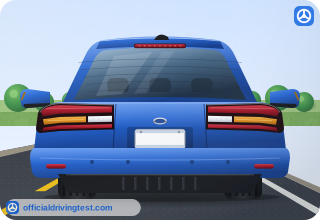
- Tap your brake pedal three or four times quickly
- Press the brake pedal once and hold it down firmly
- Flash your high beams at the vehicle behind you
- Sound your horn three or four times quickly
Show answer
Correct answer: Tap your brake pedal three or four times quickly
A few quick taps on the brake pedal alert the driver behind you that you are about to slow or stop.
Source: Washington Driver Guide (© 2025), page 49 · Open this page in the manual (Manual page 49)
-
According to Washington law, when do you need to have your headlights on?
- From one hour after sunset to one hour before sunrise
- From a half hour before sunset to a half hour after sunrise
- Only when it is raining, snowing, foggy, or smoky
- From a half hour after sunset to a half hour before sunrise
Show answer
Correct answer: From a half hour after sunset to a half hour before sunrise
Washington law requires headlights from a half hour after sunset until a half hour before sunrise.
Source: Washington Driver Guide (© 2025), page 49 · Open this page in the manual (Manual page 49)
-
Which statement about daytime running lights is true?
- They are as bright as headlights
- They don't activate your taillights
- They also turn on your taillights
- They turn on only when it gets dark
Show answer
Correct answer: They don't activate your taillights
Daytime running lights are not as bright as headlights and do not activate the taillights.
Source: Washington Driver Guide (© 2025), page 49 · Open this page in the manual (Manual page 49)
-
What should you do if your dashboard shows a "lamp out" symbol?
- Replace the bulbs
- Turn on your hazard lights
- Check your tire pressure
- Add window washer fluid
Show answer
Correct answer: Replace the bulbs
A lamp out symbol on the dashboard means it is time to replace the bulbs.
Source: Washington Driver Guide (© 2025), page 49 · Open this page in the manual (Manual page 49)
-
When using high beams, how far in front of an oncoming vehicle should you switch back to regular headlights?
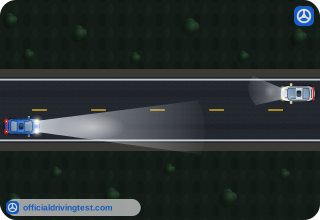
- 250 feet
- 750 feet
- 500 feet
- 1,000 feet
Show answer
Correct answer: 500 feet
You should switch back to regular headlights when you are 500 feet in front of an oncoming vehicle.
Source: Washington Driver Guide (© 2025), page 50 · Open this page in the manual (Manual page 50)
-
When using high beams, how far behind another vehicle should you switch back to regular headlights?
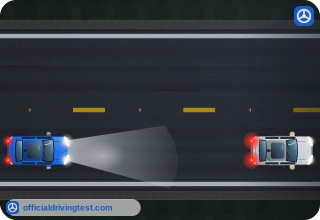
- 150 feet
- 300 feet
- 600 feet
- 1,000 feet
Show answer
Correct answer: 300 feet
You should switch back to regular headlights when you are 300 feet behind another vehicle.
Source: Washington Driver Guide (© 2025), page 50 · Open this page in the manual (Manual page 50)
-
From how far away must your red brake lights be clearly visible?
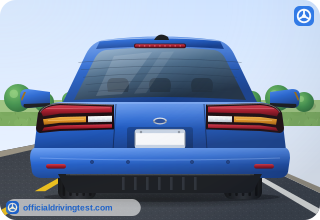
- 50 feet
- 200 feet
- 500 feet
- 100 feet
Show answer
Correct answer: 100 feet
Brake lights must be clearly visible from 100 feet away.
Source: Washington Driver Guide (© 2025), page 50 · Open this page in the manual (Manual page 50)
-
If your brake lights aren't working, how can you tell the vehicle behind you to slow down and prepare to stop?
- Tap your horn
- Flash your high beams
- Use hand signals
- Turn on your daytime running lights
Show answer
Correct answer: Use hand signals
When the brake lights fail, hand signals take their place.
Source: Washington Driver Guide (© 2025), page 50 · Open this page in the manual (Manual page 50)
-
How far before you make your move should you signal?
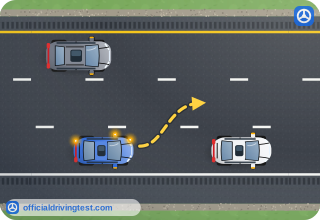
- 100 feet
- 25 feet
- 50 feet
- 75 feet
Show answer
Correct answer: 100 feet
The guide says to signal 100 feet before you make your move.
Source: Washington Driver Guide (© 2025), page 50 · Open this page in the manual (Manual page 50)
-
After you make a turn, what should you make sure of about your turn signal?
- That it keeps blinking for a few seconds
- That it is switched to your hazard lights
- That your brake lights come on
- That it stops blinking
Show answer
Correct answer: That it stops blinking
The signal should not keep blinking once the turn is finished.
Source: Washington Driver Guide (© 2025), page 50 · Open this page in the manual (Manual page 50)
-
When should you signal before you change direction?
- Only when you can see other vehicles nearby
- Always, even when you don't see anyone else around
- Only at intersections with traffic signals
- Only when a pedestrian or bicyclist is nearby
Show answer
Correct answer: Always, even when you don't see anyone else around
The guide says to make a habit of always signaling before you change direction, even with no one around.
Source: Washington Driver Guide (© 2025), page 50 · Open this page in the manual (Manual page 50)
3Part 317 questions
-
When should you use hand signals?
- When one or both of your signals aren't working
- When you are driving slowly in a parking lot
- When you are turning on a street with little traffic
- When you are driving through a school zone slowly
Show answer
Correct answer: When one or both of your signals aren't working
Hand signals let other drivers know what you are doing when one or both signals do not work.
Source: Washington Driver Guide (© 2025), page 51 · Open this page in the manual (Manual page 51)
-
Which hand signal tells the driver behind you to slow down and prepare to stop?
- Left arm out the window, fingers pointing straight out to the left
- Left arm out the window, arm bent so fingers point to the sky
- Left arm out the driver-side window, fingers pointing to the ground
- Right arm out the passenger window, fingers pointing to the ground
Show answer
Correct answer: Left arm out the driver-side window, fingers pointing to the ground
The stop signal is the left arm out the driver-side window with the fingers pointing down toward the ground.
Source: Washington Driver Guide (© 2025), page 51 · Open this page in the manual (Manual page 51)
-
Which hand signal indicates a left turn?
- Left arm out the window, fingers pointing to the ground
- Left arm out the window, fingers pointing straight out to the left
- Left arm out the window, arm bent so fingers point to the sky
- Right arm out the passenger window, fingers pointing to the right
Show answer
Correct answer: Left arm out the window, fingers pointing straight out to the left
For a left turn, the left arm goes out the window with the fingers pointing straight out to the left.
Source: Washington Driver Guide (© 2025), page 51 · Open this page in the manual (Manual page 51)
-
Which hand signal indicates a right turn?
- Left arm out the window, fingers pointing to the ground
- Left arm out the window, fingers pointing straight out to the left
- Right arm out the passenger window, fingers pointing to the sky
- Left arm out the window, arm bent so fingers point to the sky
Show answer
Correct answer: Left arm out the window, arm bent so fingers point to the sky
For a right turn, the left arm goes out the window and is bent so the fingers point up to the sky.
Source: Washington Driver Guide (© 2025), page 51 · Open this page in the manual (Manual page 51)
-
When should you turn on your flashing hazard lights?
- When you are about to pass another vehicle on a two-lane road
- When you are slowing down to make a turn at an intersection
- When your car malfunctions or you need to make an emergency stop
- When you want other drivers to let you merge into their lane
Show answer
Correct answer: When your car malfunctions or you need to make an emergency stop
Flashing hazard lights warn other drivers of a malfunction or emergency stop so they can go around you safely.
Source: Washington Driver Guide (© 2025), page 51 · Open this page in the manual (Manual page 51)
-
What is the minimum distance your chest should be from the steering wheel to leave space for the airbag?
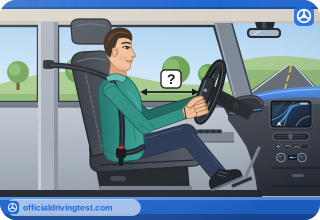
- 10 inches
- 3 inches
- 5 inches
- 7 inches
Show answer
Correct answer: 10 inches
Your chest should be at least 10 inches from the steering wheel so the airbag has room.
Source: Washington Driver Guide (© 2025), page 51 · Open this page in the manual (Manual page 51)
-
How should you adjust the steering wheel?
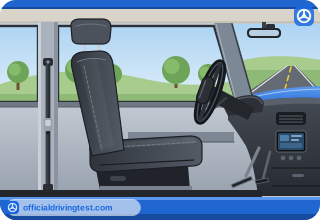
- So your arms are fully straight when you grip it
- So the wheel rests lightly against your chest
- So you can hold it with only your fingertips
- So you can grip it with a gentle bend in your elbow
Show answer
Correct answer: So you can grip it with a gentle bend in your elbow
The steering wheel is set so you can grip it with a gentle bend in your elbow.
Source: Washington Driver Guide (© 2025), page 51 · Open this page in the manual (Manual page 51)
-
To protect yourself from whiplash, where should the headrest be?
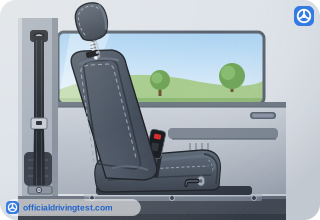
- Even with your shoulders
- Even with your ears
- Even with the top of your head
- Even with your eyes
Show answer
Correct answer: Even with your ears
A headrest that is even with your ears helps protect you from whiplash.
Source: Washington Driver Guide (© 2025), page 51 · Open this page in the manual (Manual page 51)
-
Where should you place your hands on the steering wheel to get the best control?
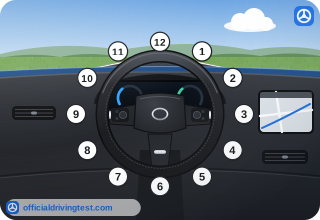
- Outside the wheel, on the top half
- Outside the wheel, on the bottom half
- Inside the wheel, near the center
- On the spokes, near the horn
Show answer
Correct answer: Outside the wheel, on the top half
Hands on the outside of the top half of the wheel give the best control.
Source: Washington Driver Guide (© 2025), page 55 · Open this page in the manual (Manual page 55)
-
How many turning methods does the guide describe for smooth, continuous steering control?
- Two
- Four
- Three
- Five
Show answer
Correct answer: Three
The guide presents three turning methods: hand-to-hand, hand-over-hand, and one-hand steering.
Source: Washington Driver Guide (© 2025), page 55 · Open this page in the manual (Manual page 55)
-
Where should your hands be when you use hand-to-hand (pull/push) steering?
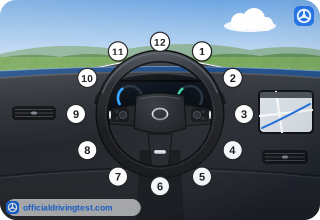
- At 12 and 6 or 11 and 5
- At 9 and 3 or 10 and 2
- At 8 and 4 or 11 and 1
- At 7 and 5 or 12 and 6
Show answer
Correct answer: At 9 and 3 or 10 and 2
For hand-to-hand steering the hands stay at 9 and 3 or 10 and 2.
Source: Washington Driver Guide (© 2025), page 56 · Open this page in the manual (Manual page 56)
-
Why does hand-to-hand steering lower the chance of injury to the face, hands, or arms if the air bag deploys?
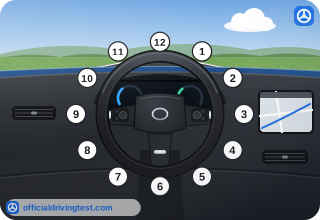
- Your arms stay straight and locked in place
- Your hands stay low on the bottom of the wheel
- You steer with only one hand at the 12 position
- Your hands never cross over the steering wheel
Show answer
Correct answer: Your hands never cross over the steering wheel
Because the hands never cross over the wheel, there is less chance of injury to the face, hands, or arms if the air bag deploys.
Source: Washington Driver Guide (© 2025), page 56 · Open this page in the manual (Manual page 56)
-
In hand-to-hand steering, what does the hand that is not gripping and steering the wheel do?
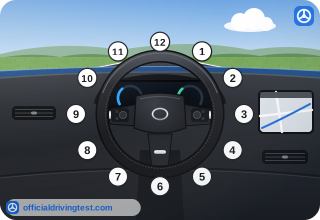
- It slides and stays opposite the steering hand
- It rests in your lap until the turn is done
- It reaches across the other arm to pull
- It lets go of the wheel and is repositioned
Show answer
Correct answer: It slides and stays opposite the steering hand
One hand grips and steers while the other slides and remains opposite it, so both hands stay on the wheel.
Source: Washington Driver Guide (© 2025), page 56 · Open this page in the manual (Manual page 56)
-
Which situation calls for hand-over-hand steering?
- Driving straight at highway speeds
- Backing with one hand at the 12 position
- Turning at low speeds
- Reaching to operate the wipers or flashers
Show answer
Correct answer: Turning at low speeds
Hand-over-hand is used for low-speed turns, limited visibility, intersections, parking, and recovering from a skid.
Source: Washington Driver Guide (© 2025), page 57 · Open this page in the manual (Manual page 57)
-
How do you turn the wheel with hand-over-hand steering?
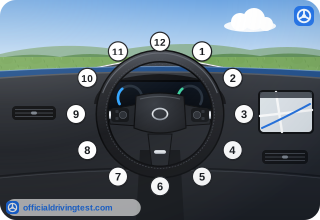
- Slide one hand along the wheel while the other pushes
- Reach one arm across the other to grasp the wheel and pull
- Keep both hands still and turn your body instead
- Hold the wheel with one hand at the 12 position
Show answer
Correct answer: Reach one arm across the other to grasp the wheel and pull
In hand-over-hand steering one arm reaches across the other to grasp and pull the wheel, and the hand underneath is then repositioned.
Source: Washington Driver Guide (© 2025), page 57 · Open this page in the manual (Manual page 57)
-
Which situation calls for one-hand steering?
- Turning at an intersection
- Recovering from a skid
- Turning at low speeds with limited visibility
- Backing the vehicle
Show answer
Correct answer: Backing the vehicle
One-hand steering is used when backing or when a hand must leave the wheel to operate controls such as wipers, flashers, or lights.
Source: Washington Driver Guide (© 2025), page 58 · Open this page in the manual (Manual page 58)
-
When is the 12 position on the steering wheel recommended?
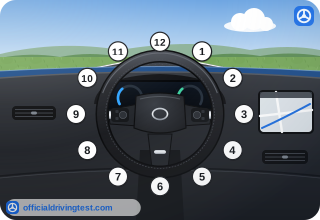
- Only when backing a vehicle
- When turning at an intersection
- When driving on a freeway
- When recovering from a skid
Show answer
Correct answer: Only when backing a vehicle
The 12 position is recommended only for backing.
Source: Washington Driver Guide (© 2025), page 58 · Open this page in the manual (Manual page 58)
4Part 417 questions
-
When you back up with one hand at the 12 position, what should you do to see where you are going?
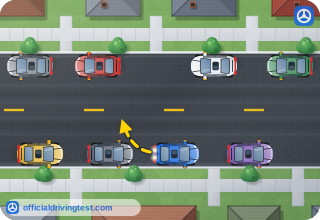
- Look only in your rearview and side mirrors
- Keep your body facing forward and look ahead
- Turn your body to see the path behind you
- Steer by feel without looking behind you
Show answer
Correct answer: Turn your body to see the path behind you
The guide says to turn your body to see the path of travel behind you when backing.
Source: Washington Driver Guide (© 2025), page 58 · Open this page in the manual (Manual page 58)
-
How many levels of braking does the guide describe?
- Two
- Four
- Three
- Five
Show answer
Correct answer: Four
The levels are light, medium, firm, and emergency braking.
Source: Washington Driver Guide (© 2025), page 58 · Open this page in the manual (Manual page 58)
-
Which levels of braking will you ideally need to use?
- Firm and emergency
- Medium and firm
- Light and emergency
- Light and medium
Show answer
Correct answer: Light and medium
Ideally only light and medium braking is needed, though firm or emergency braking can always be used when necessary.
Source: Washington Driver Guide (© 2025), page 59 · Open this page in the manual (Manual page 59)
-
What important safety advantage does an antilock brake system (ABS) offer?
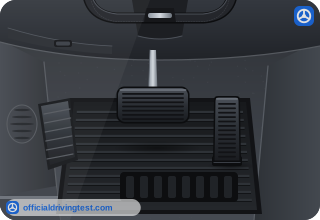
- It lets you brake without using the pedal
- It reduces the need to check your mirrors
- It lets drivers steer during emergency braking
- It keeps the engine from stalling
Show answer
Correct answer: It lets drivers steer during emergency braking
ABS allows the driver to keep steering while braking in an emergency.
Source: Washington Driver Guide (© 2025), page 59 · Open this page in the manual (Manual page 59)
-
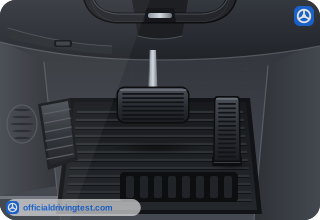
What might you feel when your antilock brake system (ABS) is engaged?
- The steering wheel locks in place
- The brake pedal drops to the floor
- The engine speeds up
- Your vehicle shakes a bit
Show answer
Correct answer: Your vehicle shakes a bit
An engaged ABS makes the vehicle shake slightly as it keeps the wheels from locking up.
Source: Washington Driver Guide (© 2025), page 59 · Open this page in the manual (Manual page 59)
-
Where should you practice firm or emergency braking?
- In a large, open, and paved space
- On a narrow neighborhood street
- On an unpaved road with loose gravel
- In the right lane of a busy road
Show answer
Correct answer: In a large, open, and paved space
The guide advises practicing hard braking in a large, open, paved space and feeling the ABS keep the wheels from locking.
Source: Washington Driver Guide (© 2025), page 59 · Open this page in the manual (Manual page 59)
-
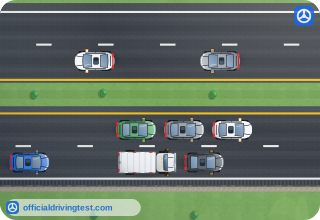
In stop-and-go traffic, what may be the only acceleration you need?
- Pressing firmly on the accelerator
- A quick burst of speed
- Releasing the brake pedal
- Pumping the accelerator
Show answer
Correct answer: Releasing the brake pedal
In stop-and-go traffic you may only need to release the brake pedal to move forward.
Source: Washington Driver Guide (© 2025), page 59 · Open this page in the manual (Manual page 59)
-
What helps keep a vehicle’s weight evenly balanced across the tires?
- Keeping all heavy items in the trunk
- Regular maintenance, correct tire pressure, and alignment checks
- Using cruise control at all times on every road
- Turning the steering wheel often while the vehicle is stopped
Show answer
Correct answer: Regular maintenance, correct tire pressure, and alignment checks
Maintenance, correct tire pressure, and alignment checks help maintain the vehicle’s stability.
Source: Washington Driver Guide (© 2025), page 60 · Open this page in the manual (Manual page 60)
-
When you accelerate, where does the weight of the vehicle shift?
- To the back, increasing pressure on the rear
- To the front, increasing pressure on the front
- To the left side
- To the right side
Show answer
Correct answer: To the back, increasing pressure on the rear
Acceleration shifts the vehicle's weight toward the rear.
Source: Washington Driver Guide (© 2025), page 60 · Open this page in the manual (Manual page 60)
-
What happens to the weight of the vehicle if you stop abruptly?
- It shifts to the back, increasing pressure on the rear
- It shifts to the outside tires
- It shifts forward, increasing pressure on the front
- It stays evenly balanced
Show answer
Correct answer: It shifts forward, increasing pressure on the front
An abrupt stop throws the weight toward the front of the vehicle.
Source: Washington Driver Guide (© 2025), page 60 · Open this page in the manual (Manual page 60)
-
When you make a left turn, to which side of the vehicle does centrifugal force transfer the weight?
- The inside, or left side
- The outside, or right side
- The front end
- The rear end
Show answer
Correct answer: The outside, or right side
In a left turn the weight is pushed down on the outside, right side, so the body of the vehicle rolls to one side.
Source: Washington Driver Guide (© 2025), page 61 · Open this page in the manual (Manual page 61)
-
When you turn the steering wheel sharply from side to side, what might the back of your car do?
- Stay perfectly lined up with the front wheels
- Steer itself back to center
- Tilt forward over the front wheels
- Slide a bit, creating a zig-zag motion
Show answer
Correct answer: Slide a bit, creating a zig-zag motion
The front wheels turn the way you steer while the back may slide a bit, making a zig-zag motion.
Source: Washington Driver Guide (© 2025), page 62 · Open this page in the manual (Manual page 62)
-
Familiarity with your vehicle reference points helps you do what?
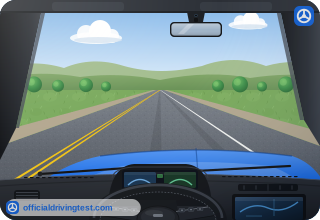
- Judge distance when you park, turn, back, and stop
- Estimate how much fuel you have left
- Tell when your tires need more air
- Measure how fast you are going in sharp turns
Show answer
Correct answer: Judge distance when you park, turn, back, and stop
Reference points help you judge distance for parking, turning, backing, and stopping.
Source: Washington Driver Guide (© 2025), page 62 · Open this page in the manual (Manual page 62)
-
Which of these is an example of a vehicle reference point?
- Dashboard clock
- Rear window defroster
- Center of hood
- Tire valve stem
Show answer
Correct answer: Center of hood
Examples of reference points include the left headlight, center of the hood, side view mirrors, and rear bumper.
Source: Washington Driver Guide (© 2025), page 62 · Open this page in the manual (Manual page 62)
-
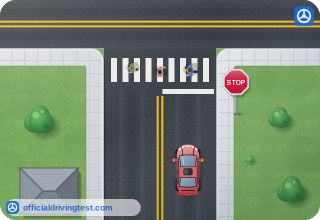
At an intersection, how far are you from the stop line when the line is under your side mirror?
- About 1 foot
- About 3 to 6 inches
- About 2 feet
- About 3 feet
Show answer
Correct answer: About 3 to 6 inches
With the stop line under the side mirror you are about 3 to 6 inches from it.
Source: Washington Driver Guide (© 2025), page 62 · Open this page in the manual (Manual page 62)
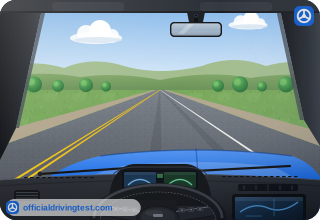
-
If the center of your hood is in line with the lane markings, how far are you from the edge of the lane?
- Approximately 1 to 2 feet
- Approximately 10 to 12 inches
- Approximately 18 inches
- Approximately 3 to 6 inches
Show answer
Correct answer: Approximately 3 to 6 inches
When the center of the hood lines up with the lane markings you are about 3 to 6 inches from the lane edge.
Source: Washington Driver Guide (© 2025), page 63 · Open this page in the manual (Manual page 63)
-
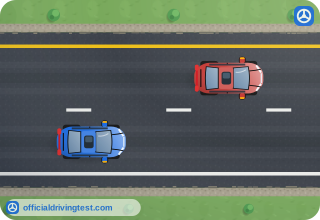
What are blind zones?
- Areas around a vehicle you can’t see from the driver’s seat
- Areas where other drivers cannot see your headlights
- Stretches of road with no lane markings
- Areas of the road hidden by darkness or fog
Show answer
Correct answer: Areas around a vehicle you can’t see from the driver’s seat
Blind zones are the areas around a vehicle that the driver cannot see from the seat.
Source: Washington Driver Guide (© 2025), page 63 · Open this page in the manual (Manual page 63)
5Part 517 questions
-
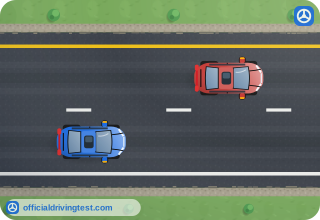
Why are blind zones dangerous?
- They make your mirrors fog up on cold days
- They turn off your vehicle safety technology
- They can fully hide another vehicle, motorcyclist, or bicyclist
- They shorten the time you have to see the road far ahead
Show answer
Correct answer: They can fully hide another vehicle, motorcyclist, or bicyclist
Another vehicle, motorcyclist, or bicyclist can be fully hidden in a blind zone.
Source: Washington Driver Guide (© 2025), page 63 · Open this page in the manual (Manual page 63)
-
Whose responsibility is it to be aware of everything in your blind zones?
- The driver of the nearest vehicle
- Yours, as the driver
- Your vehicle’s safety technology
- The vehicle manufacturer
Show answer
Correct answer: Yours, as the driver
The guide says the driver is responsible for being aware of everything in their blind zones.
Source: Washington Driver Guide (© 2025), page 63 · Open this page in the manual (Manual page 63)
-
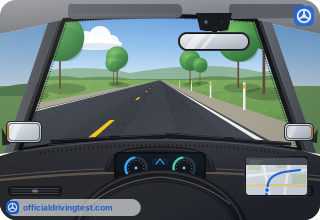
How should you adjust your rearview mirror to reduce your blind zone?
- So it points down at the rear bumper and trunk lid
- So it shows mostly the road beside the vehicle
- So it is tilted toward the side mirror and door
- So you can see out the back window without having to stretch
Show answer
Correct answer: So you can see out the back window without having to stretch
The rearview mirror should show the back window view without stretching.
Source: Washington Driver Guide (© 2025), page 63 · Open this page in the manual (Manual page 63)
-
Whichever method you use to adjust your side mirrors, what must you also do to check your blind zones?
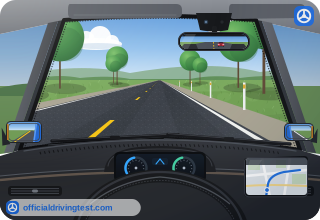
- A full visual search of the space around your vehicle
- Rely on the mirrors alone without looking
- Look only through the side windows once
- Check only the rearview mirror and speedometer
Show answer
Correct answer: A full visual search of the space around your vehicle
Mirror adjustment is not enough; you still need a full visual search around the vehicle, moving your head, neck, and body so both eyes can see.
Source: Washington Driver Guide (© 2025), page 63 · Open this page in the manual (Manual page 63)
-
When you turn your head to look at your blind zones, what should you do with the steering wheel?
- Turn it slightly toward the blind zone
- Loosen your grip so it can slide
- Keep it straight
- Turn it away from the blind zone
Show answer
Correct answer: Keep it straight
The guide notes to keep the steering wheel straight while turning your head to look.
Source: Washington Driver Guide (© 2025), page 63 · Open this page in the manual (Manual page 63)
-
If your vehicle has technology that alerts you to someone in your blind zone, what should you still do?
- Stop checking your mirrors completely
- Make a habit of checking with your own eyes
- Rely on the alert alone and not look
- Turn the system off while you are driving
Show answer
Correct answer: Make a habit of checking with your own eyes
The assistance is helpful, but you should still use your eyes to check.
Source: Washington Driver Guide (© 2025), page 63 · Open this page in the manual (Manual page 63)
-
Which of these is part of regularly checking to stay aware of your surroundings?
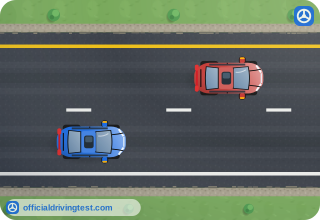
- The vehicle’s fuel gauge
- The radio display
- The contents of the trunk
- Over your shoulder
Show answer
Correct answer: Over your shoulder
Regular checks cover the area in front, the rearview mirror, the side mirrors, and over your shoulder.
Source: Washington Driver Guide (© 2025), page 64 · Open this page in the manual (Manual page 64)
-
When should you recheck your mirrors?
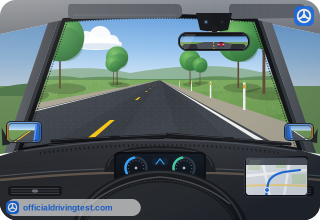
- Only once a week or so
- Only when you change lanes
- Only when you are driving at night
- Every time you get behind the wheel
Show answer
Correct answer: Every time you get behind the wheel
The guide says to recheck your mirrors every time you get behind the wheel.
Source: Washington Driver Guide (© 2025), page 65 · Open this page in the manual (Manual page 65)
-
How often should you check your mirrors for changes to your driving situation?
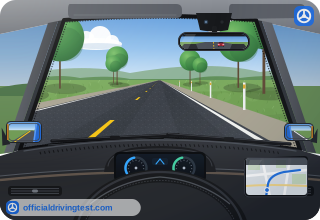
- Constantly
- Once at the start of each trip
- Only at intersections
- Only when you hear a horn
Show answer
Correct answer: Constantly
The guide says to constantly check your mirrors for any changes.
Source: Washington Driver Guide (© 2025), page 65 · Open this page in the manual (Manual page 65)
-
Which of these is part of checking outside your vehicle before you drive?
- Checking that your seat belt is buckled
- Looking for warnings on the instrument panel
- Looking for fluid leaks under the vehicle
- Making sure loose items are secured
Show answer
Correct answer: Looking for fluid leaks under the vehicle
The outside check covers foreign objects in the tires, broken glass, fluid leaks, and obstructions, children, pets, or weather.
Source: Washington Driver Guide (© 2025), page 66 · Open this page in the manual (Manual page 66)
-
Which of these is part of checking inside your vehicle before you drive?
- Looking for fluid leaks under the vehicle
- Making sure loose items are safely secured
- Looking for broken glass near the vehicle
- Checking for children or pets near the vehicle
Show answer
Correct answer: Making sure loose items are safely secured
The inside check covers warnings on the instrument panel, clear windows, and securing loose items.
Source: Washington Driver Guide (© 2025), page 66 · Open this page in the manual (Manual page 66)
-
Which of these is part of checking all internal adjustments before you drive?
- Whether there are fluid leaks under the vehicle
- Whether there are warnings on the instrument panel
- Whether any pets are near the vehicle
- Whether your seat belt is buckled
Show answer
Correct answer: Whether your seat belt is buckled
The internal adjustments check covers mirrors, seat and steering wheel position, seat belt, and phone.
Source: Washington Driver Guide (© 2025), page 66 · Open this page in the manual (Manual page 66)
-
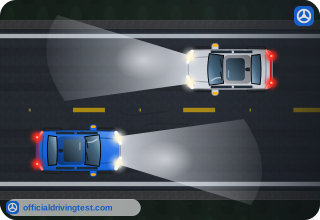
What can misaimed headlights do?
- Drain the battery faster and shorten the life of the headlight bulbs
- Make the headlights flash on and off by themselves at random times
- Make it hard for other drivers to see and reduce your ability to see the road
- Turn the high beams on automatically whenever it gets dark outside
Show answer
Correct answer: Make it hard for other drivers to see and reduce your ability to see the road
Misaimed headlights make it harder for other drivers to see and also reduce how well you can see the road.
Source: Washington Driver Guide (© 2025), page 70 · Open this page in the manual (Manual page 70)
-
According to the guide, how are smart drivers predictable to others?
- With quick lane changes and sudden stops
- By driving faster than the traffic around them
- By changing lanes without signaling when the road is clear
- With signaling and smooth movements
Show answer
Correct answer: With signaling and smooth movements
The guide says smart drivers are predictable through signaling and smooth movements.
Source: Washington Driver Guide (© 2025), page 86 · Open this page in the manual (Manual page 86)
-
Which set of things does the guide say a smart driver is able to control in their vehicle?
- Gas, brake, steering, and position
- Gas, brake, radio, and cruise control
- Speed, gears, fuel economy, and tire pressure
- Horn, wipers, headlights, and hazard flashers
Show answer
Correct answer: Gas, brake, steering, and position
The guide says smart drivers can control their vehicle’s gas, brake, steering, and position.
Source: Washington Driver Guide (© 2025), page 86 · Open this page in the manual (Manual page 86)
-
When you tow a boat, trailer, or camper, what are you responsible for following?
- Only the rules in the trailer’s sales contract
- Manufacturers’ agreements, state laws, and federal standards
- Only the laws of the county where you are registered
- Only federal standards for commercial vehicles
Show answer
Correct answer: Manufacturers’ agreements, state laws, and federal standards
A driver who tows is responsible for following manufacturers’ agreements, state laws and federal standards.
Source: Washington Driver Guide (© 2025), page 150 · Open this page in the manual (Manual page 150)
-
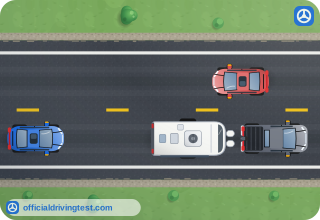
Which of these is a guideline a driver who is towing needs to know and follow?
- Tow cables and taillight hookups
- Radio frequency band limits for trailers
- Seat cover materials and colors
- Tire brand and color requirements
Show answer
Correct answer: Tow cables and taillight hookups
Towing guidelines cover weight limits, vehicle restrictions, tow cables and taillight hookups, service brakes, and licensing and documentation.
Source: Washington Driver Guide (© 2025), page 150 · Open this page in the manual (Manual page 150)
6Part 617 questions
-
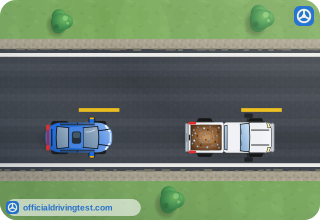
What does the law say about driving with an unsecured load?
- It is allowed if the load is light and short
- It is legal if you drive slowly and carefully
- It is against the law and extremely dangerous
- It is allowed on local roads at low speeds
Show answer
Correct answer: It is against the law and extremely dangerous
An unsecured load is both illegal and extremely dangerous.
Source: Washington Driver Guide (© 2025), page 151 · Open this page in the manual (Manual page 151)
-
How should you secure a load in your vehicle or trailer?
- Stack the items so they press against each other
- Tie everything down with rope, netting, or straps
- Rest the items loosely in the cargo area
- Pile light items on top of heavy ones
Show answer
Correct answer: Tie everything down with rope, netting, or straps
Rope, netting or straps keep items from sliding, shifting or falling onto the road.
Source: Washington Driver Guide (© 2025), page 151 · Open this page in the manual (Manual page 151)
-
Where should large objects be tied?
- To the other items in the load
- To each other, not to the vehicle
- To the tailgate only
- Directly to your vehicle or trailer
Show answer
Correct answer: Directly to your vehicle or trailer
Large objects should be tied directly to the vehicle or trailer.
Source: Washington Driver Guide (© 2025), page 151 · Open this page in the manual (Manual page 151)
-
What should you pack in your vehicle or trailer?
- Anything that fits, if you drive slowly
- Any items, if the heaviest are placed on top
- Only items you can safely and securely carry
- Any items that you cover with a tarp
Show answer
Correct answer: Only items you can safely and securely carry
You should pack only items you can carry safely and securely.
Source: Washington Driver Guide (© 2025), page 151 · Open this page in the manual (Manual page 151)
-
It is illegal to transport an animal outside a vehicle, such as in the bed of a truck, without what?
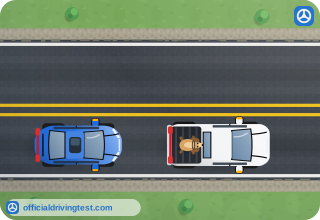
- A protective harness or enclosure
- A warning sign on the tailgate
- A permit from the Department of Licensing
- A water bowl secured in the bed
Show answer
Correct answer: A protective harness or enclosure
The animal needs a protective harness or enclosure so it cannot jump or fall out.
Source: Washington Driver Guide (© 2025), page 151 · Open this page in the manual (Manual page 151)
-
Transporting animals in a way that poses a risk to the animal or public safety is what kind of offense?
- A felony
- A civil infraction
- Only a warning
- A misdemeanor
Show answer
Correct answer: A misdemeanor
Such transport is a misdemeanor under Washington’s Prevention of Cruelty to Animals laws.
Source: Washington Driver Guide (© 2025), page 151 · Open this page in the manual (Manual page 151)
-
If you are taken into custody for any reason, what can an officer do about animals in your vehicle?
- Leave them locked in the vehicle
- Take charge of them
- Release them at the roadside
- Give them to any bystander
Show answer
Correct answer: Take charge of them
An officer can take charge of any animals in the vehicle if you are taken into custody.
Source: Washington Driver Guide (© 2025), page 151 · Open this page in the manual (Manual page 151)
-
What should you avoid doing when oncoming headlights shine at you at night?
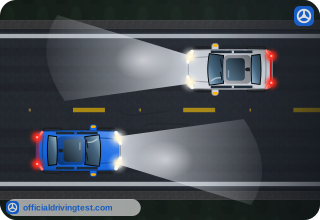
- Searching the road in front of your vehicle
- Looking directly into the oncoming headlights
- Glancing occasionally to the sides
- Looking for dark shapes on the roadway
Show answer
Correct answer: Looking directly into the oncoming headlights
The guide says to avoid looking straight into oncoming lights and to keep your eyes searching the road ahead.
Source: Washington Driver Guide (© 2025), page 167 · Open this page in the manual (Manual page 167)
-
When driving at night, what should you look for beyond your headlight beams?
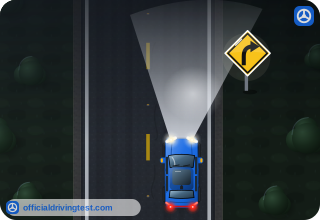
- Reflections from the sun on the pavement
- Brake lights from vehicles two blocks away
- Dark shapes or shadows on the roadway
- Bright flashes from oncoming traffic
Show answer
Correct answer: Dark shapes or shadows on the roadway
Searching past your beams lets you spot dark shapes or shadows that may be hazards.
Source: Washington Driver Guide (© 2025), page 167 · Open this page in the manual (Manual page 167)
-
Why should you glance occasionally to the sides when driving at night?
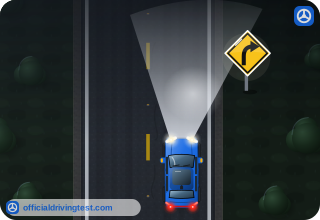
- To find the edge of the pavement and spot hazards from the sides
- To check whether other drivers have their headlights on
- To rest your eyes from the glare of your own lights
- To read road signs that are hard to see ahead
Show answer
Correct answer: To find the edge of the pavement and spot hazards from the sides
Side glances help you locate the pavement edge and notice hazards coming from the sides.
Source: Washington Driver Guide (© 2025), page 167 · Open this page in the manual (Manual page 167)
-
Why should you not wear sunglasses or colored lenses when driving at night?
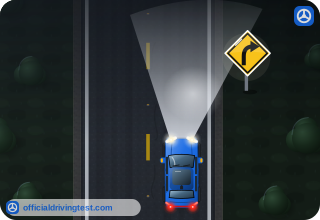
- They make oncoming headlights brighter
- Tinted or colored lenses reduce your vision
- They cause your eyes to dry out
- They make it harder to hear sirens
Show answer
Correct answer: Tinted or colored lenses reduce your vision
The guide says tinted or colored lenses reduce vision, so they should not be worn at night or on overcast days.
Source: Washington Driver Guide (© 2025), page 167 · Open this page in the manual (Manual page 167)
-
If a vehicle comes toward you with its high beams on, where should you look?
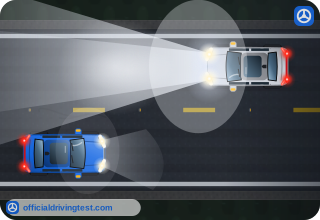
- Toward the right side of the road
- Toward the left side of the road
- Straight at the oncoming headlights
- Down at your dashboard
Show answer
Correct answer: Toward the right side of the road
Looking toward the right side of the road keeps you from being distracted by the glare.
Source: Washington Driver Guide (© 2025), page 167 · Open this page in the manual (Manual page 167)
-
As you approach a curve, where should you position your vehicle in your lane?
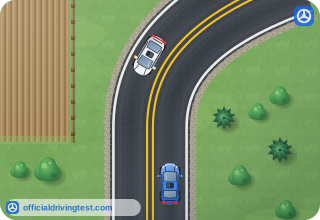
- Slightly to the outside of the lane
- Slightly to the inside of the lane
- Exactly on the lane marking
- In the center of the road
Show answer
Correct answer: Slightly to the outside of the lane
The outside lane position gives more room to maneuver and better visibility around the curve.
Source: Washington Driver Guide (© 2025), page 168 · Open this page in the manual (Manual page 168)
-
How should you steer through a curve?
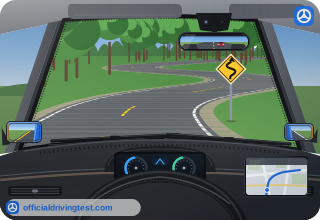
- With quick, sharp movements
- Smoothly and gradually
- By turning the wheel as far as it will go
- By letting go of the wheel briefly
Show answer
Correct answer: Smoothly and gradually
Jerky steering or oversteering can make the vehicle skid, so steer gently.
Source: Washington Driver Guide (© 2025), page 168 · Open this page in the manual (Manual page 168)
-
Why should you check your mirrors as you exit a curve?
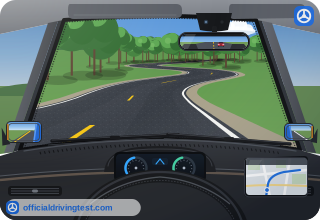
- To see whether your headlights are aimed correctly
- To confirm that no one is following too far behind
- To make sure you have space to merge or change lanes
- To check the condition of your tires
Show answer
Correct answer: To make sure you have space to merge or change lanes
Mirrors tell you whether there is adequate space to merge or change lanes after the curve.
Source: Washington Driver Guide (© 2025), page 168 · Open this page in the manual (Manual page 168)
-
What does inertia do if you suddenly turn the steering wheel in a curve?
- It pulls the car harder into the turn
- It makes the tires grip more firmly
- It stops the car at once
- It tries to keep the car moving straight
Show answer
Correct answer: It tries to keep the car moving straight
Inertia resists the change of direction, which is why you must steer carefully and smoothly.
Source: Washington Driver Guide (© 2025), page 169 · Open this page in the manual (Manual page 169)
-
What is friction, as the guide describes it for driving?
- The force that keeps a moving vehicle going in a straight line
- The force between the tires and the road that grips the surface
- The tilt of a vehicle as it turns
- The energy created by higher speeds
Show answer
Correct answer: The force between the tires and the road that grips the surface
Friction between tires and road lets you slow down, speed up, or turn safely.
Source: Washington Driver Guide (© 2025), page 169 · Open this page in the manual (Manual page 169)