Washington: Cheat Sheet
Key facts and numbers from the driver's manual, on two printable pages — free to print or save.
Independent educational site · not affiliated with any government agency or DMV
Driving Test Practiceofficialdrivingtest.com
Road signs
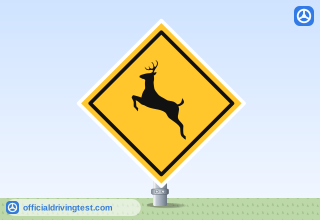 A yellow diamond with a leaping deer is the deer crossing warning sign.
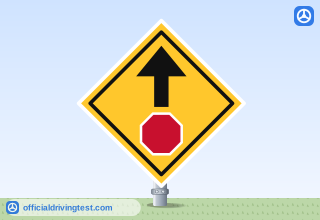 A yellow diamond with a red octagon and an upward arrow is the stop ahead sign.
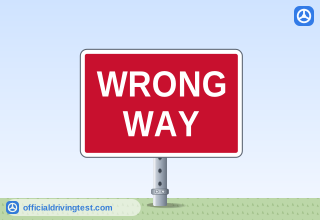 A Wrong Way sign alerts you that you are driving in the wrong direction and helps prevent head-on collisions, so you stop and turn around right away.
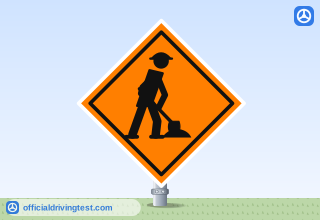 Construction, maintenance and emergency operations signs warn that people are working near the roadway.
- Every camera location is clearly marked, and speeding tickets from them are mailed to the owner of the vehicle.
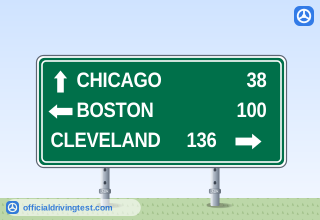 Destination signs give directions and distances to places such as cities, airports, state lines, national parks, historical areas, or museums.
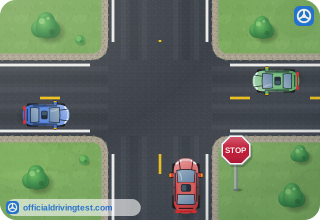 After stopping, you check all directions for crossing vehicles and pedestrians and yield the right-of-way.
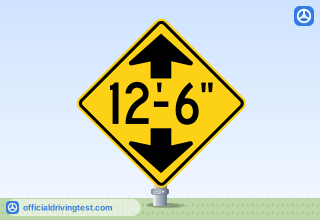 A yellow diamond with a height in feet and inches and up-and-down arrows is the low clearance sign.
Sign shapes and colors
- Yellow signs warn of general and unexpected road conditions.
- Orange is the color used for construction and maintenance warnings.
Traffic signals
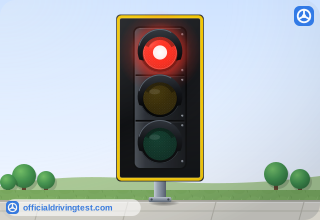 At a solid red light you must stop and wait for green, and the intersection must also be free of vehicles and pedestrians.
- The guide says a flashing green light is not used in Washington, while flashing red, flashing yellow and green arrow signals are.
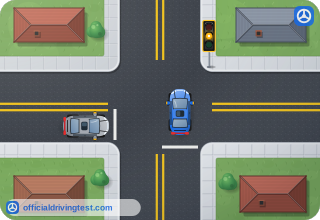 A driver already in the intersection keeps going through at the posted speed.
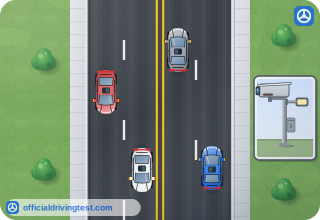 Automated traffic safety cameras record images of drivers who fail to stop at a steady red light.
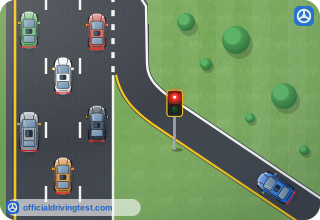 Ramp meters work like regular traffic signals, so on red you stop at the white stop line and go on green.
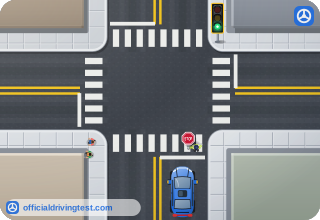 People who direct traffic can overrule signals, and their orders or directions must be followed.
Right-of-way and turning
- The guide says to apply the same right-of-way rules you would use at any other intersection.
- Entering or crossing a state highway from a secondary road is a case where you yield at an uncontrolled intersection.
- The guide says to pay close attention to vehicles, pedestrians, and cyclists coming from both sides at intersections.
- The lane choice sign tells you which lane to pick for a right turn, straight travel, or a left turn.
- The only time you might temporarily travel on the left is when safely and legally passing another vehicle on a two-lane road.
- Checking mirrors and over your shoulder helps you spot a cyclist, motorcyclist, or pedestrian coming into your path.
- You should not enter unless you have room to cross or turn without blocking the intersection.
Alcohol and drugs
- Driving in Washington means you agree to be tested if an officer suspects alcohol or drug impairment.
- The law applies to any person in a vehicle on the road, not only the driver.
- Such an offense can delay a minor’s license until age 17.
- The guide says to wait until you know how a new medicine affects your judgment, coordination, and reaction time.
- The guide says not to ride with a driver who has had any kind or amount of impairing substances.
- The guide says even an experienced driver cannot drive safely after drinking alcohol or using drugs.
Speed and space
- The guide says to watch for feet, wheels, shadows, and movement in, under, and around parked vehicles.
- What is happening behind you can affect your decision, so you check there after spotting the hazard.
- To be prepared, you anticipate hazards by scanning ahead and stay aware of your surroundings.
- Higher speeds create more energy, so you need more time and space to stop or change direction.
- Driving requires you to keep shifting your visual focus and attention between your current position and your target.
- The guide advises driving smoothly because speeding or braking hard uses more fuel.
- Speed limit laws apply even when you use the left lane to pass.
Licensing basics
- You must bring original copies of the documents that prove your identity.
- A 16- or 17-year-old must have held the instruction permit for at least 6 months before getting a first license.
- From 6 months on, up to 3 passengers under age 20 are allowed, not counting immediate family members.
- The guide says properly inflated tires give better gas mileage.
Vehicle controls and equipment
- The guide notes to keep the steering wheel straight while turning your head to look.
- The guide says to signal 100 feet before you make your move.
- Jerky steering or oversteering can make the vehicle skid, so steer gently.
- A lamp out symbol on the dashboard means it is time to replace the bulbs.
Pavement markings
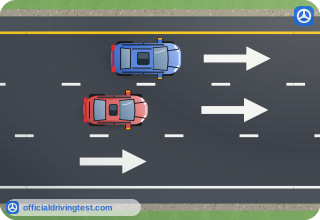 A dashed white line is permission to change lanes when conditions are safe.
- A shared center lane is for left turns from or into the roadway by traffic going either way, and U-turns where they are permitted.
- The guide gives transit lanes as an example of reserved lanes: they are for bus use only.
- Shorter dashed white lines warn that the lane ends; you can cross them if it is safe.
Freeway driving
- Overhead signs tell you whether the lane is open to you at that moment.
- Avoid blocking travel lanes by continuing to move until you can safely pull over.
- The guide says to use the entire on-ramp, your turn signal and your mirrors to merge into a safe space.
Parking rules
- You should always set the parking brake, and especially on a hill.
- You first back up as far as you can toward the vehicle behind you, then pull out.
- You should reverse and adjust the steering wheel instead of pulling out.
- You should park only in designated areas and check for signs that prohibit or limit parking.
Railroad crossings
- Flashing red lights at a railroad crossing mean a train is approaching, so stay outside of the gates.
- You must stop whenever the lights flash and bells ring, whether the gate is down or not, and never drive around the gate.
Pedestrians
- Every intersection is legally a crosswalk, so you must be ready to yield to pedestrians at all of them.
- School zones can be marked with signs, pavement markings, and flashing lights.
- The guide says pedestrians always have the right-of-way in a marked crosswalk.
Sharing the road
- School bus lights work like traffic signals: red means stop and yellow means caution or slow down.
- You may go after the lights stop flashing, the sign is retracted, and the metal arm returns to the front bumper of the bus.
- With one lane each way, you move into the other lane only when there isn't any oncoming traffic.
- Bicyclists can go ahead past vehicles waiting in the ferry holding lane.
Seatbelts and child safety
- An airbag could seriously injure or kill a child under 13, so they should never ride in the front seat.
- Leaving a child under 16 unattended in a parked vehicle with the motor running is a crime.
- Children up to age 2 must ride in a rear-facing car seat.
Distracted and tired driving
- The guide says that like alcohol and drugs, fatigue impairs your vision and judgment.
- The guide says these sounds can give direction or warn you of danger, which is why hearing matters when driving.
- The guide defines it as any activity that pulls your attention away from the main task of driving, not only phone use.
- The guide says you should always aim to be aware, predictable, and smooth.
Hazardous conditions and collisions
- The guide says not to return until you are told it is safe.
- The guide says to check for breathing, then check for bleeding.
- Slippery roads reduce friction a lot, so you should slow down even more and avoid sudden movements.
Emergency vehicles and work zones
- The guide lists driver license, proof of insurance, and vehicle registration.
- Fire trucks, ambulances and police cars using lights and/or sirens always have the right-of-way.
Insurance
- Required liability coverage should provide $25,000 or more for the injury or death of one person in a one-person-injured collision.
- The guide lists insurance company and policy number among what drivers exchange after a collision.
Tickets and losing your license
- Signing a ticket is required and does not admit guilt; refusing could lead to arrest.
- A second violation brings a suspension of 6 months or until the holder turns 18, whichever comes first.