Washington: Pavement markings Practice Test
White and yellow lines, arrows, reversible and reserved lanes, center turn lanes, bicycle lanes and sharrows.
Independent educational site · not affiliated with any government agency or DMV
Ready? Test yourself
Answer to start, or tap Start below:
What are road markings?
- Instant feedback with an explanation
- Every answer cites its source in the manual
- Your best score is saved on this device
- Keyboard: press 1 to 4 to answer and Enter for the next question
Questions are original and based on the official manual "Washington Driver Guide" (© 2025), Washington State Department of Licensing (DOL).
All 26 questions in this practice test
Take the test above first, then use this list to study. Tap “Show answer” to see the correct answer and explanation.
Show the questions and answersHide the questions
-
What are road markings?
- Signs, lights, and flags placed beside the roadway to control traffic and warn drivers of hazards
- Colored curbs and posts used only to show where parking is limited
- Lines, arrows, words, or symbols painted on the roadway to give directions or warnings
- Rules in the traffic law that tell drivers where to stop and turn
Show answer
Correct answer: Lines, arrows, words, or symbols painted on the roadway to give directions or warnings
Road markings are painted on the roadway and are used to divide lanes, show passing and lane changes, and show where to stop.
Source: Washington Driver Guide (© 2025), page 130 · Open this page in the manual (Manual page 130)
-
What do solid white lines mark?
- The edge of the road and the separation of bicycle lanes from other traffic
- The center of a two-way road, where passing is never allowed on either side
- The lane that is ending, where you must merge or exit
- The places where traffic moves in opposite directions
Show answer
Correct answer: The edge of the road and the separation of bicycle lanes from other traffic
Solid white lines mark the road edge and keep bike lanes apart from other traffic.
Source: Washington Driver Guide (© 2025), page 130 · Open this page in the manual (Manual page 130)
-
If there are no markings on the road, where should you drive?
- In the center of the road
- As close to the left side as safely possible
- In whichever lane has the least traffic
- As close to the right side as safely possible
Show answer
Correct answer: As close to the right side as safely possible
Without markings you keep to the right side as far as is safe.
Source: Washington Driver Guide (© 2025), page 130 · Open this page in the manual (Manual page 130)
-
Which lines separate traffic traveling in opposite directions?
- White lines
- Yellow lines
- Red lines
- Green lines
Show answer
Correct answer: Yellow lines
Yellow lines separate opposite directions of travel, while white lines separate lanes moving the same way.
Source: Washington Driver Guide (© 2025), page 131 · Open this page in the manual (Manual page 131)
-
What do shorter dashed white lines mean?
- The lane is reserved for buses and carpools
- The lane is ending, and you will need to merge or exit
- You must stay in your lane and not change lanes
- A bicycle lane begins and you must not enter it
Show answer
Correct answer: The lane is ending, and you will need to merge or exit
Shorter dashed white lines warn that the lane ends; you can cross them if it is safe.
Source: Washington Driver Guide (© 2025), page 131 · Open this page in the manual (Manual page 131)
-
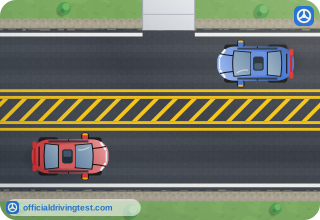
What is the rule about driving within, over, or across medians?
- It is allowed when you signal first
- It is allowed if no vehicles are within 300 feet
- It is allowed only at a crosswalk
- It is illegal
Show answer
Correct answer: It is illegal
Medians divide roadways, and the guide says it is illegal to drive within, over, or across them.
Source: Washington Driver Guide (© 2025), page 131 · Open this page in the manual (Manual page 131)
-
Which of these can be a median?
- 18-inch solid yellow pavement markings with stripes
- A single dashed yellow centerline
- A solid white line along the edge of the road
- A double dashed white line between lanes
Show answer
Correct answer: 18-inch solid yellow pavement markings with stripes
Medians can be open spaces, cement dividers, or wide solid yellow pavement markings with stripes.
Source: Washington Driver Guide (© 2025), page 131 · Open this page in the manual (Manual page 131)
-
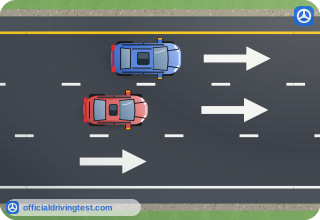
What does a dashed white line between lanes of traffic mean?
- You may never cross it, even when it is safe
- The lane is reserved for buses and carpools
- You can cross it to change lanes if it is safe
- Traffic in the other lane travels in the opposite direction
Show answer
Correct answer: You can cross it to change lanes if it is safe
A dashed white line is permission to change lanes when conditions are safe.
Source: Washington Driver Guide (© 2025), page 132 · Open this page in the manual (Manual page 132)
-
What does a solid white line between lanes mean?
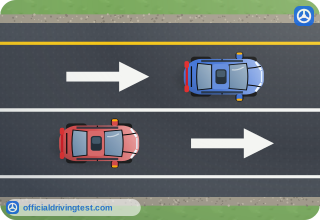
- Stay in your lane unless a special situation requires you to change lanes
- Cross it to pass slower traffic ahead whenever it is safe to do so
- It is illegal to cross it under any circumstances
- The lane ahead is ending and you must merge soon
Show answer
Correct answer: Stay in your lane unless a special situation requires you to change lanes
A solid white line tells you to stay in your lane except in a special situation.
Source: Washington Driver Guide (© 2025), page 132 · Open this page in the manual (Manual page 132)
-
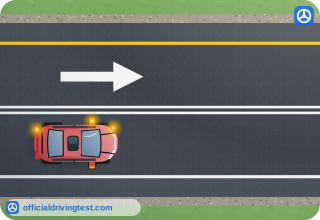
What is the rule for double solid white lines between lanes?
- They allow lane changes when the other lane is clear
- They show the lane is ending and you must merge
- They are a barrier, and it is illegal to cross them
- They separate traffic traveling in opposite directions
Show answer
Correct answer: They are a barrier, and it is illegal to cross them
Double solid white lines act as a barrier between lanes, and crossing them is illegal.
Source: Washington Driver Guide (© 2025), page 132 · Open this page in the manual (Manual page 132)
-
What does a dashed yellow line show?
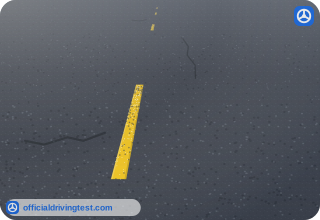
- The boundary of a bike lane that you may not enter
- The center of a two-way, two-lane road, where you may pass when it is safe
- The center of a one-way road where passing is prohibited
- A turn-only area where you must follow through with the turn once you enter
Show answer
Correct answer: The center of a two-way, two-lane road, where you may pass when it is safe
A dashed yellow line marks the center of a two-way, two-lane road, and you may use the oncoming lane to pass if it is safe.
Source: Washington Driver Guide (© 2025), page 132 · Open this page in the manual (Manual page 132)
-
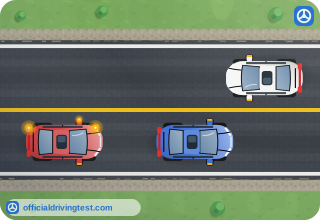
What may a solid yellow line indicate?
- A lane reserved for carpools and buses
- A bike lane separated by a buffer
- The center of a lane that is ending
- The edge of the road or a no-passing zone
Show answer
Correct answer: The edge of the road or a no-passing zone
A solid yellow line can mark the road edge or a no-passing zone, and you must not cross it to pass.
Source: Washington Driver Guide (© 2025), page 132 · Open this page in the manual (Manual page 132)
-
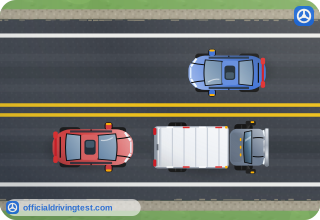
What is the passing rule on a two-way road with double solid yellow centerlines?
- You may pass when the oncoming lane is clear
- Passing is allowed in one direction only
- You may pass a slow vehicle if you signal
- You may not pass in either direction
Show answer
Correct answer: You may not pass in either direction
Double solid yellow centerlines show the middle of a two-way road, and passing is not allowed in either direction.
Source: Washington Driver Guide (© 2025), page 132 · Open this page in the manual (Manual page 132)
-
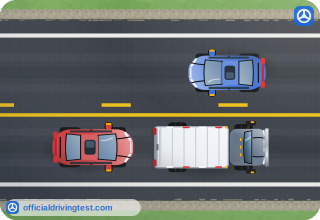
A two-way road is marked with a solid yellow line and a dashed yellow line. When may you pass?
- When the solid line is on your side and it is safe
- When the dashed line is on your side and it is safe
- Whenever the oncoming lane is clear, from either side
- Never, because the solid line applies to both directions
Show answer
Correct answer: When the dashed line is on your side and it is safe
You may not pass when the solid line is on your side; if the dashed line is on your side, you may pass when it is safe.
Source: Washington Driver Guide (© 2025), page 133 · Open this page in the manual (Manual page 133)
-
Once you are in a turn lane, what must you do?
- Change lanes before the intersection
- Go straight if no one is behind you
- Follow through with the turn
- Stop and wait for a green arrow
Show answer
Correct answer: Follow through with the turn
The guide says that once you are in a turn lane you must follow through with the turn.
Source: Washington Driver Guide (© 2025), page 133 · Open this page in the manual (Manual page 133)
-
What may you do with a solid yellow line on your side of the road when a center lane with left turn arrows is next to you?
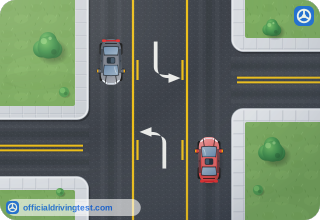
- Cross it to get into the center lane
- Cross it to pass slower traffic
- Never cross it for any reason
- Cross it only after stopping for a few seconds
Show answer
Correct answer: Cross it to get into the center lane
The guide allows crossing a solid yellow line on your side to enter a center lane marked with left turn arrows.
Source: Washington Driver Guide (© 2025), page 133 · Open this page in the manual (Manual page 133)
-
What are shared center lanes reserved for?
- Buses and carpools during morning and evening commuting hours
- Through traffic when the other lanes are heavily congested
- Vehicles making left turns in either direction, or U-turns when permitted
- Vehicles that have broken down and need to wait for help
Show answer
Correct answer: Vehicles making left turns in either direction, or U-turns when permitted
A shared center lane is for left turns from or into the roadway by traffic going either way, and U-turns where they are permitted.
Source: Washington Driver Guide (© 2025), page 133 · Open this page in the manual (Manual page 133)
-
Can you use a shared center lane to pass another vehicle?
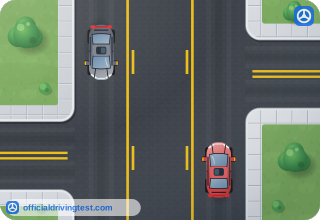
- No, these lanes must not be used for passing
- Yes, if the vehicle ahead is turning left
- Yes, if no oncoming vehicle is using the lane
- Yes, for up to 300 feet
Show answer
Correct answer: No, these lanes must not be used for passing
Shared center lanes are for turning and must not be used for passing.
Source: Washington Driver Guide (© 2025), page 134 · Open this page in the manual (Manual page 134)
-
What is the farthest you should travel in a shared center lane?
- 100 feet
- 500 feet
- 1,000 feet
- 300 feet
Show answer
Correct answer: 300 feet
The guide says you should not travel more than 300 feet in a center lane.
Source: Washington Driver Guide (© 2025), page 134 · Open this page in the manual (Manual page 134)
-
How are reserved lanes identified?
- By signs and/or pavement markings showing the lane is reserved for special uses
- By a solid green line along both edges of the lane and a diamond symbol
- By overhead signs showing a green arrow, and by no markings on the pavement
- By orange cones placed along the lane every day of the week
Show answer
Correct answer: By signs and/or pavement markings showing the lane is reserved for special uses
Reserved lanes have signs or pavement markings that indicate their special use.
Source: Washington Driver Guide (© 2025), page 136 · Open this page in the manual (Manual page 136)
-
Which vehicles may use a transit lane, which is a type of reserved lane?
- Carpools and vanpools only
- Bicycles and scooters only
- Buses only
- Emergency vehicles only
Show answer
Correct answer: Buses only
The guide gives transit lanes as an example of reserved lanes: they are for bus use only.
Source: Washington Driver Guide (© 2025), page 136 · Open this page in the manual (Manual page 136)
-
How are bike lanes marked?
- With solid white lines and bike symbols
- With dashed yellow lines and arrows
- With double white lines and diamond symbols
- With red stripes and bike symbols
Show answer
Correct answer: With solid white lines and bike symbols
Bike lanes use solid white lines and bike symbols.
Source: Washington Driver Guide (© 2025), page 138 · Open this page in the manual (Manual page 138)
-
A bike lane buffer is made of two solid white lines with diagonal crosshatching between them. When should you enter it?
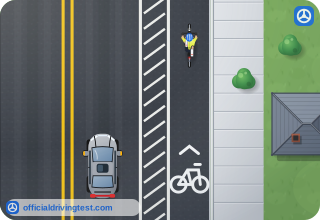
- To pass a slower vehicle traveling in the adjacent travel lane
- To stop and wait for a bicyclist to pass you
- Only when making a legal turn after checking that it is safe
- Whenever the adjacent travel lane is congested with vehicles
Show answer
Correct answer: Only when making a legal turn after checking that it is safe
The buffer counts as part of the bike lane, so you enter it only to make a legal turn after checking that it is safe.
Source: Washington Driver Guide (© 2025), page 138 · Open this page in the manual (Manual page 138)
-
Where must you stop at a stop sign or signal that has a stop line?
- Before your vehicle reaches the stop line or crosswalk
- Past the stop line, but before the intersection
- At the far edge of the crosswalk
- Anywhere before the middle of the intersection
Show answer
Correct answer: Before your vehicle reaches the stop line or crosswalk
The guide says to stop before the vehicle reaches the stop line or crosswalk, if there is one.
Source: Washington Driver Guide (© 2025), page 138 · Open this page in the manual (Manual page 138)
-
How are fire lanes usually marked?
- With yellow stripes or a yellow curb
- With white stripes or a white curb
- With red stripes or a red curb
- With blue stripes or a blue curb
Show answer
Correct answer: With red stripes or a red curb
Fire lanes are normally marked in red, either with stripes or on the curb.
Source: Washington Driver Guide (© 2025), page 138 · Open this page in the manual (Manual page 138)
-
What do yellow stripes painted on the pavement show?
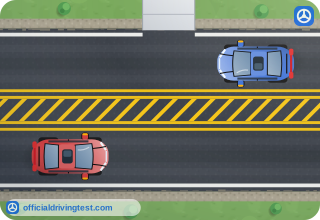
- Where bicycles must ride
- Where the lane ends and you must merge
- Where you may stop to let vehicles pass
- Where you are not allowed to drive
Show answer
Correct answer: Where you are not allowed to drive
Yellow stripes mark areas that vehicles must not drive on.
Source: Washington Driver Guide (© 2025), page 139 · Open this page in the manual (Manual page 139)