Washington: 30 Hardest Driving Test Questions
Questions that need a second thought, picked for close numbers, exceptions and easy-to-confuse rules. Take your time.
Independent educational site · not affiliated with any government agency or DMV
Ready? Test yourself
Answer to start, or tap Start below:
You must not park within how many feet of a fire station driveway on the opposite side of the street?
- Instant feedback with an explanation
- Every answer cites its source in the manual
- Your best score is saved on this device
- Keyboard: press 1 to 4 to answer and Enter for the next question
Questions are original and based on the official manual "Washington Driver Guide" (© 2025), Washington State Department of Licensing (DOL).
All 30 questions in this practice test
Take the test above first, then use this list to study. Tap “Show answer” to see the correct answer and explanation.
Show the questions and answersHide the questions
-
You must not park within how many feet of a fire station driveway on the opposite side of the street?
- 75 feet
- 25 feet
- 100 feet
- 150 feet
Show answer
Correct answer: 75 feet
Parking within 75 feet of a fire station driveway on the opposite side of the street is not allowed.
Source: Washington Driver Guide (© 2025), page 143 · Open this page in the manual (Manual page 143)
-
You must not park within how many feet of a traffic signal, stop sign, or yield sign?
- 10 feet
- 40 feet
- 60 feet
- 30 feet
Show answer
Correct answer: 30 feet
Parking is not allowed within 30 feet of a traffic signal, stop sign or yield sign.
Source: Washington Driver Guide (© 2025), page 143 · Open this page in the manual (Manual page 143)
-
You must not park within how many feet of a driveway, alley, or private road?
- 2 feet
- 10 feet
- 5 feet
- 25 feet
Show answer
Correct answer: 5 feet
Parking within 5 feet of a driveway, alley or private road is prohibited.
Source: Washington Driver Guide (© 2025), page 143 · Open this page in the manual (Manual page 143)
-
How far before a turn across oncoming traffic should you put on your turn signal?
- At least 50 feet before the turn
- At least 300 feet before the turn
- Right as you begin the turn
- At least 100 feet before the turn
Show answer
Correct answer: At least 100 feet before the turn
The guide tells drivers to signal at least 100 feet before turning left or right across oncoming traffic.
Source: Washington Driver Guide (© 2025), page 123 · Open this page in the manual (Manual page 123)
-
How far from the nearest rail of a crossing must you stop when the signal is flashing?
- Between 5 and 10 feet
- Between 50 and 100 feet
- Between 100 and 200 feet
- Between 15 and 50 feet
Show answer
Correct answer: Between 15 and 50 feet
Stop between 15 and 50 feet away from the nearest rail when the signal is flashing.
Source: Washington Driver Guide (© 2025), page 105 · Open this page in the manual (Manual page 105)
-
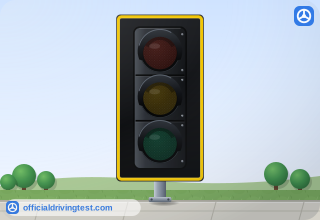
At an intersection with a non-working traffic signal, whom should you yield to after coming to a complete stop?
- Traffic on your left
- Traffic going straight only
- The largest vehicle
- Traffic on your right
Show answer
Correct answer: Traffic on your right
After a complete stop, yield to traffic on your right and proceed cautiously when it is safe.
Source: Washington Driver Guide (© 2025), page 109 · Open this page in the manual (Manual page 109)
-
Roundabouts are designed for what range of speeds?
- 5 to 10 mph
- 30 to 35 mph
- 35 to 45 mph
- 15 to 25 mph
Show answer
Correct answer: 15 to 25 mph
The guide says roundabouts are designed for speeds between 15 and 25 mph, so you slow down when approaching.
Source: Washington Driver Guide (© 2025), page 127 · Open this page in the manual (Manual page 127)
-
What is the speed limit on an ocean beach where driving is allowed?
- 15 mph
- 20 mph
- 25 mph
- 35 mph
Show answer
Correct answer: 25 mph
The beach speed limit is 25 mph.
Source: Washington Driver Guide (© 2025), page 152 · Open this page in the manual (Manual page 152)
-
In the guide's child restraint stages, what size is listed for using the vehicle seat belt?
- Over 4'9"
- Over 3'6"
- Over 4'0"
- Over 5'6"
Show answer
Correct answer: Over 4'9"
The seat belt stage is listed for occupants over 4 feet 9 inches tall.
Source: Washington Driver Guide (© 2025), page 54 · Open this page in the manual (Manual page 54)
-
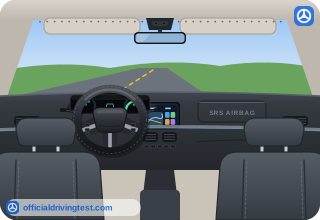
Children under what age should never ride in the front seat because of airbags?
- Under the age of 8
- Under the age of 13
- Under the age of 10
- Under the age of 15
Show answer
Correct answer: Under the age of 13
An airbag could seriously injure or kill a child under 13, so they should never ride in the front seat.
Source: Washington Driver Guide (© 2025), page 54 · Open this page in the manual (Manual page 54)
-
It is a crime to leave a child under what age unattended in a parked vehicle?
- 6
- 8
- 12
- 10
Show answer
Correct answer: 12
Leaving a child under 12 unattended in a parked vehicle is a crime.
Source: Washington Driver Guide (© 2025), page 145 · Open this page in the manual (Manual page 145)
-
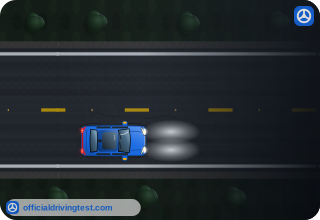
You should drive slowly enough to stop within the glow of your headlights at night. About how far do the headlights usually light the road?
- 100 feet
- 250 feet
- 400 feet
- 600 feet
Show answer
Correct answer: 400 feet
The guide gives 400 feet as the usual distance within which you should be able to stop at night.
Source: Washington Driver Guide (© 2025), page 166 · Open this page in the manual (Manual page 166)
-
According to Washington law, when do you need to have your headlights on?
- From one hour after sunset to one hour before sunrise
- From a half hour before sunset to a half hour after sunrise
- Only when it is raining, snowing, foggy, or smoky
- From a half hour after sunset to a half hour before sunrise
Show answer
Correct answer: From a half hour after sunset to a half hour before sunrise
Washington law requires headlights from a half hour after sunset until a half hour before sunrise.
Source: Washington Driver Guide (© 2025), page 49 · Open this page in the manual (Manual page 49)
-
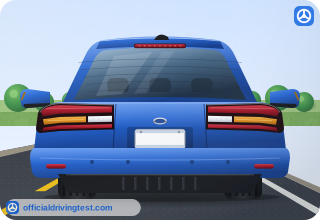
If you are stopping or slowing down where the person behind you might not expect it, what does the guide suggest?
- Tap your brake pedal three or four times quickly
- Press the brake pedal once and hold it down firmly
- Flash your high beams at the vehicle behind you
- Sound your horn three or four times quickly
Show answer
Correct answer: Tap your brake pedal three or four times quickly
A few quick taps on the brake pedal alert the driver behind you that you are about to slow or stop.
Source: Washington Driver Guide (© 2025), page 49 · Open this page in the manual (Manual page 49)
-
When using high beams, how far behind another vehicle should you switch back to regular headlights?
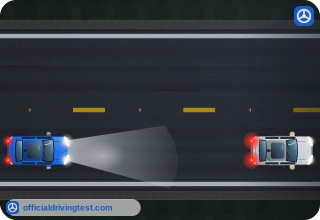
- 150 feet
- 300 feet
- 600 feet
- 1,000 feet
Show answer
Correct answer: 300 feet
You should switch back to regular headlights when you are 300 feet behind another vehicle.
Source: Washington Driver Guide (© 2025), page 50 · Open this page in the manual (Manual page 50)
-
When using high beams, how far in front of an oncoming vehicle should you switch back to regular headlights?
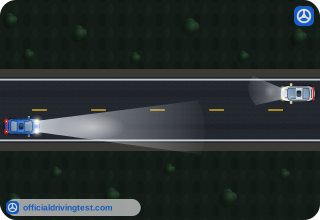
- 250 feet
- 750 feet
- 500 feet
- 1,000 feet
Show answer
Correct answer: 500 feet
You should switch back to regular headlights when you are 500 feet in front of an oncoming vehicle.
Source: Washington Driver Guide (© 2025), page 50 · Open this page in the manual (Manual page 50)
-
A motorcyclist is riding far to one side of a wide lane. May you move into the same lane alongside the motorcyclist?
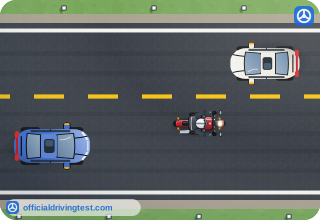
- Yes, if the lane is wide enough
- Yes, if you pass slowly
- No, never, even if the lane is wide
- Yes, if the motorcyclist signals you
Show answer
Correct answer: No, never, even if the lane is wide
Never move into the same lane alongside a motorcyclist, even if the lane is wide.
Source: Washington Driver Guide (© 2025), page 101 · Open this page in the manual (Manual page 101)
-
When may you drive in a bicycle lane?
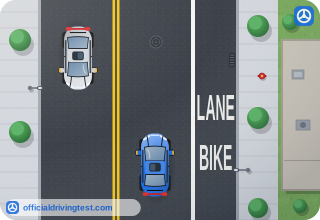
- Only when turning or crossing it to park near the curb
- When traffic in the other lanes is stopped or moving slowly
- When you need to pass a slow vehicle on the right
- Whenever no bicyclist is in sight and you are hurrying
Show answer
Correct answer: Only when turning or crossing it to park near the curb
Drive in bicycle lanes only when turning or crossing the lane to park near the curb.
Source: Washington Driver Guide (© 2025), page 104 · Open this page in the manual (Manual page 104)
-
How far does it take a loaded truck with properly adjusted brakes, traveling at 55 mph, to come to a complete stop?
- 450 feet
- 250 feet
- 650 feet
- 900 feet
Show answer
Correct answer: 450 feet
Such a truck needs 450 feet to stop, so cutting in front of it without enough space is dangerous.
Source: Washington Driver Guide (© 2025), page 98 · Open this page in the manual (Manual page 98)
-
How far behind your disabled vehicle should you place emergency flares?
- 10 to 20 feet
- 50 to 75 feet
- 200 to 300 feet
- 500 to 600 feet
Show answer
Correct answer: 200 to 300 feet
Flares 200 to 300 feet behind the vehicle warn other road users.
Source: Washington Driver Guide (© 2025), page 173 · Open this page in the manual (Manual page 173)
-
Within how many days of a crash must you file a collision report form if a law enforcement officer does not file one for you?
- 24 hours
- 4 days
- 10 days
- 30 days
Show answer
Correct answer: 4 days
State law requires the form within 4 days when no officer files it.
Source: Washington Driver Guide (© 2025), page 176 · Open this page in the manual (Manual page 176)
-
If power lines fall on your vehicle or you hit a transformer box, how far away should you encourage people to stay, when possible?
- At least 5 feet
- At least 35 feet
- At least 10 feet
- At least 100 feet
Show answer
Correct answer: At least 35 feet
The ground around the vehicle could also be energized, so bystanders should keep at least 35 feet away.
Source: Washington Driver Guide (© 2025), page 178 · Open this page in the manual (Manual page 178)
-
What does a flashing yellow light mean?
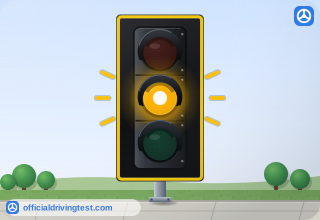
- The same as a stop sign: stop fully and go when it is your turn
- The light will turn red soon, so you must stop at the line
- You have the right-of-way, so cross traffic must stop for you
- The same as a yield sign: go when you have the right-of-way
Show answer
Correct answer: The same as a yield sign: go when you have the right-of-way
A flashing yellow light is handled like a yield sign at an uncontrolled intersection, so you go only when you have the right-of-way.
Source: Washington Driver Guide (© 2025), page 111 · Open this page in the manual (Manual page 111)
-
What is the least amount that required liability insurance should provide for the bodily injury or death of two or more persons in any one collision?
- $30,000
- $75,000
- $100,000
- $50,000
Show answer
Correct answer: $50,000
Required liability coverage should provide $50,000 or more for the injury or death of two or more people in one collision.
Source: Washington Driver Guide (© 2025), page 43 · Open this page in the manual (Manual page 43)
-
After the first 6 months, what is the passenger limit for an intermediate driver license holder until age 18 or one year, whichever comes first?
- No more than 3 passengers under age 20 except immediate family members
- No more than 2 passengers under age 20 except immediate family members
- No more than 3 passengers under age 18 except immediate family members
- No more than 5 passengers of any age except immediate family members
Show answer
Correct answer: No more than 3 passengers under age 20 except immediate family members
From 6 months on, up to 3 passengers under age 20 are allowed, not counting immediate family members.
Source: Washington Driver Guide (© 2025), page 28 · Open this page in the manual (Manual page 28)
-
Who may accompany an intermediate driver license holder driving between 1 a.m. and 5 a.m.?
- A parent, guardian, or licensed driver at least age 21
- A parent, guardian, or licensed driver at least age 25
- Any licensed driver who is at least age 18
- Only an immediate family member who is 18 or older
Show answer
Correct answer: A parent, guardian, or licensed driver at least age 25
Driving at those hours is allowed only with a parent, guardian, or licensed driver who is at least age 25.
Source: Washington Driver Guide (© 2025), page 28 · Open this page in the manual (Manual page 28)
-
What is the penalty for a second traffic violation or at-fault collision by an intermediate driver license holder?
- The license is suspended for 1 year or until you turn 18, whichever comes first
- The license is suspended for 3 months or until you turn 17, whichever comes first
- The current restrictions continue for 6 more months, then are lifted
- The license is suspended for 6 months or until you turn 18, whichever comes first
Show answer
Correct answer: The license is suspended for 6 months or until you turn 18, whichever comes first
A second violation brings a suspension of 6 months or until the holder turns 18, whichever comes first.
Source: Washington Driver Guide (© 2025), page 29 · Open this page in the manual (Manual page 29)
-
What risk do minors who receive an alcohol, drug, or firearm offense run?
- Delaying their license until they are 16
- Delaying their license until they are 18
- Delaying their license until they are 21
- Delaying their license until they are 17
Show answer
Correct answer: Delaying their license until they are 17
Such an offense can delay a minor’s license until age 17.
Source: Washington Driver Guide (© 2025), page 36 · Open this page in the manual (Manual page 36)
-
For how long can driving privileges be suspended after a DUI conviction?
- 30 days to 1 year
- 90 days to 4 years
- 6 months to 2 years
- 1 to 10 years
Show answer
Correct answer: 90 days to 4 years
A conviction can include a suspension of driving privileges for 90 days to 4 years.
Source: Washington Driver Guide (© 2025), page 38 · Open this page in the manual (Manual page 38)
-
If you refuse to be tested, how long could you lose your driving privilege?
- 90 to 730 days, or until you reach age 21, whichever is longer
- 30 to 90 days, or until you reach age 18, whichever is longer
- 180 to 365 days, or until you reach age 19, whichever is shorter
- 1 to 4 years, or until you reach age 25, whichever is longer
Show answer
Correct answer: 90 to 730 days, or until you reach age 21, whichever is longer
A refusal can mean a suspension of 90 to 730 days or until age 21, whichever is longer, depending on factors such as prior violations.
Source: Washington Driver Guide (© 2025), page 37 · Open this page in the manual (Manual page 37)