Washington: Vehicle controls and equipment — Part 3 Practice Test
Questions in this part include: “When should you use hand signals?” · “When should you turn on your flashing hazard lights?”
Independent educational site · not affiliated with any government agency or DMV
Ready? Test yourself
Answer to start, or tap Start below:
When should you use hand signals?
- Instant feedback with an explanation
- Every answer cites its source in the manual
- Your best score is saved on this device
- Keyboard: press 1 to 4 to answer and Enter for the next question
Questions are original and based on the official manual "Washington Driver Guide" (© 2025), Washington State Department of Licensing (DOL).
All 17 questions in this practice test
Take the test above first, then use this list to study. Tap “Show answer” to see the correct answer and explanation.
Show the questions and answersHide the questions
-
When should you use hand signals?
- When one or both of your signals aren't working
- When you are driving slowly in a parking lot
- When you are turning on a street with little traffic
- When you are driving through a school zone slowly
Show answer
Correct answer: When one or both of your signals aren't working
Hand signals let other drivers know what you are doing when one or both signals do not work.
Source: Washington Driver Guide (© 2025), page 51 · Open this page in the manual (Manual page 51)
-
Which hand signal tells the driver behind you to slow down and prepare to stop?
- Left arm out the window, fingers pointing straight out to the left
- Left arm out the window, arm bent so fingers point to the sky
- Left arm out the driver-side window, fingers pointing to the ground
- Right arm out the passenger window, fingers pointing to the ground
Show answer
Correct answer: Left arm out the driver-side window, fingers pointing to the ground
The stop signal is the left arm out the driver-side window with the fingers pointing down toward the ground.
Source: Washington Driver Guide (© 2025), page 51 · Open this page in the manual (Manual page 51)
-
Which hand signal indicates a left turn?
- Left arm out the window, fingers pointing to the ground
- Left arm out the window, fingers pointing straight out to the left
- Left arm out the window, arm bent so fingers point to the sky
- Right arm out the passenger window, fingers pointing to the right
Show answer
Correct answer: Left arm out the window, fingers pointing straight out to the left
For a left turn, the left arm goes out the window with the fingers pointing straight out to the left.
Source: Washington Driver Guide (© 2025), page 51 · Open this page in the manual (Manual page 51)
-
Which hand signal indicates a right turn?
- Left arm out the window, fingers pointing to the ground
- Left arm out the window, fingers pointing straight out to the left
- Right arm out the passenger window, fingers pointing to the sky
- Left arm out the window, arm bent so fingers point to the sky
Show answer
Correct answer: Left arm out the window, arm bent so fingers point to the sky
For a right turn, the left arm goes out the window and is bent so the fingers point up to the sky.
Source: Washington Driver Guide (© 2025), page 51 · Open this page in the manual (Manual page 51)
-
When should you turn on your flashing hazard lights?
- When you are about to pass another vehicle on a two-lane road
- When you are slowing down to make a turn at an intersection
- When your car malfunctions or you need to make an emergency stop
- When you want other drivers to let you merge into their lane
Show answer
Correct answer: When your car malfunctions or you need to make an emergency stop
Flashing hazard lights warn other drivers of a malfunction or emergency stop so they can go around you safely.
Source: Washington Driver Guide (© 2025), page 51 · Open this page in the manual (Manual page 51)
-
What is the minimum distance your chest should be from the steering wheel to leave space for the airbag?
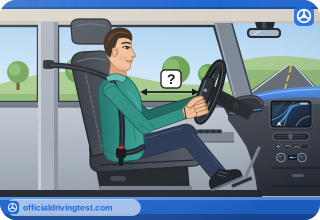
- 10 inches
- 3 inches
- 5 inches
- 7 inches
Show answer
Correct answer: 10 inches
Your chest should be at least 10 inches from the steering wheel so the airbag has room.
Source: Washington Driver Guide (© 2025), page 51 · Open this page in the manual (Manual page 51)
-
How should you adjust the steering wheel?
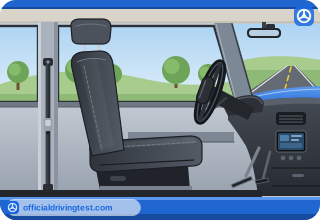
- So your arms are fully straight when you grip it
- So the wheel rests lightly against your chest
- So you can hold it with only your fingertips
- So you can grip it with a gentle bend in your elbow
Show answer
Correct answer: So you can grip it with a gentle bend in your elbow
The steering wheel is set so you can grip it with a gentle bend in your elbow.
Source: Washington Driver Guide (© 2025), page 51 · Open this page in the manual (Manual page 51)
-
To protect yourself from whiplash, where should the headrest be?
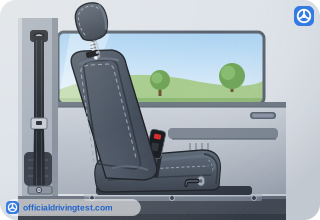
- Even with your shoulders
- Even with your ears
- Even with the top of your head
- Even with your eyes
Show answer
Correct answer: Even with your ears
A headrest that is even with your ears helps protect you from whiplash.
Source: Washington Driver Guide (© 2025), page 51 · Open this page in the manual (Manual page 51)
-
Where should you place your hands on the steering wheel to get the best control?
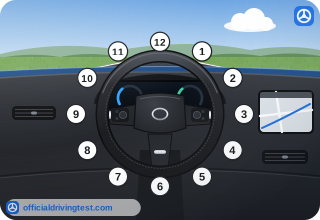
- Outside the wheel, on the top half
- Outside the wheel, on the bottom half
- Inside the wheel, near the center
- On the spokes, near the horn
Show answer
Correct answer: Outside the wheel, on the top half
Hands on the outside of the top half of the wheel give the best control.
Source: Washington Driver Guide (© 2025), page 55 · Open this page in the manual (Manual page 55)
-
How many turning methods does the guide describe for smooth, continuous steering control?
- Two
- Four
- Three
- Five
Show answer
Correct answer: Three
The guide presents three turning methods: hand-to-hand, hand-over-hand, and one-hand steering.
Source: Washington Driver Guide (© 2025), page 55 · Open this page in the manual (Manual page 55)
-
Where should your hands be when you use hand-to-hand (pull/push) steering?
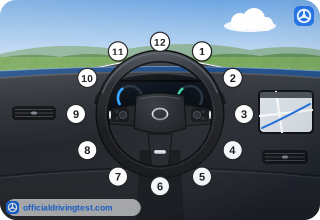
- At 12 and 6 or 11 and 5
- At 9 and 3 or 10 and 2
- At 8 and 4 or 11 and 1
- At 7 and 5 or 12 and 6
Show answer
Correct answer: At 9 and 3 or 10 and 2
For hand-to-hand steering the hands stay at 9 and 3 or 10 and 2.
Source: Washington Driver Guide (© 2025), page 56 · Open this page in the manual (Manual page 56)
-
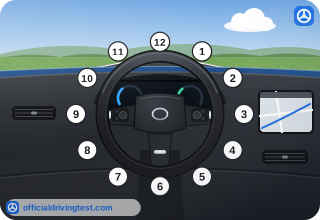
Why does hand-to-hand steering lower the chance of injury to the face, hands, or arms if the air bag deploys?
- Your arms stay straight and locked in place
- Your hands stay low on the bottom of the wheel
- You steer with only one hand at the 12 position
- Your hands never cross over the steering wheel
Show answer
Correct answer: Your hands never cross over the steering wheel
Because the hands never cross over the wheel, there is less chance of injury to the face, hands, or arms if the air bag deploys.
Source: Washington Driver Guide (© 2025), page 56 · Open this page in the manual (Manual page 56)
-
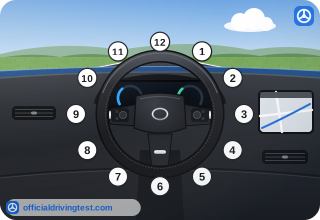
In hand-to-hand steering, what does the hand that is not gripping and steering the wheel do?
- It slides and stays opposite the steering hand
- It rests in your lap until the turn is done
- It reaches across the other arm to pull
- It lets go of the wheel and is repositioned
Show answer
Correct answer: It slides and stays opposite the steering hand
One hand grips and steers while the other slides and remains opposite it, so both hands stay on the wheel.
Source: Washington Driver Guide (© 2025), page 56 · Open this page in the manual (Manual page 56)
-
Which situation calls for hand-over-hand steering?
- Driving straight at highway speeds
- Backing with one hand at the 12 position
- Turning at low speeds
- Reaching to operate the wipers or flashers
Show answer
Correct answer: Turning at low speeds
Hand-over-hand is used for low-speed turns, limited visibility, intersections, parking, and recovering from a skid.
Source: Washington Driver Guide (© 2025), page 57 · Open this page in the manual (Manual page 57)
-
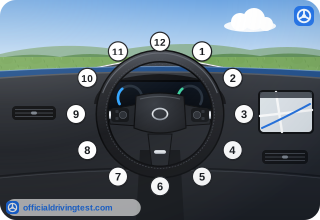
How do you turn the wheel with hand-over-hand steering?
- Slide one hand along the wheel while the other pushes
- Reach one arm across the other to grasp the wheel and pull
- Keep both hands still and turn your body instead
- Hold the wheel with one hand at the 12 position
Show answer
Correct answer: Reach one arm across the other to grasp the wheel and pull
In hand-over-hand steering one arm reaches across the other to grasp and pull the wheel, and the hand underneath is then repositioned.
Source: Washington Driver Guide (© 2025), page 57 · Open this page in the manual (Manual page 57)
-
Which situation calls for one-hand steering?
- Turning at an intersection
- Recovering from a skid
- Turning at low speeds with limited visibility
- Backing the vehicle
Show answer
Correct answer: Backing the vehicle
One-hand steering is used when backing or when a hand must leave the wheel to operate controls such as wipers, flashers, or lights.
Source: Washington Driver Guide (© 2025), page 58 · Open this page in the manual (Manual page 58)
-
When is the 12 position on the steering wheel recommended?
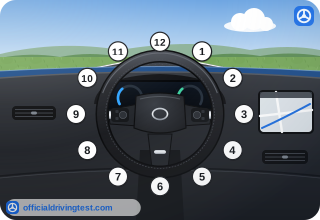
- Only when backing a vehicle
- When turning at an intersection
- When driving on a freeway
- When recovering from a skid
Show answer
Correct answer: Only when backing a vehicle
The 12 position is recommended only for backing.
Source: Washington Driver Guide (© 2025), page 58 · Open this page in the manual (Manual page 58)