Washington: Vehicle controls and equipment — Part 4 Practice Test
Questions in this part include: “How many levels of braking does the guide describe?” · “When you accelerate, where does the weight of the vehicle shift?”
Independent educational site · not affiliated with any government agency or DMV
Ready? Test yourself
Answer to start, or tap Start below:
How many levels of braking does the guide describe?
- Instant feedback with an explanation
- Every answer cites its source in the manual
- Your best score is saved on this device
- Keyboard: press 1 to 4 to answer and Enter for the next question
Questions are original and based on the official manual "Washington Driver Guide" (© 2025), Washington State Department of Licensing (DOL).
All 17 questions in this practice test
Take the test above first, then use this list to study. Tap “Show answer” to see the correct answer and explanation.
Show the questions and answersHide the questions
-
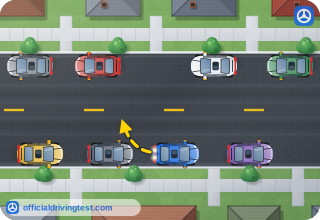
When you back up with one hand at the 12 position, what should you do to see where you are going?
- Look only in your rearview and side mirrors
- Keep your body facing forward and look ahead
- Turn your body to see the path behind you
- Steer by feel without looking behind you
Show answer
Correct answer: Turn your body to see the path behind you
The guide says to turn your body to see the path of travel behind you when backing.
Source: Washington Driver Guide (© 2025), page 58 · Open this page in the manual (Manual page 58)
-
How many levels of braking does the guide describe?
- Two
- Four
- Three
- Five
Show answer
Correct answer: Four
The levels are light, medium, firm, and emergency braking.
Source: Washington Driver Guide (© 2025), page 58 · Open this page in the manual (Manual page 58)
-
Which levels of braking will you ideally need to use?
- Firm and emergency
- Medium and firm
- Light and emergency
- Light and medium
Show answer
Correct answer: Light and medium
Ideally only light and medium braking is needed, though firm or emergency braking can always be used when necessary.
Source: Washington Driver Guide (© 2025), page 59 · Open this page in the manual (Manual page 59)
-
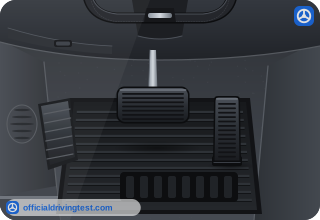
What important safety advantage does an antilock brake system (ABS) offer?
- It lets you brake without using the pedal
- It reduces the need to check your mirrors
- It lets drivers steer during emergency braking
- It keeps the engine from stalling
Show answer
Correct answer: It lets drivers steer during emergency braking
ABS allows the driver to keep steering while braking in an emergency.
Source: Washington Driver Guide (© 2025), page 59 · Open this page in the manual (Manual page 59)
-
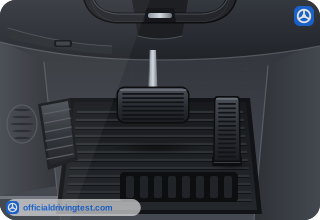
What might you feel when your antilock brake system (ABS) is engaged?
- The steering wheel locks in place
- The brake pedal drops to the floor
- The engine speeds up
- Your vehicle shakes a bit
Show answer
Correct answer: Your vehicle shakes a bit
An engaged ABS makes the vehicle shake slightly as it keeps the wheels from locking up.
Source: Washington Driver Guide (© 2025), page 59 · Open this page in the manual (Manual page 59)
-
Where should you practice firm or emergency braking?
- In a large, open, and paved space
- On a narrow neighborhood street
- On an unpaved road with loose gravel
- In the right lane of a busy road
Show answer
Correct answer: In a large, open, and paved space
The guide advises practicing hard braking in a large, open, paved space and feeling the ABS keep the wheels from locking.
Source: Washington Driver Guide (© 2025), page 59 · Open this page in the manual (Manual page 59)
-
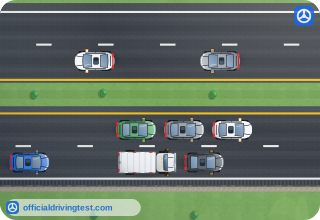
In stop-and-go traffic, what may be the only acceleration you need?
- Pressing firmly on the accelerator
- A quick burst of speed
- Releasing the brake pedal
- Pumping the accelerator
Show answer
Correct answer: Releasing the brake pedal
In stop-and-go traffic you may only need to release the brake pedal to move forward.
Source: Washington Driver Guide (© 2025), page 59 · Open this page in the manual (Manual page 59)
-
What helps keep a vehicle’s weight evenly balanced across the tires?
- Keeping all heavy items in the trunk
- Regular maintenance, correct tire pressure, and alignment checks
- Using cruise control at all times on every road
- Turning the steering wheel often while the vehicle is stopped
Show answer
Correct answer: Regular maintenance, correct tire pressure, and alignment checks
Maintenance, correct tire pressure, and alignment checks help maintain the vehicle’s stability.
Source: Washington Driver Guide (© 2025), page 60 · Open this page in the manual (Manual page 60)
-
When you accelerate, where does the weight of the vehicle shift?
- To the back, increasing pressure on the rear
- To the front, increasing pressure on the front
- To the left side
- To the right side
Show answer
Correct answer: To the back, increasing pressure on the rear
Acceleration shifts the vehicle's weight toward the rear.
Source: Washington Driver Guide (© 2025), page 60 · Open this page in the manual (Manual page 60)
-
What happens to the weight of the vehicle if you stop abruptly?
- It shifts to the back, increasing pressure on the rear
- It shifts to the outside tires
- It shifts forward, increasing pressure on the front
- It stays evenly balanced
Show answer
Correct answer: It shifts forward, increasing pressure on the front
An abrupt stop throws the weight toward the front of the vehicle.
Source: Washington Driver Guide (© 2025), page 60 · Open this page in the manual (Manual page 60)
-
When you make a left turn, to which side of the vehicle does centrifugal force transfer the weight?
- The inside, or left side
- The outside, or right side
- The front end
- The rear end
Show answer
Correct answer: The outside, or right side
In a left turn the weight is pushed down on the outside, right side, so the body of the vehicle rolls to one side.
Source: Washington Driver Guide (© 2025), page 61 · Open this page in the manual (Manual page 61)
-
When you turn the steering wheel sharply from side to side, what might the back of your car do?
- Stay perfectly lined up with the front wheels
- Steer itself back to center
- Tilt forward over the front wheels
- Slide a bit, creating a zig-zag motion
Show answer
Correct answer: Slide a bit, creating a zig-zag motion
The front wheels turn the way you steer while the back may slide a bit, making a zig-zag motion.
Source: Washington Driver Guide (© 2025), page 62 · Open this page in the manual (Manual page 62)
-
Familiarity with your vehicle reference points helps you do what?
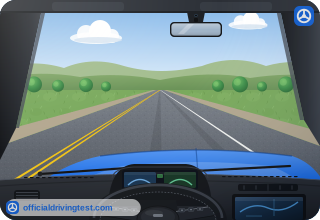
- Judge distance when you park, turn, back, and stop
- Estimate how much fuel you have left
- Tell when your tires need more air
- Measure how fast you are going in sharp turns
Show answer
Correct answer: Judge distance when you park, turn, back, and stop
Reference points help you judge distance for parking, turning, backing, and stopping.
Source: Washington Driver Guide (© 2025), page 62 · Open this page in the manual (Manual page 62)
-
Which of these is an example of a vehicle reference point?
- Dashboard clock
- Rear window defroster
- Center of hood
- Tire valve stem
Show answer
Correct answer: Center of hood
Examples of reference points include the left headlight, center of the hood, side view mirrors, and rear bumper.
Source: Washington Driver Guide (© 2025), page 62 · Open this page in the manual (Manual page 62)
-
At an intersection, how far are you from the stop line when the line is under your side mirror?
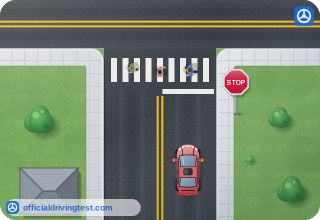
- About 1 foot
- About 3 to 6 inches
- About 2 feet
- About 3 feet
Show answer
Correct answer: About 3 to 6 inches
With the stop line under the side mirror you are about 3 to 6 inches from it.
Source: Washington Driver Guide (© 2025), page 62 · Open this page in the manual (Manual page 62)
-
If the center of your hood is in line with the lane markings, how far are you from the edge of the lane?
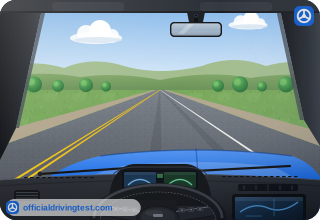
- Approximately 1 to 2 feet
- Approximately 10 to 12 inches
- Approximately 18 inches
- Approximately 3 to 6 inches
Show answer
Correct answer: Approximately 3 to 6 inches
When the center of the hood lines up with the lane markings you are about 3 to 6 inches from the lane edge.
Source: Washington Driver Guide (© 2025), page 63 · Open this page in the manual (Manual page 63)
-
What are blind zones?
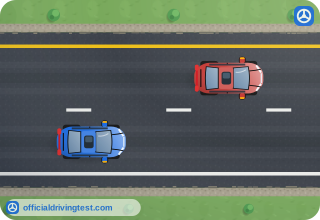
- Areas around a vehicle you can’t see from the driver’s seat
- Areas where other drivers cannot see your headlights
- Stretches of road with no lane markings
- Areas of the road hidden by darkness or fog
Show answer
Correct answer: Areas around a vehicle you can’t see from the driver’s seat
Blind zones are the areas around a vehicle that the driver cannot see from the seat.
Source: Washington Driver Guide (© 2025), page 63 · Open this page in the manual (Manual page 63)