Pennsylvania: Emergencies and special situations
Skids, breakdowns, floods, and being stopped by police. Split into 6 shorter tests so you're not stuck in one long quiz.
Independent educational site · not affiliated with any government agency or DMV
Choose a part
Emergencies and special situations — Part 1
Questions in this part include: “According to the manual, why should you maintain a constant supply of fresh air in your vehicle while driving?”
Emergencies and special situations — Part 2
Questions in this part include: “What does the manual say you should never do on the road, even if another driver upsets you?”
Emergencies and special situations — Part 3
Skids, breakdowns, floods, and being stopped by police. — Part 3
Emergencies and special situations — Part 4
Questions in this part include: “According to the manual, how can you best protect against a tire blowout?”
Emergencies and special situations — Part 5
Questions in this part include: “About how far off the ground should the jack raise the tire when changing it?”
Emergencies and special situations — Part 6
Questions in this part include: “According to the manual, what do all real police officers always carry?”
Questions are original and based on the official manual "Pennsylvania Driver's Manual" (Pub 95), Pennsylvania Department of Transportation (PennDOT), Bureau of Driver Licensing.
All 107 Emergencies and special situations questions with answers
Choose a part above to take a practice test, or study every question and answer here.
Show the questions and answersHide the questions
1Part 118 questions
-
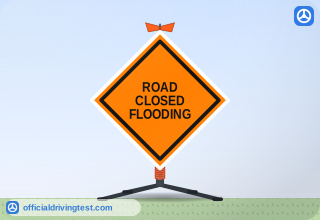
A ROAD CLOSED FLOODING sign informs you that:
- flooding is possible but the road remains open
- only heavy trucks are restricted from the road
- the flooding has already cleared
- the road is closed and you must use an alternate route
Show answer
Correct answer: the road is closed and you must use an alternate route
This sign informs you that the road ahead is closed due to flooding; you must use an alternate route.
Source: Pennsylvania Driver's Manual (Pub 95), page 18 · Open this page in the manual (Manual page 18)
-
According to the manual, which of the following should you keep in your vehicle at all times to help you deal with a flat tire?
- A tire pressure gauge only
- A full-size replacement wheel only
- Nothing — roadside assistance should always be called instead
- A spare tire, lug wrench, jack and flashlight
Show answer
Correct answer: A spare tire, lug wrench, jack and flashlight
The manual recommends keeping tools such as a spare tire, lug wrench, jack, flashlight, flares/reflective triangles, wheel wedges, a flat tire repair kit and gloves in your vehicle.
Source: Pennsylvania Driver's Manual (Pub 95), page 31 · Open this page in the manual (Manual page 31)
-
According to the manual, why should you maintain a constant supply of fresh air in your vehicle while driving?
- To keep the windows from fogging only
- To stay alert and avoid carbon monoxide poisoning
- To reduce road noise inside the passenger cabin
- To keep the tires cool
Show answer
Correct answer: To stay alert and avoid carbon monoxide poisoning
A constant supply of fresh air helps you stay alert and guards against carbon monoxide (exhaust gas) poisoning.
Source: Pennsylvania Driver's Manual (Pub 95), page 32 · Open this page in the manual (Manual page 32)
-
According to the manual, driving while fatigued has effects similar to driving under the influence of what?
- Caffeine
- Nicotine
- Motion sickness
- Alcohol
Show answer
Correct answer: Alcohol
Driving while fatigued has similar effects as driving under the influence of alcohol.
Source: Pennsylvania Driver's Manual (Pub 95), page 33 · Open this page in the manual (Manual page 33)
-
According to the manual, being awake for 18 hours in a row impairs your driving about as much as having a blood alcohol level of what percent?
- .05 percent
- .02 percent
- .08 percent
- .10 percent
Show answer
Correct answer: .05 percent
Being awake for 18 hours impairs your driving about as much as a blood alcohol level of .05 percent.
Source: Pennsylvania Driver's Manual (Pub 95), page 33 · Open this page in the manual (Manual page 33)
-
According to the manual, being awake for 24 hours in a row impairs your driving about as much as having a blood alcohol level of what percent?
- .05 percent
- .10 percent
- .08 percent
- .15 percent
Show answer
Correct answer: .10 percent
Being awake for 24 hours in a row impairs your driving as much as having a blood alcohol level of .10 percent.
Source: Pennsylvania Driver's Manual (Pub 95), page 33 · Open this page in the manual (Manual page 33)
-
According to the manual, teens who sleep less than how many hours a night are at increased risk for vehicle crashes?
- Six hours
- Seven hours
- Eight hours
- Nine hours
Show answer
Correct answer: Eight hours
Teens who sleep less than eight (8) hours a night are at increased risk for vehicle crashes.
Source: Pennsylvania Driver's Manual (Pub 95), page 33 · Open this page in the manual (Manual page 33)
-
According to the manual, what is the best thing to do if you begin to feel tired while driving?
- Turn up the radio
- Open the window and drive faster
- Drink coffee and continue driving
- Stop driving
Show answer
Correct answer: Stop driving
The best thing to do if you begin to feel tired while driving is to stop driving.
Source: Pennsylvania Driver's Manual (Pub 95), page 33 · Open this page in the manual (Manual page 33)
-
According to the manual, falling asleep while driving causes at least how many crashes across the U.S. every year?
- 100,000
- 10,000
- 50,000
- 500,000
Show answer
Correct answer: 100,000
Every year across the U.S., falling asleep while driving causes at least 100,000 crashes.
Source: Pennsylvania Driver's Manual (Pub 95), page 33 · Open this page in the manual (Manual page 33)
-
According to the manual, about how many people die each year in crashes linked to drowsy driving in the U.S.?
- 150
- 1,500
- 500
- 5,000
Show answer
Correct answer: 1,500
1,500 people die and 40,000 are injured in drowsy driving crashes each year.
Source: Pennsylvania Driver's Manual (Pub 95), page 33 · Open this page in the manual (Manual page 33)
-
According to the manual, of the 100,000 vehicle crashes linked to drowsy driving each year, almost half involve drivers in which age range?
- 25 to 34
- 35 to 44
- 15 to 24
- 45 to 54
Show answer
Correct answer: 15 to 24
Almost half of the 100,000 drowsy-driving crashes each year involve drivers between 15 and 24 years of age.
Source: Pennsylvania Driver's Manual (Pub 95), page 33 · Open this page in the manual (Manual page 33)
-
According to the manual, how often should you have your vision checked?
- Every six months
- Every five years
- Only when you renew your license
- Every one or two years
Show answer
Correct answer: Every one or two years
The manual advises having your vision checked every one (1) or two (2) years, since side vision, distance judgment and low-light vision can deteriorate over time.
Source: Pennsylvania Driver's Manual (Pub 95), page 33 · Open this page in the manual (Manual page 33)
-
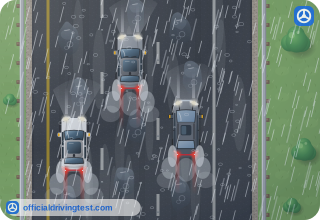
If you find yourself hydroplaning, what should you do first?
- Slam on the brakes immediately
- Keep both hands on the wheel and slowly ease off the gas
- Turn the steering wheel sharply toward the shoulder
- Shift into neutral
Show answer
Correct answer: Keep both hands on the wheel and slowly ease off the gas
If you hydroplane, keep both hands on the wheel and slowly take your foot off the gas pedal to let the vehicle slow down.
Source: Pennsylvania Driver's Manual (Pub 95), page 41 · Open this page in the manual (Manual page 41)
-
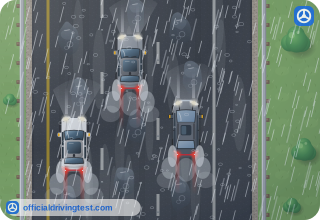
While hydroplaning, why should you avoid slamming on the brakes or turning suddenly?
- It will damage the brakes
- It is illegal to brake while hydroplaning
- It will cause your vehicle to skid
- It will not affect the vehicle at all
Show answer
Correct answer: It will cause your vehicle to skid
Slamming the brakes or turning suddenly while hydroplaning will cause your vehicle to skid.
Source: Pennsylvania Driver's Manual (Pub 95), page 41 · Open this page in the manual (Manual page 41)
-
If you get caught in fog so dense you cannot see, what does the manual recommend?
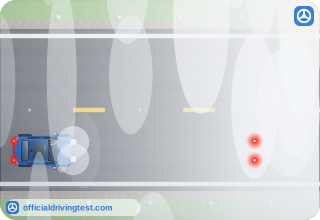
- Pull completely off the road and wait for the fog to clear
- Continue driving slowly with your hazard lights on
- Follow the taillights of the vehicle ahead closely
- Pull onto the shoulder and turn off all lights
Show answer
Correct answer: Pull completely off the road and wait for the fog to clear
If you get caught in dense fog, pull completely off the road, preferably into a parking lot, and wait until it clears, with your hazard lights on and seat belt fastened.
Source: Pennsylvania Driver's Manual (Pub 95), page 42 · Open this page in the manual (Manual page 42)
-
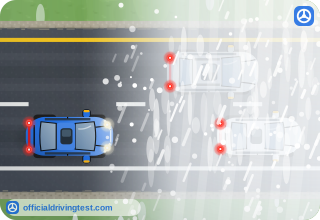
Snow squalls can reduce visibility to near zero and slicken the roadway within seconds, sometimes while vehicles are traveling on interstates at speeds in excess of:
- 40 mph
- 50 mph
- 60 mph
- 70 mph
Show answer
Correct answer: 60 mph
Snow squall events leave little time to react, often at speeds in excess of 60 mph on interstates.
Source: Pennsylvania Driver's Manual (Pub 95), page 42 · Open this page in the manual (Manual page 42)
-
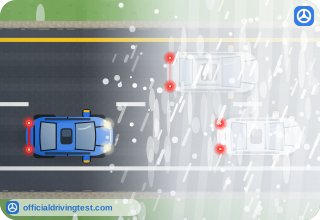
If you encounter a snow squall while driving, what does the manual advise?
- Brake hard immediately to slow down as fast as possible
- Speed up to get through the squall quickly
- Pull into the passing lane and pass slower vehicles
- Gradually slow down and activate your hazard lights
Show answer
Correct answer: Gradually slow down and activate your hazard lights
If you encounter a snow squall, exercise extreme caution by gradually slowing and activating your hazard lights; do not slam on your brakes.
Source: Pennsylvania Driver's Manual (Pub 95), page 43 · Open this page in the manual (Manual page 43)
-
A National Weather Service "Snow Squall Warning" for a roadway typically lasts:
- Less than 45 minutes
- Less than 15 minutes
- Less than 30 minutes
- Less than 90 minutes
Show answer
Correct answer: Less than 45 minutes
Snow Squall Warnings typically last less than 45 minutes for a given roadway.
Source: Pennsylvania Driver's Manual (Pub 95), page 43 · Open this page in the manual (Manual page 43)
2Part 218 questions
-
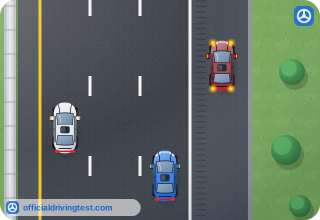
If your vehicle breaks down on the highway, after pulling off the road and turning on your hazard flashers, what else should you do to let other drivers know your vehicle is disabled?
- Turn off all your lights
- Lift your hood
- Sound your horn continuously
- Stand behind the vehicle
Show answer
Correct answer: Lift your hood
Lift your hood to let other drivers know your vehicle is disabled.
Source: Pennsylvania Driver's Manual (Pub 95), page 44 · Open this page in the manual (Manual page 44)
-
What does the manual say you should never do on the road, even if another driver upsets you?
- Take your anger out on someone else
- Slow down when traffic gets heavy
- Use your turn signal to change lanes
- Check your mirrors before merging
Show answer
Correct answer: Take your anger out on someone else
The manual states you should NEVER take your anger out on someone else on the road.
Source: Pennsylvania Driver's Manual (Pub 95), page 60 · Open this page in the manual (Manual page 60)
-
If another driver cuts you off or pulls in front of you, what does the manual advise?
- Flash your high beams repeatedly
- Follow closely to teach them a lesson
- Never take it personally; let it go
- Retaliate immediately
Show answer
Correct answer: Never take it personally; let it go
The manual says to never take it personally when someone cuts you off; just let it go and ignore the other driver.
Source: Pennsylvania Driver's Manual (Pub 95), page 60 · Open this page in the manual (Manual page 60)
-
What does the manual say about trying to 'teach another driver a lesson'?
- You should not do it, even if you are right
- It is encouraged if a passenger agrees
- It is only acceptable at low speeds
- It is recommended if you are clearly right
Show answer
Correct answer: You should not do it, even if you are right
The manual states you should not insist on being right or try to teach another driver a lesson, even if you are right.
Source: Pennsylvania Driver's Manual (Pub 95), page 60 · Open this page in the manual (Manual page 60)
-
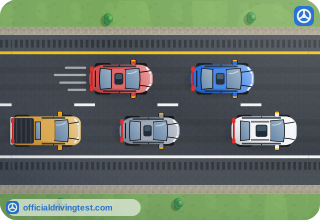
If an aggressive driver demands to pass you in the passing lane, what does the manual suggest doing?
- Block the lane to prevent them from passing
- Let them go
- Speed up to stay ahead of them
- Slam on your brakes
Show answer
Correct answer: Let them go
The manual advises not blocking the passing lane; if someone demands to pass, let them go.
Source: Pennsylvania Driver's Manual (Pub 95), page 60 · Open this page in the manual (Manual page 60)
-
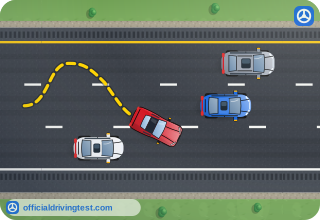
If an aggressive driver pursues you, what does the manual say you should do?
- Stop and confront the driver to calm things down
- Drive straight home and call the police from there
- Pull over immediately wherever you happen to be
- Drive to a police station or other place with witnesses
Show answer
Correct answer: Drive to a police station or other place with witnesses
If an aggressive driver pursues you, do not go home — instead drive to a police station, convenience store, or other location where you can get help and there will be witnesses.
Source: Pennsylvania Driver's Manual (Pub 95), page 60 · Open this page in the manual (Manual page 60)
-
About what percentage of the roughly 1,500 annual highway deaths in Pennsylvania are attributed to aggressive driving?
- About 90 percent
- About 10 percent
- About 60 percent
- About 30 percent
Show answer
Correct answer: About 60 percent
The manual's Did You Know box states about 60 percent, or around 900, of roughly 1,500 annual PA highway deaths are attributed to aggressive driving.
Source: Pennsylvania Driver's Manual (Pub 95), page 60 · Open this page in the manual (Manual page 60)
-
In a review of 12,000 crashes cited by the manual, what percentage of drivers took no action at all to avoid the crash?
- 37 percent
- 17 percent
- 7 percent
- 27 percent
Show answer
Correct answer: 37 percent
The manual's Did You Know box states that in a review of 12,000 crashes, 37 percent of drivers took no action to avoid the crash.
Source: Pennsylvania Driver's Manual (Pub 95), page 60 · Open this page in the manual (Manual page 60)
-
When you have a choice between braking or steering to avoid a collision, which does the manual say is usually better, especially above 25 mph?
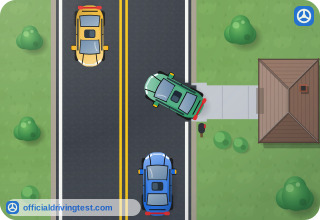
- Steering, since you react faster by swerving than by braking
- Neither; you should close your eyes and hope for the best
- Accelerating past the hazard
- Braking, since it is always safer
Show answer
Correct answer: Steering, since you react faster by swerving than by braking
The manual explains that steering is usually better than braking above 25 mph because your reaction time to swerve is faster than your reaction time to brake.
Source: Pennsylvania Driver's Manual (Pub 95), page 60 · Open this page in the manual (Manual page 60)
-
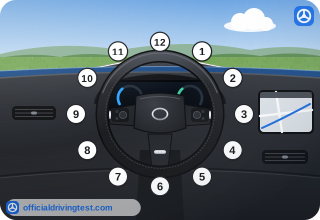
In an evasive steering maneuver, after you turn the wheel quickly at least a half turn in one direction, what do you do next?
- Immediately brake hard and hold the wheel still
- Turn the wheel back almost a full circle the other way
- Let go of the wheel and allow it to spin freely
- Continue turning the same direction indefinitely
Show answer
Correct answer: Turn the wheel back almost a full circle the other way
Evasive steering requires turning the wheel at least a half turn in one direction, then turning it back almost a full circle in the opposite direction once you clear the object, before returning to center.
Source: Pennsylvania Driver's Manual (Pub 95), page 61 · Open this page in the manual (Manual page 61)
-
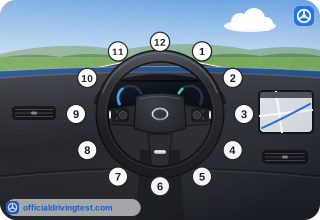
At higher speeds, how much steering input is needed to move your vehicle left or right?
- None at all
- Less steering input is needed
- More steering input is needed
- The same amount, regardless of speed
Show answer
Correct answer: Less steering input is needed
The manual notes that at higher speeds, less steering input is needed to move your vehicle left or right.
Source: Pennsylvania Driver's Manual (Pub 95), page 61 · Open this page in the manual (Manual page 61)
-
According to the manual, where should your hands hold the steering wheel, thinking of it as a clock face?
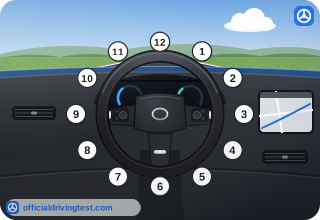
- 12 and 6 o'clock
- 11 and 1, or 7 and 5 o'clock
- 9 and 3, or 8 and 4 o'clock
- 10 and 2 o'clock only
Show answer
Correct answer: 9 and 3, or 8 and 4 o'clock
The manual recommends holding the wheel at either the 9 and 3 o'clock position or the 8 and 4 o'clock position, whichever is more comfortable.
Source: Pennsylvania Driver's Manual (Pub 95), page 61 · Open this page in the manual (Manual page 61)
-
How should your thumbs be positioned on the steering wheel, according to the manual?
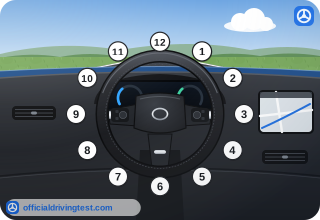
- Gripping the inside of the rim
- Along the face of the steering wheel
- Crossed over each other
- Off the wheel entirely
Show answer
Correct answer: Along the face of the steering wheel
The manual instructs keeping your thumbs along the face of the steering wheel instead of gripping the inside of the rim.
Source: Pennsylvania Driver's Manual (Pub 95), page 61 · Open this page in the manual (Manual page 61)
-
Why is the recommended hand position (9-3 or 8-4 o'clock) safer if the air bag deploys?
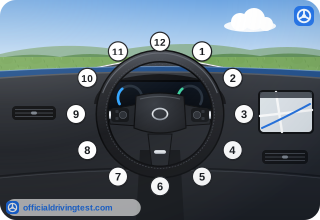
- It prevents the air bag from deploying in a frontal crash
- It has no relation to air bag safety in a crash
- It increases your grip strength so you can steer harder
- The air bag is less likely to throw your arms into your face
Show answer
Correct answer: The air bag is less likely to throw your arms into your face
This hand position makes it less likely the air bag will throw your arms and hands back into your face, possibly breaking them, in a crash.
Source: Pennsylvania Driver's Manual (Pub 95), page 61 · Open this page in the manual (Manual page 61)
-
Is a 10 and 2 o'clock hand position acceptable, according to the manual?
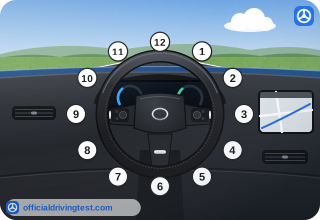
- Yes, and it is the safest position to use
- Yes, but you risk injury if the air bag deploys
- No, it will damage the steering wheel over time
- No, it is illegal to drive with your hands there
Show answer
Correct answer: Yes, but you risk injury if the air bag deploys
A 10 and 2 o'clock hand position is acceptable, but the manual warns you are at risk of injury if your air bag deploys in that position.
Source: Pennsylvania Driver's Manual (Pub 95), page 61 · Open this page in the manual (Manual page 61)
-
In the 'hand-over-hand' steering method described in the manual, what does the driver do?
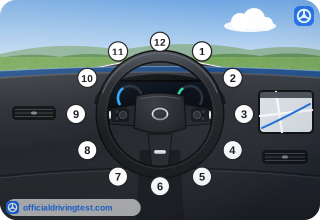
- Reach across to grasp the opposite side and pull it over the top
- Push up with one hand while the other slides and pulls down
- Steer using only one hand
- Keep both hands fixed at 9 and 3
Show answer
Correct answer: Reach across to grasp the opposite side and pull it over the top
In the hand-over-hand method, the driver reaches across the steering wheel to grasp the opposite side and pulls the wheel over the top, repeating as needed.
Source: Pennsylvania Driver's Manual (Pub 95), page 61 · Open this page in the manual (Manual page 61)
-
In the 'push-pull' steering method described in the manual, what happens?
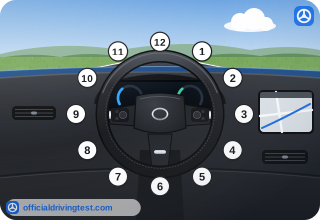
- The driver reaches across the wheel to grasp the opposite side
- Both hands remain crossed at all times
- One hand pushes up while the other slides to the top and pulls down
- The driver releases the wheel between turns
Show answer
Correct answer: One hand pushes up while the other slides to the top and pulls down
In the push-pull method, one hand pushes up on the steering wheel while the other slides to the top and then pulls the wheel down, repeating until the turn is complete.
Source: Pennsylvania Driver's Manual (Pub 95), page 61 · Open this page in the manual (Manual page 61)
-
According to the manual, injury prevention in a crash depends mostly on which factors?
- Your vehicle's color, age and type of engine
- The brand of your tires and the pattern of their tread
- Seat belt, head restraints, air bag and distance from it
- Your years of driving experience and nothing else
Show answer
Correct answer: Seat belt, head restraints, air bag and distance from it
The manual says injury prevention depends mostly on wearing your seat belt properly, having your head restraints properly adjusted, having an air bag, and being positioned an adequate distance from it.
Source: Pennsylvania Driver's Manual (Pub 95), page 61 · Open this page in the manual (Manual page 61)
3Part 318 questions
-
How far away from your air bag should you be positioned, at minimum, according to the manual?
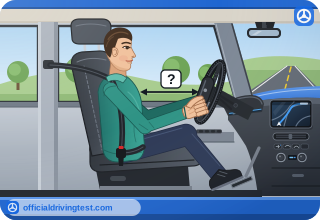
- 30 inches
- 20 inches
- 10 inches
- 5 inches
Show answer
Correct answer: 10 inches
The manual advises being positioned at least ten inches away from your air bag.
Source: Pennsylvania Driver's Manual (Pub 95), page 61 · Open this page in the manual (Manual page 61)
-
If your vehicle does NOT have anti-lock brakes (ABS) and you must brake suddenly, what should you do?
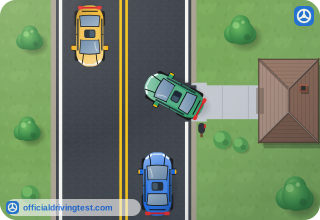
- Press and release the brakes repeatedly
- Slam on the brakes and hold them down
- Pump the accelerator instead
- Shift into neutral first
Show answer
Correct answer: Press and release the brakes repeatedly
Without ABS, press and release the brakes repeatedly; pumping the brakes slows the vehicle and keeps it under control, while slamming on the brakes can lock the wheels and cause a skid.
Source: Pennsylvania Driver's Manual (Pub 95), page 61 · Open this page in the manual (Manual page 61)
-
If your vehicle HAS anti-lock brakes (ABS), what should you do when braking suddenly?
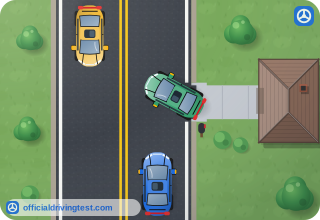
- Maintain firm, continuous pressure on the brake
- Avoid using the brakes at all
- Tap the brake lightly, then release it
- Pump the brake pedal repeatedly and quickly
Show answer
Correct answer: Maintain firm, continuous pressure on the brake
With ABS, maintain firm and continuous pressure on the brake pedal; the vehicle will not skid, and you should not pump the brake pedal.
Source: Pennsylvania Driver's Manual (Pub 95), page 61 · Open this page in the manual (Manual page 61)
-
When braking hard with ABS, what should you NOT be alarmed by?
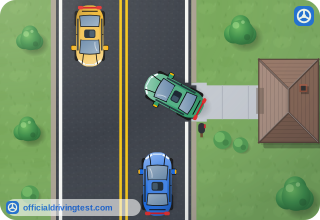
- Mechanical noises or slight pulsations
- A sudden, complete loss of braking power
- The engine shutting off
- The steering wheel locking
Show answer
Correct answer: Mechanical noises or slight pulsations
The manual reassures drivers not to be alarmed by mechanical noises and/or slight pulsations when ABS engages.
Source: Pennsylvania Driver's Manual (Pub 95), page 61 · Open this page in the manual (Manual page 61)
-
If the rear of your vehicle is skidding to the left, which way should you turn the steering wheel?
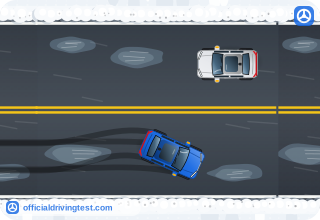
- To the right
- To the left
- It does not matter
- Keep it perfectly straight
Show answer
Correct answer: To the left
If the rear of your vehicle is skidding to the left, turn the wheel to the left, in the direction you want to go.
Source: Pennsylvania Driver's Manual (Pub 95), page 61 · Open this page in the manual (Manual page 61)
-
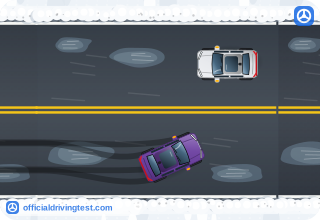
After correcting a skid, what does the manual say might happen next?
- The vehicle will always stop skidding permanently
- The vehicle will accelerate uncontrollably
- A milder second skid may occur in the opposite direction
- The engine will stall automatically
Show answer
Correct answer: A milder second skid may occur in the opposite direction
When you steer to correct a skid, another skid may result in the opposite direction, but it will not be as bad as the first; be ready to correct it the same way.
Source: Pennsylvania Driver's Manual (Pub 95), page 61 · Open this page in the manual (Manual page 61)
-
What should you NOT do while your vehicle is skidding?
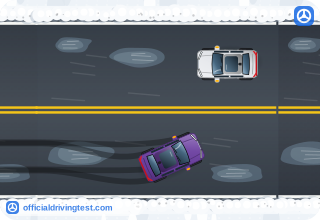
- Keep both hands on the wheel
- Use your brakes
- Look in the direction you want to go
- Steer in the direction the rear of the vehicle is skidding
Show answer
Correct answer: Use your brakes
The manual warns not to use your brakes while skidding; hitting the brakes will make the skid worse and risks locking your wheels and losing steering control.
Source: Pennsylvania Driver's Manual (Pub 95), page 61 · Open this page in the manual (Manual page 61)
-
Under Pennsylvania law, what must a driver do when a road or highway is closed by signs or traffic control devices because of a hazardous condition?
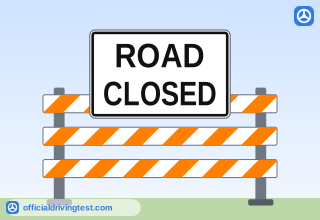
- Find another route, never around or through the closure
- Drive around the signs if no workers are visible
- Follow other vehicles that go around the closure
- Proceed through slowly if the road looks passable
Show answer
Correct answer: Find another route, never around or through the closure
It is against the law to drive around or through signs or devices that close a road due to hazardous conditions; find another route instead.
Source: Pennsylvania Driver's Manual (Pub 95), page 62 · Open this page in the manual (Manual page 62)
-
According to the Pennsylvania Driver's Manual, what should a driver do upon reaching a flooded roadway?
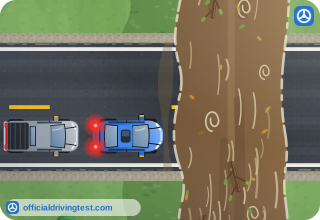
- Drive through slowly in the center of the road
- Find another route and do not attempt to cross
- Follow another vehicle that has already crossed
- Cross quickly before the water rises further
Show answer
Correct answer: Find another route and do not attempt to cross
The manual advises "Turn Around, Don't Drown" - find another travel route and never attempt to cross a flooded roadway.
Source: Pennsylvania Driver's Manual (Pub 95), page 62 · Open this page in the manual (Manual page 62)
-
What does Pennsylvania law say about flood control barriers?
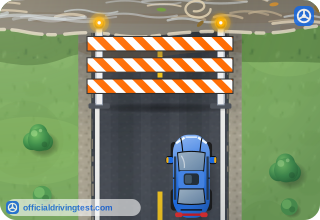
- They may be passed if the water looks shallow
- They may be passed only during daylight hours
- It is against the law to pass any flood control barrier
- They may be passed if no other route is available
Show answer
Correct answer: It is against the law to pass any flood control barrier
It is against the law to pass any flood control barrier, regardless of how the water appears.
Source: Pennsylvania Driver's Manual (Pub 95), page 62 · Open this page in the manual (Manual page 62)
-
How much floodwater can cause some cars to lose control or stall, according to the Pennsylvania Driver's Manual?
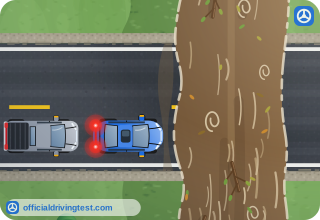
- Twelve inches
- Two feet
- Three inches
- Six inches
Show answer
Correct answer: Six inches
Six inches of water - about the length of a dollar bill - can cause some cars to lose control or stall.
Source: Pennsylvania Driver's Manual (Pub 95), page 62 · Open this page in the manual (Manual page 62)
-
How much moving water can float many cars, according to the manual?
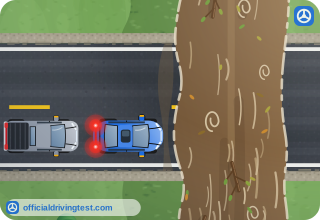
- Twelve inches
- Six inches
- Three feet
- Eighteen inches
Show answer
Correct answer: Twelve inches
Twelve inches of moving water can float many cars.
Source: Pennsylvania Driver's Manual (Pub 95), page 62 · Open this page in the manual (Manual page 62)
-
How much moving water can move most SUVs and pickup trucks?
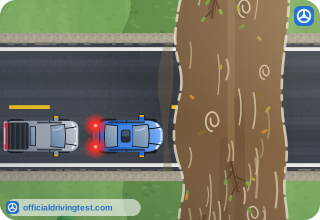
- One foot
- Two feet
- Six inches
- Three feet
Show answer
Correct answer: Two feet
Two feet of moving water can move most SUVs and pickup trucks.
Source: Pennsylvania Driver's Manual (Pub 95), page 62 · Open this page in the manual (Manual page 62)
-
If you get stuck in floodwaters, what should you do?
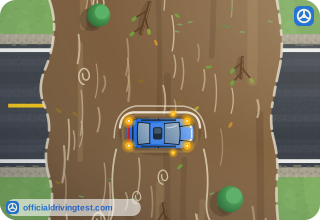
- Stay inside your vehicle and wait for rescue
- Rev the engine to try to drive out
- Quickly get out of the vehicle and move to higher ground
- Open the windows and wait for the water to recede
Show answer
Correct answer: Quickly get out of the vehicle and move to higher ground
If you get stuck in floodwaters, quickly get out of your vehicle and move to higher ground.
Source: Pennsylvania Driver's Manual (Pub 95), page 62 · Open this page in the manual (Manual page 62)
-
If your accelerator (gas pedal) sticks, what should you avoid doing?
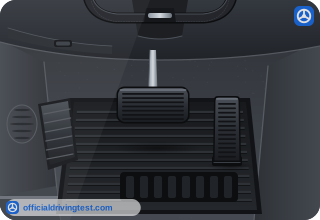
- Tapping the pedal a few times
- Trying to lift it with your toe
- Keeping your eyes on the road
- Reaching down to free it by hand
Show answer
Correct answer: Reaching down to free it by hand
If the accelerator sticks, do not reach down to try to free the pedal with your hand; keep your eyes on the road and try tapping it or lifting it with your toe instead.
Source: Pennsylvania Driver's Manual (Pub 95), page 62 · Open this page in the manual (Manual page 62)
-
If your accelerator remains stuck after trying to free it, what should you do next?
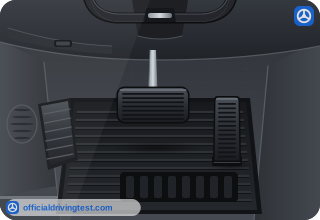
- Shift to neutral at once and brake
- Turn on the radio to stay calm
- Pump the accelerator repeatedly
- Turn the steering wheel sharply
Show answer
Correct answer: Shift to neutral at once and brake
If the pedal remains stuck, shift to neutral immediately and use the brakes; this causes the engine to race but removes power from the wheels.
Source: Pennsylvania Driver's Manual (Pub 95), page 62 · Open this page in the manual (Manual page 62)
-
After pulling off the road because your accelerator stuck, what should you do?
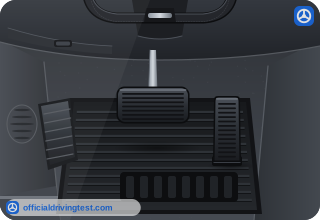
- Leave the engine running in case you need to move again
- Stop, turn off the engine, and put on your emergency flashers
- Immediately try to restart the engine
- Leave the vehicle in gear with the engine off
Show answer
Correct answer: Stop, turn off the engine, and put on your emergency flashers
After pulling off the road and slowing to a safe speed, stop, turn off the engine, and put on your emergency flashers.
Source: Pennsylvania Driver's Manual (Pub 95), page 62 · Open this page in the manual (Manual page 62)
-
If you need to slow or stop quickly and must turn off your ignition, what position should you use?
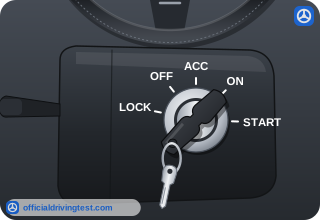
- "LOCK," to secure the steering wheel
- "ACC," to keep accessories running
- "OFF," never "LOCK"
- Either "OFF" or "LOCK," whichever is faster
Show answer
Correct answer: "OFF," never "LOCK"
Turn your ignition to "OFF" - never "LOCK" - because "LOCK" will cause you to lose steering ability.
Source: Pennsylvania Driver's Manual (Pub 95), page 62 · Open this page in the manual (Manual page 62)
4Part 418 questions
-
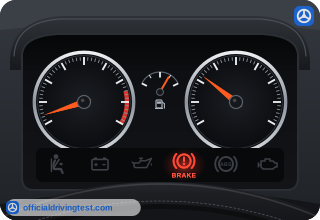
If the brake system warning light comes on in a newer vehicle with a split braking system, what is likely still working?
- All four wheels' brakes, but weakly
- None of the brakes
- Only the parking brake
- Braking in one front and one rear wheel
Show answer
Correct answer: Braking in one front and one rear wheel
A split braking system means you may still have braking in two of the four wheels - probably one front wheel and one rear wheel - enough to pull over safely.
Source: Pennsylvania Driver's Manual (Pub 95), page 62 · Open this page in the manual (Manual page 62)
-
With partial brake failure in a newer vehicle, what will you notice about the brake pedal and stopping distance?
- The pedal goes down farther and stopping distance increases
- The pedal will feel normal but stopping distance decreases
- The pedal will lock in place and not move at all
- The pedal becomes looser but stopping distance stays the same
Show answer
Correct answer: The pedal goes down farther and stopping distance increases
With partial brake failure, the brake pedal goes down farther than usual before the vehicle slows, you must push harder, and your stopping distance is increased.
Source: Pennsylvania Driver's Manual (Pub 95), page 62 · Open this page in the manual (Manual page 62)
-
What can help you slow down if your newer vehicle experiences partial brake failure?
- Turning off the engine while moving
- Shifting to a lower gear
- Pumping the gas pedal
- Shifting into neutral
Show answer
Correct answer: Shifting to a lower gear
Shifting to a lower gear will help you slow down when experiencing partial brake failure.
Source: Pennsylvania Driver's Manual (Pub 95), page 62 · Open this page in the manual (Manual page 62)
-
If you have an older vehicle and your brakes suddenly fail, what is the first thing you should do?
- Turn off the ignition immediately
- Pull the parking brake as hard as possible right away
- Shift to low gear and look for a place to slow to a stop
- Steer directly toward the shoulder without slowing down
Show answer
Correct answer: Shift to low gear and look for a place to slow to a stop
With sudden brake failure in an older vehicle, first shift to low gear and look for a place to slow to a stop.
Source: Pennsylvania Driver's Manual (Pub 95), page 63 · Open this page in the manual (Manual page 63)
-
In an older vehicle with sudden brake failure, what should you try after shifting to low gear?
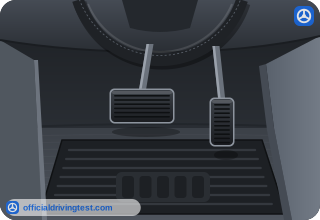
- Turn off the engine completely
- Accelerate to gain control
- Release the steering wheel briefly
- Pump the brakes quickly several times
Show answer
Correct answer: Pump the brakes quickly several times
Pump the brake pedal quickly several times - this will often build up enough brake pressure to stop the vehicle.
Source: Pennsylvania Driver's Manual (Pub 95), page 63 · Open this page in the manual (Manual page 63)
-
If pumping the brake pedal does not work in an older vehicle with brake failure, what should you use, and what must you be ready to do if the rear wheels lock?
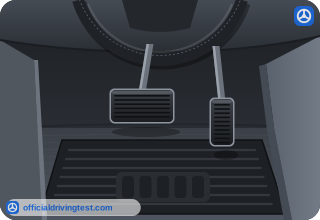
- The parking brake, and be ready to let off of it if you skid
- The parking brake, and pull it harder if you start to skid
- The headlights, and flash them to warn the drivers ahead
- The clutch, and hold it down fully until the vehicle stops
Show answer
Correct answer: The parking brake, and be ready to let off of it if you skid
Use the parking (emergency) brake if pumping does not work, holding the brake release so you can let off of the parking brake if the rear wheels lock and you begin to skid.
Source: Pennsylvania Driver's Manual (Pub 95), page 63 · Open this page in the manual (Manual page 63)
-
As a last resort with an older vehicle's brakes still not stopping the car, what should you do with the ignition?
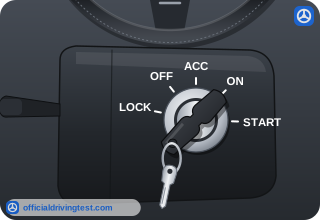
- Turn it to "LOCK" to secure the wheel
- Turn it to "OFF," never "LOCK"
- Leave it running and coast to a stop
- Turn it to "ACC" only
Show answer
Correct answer: Turn it to "OFF," never "LOCK"
As a last resort, turn your ignition "OFF" - never to "LOCK," which would also lock your steering - then shift into your lowest gear.
Source: Pennsylvania Driver's Manual (Pub 95), page 63 · Open this page in the manual (Manual page 63)
-
After you manage to stop a vehicle whose brakes have failed, what should you do?
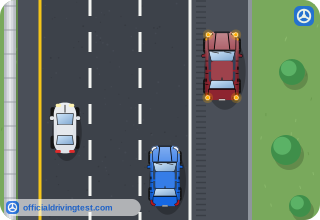
- Try to drive carefully to the nearest garage
- Continue driving at a reduced speed
- Call for help and do not try to drive
- Wait a few minutes, then resume driving normally
Show answer
Correct answer: Call for help and do not try to drive
After you have stopped your vehicle, call for help; do not try to drive it.
Source: Pennsylvania Driver's Manual (Pub 95), page 63 · Open this page in the manual (Manual page 63)
-
According to the manual, how can you best protect against a tire blowout?
- Drive slower than the speed limit at all times
- Avoid driving on highways
- Replace all four tires every year
- Keep your tires in good condition and properly inflated
Show answer
Correct answer: Keep your tires in good condition and properly inflated
You usually will not know ahead of time when a tire will blow, so protect against blowouts by keeping your tires in good condition and properly inflated.
Source: Pennsylvania Driver's Manual (Pub 95), page 63 · Open this page in the manual (Manual page 63)
-
What happens when a front tire blows out?
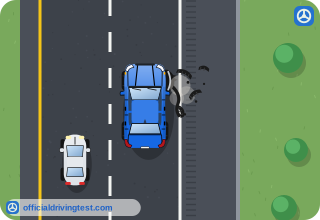
- Steering wheel vibrates; the vehicle pulls to one side
- The vehicle accelerates on its own
- Nothing is noticeable until you stop
- The rear of the vehicle wobbles back and forth
Show answer
Correct answer: Steering wheel vibrates; the vehicle pulls to one side
When a front tire blows out, your steering wheel will vibrate and you will feel the vehicle suddenly pull to one side.
Source: Pennsylvania Driver's Manual (Pub 95), page 63 · Open this page in the manual (Manual page 63)
-
What happens when a rear tire blows out?
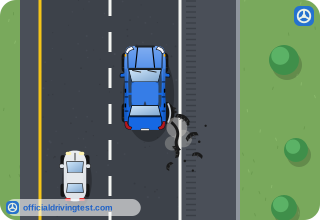
- The steering wheel locks up completely
- One corner drops; the rear wobbles back and forth
- The vehicle pulls sharply to one side only
- Nothing changes until the vehicle stops
Show answer
Correct answer: One corner drops; the rear wobbles back and forth
When a rear tire blows out, one corner of the vehicle will drop suddenly, and you will feel the rear of the vehicle wobble back and forth.
Source: Pennsylvania Driver's Manual (Pub 95), page 63 · Open this page in the manual (Manual page 63)
-
If one of your tires blows out, what should you avoid doing at first?
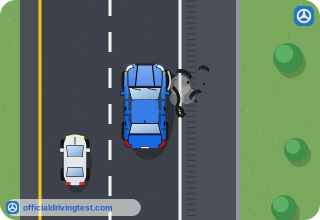
- Holding the steering wheel tightly
- Slowly taking your foot off the gas pedal
- Using your brake
- Steering smoothly toward where you want to go
Show answer
Correct answer: Using your brake
Stay off of your brake after a blowout - braking will cause you to skid and lose control of your vehicle.
Source: Pennsylvania Driver's Manual (Pub 95), page 63 · Open this page in the manual (Manual page 63)
-
After a tire blowout, how should you steer?
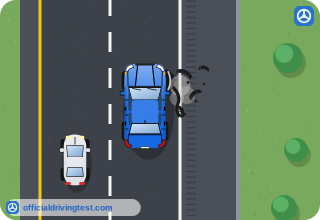
- With large, quick corrections to compensate
- Not at all, until the vehicle stops
- Only to the right, regardless of traffic
- Smoothly toward where you want to go
Show answer
Correct answer: Smoothly toward where you want to go
Steer where you want to go, but steer smoothly - do not make large or jerky steering actions after a blowout.
Source: Pennsylvania Driver's Manual (Pub 95), page 63 · Open this page in the manual (Manual page 63)
-
If you must brake after a tire blowout once you have slowed and are steering safely, how should you apply the brakes?
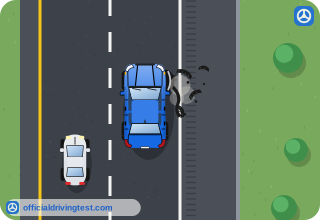
- Gently, letting the vehicle slow to a stop
- Firmly and suddenly to stop as fast as possible
- By pumping them rapidly
- Not at all, under any circumstance
Show answer
Correct answer: Gently, letting the vehicle slow to a stop
You can ride on a flat tire to reach a safe spot; if you must use your brakes, press them gently and let the vehicle slow to a stop.
Source: Pennsylvania Driver's Manual (Pub 95), page 63 · Open this page in the manual (Manual page 63)
-
Which items does the manual recommend keeping in your vehicle at all times for changing a flat tire?
- Only a spare tire
- A spare tire, lug wrench, jack, and flashlight
- Only a jack and flares
- A fire extinguisher and first aid kit only
Show answer
Correct answer: A spare tire, lug wrench, jack, and flashlight
The manual recommends keeping a spare tire, lug wrench, jack, screwdriver, flashlight, flares and reflective triangles, wheel wedges, a flat tire repair kit, gloves, and similar tools in your vehicle at all times.
Source: Pennsylvania Driver's Manual (Pub 95), page 63 · Open this page in the manual (Manual page 63)
-
Where should you park before changing a flat tire?
- In the travel lane with flashers on
- On the shoulder as close to traffic as possible
- On a flat surface away from traffic, far off the road
- On any incline that is convenient
Show answer
Correct answer: On a flat surface away from traffic, far off the road
Park on a flat surface that is away from traffic and as far off of the road as possible before changing a tire.
Source: Pennsylvania Driver's Manual (Pub 95), page 63 · Open this page in the manual (Manual page 63)
-
Before raising a vehicle with a jack to change a tire, what should you do to secure it?
- Remove all four tires at once
- Turn the engine off only, with no other precautions
- Leave the vehicle in drive
- Apply the parking brake and place wedges or chocks at the front and rear of a remaining good tire
Show answer
Correct answer: Apply the parking brake and place wedges or chocks at the front and rear of a remaining good tire
Apply the parking brake and secure the vehicle by placing bricks, wooden wedges, or wheel chocks at both the front and rear of one of the remaining good tires.
Source: Pennsylvania Driver's Manual (Pub 95), page 63 · Open this page in the manual (Manual page 63)
-
When should you loosen the lug nuts while changing a tire?
- While the vehicle is on the ground, before jacking it up
- After the vehicle has been fully raised on the jack
- Only after removing the spare from the trunk
- It does not matter when
Show answer
Correct answer: While the vehicle is on the ground, before jacking it up
While the vehicle is on the ground, loosen (but do not fully remove) the lug nuts, before raising the vehicle with the jack.
Source: Pennsylvania Driver's Manual (Pub 95), page 63 · Open this page in the manual (Manual page 63)
5Part 518 questions
-
About how far off the ground should the jack raise the tire when changing it?
- Approximately 18 inches
- Approximately 6 inches
- Approximately 1 inch
- Approximately 12 inches
Show answer
Correct answer: Approximately 6 inches
Raise the vehicle with the jack until the tire is approximately 6 inches off the ground.
Source: Pennsylvania Driver's Manual (Pub 95), page 63 · Open this page in the manual (Manual page 63)
-
When installing the spare tire's lug nuts, what does the manual instruct before the vehicle is lowered?
- Fully torque the lug nuts to the final specification
- Leave the lug nuts loose until the next service
- Tighten with minimal pressure; do not fully torque yet
- Skip tightening until after driving away
Show answer
Correct answer: Tighten with minimal pressure; do not fully torque yet
After threading the lug nuts on by hand, the lug wrench may be used to tighten them, but only use minimal pressure - do not fully torque the nuts until after the vehicle is lowered.
Source: Pennsylvania Driver's Manual (Pub 95), page 63 · Open this page in the manual (Manual page 63)
-
What commonly causes a dangerous "drop-off," where a vehicle's tire leaves the pavement onto a lower shoulder?
- Driving too slowly on a straight road
- Using cruise control on a highway
- Following too closely behind another vehicle
- Driving too close to the edge or too fast in a curve
Show answer
Correct answer: Driving too close to the edge or too fast in a curve
A "drop-off" can happen if you are driving too close to the edge of the road or too fast through a curve, allowing your front tire to drift off the road.
Source: Pennsylvania Driver's Manual (Pub 95), page 64 · Open this page in the manual (Manual page 64)
-
If your vehicle drifts off the pavement onto the shoulder, what are the two most important things to remember?
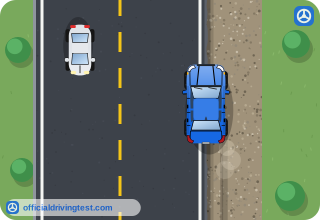
- Do not steer sharply and do not brake suddenly
- Accelerate and honk your horn
- Turn off the engine and steer sharply back
- Brake hard and steer sharply back onto the road
Show answer
Correct answer: Do not steer sharply and do not brake suddenly
The most important things to remember after a drop-off are: do not steer sharply, and do not brake suddenly.
Source: Pennsylvania Driver's Manual (Pub 95), page 64 · Open this page in the manual (Manual page 64)
-
Why is it dangerous to turn the wheel sharply to get back onto the road after a drop-off?
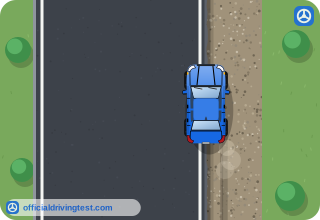
- It can damage the tires immediately
- It can make the vehicle whip sideways into oncoming traffic
- It will trigger the anti-lock brakes unnecessarily
- It has no real danger, it is simply discouraged
Show answer
Correct answer: It can make the vehicle whip sideways into oncoming traffic
Turning the wheel sharply to get back onto the road can cause the vehicle to whip sideways and cross into oncoming traffic.
Source: Pennsylvania Driver's Manual (Pub 95), page 64 · Open this page in the manual (Manual page 64)
-
Why is braking hard dangerous when two wheels are on the pavement and two are on a soft shoulder?
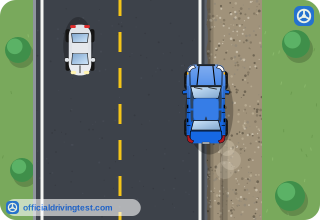
- It will overheat the brakes
- It voids the vehicle's warranty
- The vehicle will probably skid out of control
- It has no additional danger compared to normal braking
Show answer
Correct answer: The vehicle will probably skid out of control
If you brake hard with two wheels on the pavement and two wheels on a soft shoulder, the vehicle will probably skid out of control.
Source: Pennsylvania Driver's Manual (Pub 95), page 64 · Open this page in the manual (Manual page 64)
-
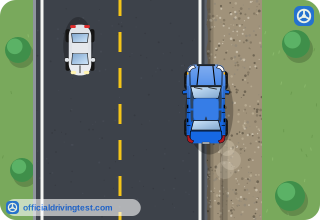
What is the first step to take when your two right-side wheels go off the pavement?
- Brake suddenly to stop as quickly as possible
- Accelerate to get back on the road faster
- Turn the wheel sharply back onto the roadway
- Ease off the gas pedal, without braking suddenly
Show answer
Correct answer: Ease off the gas pedal, without braking suddenly
Ease off of the gas pedal to slow down when your two wheels go off the pavement; do not brake suddenly.
Source: Pennsylvania Driver's Manual (Pub 95), page 64 · Open this page in the manual (Manual page 64)
-
While straddling the drop-off edge with a firm grip on the wheel, how should you steer?
- Parallel to the roadway
- Sharply toward the roadway
- Directly away from the roadway
- In a zigzag pattern to test traction
Show answer
Correct answer: Parallel to the roadway
Keep a tight grip on the steering wheel and steer parallel to the roadway, with two wheels on the roadway and two off, keeping the tires from scraping the pavement edge.
Source: Pennsylvania Driver's Manual (Pub 95), page 64 · Open this page in the manual (Manual page 64)
-
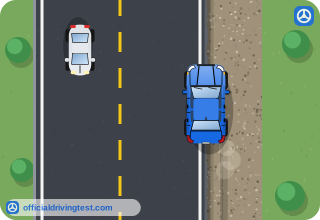
How slow should you get your vehicle before trying to steer back onto the pavement after a drop-off?
- Exactly the posted speed limit
- Less than 25 mph, preferably closer to 10 mph
- Less than 45 mph
- It does not matter, as long as you are steady
Show answer
Correct answer: Less than 25 mph, preferably closer to 10 mph
Continue to slow gradually until you are traveling very slowly - less than 25 mph and preferably closer to 10 mph - and you have your vehicle under control.
Source: Pennsylvania Driver's Manual (Pub 95), page 64 · Open this page in the manual (Manual page 64)
-
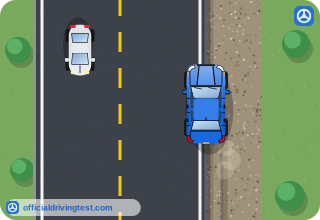
Before steering back onto the pavement after a drop-off, what should you check and signal?
- Check your fuel gauge and turn on your headlights
- Check your mirrors for tailgaters and turn on your right turn signal
- Check for traffic approaching from the rear and turn on your left turn signal
- Nothing; signaling is unnecessary in this situation
Show answer
Correct answer: Check for traffic approaching from the rear and turn on your left turn signal
Check for traffic approaching from the rear in the lane you will reenter, and turn on your left turn signal.
Source: Pennsylvania Driver's Manual (Pub 95), page 64 · Open this page in the manual (Manual page 64)
-
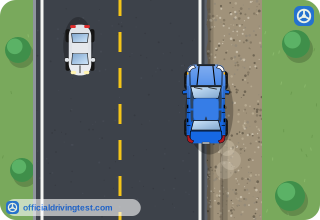
How should you bring your right wheels back onto the pavement after a drop-off, once it is clear?
- Steer sharply left, then hold the wheel steady
- Brake firmly while turning left
- Accelerate hard while turning right
- Gently steer left, then gently right to straighten out
Show answer
Correct answer: Gently steer left, then gently right to straighten out
Gently steer left to ease the right wheels onto the pavement when it is clear; as soon as you feel the wheels come back onto the road, gently steer right to straighten out.
Source: Pennsylvania Driver's Manual (Pub 95), page 64 · Open this page in the manual (Manual page 64)
-
If another vehicle is approaching you head-on in your lane, what should you do first?
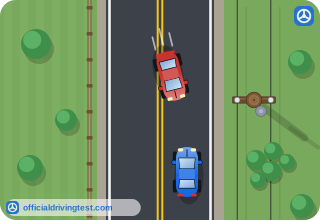
- Honk your horn to attract attention
- Swerve left immediately
- Brake as hard as possible
- Flash your high beams repeatedly
Show answer
Correct answer: Honk your horn to attract attention
If another vehicle is approaching head-on in your lane, first honk your horn to attract attention.
Source: Pennsylvania Driver's Manual (Pub 95), page 64 · Open this page in the manual (Manual page 64)
-
If the other driver does not move over when a head-on collision threatens, which direction should you try to escape, if possible?
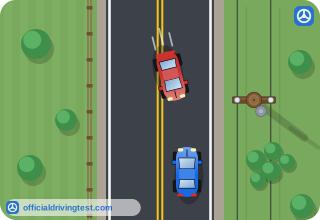
- Left, into the oncoming lane
- Right
- Straight ahead without changing direction
- It does not matter which direction
Show answer
Correct answer: Right
If the other driver does not move over, try to escape to the right, if possible.
Source: Pennsylvania Driver's Manual (Pub 95), page 64 · Open this page in the manual (Manual page 64)
-
Why should you avoid swerving left to avoid a head-on collision?
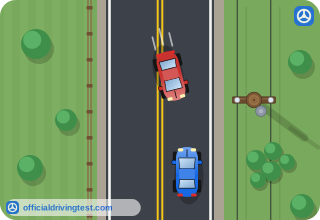
- It is illegal in every case
- It will automatically trigger your airbags
- If the other driver corrects late, you will still crash
- Left turns always take longer than right turns
Show answer
Correct answer: If the other driver corrects late, you will still crash
If you swerve left and the other driver corrects at the last instant, you will still crash.
Source: Pennsylvania Driver's Manual (Pub 95), page 64 · Open this page in the manual (Manual page 64)
-
If a head-on collision becomes unavoidable, what should you do, and why?
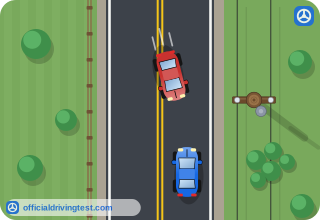
- Accelerate to get past the other vehicle faster
- Release the brakes completely and coast
- Close your eyes and hold the wheel straight
- Brake firmly and steadily to reduce the impact
Show answer
Correct answer: Brake firmly and steadily to reduce the impact
If a collision is unavoidable, brake firmly and steadily - every mile per hour you slow down will reduce the impact.
Source: Pennsylvania Driver's Manual (Pub 95), page 64 · Open this page in the manual (Manual page 64)
-
If you have a tire blowout, what should you do?
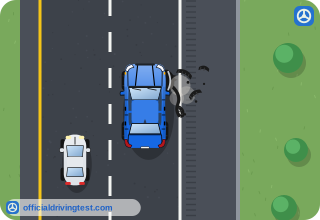
- Let the car slow to a stop
- Brake hard to stop the car immediately
- Continue driving until you reach a garage
- Allow the steering wheel to move freely
Show answer
Correct answer: Let the car slow to a stop
After a blowout, stay off the brake (if you must brake, press gently) and let the vehicle slow to a stop. You can ride on the flat tire as long as you need to in order to reach a safe spot to pull over and change it.
Source: Pennsylvania Driver's Manual (Pub 95), page 63 · Open this page in the manual (Manual page 63)
-
If your car breaks down on a Pennsylvania highway, what should you do?
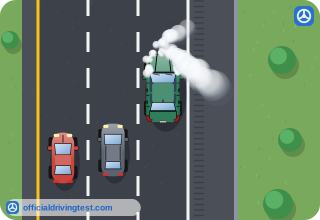
- Sound your horn at passing motorists
- Use your four-way flashers to warn other drivers
- Sit in your car and wait for help without taking further action
- Flash your headlights at oncoming traffic
Show answer
Correct answer: Use your four-way flashers to warn other drivers
If your vehicle breaks down on the highway, signal, carefully exit the roadway, and put on your hazard (four-way) flashers to warn other drivers.
Source: Pennsylvania Driver's Manual (Pub 95), page 44 · Open this page in the manual (Manual page 44)
-
If an oncoming driver is heading toward you in your lane, what should you do?
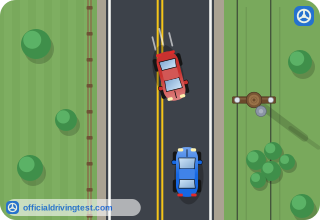
- Stay in the center of your lane, blow your horn, and brake
- Steer left, blow your horn, and brake
- Steer right, blow your horn, and brake
- Steer right, blow your horn, and accelerate
Show answer
Correct answer: Steer right, blow your horn, and brake
Steer right, blow your horn, and brake - trying to escape to the right while alerting the other driver and slowing down.
Source: Pennsylvania Driver's Manual (Pub 95), page 64 · Open this page in the manual (Manual page 64)
6Part 617 questions
-
When a police vehicle stops behind you, what should you do first?
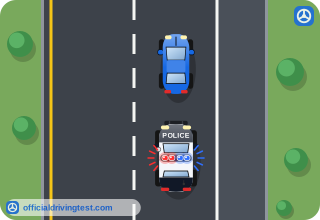
- Turn off your headlights and wait
- Signal and pull over to the right edge
- Immediately exit your vehicle
- Speed up to find a police station
Show answer
Correct answer: Signal and pull over to the right edge
Police recommend activating your turn signal and driving as close as safely possible to the right edge of the road, then stopping and parking safely away from traffic.
Source: Pennsylvania Driver's Manual (Pub 95), page 80 · Open this page in the manual (Manual page 80)
-
If you are stopped by police at night, when should you turn on your vehicle's interior light?
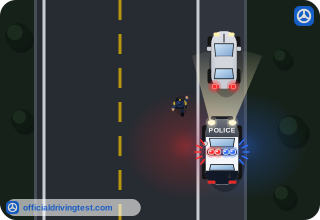
- Only after the officer asks
- Never; it can startle the officer
- Once stopped, before the officer approaches
- Only if you are alone in the vehicle
Show answer
Correct answer: Once stopped, before the officer approaches
At night, turn on your vehicle's interior light as soon as you stop and before the officer approaches.
Source: Pennsylvania Driver's Manual (Pub 95), page 80 · Open this page in the manual (Manual page 80)
-
If you are transporting a firearm and are stopped by police, you should:
- Alert the officer immediately
- Say nothing unless asked
- Hide it from view immediately
- Hand it out the window before the officer arrives
Show answer
Correct answer: Alert the officer immediately
The manual advises alerting the officer immediately if you are transporting any type of firearm.
Source: Pennsylvania Driver's Manual (Pub 95), page 80 · Open this page in the manual (Manual page 80)
-
During a traffic stop, when should you retrieve your license, registration, and insurance card?
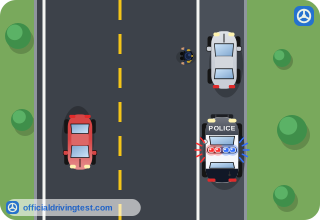
- Before the officer reaches the window
- While the officer is still in their vehicle
- Immediately after coming to a stop
- Only after the officer asks you to
Show answer
Correct answer: Only after the officer asks you to
You should wait until the officer asks you to retrieve your driver's license, registration, and insurance cards.
Source: Pennsylvania Driver's Manual (Pub 95), page 80 · Open this page in the manual (Manual page 80)
-
During a traffic stop, you should keep which of the following fastened until the officer has seen that you are appropriately restrained?
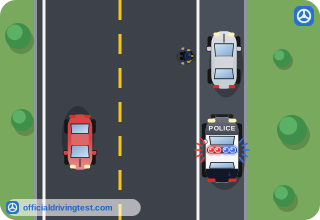
- Your parking brake
- Your seat belt
- Your door lock
- Your headrest
Show answer
Correct answer: Your seat belt
Keep your seat belt fastened until the officer has seen you are appropriately restrained.
Source: Pennsylvania Driver's Manual (Pub 95), page 80 · Open this page in the manual (Manual page 80)
-
If you disagree with a citation issued during a traffic stop, you are entitled to:
- An automatic dismissal
- A refund of any fine already paid
- A court hearing to present your arguments
- A private hearing with the officer alone
Show answer
Correct answer: A court hearing to present your arguments
If you disagree with a citation, you are entitled to a court hearing where you can present your arguments.
Source: Pennsylvania Driver's Manual (Pub 95), page 80 · Open this page in the manual (Manual page 80)
-
Police lights on a marked vehicle are typically red and blue, but an unmarked police vehicle may instead show:
- Flashing green lights only
- Flashing amber lights only
- Flashing white lights only
- A flashing red light only
Show answer
Correct answer: A flashing red light only
In some instances, an unmarked police vehicle may be equipped with a flashing red light only.
Source: Pennsylvania Driver's Manual (Pub 95), page 80 · Open this page in the manual (Manual page 80)
-
If a vehicle behind you is flashing only blue lights, this means:
- It is not a police officer
- It is always an unmarked state trooper
- It is a volunteer firefighter who must be obeyed
- It is a tow truck operator
Show answer
Correct answer: It is not a police officer
If the vehicle is flashing only blue lights, then it is not a police officer.
Source: Pennsylvania Driver's Manual (Pub 95), page 81 · Open this page in the manual (Manual page 81)
-
If you are unsure whether the vehicle signaling you to stop is really driven by a police officer, you should:
- Pull over immediately wherever you are
- Drive slowly, with flashers on, to the nearest well-lit, populated area
- Ignore the signal completely and continue at normal speed
- Call the license plate number in to a friend and keep driving normally
Show answer
Correct answer: Drive slowly, with flashers on, to the nearest well-lit, populated area
If you are still not certain the person pulling you over is a police officer, you may drive to the nearest well-lit, populated area, acknowledging the stop with your flashers and reduced speed.
Source: Pennsylvania Driver's Manual (Pub 95), page 81 · Open this page in the manual (Manual page 81)
-
According to the manual, what do all real police officers always carry?
- A citation pad only
- A department vehicle only
- A photo ID card and a badge
- A printed warrant
Show answer
Correct answer: A photo ID card and a badge
Police officers always possess a photo ID card and a badge.
Source: Pennsylvania Driver's Manual (Pub 95), page 81 · Open this page in the manual (Manual page 81)
-
If you come upon a crash you are not involved in, you should stop only if:
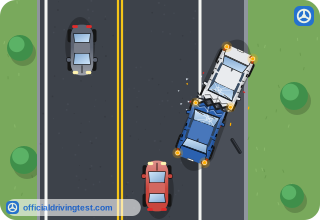
- Emergency help has not yet arrived
- You want to take photos for insurance purposes
- There is heavy traffic backed up
- You recognize one of the vehicles
Show answer
Correct answer: Emergency help has not yet arrived
Do not stop at a crash unless you are involved or emergency help has not yet arrived.
Source: Pennsylvania Driver's Manual (Pub 95), page 81 · Open this page in the manual (Manual page 81)
-
If you are involved in a crash, you should call the police if:
- The other driver asks you not to
- The crash happened on a private driveway only
- No vehicle needs towing and no one is hurt
- Anyone is hurt or dies, or a vehicle needs to be towed
Show answer
Correct answer: Anyone is hurt or dies, or a vehicle needs to be towed
Call the police if anyone is hurt or dies, or if any vehicle needs to be towed.
Source: Pennsylvania Driver's Manual (Pub 95), page 81 · Open this page in the manual (Manual page 81)
-
If a crash involves only a parked vehicle or property damage and you cannot find the owner, you should:
- Simply drive away, since no one witnessed it
- Leave a note with the date, time, your name, and a phone number, then call police
- Wait at the scene for up to 24 hours
- Report it only if asked by your insurance company
Show answer
Correct answer: Leave a note with the date, time, your name, and a phone number, then call police
If you cannot find the owner, leave a note with the date, time, your name, and a phone number, and call the police.
Source: Pennsylvania Driver's Manual (Pub 95), page 81 · Open this page in the manual (Manual page 81)
-
If police do not investigate a crash that resulted in death or injury, or that required a vehicle to be towed, the driver should:
- Do nothing further; a report is not required
- Wait for the other driver's insurance company to file a report
- Send a Driver's Accident Report Form (AA-600) within 5 days
- Send a report within 60 days
Show answer
Correct answer: Send a Driver's Accident Report Form (AA-600) within 5 days
If police do not investigate such a crash, the driver must send a Driver's Accident Report Form (AA-600) within five days.
Source: Pennsylvania Driver's Manual (Pub 95), page 81 · Open this page in the manual (Manual page 81)
-
About how many crashes occur each year in Pennsylvania because a driver tries to flee or elude police?
- About 450
- About 150
- About 900
- About 50
Show answer
Correct answer: About 450
Each year there are about 450 crashes caused when a driver attempts to flee or elude police.
Source: Pennsylvania Driver's Manual (Pub 95), page 81 · Open this page in the manual (Manual page 81)
-
Carbon monoxide, a gas produced by all gas-powered vehicles, is especially dangerous because of which characteristic?
- It has a strong, easily recognizable odor
- It turns exhaust smoke a visible blue color
- It is odorless and cannot be smelled
- It only forms when a vehicle is moving at high speed
Show answer
Correct answer: It is odorless and cannot be smelled
Carbon monoxide is a deadly gas released from a vehicle's exhaust pipe that is completely odorless, so you cannot smell it; drowsiness or nausea can be a warning sign of exposure.
Source: Pennsylvania Driver's Manual (Pub 95), page 95 · Open this page in the manual (Manual page 95)
-
Which of these is a tip the manual gives for helping to prevent carbon monoxide poisoning in a vehicle?
- Warm up your vehicle in the garage with the garage door closed to save time
- Keep windows fully closed whenever you are stuck in idling traffic
- On snowy days, inspect and clear any snow or ice blocking the tailpipe
- Wait until you feel drowsy before checking your exhaust system
Show answer
Correct answer: On snowy days, inspect and clear any snow or ice blocking the tailpipe
The manual advises inspecting your tailpipe and removing any snow or ice that might be obstructing it on snowy days, since a blocked tailpipe can cause carbon monoxide to build up inside the vehicle.
Source: Pennsylvania Driver's Manual (Pub 95), page 95 · Open this page in the manual (Manual page 95)