Pennsylvania: Exam Simulator
18 random questions from every topic, like a mini exam.
Independent educational site · not affiliated with any government agency or DMV
Ready? Test yourself
Like the real test: 18 questions; pass with 15 correct.
- Instant feedback with an explanation
- Every answer cites its source in the manual
- Your best score is saved on this device
- Keyboard: press 1 to 4 to answer and Enter for the next question
Questions are original and based on the official manual "Pennsylvania Driver's Manual" (Pub 95), Pennsylvania Department of Transportation (PennDOT), Bureau of Driver Licensing.
Sample questions
The exam simulator picks 18 random questions from every topic each time you start. Here are a few examples.
Show the questions and answersHide the questions
-
What must a new driver obtain before operating a motor vehicle in Pennsylvania?
- A learner's permit
- A vehicle registration
- A road test appointment
- A notarized consent form
Show answer
Correct answer: A learner's permit
You must obtain a learner's permit before operating a motor vehicle in Pennsylvania; the permit process leads to the Vision, Knowledge, and Road Tests required for a driver's license.
Source: Pennsylvania Driver's Manual (Pub 95), page 1 · Open this page in the manual (Manual page 1)
-
According to the manual, tires should be checked for pressure while they are 'cold' — meaning before driving, or at least how long after you've driven?
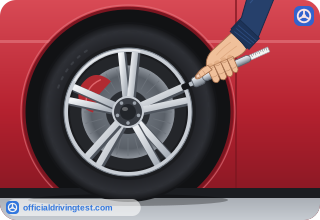
- Three hours
- One hour
- Two hours
- Six hours
Show answer
Correct answer: Three hours
Check tires 'cold' — before you've driven, or at least three hours after you've driven — for an accurate pressure reading.
Source: Pennsylvania Driver's Manual (Pub 95), page 31 · Open this page in the manual (Manual page 31)
-
Most roads have permanent pavement markings that primarily show:
- The posted speed limit
- The location of the nearest exit
- Where school buses may stop
- The road's center, lanes or edges
Show answer
Correct answer: The road's center, lanes or edges
Most roads have permanent markings to show the center of the road, travel lanes or road edges.
Source: Pennsylvania Driver's Manual (Pub 95), page 22 · Open this page in the manual (Manual page 22)
-
On Pennsylvania highways, exit numbers correspond to:
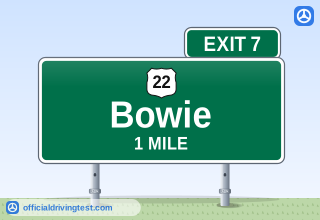
- The mile markers on the highway
- The number of exits from the state line
- The county road index
- The order in which the exits were built
Show answer
Correct answer: The mile markers on the highway
Exit numbers correspond with the mile markers, allowing motorists to quickly calculate distances between exits.
Source: Pennsylvania Driver's Manual (Pub 95), page 19 · Open this page in the manual (Manual page 19)
-
According to the manual, what should you do before backing up your vehicle?
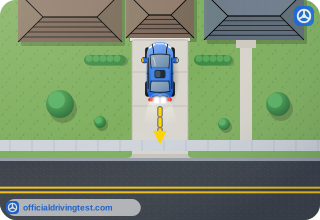
- Rely on your rearview mirror and backup sensors alone
- Sound your horn continuously while moving
- Check behind it before getting in and look out the rear window
- Ask a passenger to stand behind the vehicle
Show answer
Correct answer: Check behind it before getting in and look out the rear window
When backing up, always check behind your vehicle before you get in it. Before backing up, turn your head so you can see through the rear window — do not depend on your mirrors or sensors alone.
Source: Pennsylvania Driver's Manual (Pub 95), page 38 · Open this page in the manual (Manual page 38)
-
Traffic signs are divided into three basic categories. What are they?
- Mandatory, Optional and Informational signs
- Regulatory, Warning and Guide signs
- Stop, Yield and Caution signs
- Federal, State and Local signs
Show answer
Correct answer: Regulatory, Warning and Guide signs
Signs are divided into three basic categories: Regulatory, Warning and Guide signs.
Source: Pennsylvania Driver's Manual (Pub 95), page 10 · Open this page in the manual (Manual page 10)
-
What do regulatory signs tell drivers?
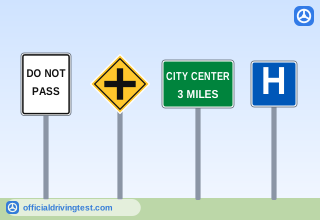
- General information about services and distances
- Possible hazards or changes in roadway conditions ahead
- What you must do, or must not do, according to the law
- Only which lane to use for through traffic
Show answer
Correct answer: What you must do, or must not do, according to the law
Regulatory signs tell you what you must do, or must not do, according to the law.
Source: Pennsylvania Driver's Manual (Pub 95), page 10 · Open this page in the manual (Manual page 10)
-
When traffic signals at an intersection are arranged vertically, which color is always on top?
- Red
- Yellow
- Green
- It depends on the intersection
Show answer
Correct answer: Red
When traffic signals are arranged vertically, red is always on top and green is always on the bottom.
Source: Pennsylvania Driver's Manual (Pub 95), page 7 · Open this page in the manual (Manual page 7)
-
At a four-way stop intersection, which vehicle should move forward first?
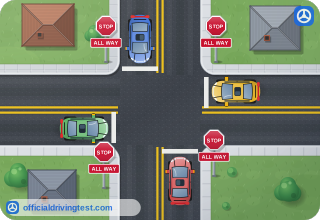
- The vehicle turning left, regardless of arrival order
- The first vehicle to reach the intersection
- The vehicle on the right, regardless of arrival order
- Whichever vehicle is largest
Show answer
Correct answer: The first vehicle to reach the intersection
At a four-way stop, the first vehicle to reach the intersection should move forward first.
Source: Pennsylvania Driver's Manual (Pub 95), page 10 · Open this page in the manual (Manual page 10)
-
Which of the following are signals that indicate an approaching train at a railroad crossing, requiring you to stop?
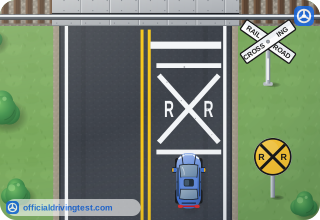
- Only a lowered crossing gate
- Flashing red lights, a lowered crossing gate, a flagger signaling, or the train's audible warning signal
- Only flashing red lights
- Only the train's audible signal
Show answer
Correct answer: Flashing red lights, a lowered crossing gate, a flagger signaling, or the train's audible warning signal
You are required to stop when there is any signal of an approaching train: flashing red lights, a lowered gate, a flagger signaling, or the train's audible signal.
Source: Pennsylvania Driver's Manual (Pub 95), page 9 · Open this page in the manual (Manual page 9)