Pennsylvania: Emergencies and special situations — Part 1 Practice Test
Questions in this part include: “According to the manual, why should you maintain a constant supply of fresh air in your vehicle while driving?” · “According to the manual, what is the best thing to do if you begin to feel tired while driving?”
Independent educational site · not affiliated with any government agency or DMV
Ready? Test yourself
Answer to start, or tap Start below:
According to the manual, which of the following should you keep in your vehicle at all times to help you deal with a flat tire?
- Instant feedback with an explanation
- Every answer cites its source in the manual
- Your best score is saved on this device
- Keyboard: press 1 to 4 to answer and Enter for the next question
Questions are original and based on the official manual "Pennsylvania Driver's Manual" (Pub 95), Pennsylvania Department of Transportation (PennDOT), Bureau of Driver Licensing.
All 18 questions in this practice test
Take the test above first, then use this list to study. Tap “Show answer” to see the correct answer and explanation.
Show the questions and answersHide the questions
-
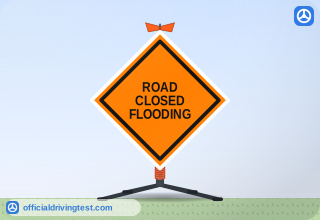
A ROAD CLOSED FLOODING sign informs you that:
- flooding is possible but the road remains open
- only heavy trucks are restricted from the road
- the flooding has already cleared
- the road is closed and you must use an alternate route
Show answer
Correct answer: the road is closed and you must use an alternate route
This sign informs you that the road ahead is closed due to flooding; you must use an alternate route.
Source: Pennsylvania Driver's Manual (Pub 95), page 18 · Open this page in the manual (Manual page 18)
-
According to the manual, which of the following should you keep in your vehicle at all times to help you deal with a flat tire?
- A tire pressure gauge only
- A full-size replacement wheel only
- Nothing — roadside assistance should always be called instead
- A spare tire, lug wrench, jack and flashlight
Show answer
Correct answer: A spare tire, lug wrench, jack and flashlight
The manual recommends keeping tools such as a spare tire, lug wrench, jack, flashlight, flares/reflective triangles, wheel wedges, a flat tire repair kit and gloves in your vehicle.
Source: Pennsylvania Driver's Manual (Pub 95), page 31 · Open this page in the manual (Manual page 31)
-
According to the manual, why should you maintain a constant supply of fresh air in your vehicle while driving?
- To keep the windows from fogging only
- To stay alert and avoid carbon monoxide poisoning
- To reduce road noise inside the passenger cabin
- To keep the tires cool
Show answer
Correct answer: To stay alert and avoid carbon monoxide poisoning
A constant supply of fresh air helps you stay alert and guards against carbon monoxide (exhaust gas) poisoning.
Source: Pennsylvania Driver's Manual (Pub 95), page 32 · Open this page in the manual (Manual page 32)
-
According to the manual, driving while fatigued has effects similar to driving under the influence of what?
- Caffeine
- Nicotine
- Motion sickness
- Alcohol
Show answer
Correct answer: Alcohol
Driving while fatigued has similar effects as driving under the influence of alcohol.
Source: Pennsylvania Driver's Manual (Pub 95), page 33 · Open this page in the manual (Manual page 33)
-
According to the manual, being awake for 18 hours in a row impairs your driving about as much as having a blood alcohol level of what percent?
- .05 percent
- .02 percent
- .08 percent
- .10 percent
Show answer
Correct answer: .05 percent
Being awake for 18 hours impairs your driving about as much as a blood alcohol level of .05 percent.
Source: Pennsylvania Driver's Manual (Pub 95), page 33 · Open this page in the manual (Manual page 33)
-
According to the manual, being awake for 24 hours in a row impairs your driving about as much as having a blood alcohol level of what percent?
- .05 percent
- .10 percent
- .08 percent
- .15 percent
Show answer
Correct answer: .10 percent
Being awake for 24 hours in a row impairs your driving as much as having a blood alcohol level of .10 percent.
Source: Pennsylvania Driver's Manual (Pub 95), page 33 · Open this page in the manual (Manual page 33)
-
According to the manual, teens who sleep less than how many hours a night are at increased risk for vehicle crashes?
- Six hours
- Seven hours
- Eight hours
- Nine hours
Show answer
Correct answer: Eight hours
Teens who sleep less than eight (8) hours a night are at increased risk for vehicle crashes.
Source: Pennsylvania Driver's Manual (Pub 95), page 33 · Open this page in the manual (Manual page 33)
-
According to the manual, what is the best thing to do if you begin to feel tired while driving?
- Turn up the radio
- Open the window and drive faster
- Drink coffee and continue driving
- Stop driving
Show answer
Correct answer: Stop driving
The best thing to do if you begin to feel tired while driving is to stop driving.
Source: Pennsylvania Driver's Manual (Pub 95), page 33 · Open this page in the manual (Manual page 33)
-
According to the manual, falling asleep while driving causes at least how many crashes across the U.S. every year?
- 100,000
- 10,000
- 50,000
- 500,000
Show answer
Correct answer: 100,000
Every year across the U.S., falling asleep while driving causes at least 100,000 crashes.
Source: Pennsylvania Driver's Manual (Pub 95), page 33 · Open this page in the manual (Manual page 33)
-
According to the manual, about how many people die each year in crashes linked to drowsy driving in the U.S.?
- 150
- 1,500
- 500
- 5,000
Show answer
Correct answer: 1,500
1,500 people die and 40,000 are injured in drowsy driving crashes each year.
Source: Pennsylvania Driver's Manual (Pub 95), page 33 · Open this page in the manual (Manual page 33)
-
According to the manual, of the 100,000 vehicle crashes linked to drowsy driving each year, almost half involve drivers in which age range?
- 25 to 34
- 35 to 44
- 15 to 24
- 45 to 54
Show answer
Correct answer: 15 to 24
Almost half of the 100,000 drowsy-driving crashes each year involve drivers between 15 and 24 years of age.
Source: Pennsylvania Driver's Manual (Pub 95), page 33 · Open this page in the manual (Manual page 33)
-
According to the manual, how often should you have your vision checked?
- Every six months
- Every five years
- Only when you renew your license
- Every one or two years
Show answer
Correct answer: Every one or two years
The manual advises having your vision checked every one (1) or two (2) years, since side vision, distance judgment and low-light vision can deteriorate over time.
Source: Pennsylvania Driver's Manual (Pub 95), page 33 · Open this page in the manual (Manual page 33)
-
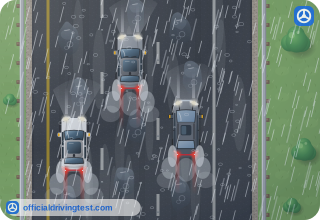
If you find yourself hydroplaning, what should you do first?
- Slam on the brakes immediately
- Keep both hands on the wheel and slowly ease off the gas
- Turn the steering wheel sharply toward the shoulder
- Shift into neutral
Show answer
Correct answer: Keep both hands on the wheel and slowly ease off the gas
If you hydroplane, keep both hands on the wheel and slowly take your foot off the gas pedal to let the vehicle slow down.
Source: Pennsylvania Driver's Manual (Pub 95), page 41 · Open this page in the manual (Manual page 41)
-
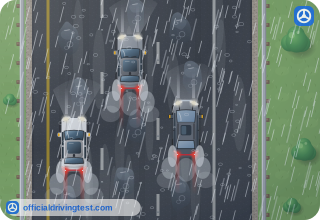
While hydroplaning, why should you avoid slamming on the brakes or turning suddenly?
- It will damage the brakes
- It is illegal to brake while hydroplaning
- It will cause your vehicle to skid
- It will not affect the vehicle at all
Show answer
Correct answer: It will cause your vehicle to skid
Slamming the brakes or turning suddenly while hydroplaning will cause your vehicle to skid.
Source: Pennsylvania Driver's Manual (Pub 95), page 41 · Open this page in the manual (Manual page 41)
-
If you get caught in fog so dense you cannot see, what does the manual recommend?

- Pull completely off the road and wait for the fog to clear
- Continue driving slowly with your hazard lights on
- Follow the taillights of the vehicle ahead closely
- Pull onto the shoulder and turn off all lights
Show answer
Correct answer: Pull completely off the road and wait for the fog to clear
If you get caught in dense fog, pull completely off the road, preferably into a parking lot, and wait until it clears, with your hazard lights on and seat belt fastened.
Source: Pennsylvania Driver's Manual (Pub 95), page 42 · Open this page in the manual (Manual page 42)
-
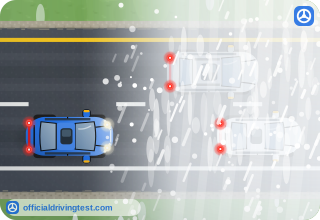
Snow squalls can reduce visibility to near zero and slicken the roadway within seconds, sometimes while vehicles are traveling on interstates at speeds in excess of:
- 40 mph
- 50 mph
- 60 mph
- 70 mph
Show answer
Correct answer: 60 mph
Snow squall events leave little time to react, often at speeds in excess of 60 mph on interstates.
Source: Pennsylvania Driver's Manual (Pub 95), page 42 · Open this page in the manual (Manual page 42)
-
If you encounter a snow squall while driving, what does the manual advise?
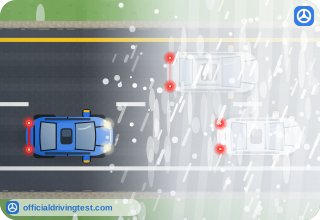
- Brake hard immediately to slow down as fast as possible
- Speed up to get through the squall quickly
- Pull into the passing lane and pass slower vehicles
- Gradually slow down and activate your hazard lights
Show answer
Correct answer: Gradually slow down and activate your hazard lights
If you encounter a snow squall, exercise extreme caution by gradually slowing and activating your hazard lights; do not slam on your brakes.
Source: Pennsylvania Driver's Manual (Pub 95), page 43 · Open this page in the manual (Manual page 43)
-
A National Weather Service "Snow Squall Warning" for a roadway typically lasts:
- Less than 45 minutes
- Less than 15 minutes
- Less than 30 minutes
- Less than 90 minutes
Show answer
Correct answer: Less than 45 minutes
Snow Squall Warnings typically last less than 45 minutes for a given roadway.
Source: Pennsylvania Driver's Manual (Pub 95), page 43 · Open this page in the manual (Manual page 43)