Pennsylvania: Emergencies and special situations — Part 4 Practice Test
Questions in this part include: “According to the manual, how can you best protect against a tire blowout?” · “Where should you park before changing a flat tire?”
Independent educational site · not affiliated with any government agency or DMV
Ready? Test yourself
- Instant feedback with an explanation
- Every answer cites its source in the manual
- Your best score is saved on this device
Questions are original and based on the official manual "Pennsylvania Driver's Manual" (Pub 95), Pennsylvania Department of Transportation (PennDOT), Bureau of Driver Licensing.
All 18 questions in this practice test
Take the test above first, then use this list to study. Tap “Show answer” to see the correct answer and explanation.
Show the questions and answersHide the questions
-
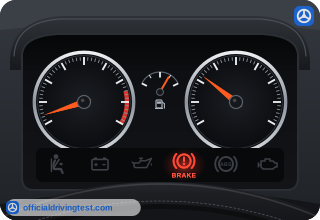
If the brake system warning light comes on in a newer vehicle with a split braking system, what is likely still working?
- All four wheels' brakes, but weakly
- None of the brakes
- Only the parking brake
- Braking in one front and one rear wheel
Show answer
Correct answer: Braking in one front and one rear wheel
A split braking system means you may still have braking in two of the four wheels - probably one front wheel and one rear wheel - enough to pull over safely.
Source: Pennsylvania Driver's Manual (Pub 95), page 62 · Open this page in the manual (Manual page 62)
-
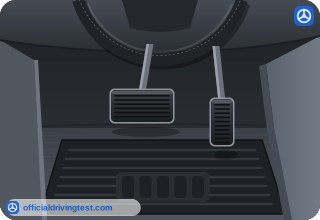
With partial brake failure in a newer vehicle, what will you notice about the brake pedal and stopping distance?
- The pedal goes down farther and stopping distance increases
- The pedal will feel normal but stopping distance decreases
- The pedal will lock in place and not move at all
- The pedal becomes looser but stopping distance stays the same
Show answer
Correct answer: The pedal goes down farther and stopping distance increases
With partial brake failure, the brake pedal goes down farther than usual before the vehicle slows, you must push harder, and your stopping distance is increased.
Source: Pennsylvania Driver's Manual (Pub 95), page 62 · Open this page in the manual (Manual page 62)
-
What can help you slow down if your newer vehicle experiences partial brake failure?
- Turning off the engine while moving
- Shifting to a lower gear
- Pumping the gas pedal
- Shifting into neutral
Show answer
Correct answer: Shifting to a lower gear
Shifting to a lower gear will help you slow down when experiencing partial brake failure.
Source: Pennsylvania Driver's Manual (Pub 95), page 62 · Open this page in the manual (Manual page 62)
-
If you have an older vehicle and your brakes suddenly fail, what is the first thing you should do?
- Turn off the ignition immediately
- Pull the parking brake as hard as possible right away
- Shift to low gear and look for a place to slow to a stop
- Steer directly toward the shoulder without slowing down
Show answer
Correct answer: Shift to low gear and look for a place to slow to a stop
With sudden brake failure in an older vehicle, first shift to low gear and look for a place to slow to a stop.
Source: Pennsylvania Driver's Manual (Pub 95), page 63 · Open this page in the manual (Manual page 63)
-
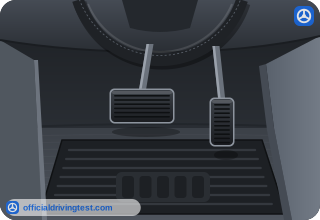
In an older vehicle with sudden brake failure, what should you try after shifting to low gear?
- Turn off the engine completely
- Accelerate to gain control
- Release the steering wheel briefly
- Pump the brakes quickly several times
Show answer
Correct answer: Pump the brakes quickly several times
Pump the brake pedal quickly several times - this will often build up enough brake pressure to stop the vehicle.
Source: Pennsylvania Driver's Manual (Pub 95), page 63 · Open this page in the manual (Manual page 63)
-
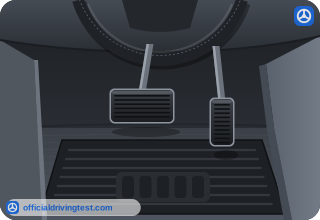
If pumping the brake pedal does not work in an older vehicle with brake failure, what should you use, and what must you be ready to do if the rear wheels lock?
- The parking brake, and be ready to let off of it if you skid
- The parking brake, and pull it harder if you start to skid
- The headlights, and flash them to warn the drivers ahead
- The clutch, and hold it down fully until the vehicle stops
Show answer
Correct answer: The parking brake, and be ready to let off of it if you skid
Use the parking (emergency) brake if pumping does not work, holding the brake release so you can let off of the parking brake if the rear wheels lock and you begin to skid.
Source: Pennsylvania Driver's Manual (Pub 95), page 63 · Open this page in the manual (Manual page 63)
-
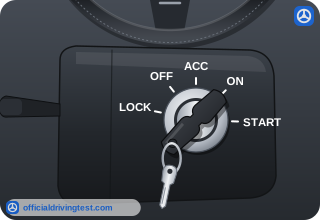
As a last resort with an older vehicle's brakes still not stopping the car, what should you do with the ignition?
- Turn it to "LOCK" to secure the wheel
- Turn it to "OFF," never "LOCK"
- Leave it running and coast to a stop
- Turn it to "ACC" only
Show answer
Correct answer: Turn it to "OFF," never "LOCK"
As a last resort, turn your ignition "OFF" - never to "LOCK," which would also lock your steering - then shift into your lowest gear.
Source: Pennsylvania Driver's Manual (Pub 95), page 63 · Open this page in the manual (Manual page 63)
-
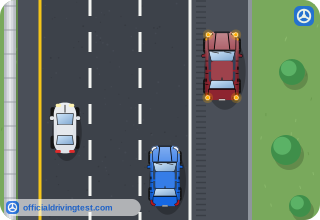
After you manage to stop a vehicle whose brakes have failed, what should you do?
- Try to drive carefully to the nearest garage
- Continue driving at a reduced speed
- Call for help and do not try to drive
- Wait a few minutes, then resume driving normally
Show answer
Correct answer: Call for help and do not try to drive
After you have stopped your vehicle, call for help; do not try to drive it.
Source: Pennsylvania Driver's Manual (Pub 95), page 63 · Open this page in the manual (Manual page 63)
-
According to the manual, how can you best protect against a tire blowout?
- Drive slower than the speed limit at all times
- Avoid driving on highways
- Replace all four tires every year
- Keep your tires in good condition and properly inflated
Show answer
Correct answer: Keep your tires in good condition and properly inflated
You usually will not know ahead of time when a tire will blow, so protect against blowouts by keeping your tires in good condition and properly inflated.
Source: Pennsylvania Driver's Manual (Pub 95), page 63 · Open this page in the manual (Manual page 63)
-
What happens when a front tire blows out?
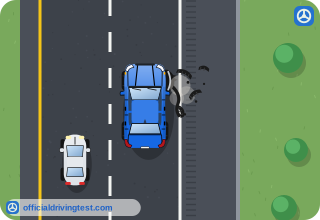
- Steering wheel vibrates; the vehicle pulls to one side
- The vehicle accelerates on its own
- Nothing is noticeable until you stop
- The rear of the vehicle wobbles back and forth
Show answer
Correct answer: Steering wheel vibrates; the vehicle pulls to one side
When a front tire blows out, your steering wheel will vibrate and you will feel the vehicle suddenly pull to one side.
Source: Pennsylvania Driver's Manual (Pub 95), page 63 · Open this page in the manual (Manual page 63)
-
What happens when a rear tire blows out?
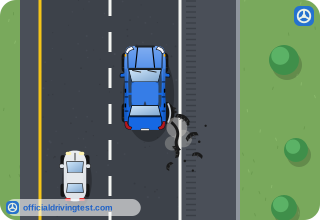
- The steering wheel locks up completely
- One corner drops; the rear wobbles back and forth
- The vehicle pulls sharply to one side only
- Nothing changes until the vehicle stops
Show answer
Correct answer: One corner drops; the rear wobbles back and forth
When a rear tire blows out, one corner of the vehicle will drop suddenly, and you will feel the rear of the vehicle wobble back and forth.
Source: Pennsylvania Driver's Manual (Pub 95), page 63 · Open this page in the manual (Manual page 63)
-
If one of your tires blows out, what should you avoid doing at first?
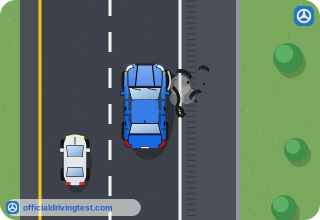
- Holding the steering wheel tightly
- Slowly taking your foot off the gas pedal
- Using your brake
- Steering smoothly toward where you want to go
Show answer
Correct answer: Using your brake
Stay off of your brake after a blowout - braking will cause you to skid and lose control of your vehicle.
Source: Pennsylvania Driver's Manual (Pub 95), page 63 · Open this page in the manual (Manual page 63)
-
After a tire blowout, how should you steer?
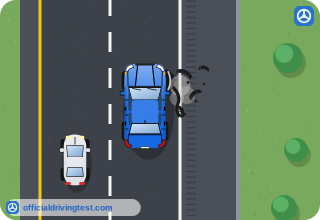
- With large, quick corrections to compensate
- Not at all, until the vehicle stops
- Only to the right, regardless of traffic
- Smoothly toward where you want to go
Show answer
Correct answer: Smoothly toward where you want to go
Steer where you want to go, but steer smoothly - do not make large or jerky steering actions after a blowout.
Source: Pennsylvania Driver's Manual (Pub 95), page 63 · Open this page in the manual (Manual page 63)
-
If you must brake after a tire blowout once you have slowed and are steering safely, how should you apply the brakes?
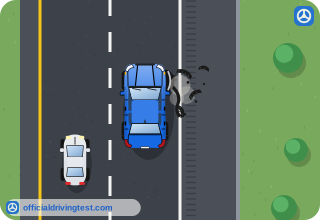
- Gently, letting the vehicle slow to a stop
- Firmly and suddenly to stop as fast as possible
- By pumping them rapidly
- Not at all, under any circumstance
Show answer
Correct answer: Gently, letting the vehicle slow to a stop
You can ride on a flat tire to reach a safe spot; if you must use your brakes, press them gently and let the vehicle slow to a stop.
Source: Pennsylvania Driver's Manual (Pub 95), page 63 · Open this page in the manual (Manual page 63)
-
Which items does the manual recommend keeping in your vehicle at all times for changing a flat tire?
- Only a spare tire
- A spare tire, lug wrench, jack, and flashlight
- Only a jack and flares
- A fire extinguisher and first aid kit only
Show answer
Correct answer: A spare tire, lug wrench, jack, and flashlight
The manual recommends keeping a spare tire, lug wrench, jack, screwdriver, flashlight, flares and reflective triangles, wheel wedges, a flat tire repair kit, gloves, and similar tools in your vehicle at all times.
Source: Pennsylvania Driver's Manual (Pub 95), page 63 · Open this page in the manual (Manual page 63)
-
Where should you park before changing a flat tire?
- In the travel lane with flashers on
- On the shoulder as close to traffic as possible
- On a flat surface away from traffic, far off the road
- On any incline that is convenient
Show answer
Correct answer: On a flat surface away from traffic, far off the road
Park on a flat surface that is away from traffic and as far off of the road as possible before changing a tire.
Source: Pennsylvania Driver's Manual (Pub 95), page 63 · Open this page in the manual (Manual page 63)
-
Before raising a vehicle with a jack to change a tire, what should you do to secure it?
- Remove all four tires at once
- Turn the engine off only, with no other precautions
- Leave the vehicle in drive
- Apply the parking brake and place wedges or chocks at the front and rear of a remaining good tire
Show answer
Correct answer: Apply the parking brake and place wedges or chocks at the front and rear of a remaining good tire
Apply the parking brake and secure the vehicle by placing bricks, wooden wedges, or wheel chocks at both the front and rear of one of the remaining good tires.
Source: Pennsylvania Driver's Manual (Pub 95), page 63 · Open this page in the manual (Manual page 63)
-
When should you loosen the lug nuts while changing a tire?
- While the vehicle is on the ground, before jacking it up
- After the vehicle has been fully raised on the jack
- Only after removing the spare from the trunk
- It does not matter when
Show answer
Correct answer: While the vehicle is on the ground, before jacking it up
While the vehicle is on the ground, loosen (but do not fully remove) the lug nuts, before raising the vehicle with the jack.
Source: Pennsylvania Driver's Manual (Pub 95), page 63 · Open this page in the manual (Manual page 63)