Pennsylvania: Emergencies and special situations — Part 2 Practice Test
Questions in this part include: “What does the manual say you should never do on the road, even if another driver upsets you?” · “About what percentage of the roughly 1,500 annual highway deaths in Pennsylvania are attributed to aggressive driving?”
Independent educational site · not affiliated with any government agency or DMV
Ready? Test yourself
Answer to start, or tap Start below:
What does the manual say you should never do on the road, even if another driver upsets you?
- Instant feedback with an explanation
- Every answer cites its source in the manual
- Your best score is saved on this device
- Keyboard: press 1 to 4 to answer and Enter for the next question
Questions are original and based on the official manual "Pennsylvania Driver's Manual" (Pub 95), Pennsylvania Department of Transportation (PennDOT), Bureau of Driver Licensing.
All 18 questions in this practice test
Take the test above first, then use this list to study. Tap “Show answer” to see the correct answer and explanation.
Show the questions and answersHide the questions
-
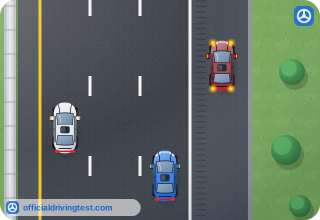
If your vehicle breaks down on the highway, after pulling off the road and turning on your hazard flashers, what else should you do to let other drivers know your vehicle is disabled?
- Turn off all your lights
- Lift your hood
- Sound your horn continuously
- Stand behind the vehicle
Show answer
Correct answer: Lift your hood
Lift your hood to let other drivers know your vehicle is disabled.
Source: Pennsylvania Driver's Manual (Pub 95), page 44 · Open this page in the manual (Manual page 44)
-
What does the manual say you should never do on the road, even if another driver upsets you?
- Take your anger out on someone else
- Slow down when traffic gets heavy
- Use your turn signal to change lanes
- Check your mirrors before merging
Show answer
Correct answer: Take your anger out on someone else
The manual states you should NEVER take your anger out on someone else on the road.
Source: Pennsylvania Driver's Manual (Pub 95), page 60 · Open this page in the manual (Manual page 60)
-
If another driver cuts you off or pulls in front of you, what does the manual advise?
- Flash your high beams repeatedly
- Follow closely to teach them a lesson
- Never take it personally; let it go
- Retaliate immediately
Show answer
Correct answer: Never take it personally; let it go
The manual says to never take it personally when someone cuts you off; just let it go and ignore the other driver.
Source: Pennsylvania Driver's Manual (Pub 95), page 60 · Open this page in the manual (Manual page 60)
-
What does the manual say about trying to 'teach another driver a lesson'?
- You should not do it, even if you are right
- It is encouraged if a passenger agrees
- It is only acceptable at low speeds
- It is recommended if you are clearly right
Show answer
Correct answer: You should not do it, even if you are right
The manual states you should not insist on being right or try to teach another driver a lesson, even if you are right.
Source: Pennsylvania Driver's Manual (Pub 95), page 60 · Open this page in the manual (Manual page 60)
-
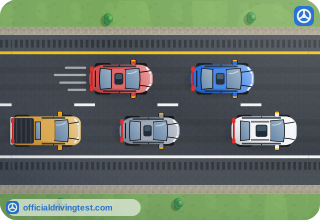
If an aggressive driver demands to pass you in the passing lane, what does the manual suggest doing?
- Block the lane to prevent them from passing
- Let them go
- Speed up to stay ahead of them
- Slam on your brakes
Show answer
Correct answer: Let them go
The manual advises not blocking the passing lane; if someone demands to pass, let them go.
Source: Pennsylvania Driver's Manual (Pub 95), page 60 · Open this page in the manual (Manual page 60)
-
If an aggressive driver pursues you, what does the manual say you should do?
- Stop and confront the driver to calm things down
- Drive straight home and call the police from there
- Pull over immediately wherever you happen to be
- Drive to a police station or other place with witnesses
Show answer
Correct answer: Drive to a police station or other place with witnesses
If an aggressive driver pursues you, do not go home — instead drive to a police station, convenience store, or other location where you can get help and there will be witnesses.
Source: Pennsylvania Driver's Manual (Pub 95), page 60 · Open this page in the manual (Manual page 60)
-
About what percentage of the roughly 1,500 annual highway deaths in Pennsylvania are attributed to aggressive driving?
- About 90 percent
- About 10 percent
- About 60 percent
- About 30 percent
Show answer
Correct answer: About 60 percent
The manual's Did You Know box states about 60 percent, or around 900, of roughly 1,500 annual PA highway deaths are attributed to aggressive driving.
Source: Pennsylvania Driver's Manual (Pub 95), page 60 · Open this page in the manual (Manual page 60)
-
In a review of 12,000 crashes cited by the manual, what percentage of drivers took no action at all to avoid the crash?
- 37 percent
- 17 percent
- 7 percent
- 27 percent
Show answer
Correct answer: 37 percent
The manual's Did You Know box states that in a review of 12,000 crashes, 37 percent of drivers took no action to avoid the crash.
Source: Pennsylvania Driver's Manual (Pub 95), page 60 · Open this page in the manual (Manual page 60)
-
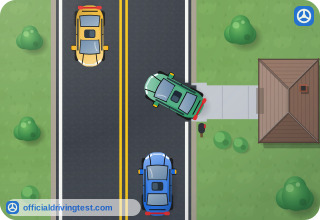
When you have a choice between braking or steering to avoid a collision, which does the manual say is usually better, especially above 25 mph?
- Steering, since you react faster by swerving than by braking
- Neither; you should close your eyes and hope for the best
- Accelerating past the hazard
- Braking, since it is always safer
Show answer
Correct answer: Steering, since you react faster by swerving than by braking
The manual explains that steering is usually better than braking above 25 mph because your reaction time to swerve is faster than your reaction time to brake.
Source: Pennsylvania Driver's Manual (Pub 95), page 60 · Open this page in the manual (Manual page 60)
-
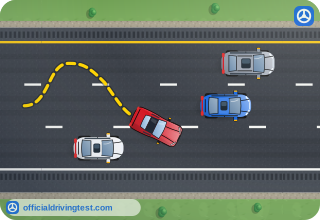
In an evasive steering maneuver, after you turn the wheel quickly at least a half turn in one direction, what do you do next?
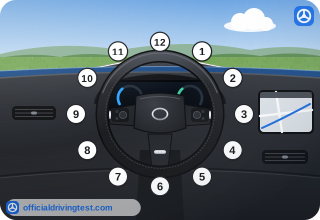
- Immediately brake hard and hold the wheel still
- Turn the wheel back almost a full circle the other way
- Let go of the wheel and allow it to spin freely
- Continue turning the same direction indefinitely
Show answer
Correct answer: Turn the wheel back almost a full circle the other way
Evasive steering requires turning the wheel at least a half turn in one direction, then turning it back almost a full circle in the opposite direction once you clear the object, before returning to center.
Source: Pennsylvania Driver's Manual (Pub 95), page 61 · Open this page in the manual (Manual page 61)
-
At higher speeds, how much steering input is needed to move your vehicle left or right?
- None at all
- Less steering input is needed
- More steering input is needed
- The same amount, regardless of speed
Show answer
Correct answer: Less steering input is needed
The manual notes that at higher speeds, less steering input is needed to move your vehicle left or right.
Source: Pennsylvania Driver's Manual (Pub 95), page 61 · Open this page in the manual (Manual page 61)
-
According to the manual, where should your hands hold the steering wheel, thinking of it as a clock face?
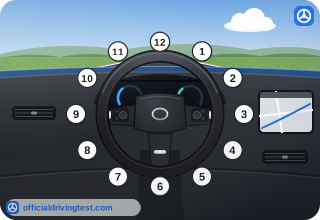
- 12 and 6 o'clock
- 11 and 1, or 7 and 5 o'clock
- 9 and 3, or 8 and 4 o'clock
- 10 and 2 o'clock only
Show answer
Correct answer: 9 and 3, or 8 and 4 o'clock
The manual recommends holding the wheel at either the 9 and 3 o'clock position or the 8 and 4 o'clock position, whichever is more comfortable.
Source: Pennsylvania Driver's Manual (Pub 95), page 61 · Open this page in the manual (Manual page 61)
-
How should your thumbs be positioned on the steering wheel, according to the manual?
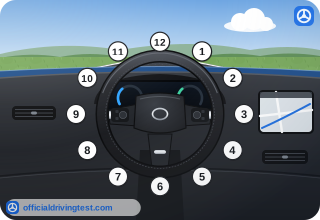
- Gripping the inside of the rim
- Along the face of the steering wheel
- Crossed over each other
- Off the wheel entirely
Show answer
Correct answer: Along the face of the steering wheel
The manual instructs keeping your thumbs along the face of the steering wheel instead of gripping the inside of the rim.
Source: Pennsylvania Driver's Manual (Pub 95), page 61 · Open this page in the manual (Manual page 61)
-
Why is the recommended hand position (9-3 or 8-4 o'clock) safer if the air bag deploys?
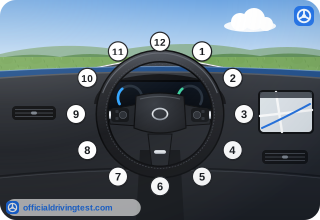
- It prevents the air bag from deploying in a frontal crash
- It has no relation to air bag safety in a crash
- It increases your grip strength so you can steer harder
- The air bag is less likely to throw your arms into your face
Show answer
Correct answer: The air bag is less likely to throw your arms into your face
This hand position makes it less likely the air bag will throw your arms and hands back into your face, possibly breaking them, in a crash.
Source: Pennsylvania Driver's Manual (Pub 95), page 61 · Open this page in the manual (Manual page 61)
-
Is a 10 and 2 o'clock hand position acceptable, according to the manual?
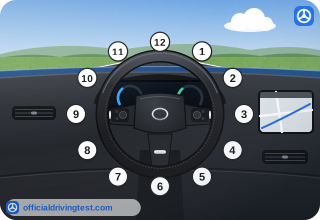
- Yes, and it is the safest position to use
- Yes, but you risk injury if the air bag deploys
- No, it will damage the steering wheel over time
- No, it is illegal to drive with your hands there
Show answer
Correct answer: Yes, but you risk injury if the air bag deploys
A 10 and 2 o'clock hand position is acceptable, but the manual warns you are at risk of injury if your air bag deploys in that position.
Source: Pennsylvania Driver's Manual (Pub 95), page 61 · Open this page in the manual (Manual page 61)
-
In the 'hand-over-hand' steering method described in the manual, what does the driver do?
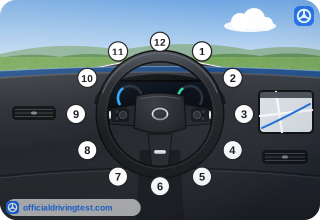
- Reach across to grasp the opposite side and pull it over the top
- Push up with one hand while the other slides and pulls down
- Steer using only one hand
- Keep both hands fixed at 9 and 3
Show answer
Correct answer: Reach across to grasp the opposite side and pull it over the top
In the hand-over-hand method, the driver reaches across the steering wheel to grasp the opposite side and pulls the wheel over the top, repeating as needed.
Source: Pennsylvania Driver's Manual (Pub 95), page 61 · Open this page in the manual (Manual page 61)
-
In the 'push-pull' steering method described in the manual, what happens?
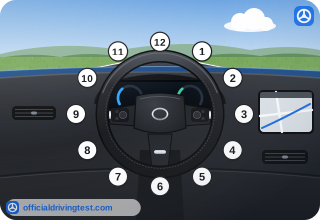
- The driver reaches across the wheel to grasp the opposite side
- Both hands remain crossed at all times
- One hand pushes up while the other slides to the top and pulls down
- The driver releases the wheel between turns
Show answer
Correct answer: One hand pushes up while the other slides to the top and pulls down
In the push-pull method, one hand pushes up on the steering wheel while the other slides to the top and then pulls the wheel down, repeating until the turn is complete.
Source: Pennsylvania Driver's Manual (Pub 95), page 61 · Open this page in the manual (Manual page 61)
-
According to the manual, injury prevention in a crash depends mostly on which factors?
- Your vehicle's color, age and type of engine
- The brand of your tires and the pattern of their tread
- Seat belt, head restraints, air bag and distance from it
- Your years of driving experience and nothing else
Show answer
Correct answer: Seat belt, head restraints, air bag and distance from it
The manual says injury prevention depends mostly on wearing your seat belt properly, having your head restraints properly adjusted, having an air bag, and being positioned an adequate distance from it.
Source: Pennsylvania Driver's Manual (Pub 95), page 61 · Open this page in the manual (Manual page 61)