Pennsylvania: 30 Hardest Driving Test Questions
Questions that need a second thought, picked for close numbers, exceptions and easy-to-confuse rules. Take your time.
Independent educational site · not affiliated with any government agency or DMV
Ready? Test yourself
Answer to start, or tap Start below:
The SCHOOL sign is the only sign of which shape used on Pennsylvania roadways?
- Instant feedback with an explanation
- Every answer cites its source in the manual
- Your best score is saved on this device
- Keyboard: press 1 to 4 to answer and Enter for the next question
Questions are original and based on the official manual "Pennsylvania Driver's Manual" (Pub 95), Pennsylvania Department of Transportation (PennDOT), Bureau of Driver Licensing.
All 30 questions in this practice test
Take the test above first, then use this list to study. Tap “Show answer” to see the correct answer and explanation.
Show the questions and answersHide the questions
-
At an intersection with a steady red light and no marked stop line or crosswalk, where must you stop?
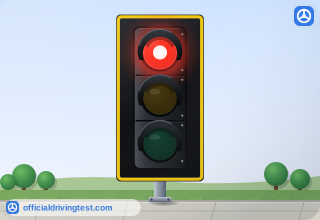
- Anywhere within the intersection
- At the nearest crosswalk on the far side
- Before entering the intersection
- You do not need to stop if no lines are marked
Show answer
Correct answer: Before entering the intersection
You must stop before the marked stop line or crosswalk; if there are no lines, stop before entering the intersection.
Source: Pennsylvania Driver's Manual (Pub 95), page 7 · Open this page in the manual (Manual page 7)
-
Drivers must always yield to which type of pedestrian, regardless of the situation?
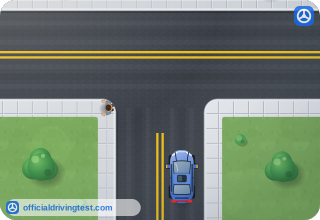
- Any pedestrian wearing reflective clothing
- Any pedestrian who makes eye contact with the driver
- A blind pedestrian with a white cane or a guide dog
- Only pedestrians in a marked crosswalk
Show answer
Correct answer: A blind pedestrian with a white cane or a guide dog
Drivers must always yield to any blind pedestrian carrying a white cane or being led by a guide dog.
Source: Pennsylvania Driver's Manual (Pub 95), page 48 · Open this page in the manual (Manual page 48)
-
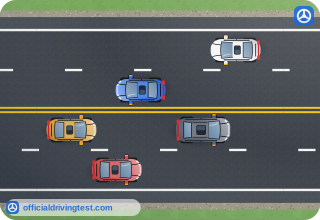
On a multi-lane highway without a median, even though broken white lane lines may be crossed to pass, you may NOT cross:
- A single broken white line
- The double yellow centerline separating opposing traffic
- The broken white line to your right, if that lane is clear
- Any pavement arrow
Show answer
Correct answer: The double yellow centerline separating opposing traffic
You may cross the broken white lines to pass, but you may not cross the double yellow centerlines to pass, since traffic is traveling in the opposite direction beyond them.
Source: Pennsylvania Driver's Manual (Pub 95), page 22 · Open this page in the manual (Manual page 22)
-
The SCHOOL sign is the only sign of which shape used on Pennsylvania roadways?
- Pentagon (5-sided)
- Octagon (8-sided)
- Triangular (3-sided)
- Pennant-shaped
Show answer
Correct answer: Pentagon (5-sided)
The SCHOOL sign is the only pentagon-shaped sign used on the roadway.
Source: Pennsylvania Driver's Manual (Pub 95), page 17 · Open this page in the manual (Manual page 17)
-
At a YIELD sign, when must you come to a complete stop?
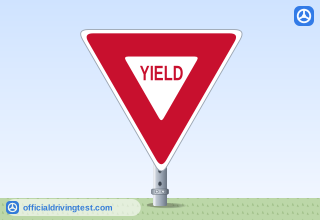
- Only when necessary to yield to traffic or pedestrians
- Every time, even when no other traffic is approaching
- Only at night, when other traffic is harder to see
- Never — a YIELD sign never requires stopping
Show answer
Correct answer: Only when necessary to yield to traffic or pedestrians
At a YIELD sign, you stop only when it is necessary; otherwise proceed when you can do so safely without interfering with normal traffic flow.
Source: Pennsylvania Driver's Manual (Pub 95), page 10 · Open this page in the manual (Manual page 10)
-
When a school bus stops with red lights flashing and its stop arm extended, how far away must you stop?
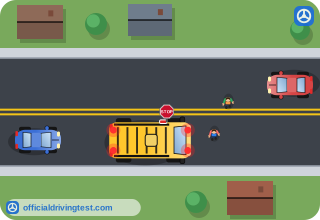
- At least 20 feet away
- At least 10 feet away
- At least 5 feet away
- At least 50 feet away
Show answer
Correct answer: At least 10 feet away
You must stop at least 10 feet away from a school bus stopped with its red lights flashing and stop arm extended.
Source: Pennsylvania Driver's Manual (Pub 95), page 58 · Open this page in the manual (Manual page 58)
-
If traffic is backed up at a railroad crossing because of a traffic signal or stop sign ahead, what should you do?
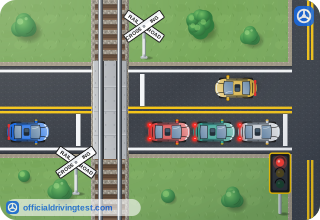
- Make sure your vehicle stops in a location entirely clear of the railroad tracks
- Stop with your vehicle straddling the tracks if that is where the line ends
- Proceed past the stopped traffic to clear the tracks first
- Reverse until the tracks are clear, even into oncoming traffic
Show answer
Correct answer: Make sure your vehicle stops in a location entirely clear of the railroad tracks
Never stop on a railroad track; if traffic is backed up, make sure you stop your vehicle in a location entirely clear of the tracks.
Source: Pennsylvania Driver's Manual (Pub 95), page 9 · Open this page in the manual (Manual page 9)
-
Under a junior driver's license, during what hours are you generally prohibited from driving unless accompanied by a qualifying adult?
- 9 p.m. to 5 a.m.
- Midnight to 6 a.m.
- 11 p.m. to 5 a.m.
- 10 p.m. to 4 a.m.
Show answer
Correct answer: 11 p.m. to 5 a.m.
Junior license holders may not drive between 11 p.m. and 5 a.m. unless a parent, guardian, person in loco parentis, or spouse who is 18 or older is with them.
Source: Pennsylvania Driver's Manual (Pub 95), page 3 · Open this page in the manual (Manual page 3)
-
Except in an emergency or unless told to by police, how close to a fire hydrant may you never stop, stand, or park?
- Within 15 feet
- Within 30 feet
- Within 5 feet
- Within 50 feet
Show answer
Correct answer: Within 15 feet
The manual lists 15 feet of a fire hydrant as a place you may never stop, stand, or park.
Source: Pennsylvania Driver's Manual (Pub 95), page 53 · Open this page in the manual (Manual page 53)
-
You may not stop, stand, or park within how many feet of a flashing signal, stop sign, yield sign, or other traffic control device located at the side of a roadway?
- 20 feet
- 30 feet
- 50 feet
- 15 feet
Show answer
Correct answer: 30 feet
The manual sets this distance at 30 feet for a flashing signal, stop sign, yield sign, or similar roadside traffic control device.
Source: Pennsylvania Driver's Manual (Pub 95), page 53 · Open this page in the manual (Manual page 53)
-
When passing a bicyclist in Pennsylvania, how much clearance must a driver allow between the vehicle and the bicycle?
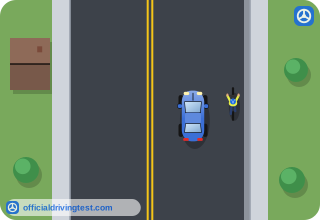
- At least 2 feet
- At least 4 feet
- At least 3 feet
- At least 6 feet
Show answer
Correct answer: At least 4 feet
When passing, a driver must allow at least four feet between the vehicle and a bicycle to pass safely.
Source: Pennsylvania Driver's Manual (Pub 95), page 92 · Open this page in the manual (Manual page 92)
-
To avoid "overdriving your headlights" on a dark road at night, you should not drive faster than:
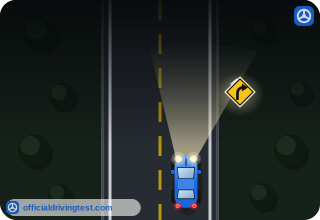
- 45 mph
- 35 mph
- 55 mph
- 65 mph
Show answer
Correct answer: 45 mph
To avoid overdriving your headlights on a dark road at night, you should not drive faster than 45 mph.
Source: Pennsylvania Driver's Manual (Pub 95), page 40 · Open this page in the manual (Manual page 40)
-
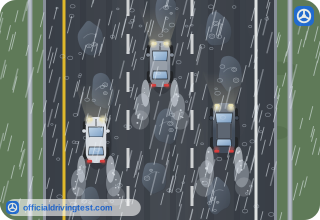
According to the manual, you can begin to hydroplane at speeds as low as:
- 25 mph
- 45 mph
- 55 mph
- 35 mph
Show answer
Correct answer: 35 mph
You can hydroplane at speeds as low as 35 mph, when water is only 1/10 of an inch deep.
Source: Pennsylvania Driver's Manual (Pub 95), page 41 · Open this page in the manual (Manual page 41)
-
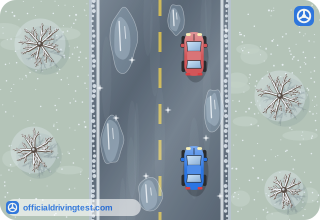
On ice-covered roads, roughly how much more space should you leave between you and the vehicle ahead compared to normal?
- About 10 times more
- About 2 times more
- About 5 times more
- About 20 times more
Show answer
Correct answer: About 10 times more
On ice, leave about 10 times more space than normal between you and the vehicle ahead.
Source: Pennsylvania Driver's Manual (Pub 95), page 41 · Open this page in the manual (Manual page 41)
-
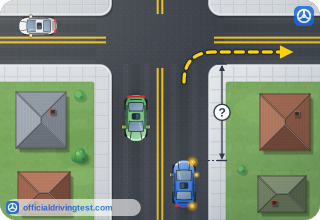
Under Pennsylvania law, if you are driving 35 mph or more, how far before turning must you signal?
- At least 100 feet
- At least 300 feet
- At least 200 feet
- At least 500 feet
Show answer
Correct answer: At least 300 feet
If you are driving 35 mph or more, you must signal at least 300 feet before turning.
Source: Pennsylvania Driver's Manual (Pub 95), page 44 · Open this page in the manual (Manual page 44)
-
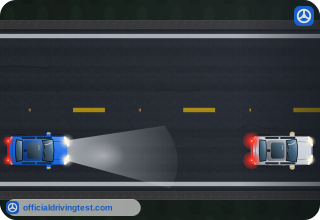
Pennsylvania law requires you to switch to low beams when following another vehicle within how many feet?
- 100 feet
- 300 feet
- 200 feet
- 500 feet
Show answer
Correct answer: 300 feet
You must use low beams when you are following a vehicle within 300 feet.
Source: Pennsylvania Driver's Manual (Pub 95), page 40 · Open this page in the manual (Manual page 40)
-
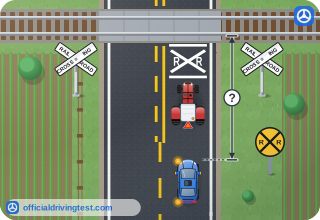
You may NOT pass another vehicle when you are within how many feet of, or are crossing, an intersection or railroad grade crossing (unless a traffic control device says you may)?
- 50 feet
- 500 feet
- 100 feet
- 200 feet
Show answer
Correct answer: 100 feet
You may not pass if you are within 100 feet of or are crossing any intersection or railroad grade crossing.
Source: Pennsylvania Driver's Manual (Pub 95), page 47 · Open this page in the manual (Manual page 47)
-
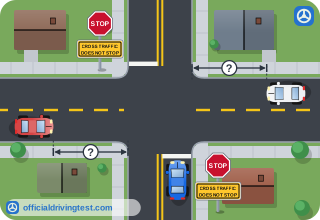
When turning right at an intersection with a two-way stop, the manual recommends allowing a gap of about how many seconds between you and any vehicle approaching from the left?
- 4 seconds
- 6 seconds
- 8 seconds
- 12 seconds
Show answer
Correct answer: 8 seconds
Allow a gap of about 8 seconds between you and any vehicle approaching from the left when turning right.
Source: Pennsylvania Driver's Manual (Pub 95), page 49 · Open this page in the manual (Manual page 49)
-
What is the maximum speed for an open-bed pickup or flatbed truck if any person is occupying the bed?
- 55 mph
- 45 mph
- 25 mph
- 35 mph
Show answer
Correct answer: 35 mph
An open-bed pickup truck or open flatbed truck may not be driven at a speed of more than 35 mph if any person is occupying the bed.
Source: Pennsylvania Driver's Manual (Pub 95), page 59 · Open this page in the manual (Manual page 59)
-
According to research cited in the manual, a teenager who is dialing a cell phone while driving misses an important road event about what percent of the time?
- 13 percent
- 53 percent
- 23 percent
- 43 percent
Show answer
Correct answer: 53 percent
A teenager dialing a cell phone misses an important road event 53 percent of the time.
Source: Pennsylvania Driver's Manual (Pub 95), page 32 · Open this page in the manual (Manual page 32)
-
According to the manual, being awake for 18 hours in a row impairs your driving about as much as having a blood alcohol level of what percent?
- .05 percent
- .02 percent
- .08 percent
- .10 percent
Show answer
Correct answer: .05 percent
Being awake for 18 hours impairs your driving about as much as a blood alcohol level of .05 percent.
Source: Pennsylvania Driver's Manual (Pub 95), page 33 · Open this page in the manual (Manual page 33)
-
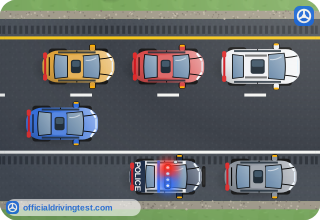
If you cannot move into a nonadjacent lane while passing an emergency scene, police stop, or a tow truck picking up a disabled vehicle, you must reduce your speed to at least how much below the posted speed limit?
- 5 mph
- 10 mph
- 15 mph
- 20 mph
Show answer
Correct answer: 20 mph
If you cannot move over, you must reduce your speed to at least 20 miles per hour below the posted speed limit.
Source: Pennsylvania Driver's Manual (Pub 95), page 43 · Open this page in the manual (Manual page 43)
-
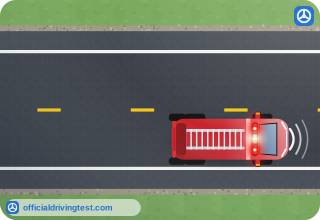
After an emergency vehicle passes you, how far away should you stay before starting to drive again?
- At least 200 feet
- At least 1,000 feet
- At least 500 feet
- At least 100 feet
Show answer
Correct answer: At least 500 feet
The manual instructs staying at least 500 feet away from an emergency vehicle after it passes, before starting to drive again.
Source: Pennsylvania Driver's Manual (Pub 95), page 59 · Open this page in the manual (Manual page 59)
-
If a Move Over law violation leads to the death of an emergency responder or a person in or near a disabled vehicle, what suspension and maximum fine apply?
- A 90-day suspension and a fine up to $1,000
- A 6-month suspension and a fine up to $5,000
- No suspension, only a fine
- A 1-year suspension and a fine up to $10,000
Show answer
Correct answer: A 1-year suspension and a fine up to $10,000
If the violation leads to the death of an emergency responder or a person in or near a disabled vehicle, a 1-year suspension and a fine of up to $10,000 could result.
Source: Pennsylvania Driver's Manual (Pub 95), page 59 · Open this page in the manual (Manual page 59)
-
If you are arrested for DUI and refuse to take a chemical test, your driving privilege will be automatically suspended for:
- 6 months
- 9 months
- 1 year
- 2 years
Show answer
Correct answer: 1 year
Refusing one or more chemical tests after a DUI arrest results in an automatic one-year suspension.
Source: Pennsylvania Driver's Manual (Pub 95), page 82 · Open this page in the manual (Manual page 82)
-
If you refuse chemical testing and you already have a prior DUI conviction or a prior test refusal, your total suspension could reach:
- 18 months
- 3 years
- 2 years
- 1 year
Show answer
Correct answer: 3 years
With a prior DUI conviction or prior refusal, you face an 18-month suspension for the refusal plus 18 more months for the DUI conviction, totaling three years.
Source: Pennsylvania Driver's Manual (Pub 95), page 82 · Open this page in the manual (Manual page 82)
-
According to the manual, a driver under age 21 is considered to be driving under the influence (DUI) if their blood alcohol concentration is what percent or more?
- .02 percent
- .01 percent
- .04 percent
- .08 percent
Show answer
Correct answer: .02 percent
If you are a driver under age 21 and your BAC is .02 percent or more, you are considered to be driving under the influence.
Source: Pennsylvania Driver's Manual (Pub 95), page 33 · Open this page in the manual (Manual page 33)
-
Before taking the Road Test, a driver under 18 must complete at least how many hours of behind-the-wheel skill-building, including at least 10 hours of nighttime driving and 5 hours of bad-weather driving?
- 40 hours
- 50 hours
- 25 hours
- 65 hours
Show answer
Correct answer: 65 hours
Drivers under 18 must complete at least 65 hours of behind-the-wheel skill-building, including no less than 10 hours of nighttime driving and 5 hours of bad-weather driving, before the Road Test.
Source: Pennsylvania Driver's Manual (Pub 95), page 2 · Open this page in the manual (Manual page 2)
-
A junior license holder faces a mandatory 90-day suspension for accumulating six or more points, or for being convicted of driving how many miles per hour over the posted speed limit?
- 10 mph or more
- 15 mph or more
- 20 mph or more
- 26 mph or more
Show answer
Correct answer: 26 mph or more
Junior license holders receive a mandatory 90-day suspension for accumulating six or more points, or for a conviction of driving 26 mph or more over the posted speed limit.
Source: Pennsylvania Driver's Manual (Pub 95), page 4 · Open this page in the manual (Manual page 4)
-
How should you treat a railroad crossbuck sign (the X-shaped sign at a railroad crossing)?
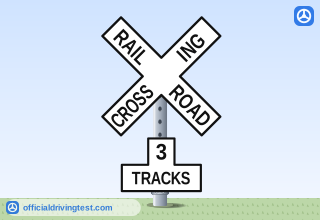
- As a STOP sign, requiring a complete stop every time, train or not
- As a warning sign with no legal requirement to slow down
- As a YIELD sign — slow down and prepare to stop if a train is approaching
- As a guide sign providing only directional information
Show answer
Correct answer: As a YIELD sign — slow down and prepare to stop if a train is approaching
You should treat the railroad crossbuck sign as a YIELD sign: slow down and prepare to stop if you see or hear a train approaching.
Source: Pennsylvania Driver's Manual (Pub 95), page 10 · Open this page in the manual (Manual page 10)