Pennsylvania: Emergencies and special situations — Part 6 Practice Test
Questions in this part include: “According to the manual, what do all real police officers always carry?” · “Carbon monoxide, a gas produced by all gas-powered vehicles, is especially dangerous because of which characteristic?”
Independent educational site · not affiliated with any government agency or DMV
Ready? Test yourself
- Instant feedback with an explanation
- Every answer cites its source in the manual
- Your best score is saved on this device
Questions are original and based on the official manual "Pennsylvania Driver's Manual" (Pub 95), Pennsylvania Department of Transportation (PennDOT), Bureau of Driver Licensing.
All 17 questions in this practice test
Take the test above first, then use this list to study. Tap “Show answer” to see the correct answer and explanation.
Show the questions and answersHide the questions
-
When a police vehicle stops behind you, what should you do first?
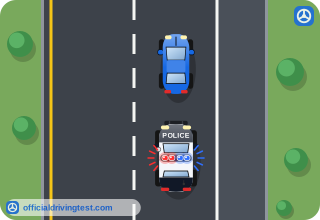
- Turn off your headlights and wait
- Signal and pull over to the right edge
- Immediately exit your vehicle
- Speed up to find a police station
Show answer
Correct answer: Signal and pull over to the right edge
Police recommend activating your turn signal and driving as close as safely possible to the right edge of the road, then stopping and parking safely away from traffic.
Source: Pennsylvania Driver's Manual (Pub 95), page 80 · Open this page in the manual (Manual page 80)
-
If you are stopped by police at night, when should you turn on your vehicle's interior light?
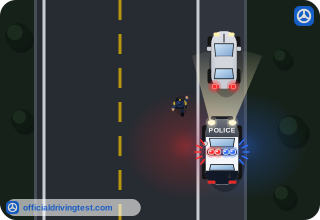
- Only after the officer asks
- Never; it can startle the officer
- Once stopped, before the officer approaches
- Only if you are alone in the vehicle
Show answer
Correct answer: Once stopped, before the officer approaches
At night, turn on your vehicle's interior light as soon as you stop and before the officer approaches.
Source: Pennsylvania Driver's Manual (Pub 95), page 80 · Open this page in the manual (Manual page 80)
-
If you are transporting a firearm and are stopped by police, you should:
- Alert the officer immediately
- Say nothing unless asked
- Hide it from view immediately
- Hand it out the window before the officer arrives
Show answer
Correct answer: Alert the officer immediately
The manual advises alerting the officer immediately if you are transporting any type of firearm.
Source: Pennsylvania Driver's Manual (Pub 95), page 80 · Open this page in the manual (Manual page 80)
-
During a traffic stop, when should you retrieve your license, registration, and insurance card?
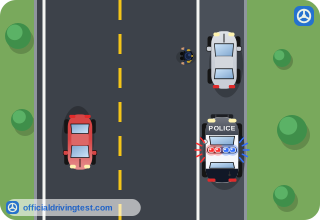
- Before the officer reaches the window
- While the officer is still in their vehicle
- Immediately after coming to a stop
- Only after the officer asks you to
Show answer
Correct answer: Only after the officer asks you to
You should wait until the officer asks you to retrieve your driver's license, registration, and insurance cards.
Source: Pennsylvania Driver's Manual (Pub 95), page 80 · Open this page in the manual (Manual page 80)
-
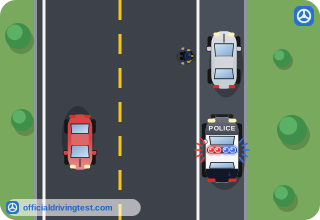
During a traffic stop, you should keep which of the following fastened until the officer has seen that you are appropriately restrained?
- Your parking brake
- Your seat belt
- Your door lock
- Your headrest
Show answer
Correct answer: Your seat belt
Keep your seat belt fastened until the officer has seen you are appropriately restrained.
Source: Pennsylvania Driver's Manual (Pub 95), page 80 · Open this page in the manual (Manual page 80)
-
If you disagree with a citation issued during a traffic stop, you are entitled to:
- An automatic dismissal
- A refund of any fine already paid
- A court hearing to present your arguments
- A private hearing with the officer alone
Show answer
Correct answer: A court hearing to present your arguments
If you disagree with a citation, you are entitled to a court hearing where you can present your arguments.
Source: Pennsylvania Driver's Manual (Pub 95), page 80 · Open this page in the manual (Manual page 80)
-
Police lights on a marked vehicle are typically red and blue, but an unmarked police vehicle may instead show:
- Flashing green lights only
- Flashing amber lights only
- Flashing white lights only
- A flashing red light only
Show answer
Correct answer: A flashing red light only
In some instances, an unmarked police vehicle may be equipped with a flashing red light only.
Source: Pennsylvania Driver's Manual (Pub 95), page 80 · Open this page in the manual (Manual page 80)
-
If a vehicle behind you is flashing only blue lights, this means:
- It is not a police officer
- It is always an unmarked state trooper
- It is a volunteer firefighter who must be obeyed
- It is a tow truck operator
Show answer
Correct answer: It is not a police officer
If the vehicle is flashing only blue lights, then it is not a police officer.
Source: Pennsylvania Driver's Manual (Pub 95), page 81 · Open this page in the manual (Manual page 81)
-
If you are unsure whether the vehicle signaling you to stop is really driven by a police officer, you should:
- Pull over immediately wherever you are
- Drive slowly, with flashers on, to the nearest well-lit, populated area
- Ignore the signal completely and continue at normal speed
- Call the license plate number in to a friend and keep driving normally
Show answer
Correct answer: Drive slowly, with flashers on, to the nearest well-lit, populated area
If you are still not certain the person pulling you over is a police officer, you may drive to the nearest well-lit, populated area, acknowledging the stop with your flashers and reduced speed.
Source: Pennsylvania Driver's Manual (Pub 95), page 81 · Open this page in the manual (Manual page 81)
-
According to the manual, what do all real police officers always carry?
- A citation pad only
- A department vehicle only
- A photo ID card and a badge
- A printed warrant
Show answer
Correct answer: A photo ID card and a badge
Police officers always possess a photo ID card and a badge.
Source: Pennsylvania Driver's Manual (Pub 95), page 81 · Open this page in the manual (Manual page 81)
-
If you come upon a crash you are not involved in, you should stop only if:
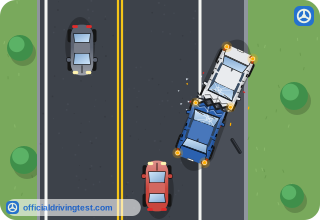
- Emergency help has not yet arrived
- You want to take photos for insurance purposes
- There is heavy traffic backed up
- You recognize one of the vehicles
Show answer
Correct answer: Emergency help has not yet arrived
Do not stop at a crash unless you are involved or emergency help has not yet arrived.
Source: Pennsylvania Driver's Manual (Pub 95), page 81 · Open this page in the manual (Manual page 81)
-
If you are involved in a crash, you should call the police if:
- The other driver asks you not to
- The crash happened on a private driveway only
- No vehicle needs towing and no one is hurt
- Anyone is hurt or dies, or a vehicle needs to be towed
Show answer
Correct answer: Anyone is hurt or dies, or a vehicle needs to be towed
Call the police if anyone is hurt or dies, or if any vehicle needs to be towed.
Source: Pennsylvania Driver's Manual (Pub 95), page 81 · Open this page in the manual (Manual page 81)
-
If a crash involves only a parked vehicle or property damage and you cannot find the owner, you should:
- Simply drive away, since no one witnessed it
- Leave a note with the date, time, your name, and a phone number, then call police
- Wait at the scene for up to 24 hours
- Report it only if asked by your insurance company
Show answer
Correct answer: Leave a note with the date, time, your name, and a phone number, then call police
If you cannot find the owner, leave a note with the date, time, your name, and a phone number, and call the police.
Source: Pennsylvania Driver's Manual (Pub 95), page 81 · Open this page in the manual (Manual page 81)
-
If police do not investigate a crash that resulted in death or injury, or that required a vehicle to be towed, the driver should:
- Do nothing further; a report is not required
- Wait for the other driver's insurance company to file a report
- Send a Driver's Accident Report Form (AA-600) within 5 days
- Send a report within 60 days
Show answer
Correct answer: Send a Driver's Accident Report Form (AA-600) within 5 days
If police do not investigate such a crash, the driver must send a Driver's Accident Report Form (AA-600) within five days.
Source: Pennsylvania Driver's Manual (Pub 95), page 81 · Open this page in the manual (Manual page 81)
-
About how many crashes occur each year in Pennsylvania because a driver tries to flee or elude police?
- About 450
- About 150
- About 900
- About 50
Show answer
Correct answer: About 450
Each year there are about 450 crashes caused when a driver attempts to flee or elude police.
Source: Pennsylvania Driver's Manual (Pub 95), page 81 · Open this page in the manual (Manual page 81)
-
Carbon monoxide, a gas produced by all gas-powered vehicles, is especially dangerous because of which characteristic?
- It has a strong, easily recognizable odor
- It turns exhaust smoke a visible blue color
- It is odorless and cannot be smelled
- It only forms when a vehicle is moving at high speed
Show answer
Correct answer: It is odorless and cannot be smelled
Carbon monoxide is a deadly gas released from a vehicle's exhaust pipe that is completely odorless, so you cannot smell it; drowsiness or nausea can be a warning sign of exposure.
Source: Pennsylvania Driver's Manual (Pub 95), page 95 · Open this page in the manual (Manual page 95)
-
Which of these is a tip the manual gives for helping to prevent carbon monoxide poisoning in a vehicle?
- Warm up your vehicle in the garage with the garage door closed to save time
- Keep windows fully closed whenever you are stuck in idling traffic
- On snowy days, inspect and clear any snow or ice blocking the tailpipe
- Wait until you feel drowsy before checking your exhaust system
Show answer
Correct answer: On snowy days, inspect and clear any snow or ice blocking the tailpipe
The manual advises inspecting your tailpipe and removing any snow or ice that might be obstructing it on snowy days, since a blocked tailpipe can cause carbon monoxide to build up inside the vehicle.
Source: Pennsylvania Driver's Manual (Pub 95), page 95 · Open this page in the manual (Manual page 95)