West Virginia: Speed and space
West Virginia speed limits, the basic speed law, following distance and stopping on wet or icy roads. Split into 4 shorter tests so you're not stuck in one long quiz.
Independent educational site · not affiliated with any government agency or DMV
Choose a part
Speed and space — Part 1
Questions in this part include: “During urban area driving, how fast should you drive?”
Speed and space — Part 2
Questions in this part include: “How does a higher speed affect the time you have to react to a traffic situation?”
Speed and space — Part 3
Questions in this part include: “What kind of speed should you always drive on an interstate?”
Speed and space — Part 4
Questions in this part include: “If your vehicle has a manual transmission and you start on snow or ice, what should you do with the clutch?”
Questions are original and based on the official manual "West Virginia Driver's Licensing Handbook" (Revised July 2026), West Virginia Division of Motor Vehicles (DMV).
All 66 Speed and space questions with answers
Choose a part above to take a practice test, or study every question and answer here.
Show the questions and answersHide the questions
1Part 117 questions
-
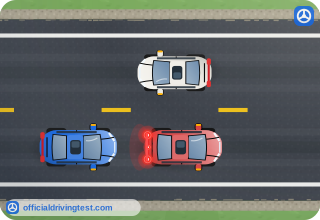
In the handbook’s definitions, what is following distance?
- The distance your vehicle travels after you press the brake pedal
- The distance between your vehicle and the vehicle in the next lane
- The distance you can see ahead on the road at night
- The space cushion between your vehicle and the vehicle directly ahead of you
Show answer
Correct answer: The space cushion between your vehicle and the vehicle directly ahead of you
Following distance is the space cushion between your vehicle and the vehicle directly ahead.
Source: West Virginia Driver's Licensing Handbook (Revised July 2026)
-
What is a safe gap when stopping behind another vehicle?
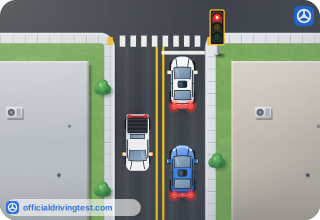
- Where you can see the rear tires of the vehicle ahead of you
- Where you can see the license plate of the vehicle ahead
- About one car length behind the vehicle ahead
- Where your hood touches the vehicle’s rear bumper
Show answer
Correct answer: Where you can see the rear tires of the vehicle ahead of you
A safe gap is to stop where you can see the rear tires of the vehicle ahead of you.
Source: West Virginia Driver's Licensing Handbook (Revised July 2026), page 29 · Open this page in the manual (Manual page 29)
-
During urban area driving, how fast should you drive?
- Faster than the flow of traffic, so the examiner sees good progress
- Ten miles per hour below the posted speed limit at all times
- At whatever speed the vehicle ahead travels, even above the limit
- Keep up with the flow of traffic, but do not exceed the posted speed limit
Show answer
Correct answer: Keep up with the flow of traffic, but do not exceed the posted speed limit
You should keep up with the flow of traffic without exceeding the posted speed limit.
Source: West Virginia Driver's Licensing Handbook (Revised July 2026), page 30 · Open this page in the manual (Manual page 30)
-
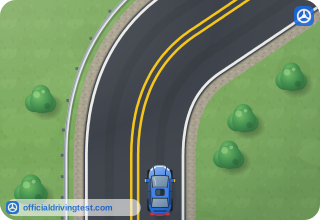
Before entering a curve, what should you do with your speed?
- Maintain it and brake in the middle of the curve
- Reduce it so further braking is not required in the curve
- Increase it slightly to keep the vehicle stable
- Reduce it only after reaching the middle of the curve
Show answer
Correct answer: Reduce it so further braking is not required in the curve
You reduce speed before the curve so that you do not need to brake again inside it.
Source: West Virginia Driver's Licensing Handbook (Revised July 2026), page 30 · Open this page in the manual (Manual page 30)
-
While driving through a curve, what should you follow?
- Posted warning signs
- The speed of the vehicle behind you
- The speed of the vehicle ahead of you
- The examiner’s hand signals
Show answer
Correct answer: Posted warning signs
In a curve you maintain a safe speed and follow posted warning signs.
Source: West Virginia Driver's Licensing Handbook (Revised July 2026), page 30 · Open this page in the manual (Manual page 30)
-
What is the maximum speed limit in a school zone when children are present or when specified?
- 10 m.p.h.
- 20 m.p.h.
- 25 m.p.h.
- 15 m.p.h.
Show answer
Correct answer: 15 m.p.h.
The maximum speed limit in a school zone is 15 m.p.h. when children are present or when specified.
Source: West Virginia Driver's Licensing Handbook (Revised July 2026), page 34 · Open this page in the manual (Manual page 34)
-
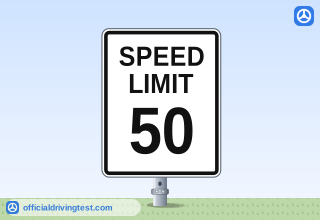
What does a speed limit sign show?
- The speed you must drive in any weather and road conditions
- The safest speed to drive when road conditions are at their worst
- The fastest speed you may drive under optimal weather and road conditions
- The average speed of the traffic that uses the road each day
Show answer
Correct answer: The fastest speed you may drive under optimal weather and road conditions
A speed limit sign shows the fastest speed you may drive under optimal weather and road conditions.
Source: West Virginia Driver's Licensing Handbook (Revised July 2026), page 35 · Open this page in the manual (Manual page 35)
-
Besides the fastest speed allowed, what does a speed limit sign sometimes also show?
- The average speed
- The minimum speed
- The speed for trucks
- The night speed
Show answer
Correct answer: The minimum speed
Speed limit signs sometimes also show the minimum speed.
Source: West Virginia Driver's Licensing Handbook (Revised July 2026), page 35 · Open this page in the manual (Manual page 35)
-
What do advisory speed signs at interstate entrances and exit ramps show?
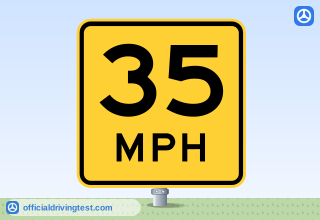
- The minimum speed required to enter the interstate
- The speed limit that police enforce on the ramp
- The maximum speed allowed on the interstate itself
- The maximum recommended safe speed for driving on the ramp
Show answer
Correct answer: The maximum recommended safe speed for driving on the ramp
Advisory speed signs on ramps show the maximum recommended safe speed for driving on the ramp.
Source: West Virginia Driver's Licensing Handbook (Revised July 2026), page 35 · Open this page in the manual (Manual page 35)
-
West Virginia law prohibits driving at a speed that is greater than what?
- Reasonable and prudent for existing conditions
- The average speed of the vehicles around you
- The speed of the vehicle directly ahead of you
- The speed that the most skilled drivers can handle
Show answer
Correct answer: Reasonable and prudent for existing conditions
State law bars driving faster than is reasonable and prudent for the existing conditions, even where a higher limit is posted.
Source: West Virginia Driver's Licensing Handbook (Revised July 2026), page 42 · Open this page in the manual (Manual page 42)
-
Which of these is a driving situation in which the handbook says you should slow down?
- Driving on a wide, straight road with no hazards
- Driving on a dry road in clear daylight with no traffic
- Approaching the top of a hill
- Driving on a road with no intersections or curves
Show answer
Correct answer: Approaching the top of a hill
The handbook lists approaching the top of a hill as a time to slow down.
Source: West Virginia Driver's Licensing Handbook (Revised July 2026), page 42 · Open this page in the manual (Manual page 42)
-
Which of these is a time when the handbook says you should reduce your speed?
- Driving straight on a long, open road with no traffic
- Approaching and going around a curve
- Driving in the right lane on a clear, dry day
- Driving past a long row of empty fields in daylight
Show answer
Correct answer: Approaching and going around a curve
The handbook lists approaching and going around a curve as a time to slow down.
Source: West Virginia Driver's Licensing Handbook (Revised July 2026), page 42 · Open this page in the manual (Manual page 42)
-
In which of these situations does the handbook say to slow down?
- When the road is dry and the view ahead is clear for a long way
- When you are driving below the speed of the traffic around you
- When no other vehicles are in sight on a straight road
- When weather or hazards limit visibility or stopping distance
Show answer
Correct answer: When weather or hazards limit visibility or stopping distance
You should slow down when traffic, weather, roadway hazards or other conditions limit your visibility or stopping distance.
Source: West Virginia Driver's Licensing Handbook (Revised July 2026), page 42 · Open this page in the manual (Manual page 42)
-
On an interstate, what is the maximum speed unless otherwise posted?
- 70 mph
- 60 mph
- 65 mph
- 75 mph
Show answer
Correct answer: 70 mph
Unless otherwise posted, the maximum speed on an interstate is 70 mph.
Source: West Virginia Driver's Licensing Handbook (Revised July 2026), page 42 · Open this page in the manual (Manual page 42)
-
On an open county highway, what is the designated speed limit unless otherwise posted?
- 45 mph
- 50 mph
- 55 mph
- 60 mph
Show answer
Correct answer: 55 mph
Unless it is posted otherwise, the designated speed on an open county highway is 55 mph.
Source: West Virginia Driver's Licensing Handbook (Revised July 2026), page 42 · Open this page in the manual (Manual page 42)
-
What is the designated speed limit in business or residential areas, unless otherwise posted or unreasonable for conditions?
- 20 mph
- 25 mph
- 30 mph
- 35 mph
Show answer
Correct answer: 25 mph
The designated speed in business or residential areas is 25 mph.
Source: West Virginia Driver's Licensing Handbook (Revised July 2026), page 42 · Open this page in the manual (Manual page 42)
-
What is the designated speed limit in a school zone while children are present along the roadway?
- 10 mph
- 20 mph
- 30 mph
- 15 mph
Show answer
Correct answer: 15 mph
While children are present along the roadway, the school zone speed is 15 mph.
Source: West Virginia Driver's Licensing Handbook (Revised July 2026), page 42 · Open this page in the manual (Manual page 42)
2Part 217 questions
-
A school zone includes any street or highway abutting the school grounds and extending how far along the street or highway from the school grounds?
- 125 feet
- 75 feet
- 200 feet
- 250 feet
Show answer
Correct answer: 125 feet
The school zone covers school property plus the street or highway that abuts it, for 125 feet from the school grounds.
Source: West Virginia Driver's Licensing Handbook (Revised July 2026), page 42 · Open this page in the manual (Manual page 42)
-
How does a higher speed affect the time you have to react to a traffic situation?
- You have more time to react because you see farther ahead
- You have less time to spot hazards and judge other vehicles' speed
- You have the same time to react at any speed
- Your reaction time improves as you gain experience at speed
Show answer
Correct answer: You have less time to spot hazards and judge other vehicles' speed
The higher the speed, the less time you have to spot hazards, judge the speed of other vehicles, and act.
Source: West Virginia Driver's Licensing Handbook (Revised July 2026), page 42 · Open this page in the manual (Manual page 42)
-
When you drive at less than the normal speed of traffic, where should you drive?
- In the middle of the lane, away from both road edges
- In the left lane so faster traffic can pass on the right
- On the center line so drivers can see you clearly
- As close as possible to the right edge of the road
Show answer
Correct answer: As close as possible to the right edge of the road
A slower driver should keep as close as possible to the right edge of the road.
Source: West Virginia Driver's Licensing Handbook (Revised July 2026), page 43 · Open this page in the manual (Manual page 43)
-
You must drive slower than the designated speed on a road with one lane in each direction, and overtaking traffic has no clear lane for passing. What should you do?
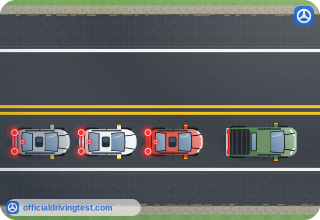
- Pull off at the first safe turnout to let faster traffic pass
- Keep driving in your lane and wave faster traffic around you
- Speed up slightly until the traffic behind you stops following
- Stop in your lane until all of the traffic behind you has passed
Show answer
Correct answer: Pull off at the first safe turnout to let faster traffic pass
Slow drivers should pull off at the first safe turnout so faster traffic can pass.
Source: West Virginia Driver's Licensing Handbook (Revised July 2026), page 43 · Open this page in the manual (Manual page 43)
-
According to the handbook, what causes most rear-end collisions?
- Following too closely
- Driving too slowly
- Faulty brake lights
- Changing lanes too often
Show answer
Correct answer: Following too closely
The handbook says following too closely causes most rear-end collisions.
Source: West Virginia Driver's Licensing Handbook (Revised July 2026), page 47 · Open this page in the manual (Manual page 47)
-
What is the space cushion ahead of your vehicle called?
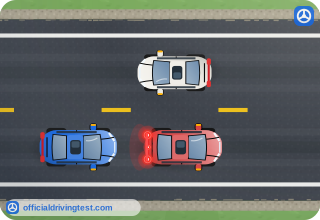
- Stopping distance
- Reaction distance
- Following distance
- Braking distance
Show answer
Correct answer: Following distance
The space ahead of your vehicle, the space cushion, is called the following distance.
Source: West Virginia Driver's Licensing Handbook (Revised July 2026), page 47 · Open this page in the manual (Manual page 47)
-
What does the handbook call the best way to assure proper following distance?
- The one-to-two second rule
- The three-to-four second rule
- The five-to-six second rule
- The six-to-eight second rule
Show answer
Correct answer: The three-to-four second rule
The best way to assure proper following distance is the three-to-four second rule.
Source: West Virginia Driver's Licensing Handbook (Revised July 2026), page 47 · Open this page in the manual (Manual page 47)
-
In the following-distance count, what does it mean if you reach the same object before you finish saying "one thousand three"?
- You are following at a safe distance
- You are driving too far behind
- You are driving faster than traffic
- You are driving too closely
Show answer
Correct answer: You are driving too closely
Reaching the object before you finish the count means you are driving too closely.
Source: West Virginia Driver's Licensing Handbook (Revised July 2026), page 47 · Open this page in the manual (Manual page 47)
-
If it is dark or raining, how many seconds should your following distance be at least?
- Four seconds
- One second
- Two seconds
- Three seconds
Show answer
Correct answer: Four seconds
In the dark or in rain, the handbook says the following distance should be at least four seconds.
Source: West Virginia Driver's Licensing Handbook (Revised July 2026), page 47 · Open this page in the manual (Manual page 47)
-
If there is ice or snow, how many seconds should you stay behind the vehicle in front?
- At least three seconds
- At least four seconds
- At least six seconds
- At least five seconds
Show answer
Correct answer: At least six seconds
On ice or snow, stay at least six seconds behind the vehicle in front.
Source: West Virginia Driver's Licensing Handbook (Revised July 2026), page 47 · Open this page in the manual (Manual page 47)
-
A vehicle is following you too closely. What does the handbook say you should do to warn the tailgater?
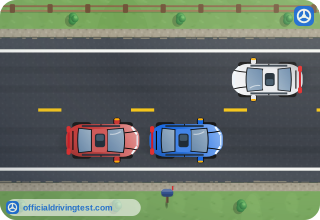
- Brake hard to make the driver back off
- Flash your high beams at the driver behind you
- Tap your brakes gently to flash the brake lights
- Turn on your hazard lights and keep driving
Show answer
Correct answer: Tap your brakes gently to flash the brake lights
Tapping your brakes gently flashes the brake lights and warns the tailgater.
Source: West Virginia Driver's Licensing Handbook (Revised July 2026), page 51 · Open this page in the manual (Manual page 51)
-
What can you do to encourage a tailgating vehicle to pass?
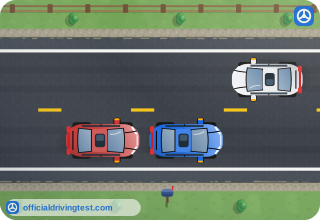
- Slow down
- Speed up
- Sound your horn
- Flash your high beams
Show answer
Correct answer: Slow down
The handbook says to slow down to encourage a tailgating vehicle to pass.
Source: West Virginia Driver's Licensing Handbook (Revised July 2026), page 51 · Open this page in the manual (Manual page 51)
-
If tapping your brakes and slowing down do not stop a tailgater, what does the handbook say to do?
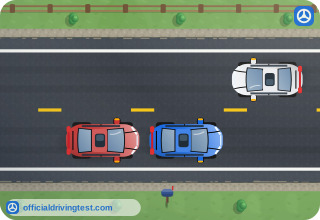
- Speed up until the vehicle falls back
- Brake hard so the driver must pass
- Change lanes repeatedly to shake the driver
- Pull over, stop and let the vehicle pass
Show answer
Correct answer: Pull over, stop and let the vehicle pass
If all else fails, you should pull over, stop and let the tailgating vehicle pass.
Source: West Virginia Driver's Licensing Handbook (Revised July 2026), page 51 · Open this page in the manual (Manual page 51)
-
What is a safe minimum following distance behind a motorcycle?
- One to two seconds
- Five to eight seconds
- Three to four seconds
- Ten seconds
Show answer
Correct answer: Three to four seconds
The handbook says it is wise to keep a safe minimum following distance of three to four seconds behind a motorcycle.
Source: West Virginia Driver's Licensing Handbook (Revised July 2026), page 51 · Open this page in the manual (Manual page 51)
-
Under which conditions should you increase your following distance behind a motorcycle?
- Only on interstate highways
- Only during daytime rush hour
- At night and in adverse weather
- Only when the motorcycle carries two riders
Show answer
Correct answer: At night and in adverse weather
The handbook says to increase the following distance time at night and under adverse weather conditions.
Source: West Virginia Driver's Licensing Handbook (Revised July 2026), page 51 · Open this page in the manual (Manual page 51)
-
A fully loaded tractor-trailer traveling 55 mph needs how many times the distance a vehicle needs to stop?
- Twice
- Three times
- Four times
- Five times
Show answer
Correct answer: Three times
A fully loaded tractor-trailer traveling 55 mph needs three times the distance a vehicle needs to stop.
Source: West Virginia Driver's Licensing Handbook (Revised July 2026), page 52 · Open this page in the manual (Manual page 52)
-
In dry conditions, how long should you wait after passing a truck before merging back to the right?
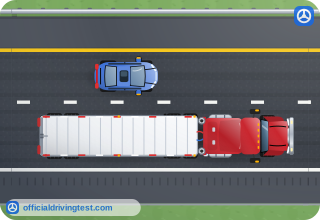
- One second
- Four seconds
- Two seconds
- Six seconds
Show answer
Correct answer: Two seconds
In dry conditions you use the two-second rule: after passing a truck, give two seconds before merging to the right.
Source: West Virginia Driver's Licensing Handbook (Revised July 2026), page 53 · Open this page in the manual (Manual page 53)
3Part 316 questions
-
In wet conditions, how much space should you give a truck?
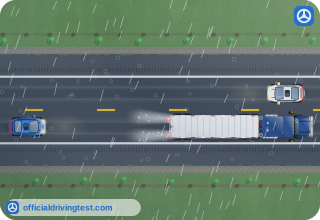
- Two seconds
- Two to three seconds at most
- At least four to six seconds
- At least ten seconds
Show answer
Correct answer: At least four to six seconds
In wet conditions you should give a truck at least four to six seconds of space.
Source: West Virginia Driver's Licensing Handbook (Revised July 2026), page 53 · Open this page in the manual (Manual page 53)
-
What is the slowest speed the handbook says you should drive on an interstate unless weather or road conditions are bad or a lower speed has been posted?
- 35 mph
- 55 mph
- 45 mph
- 65 mph
Show answer
Correct answer: 55 mph
You should not drive slower than 55 mph on an interstate unless conditions are bad or a lower speed is posted.
Source: West Virginia Driver's Licensing Handbook (Revised July 2026), page 59 · Open this page in the manual (Manual page 59)
-
What kind of speed should you always drive on an interstate?
- A speed that changes with passing vehicles
- A gradually increasing speed
- The speed of the fastest vehicle nearby
- A steady speed
Show answer
Correct answer: A steady speed
The handbook says to always drive at a steady speed.
Source: West Virginia Driver's Licensing Handbook (Revised July 2026), page 59 · Open this page in the manual (Manual page 59)
-
What is especially important when you encounter adverse conditions on an interstate?
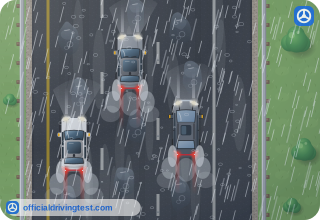
- Keeping an adequate following distance and adjusting your speed
- Driving in the left lane to stay clear of road spray ahead
- Keeping up with the fastest traffic on the road
- Using the shoulder to get around slower traffic
Show answer
Correct answer: Keeping an adequate following distance and adjusting your speed
In adverse conditions you should keep an adequate following distance and adjust your speed so a safe stop is possible.
Source: West Virginia Driver's Licensing Handbook (Revised July 2026), page 59 · Open this page in the manual (Manual page 59)
-
What does "over driving your headlights" mean?
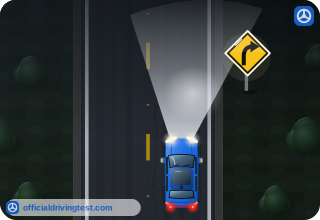
- Driving with high beams on while meeting oncoming traffic at night
- Driving with headlights that are aimed too high above the road
- Leaving your headlights on after the sun has already risen
- Driving too fast to stop safely in the area your headlights light
Show answer
Correct answer: Driving too fast to stop safely in the area your headlights light
It means your speed is too high to stop within the area your headlights clearly light.
Source: West Virginia Driver's Licensing Handbook (Revised July 2026), page 62 · Open this page in the manual (Manual page 62)
-
Why are wet roads especially dangerous at the start of a light rain?
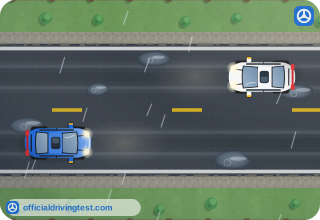
- Oil, dirt, and water form a slippery film on the road
- Rain freezes into a thin sheet of ice on the pavement
- Tires grip better, so drivers tend to speed up too much
- Deep standing water covers the entire road surface at once
Show answer
Correct answer: Oil, dirt, and water form a slippery film on the road
At the start of a light rain a mixture of oil, dirt, and water forms a slippery film, which makes contact on curves harder and increases stopping distance.
Source: West Virginia Driver's Licensing Handbook (Revised July 2026), page 63 · Open this page in the manual (Manual page 63)
-
In a standard passenger vehicle, at about what speed does partial hydroplaning occur?
- 25 mph
- 45 mph
- 35 mph
- 65 mph
Show answer
Correct answer: 35 mph
Partial hydroplaning occurs at about 35 mph in a standard passenger vehicle.
Source: West Virginia Driver's Licensing Handbook (Revised July 2026), page 63 · Open this page in the manual (Manual page 63)
-
From about what speed do tires ride totally on top of the water, according to the handbook?
- 45 mph
- 55 mph
- 65 mph
- 75 mph
Show answer
Correct answer: 55 mph
At 55 mph the tires ride totally on top of the water.
Source: West Virginia Driver's Licensing Handbook (Revised July 2026), page 63 · Open this page in the manual (Manual page 63)
-
In a severe rainstorm, what is no longer available once tires lose all contact with the road?
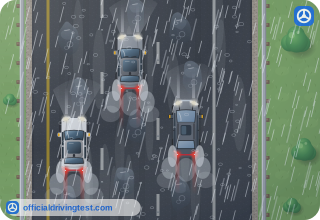
- Friction to brake, accelerate, or corner
- Steering response from the front tires only
- Traction on the rear wheels only
- Warning from the tread wear indicators
Show answer
Correct answer: Friction to brake, accelerate, or corner
When tires lose all contact with the road there is no friction to brake, accelerate, or corner.
Source: West Virginia Driver's Licensing Handbook (Revised July 2026), page 63 · Open this page in the manual (Manual page 63)
-
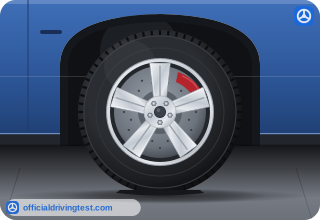
To reduce the possibility of hydroplaning, what should you do about your tires?
- Keep them slightly under-inflated for extra grip
- Replace them every year
- Keep them properly inflated
- Choose tires with no tread pattern
Show answer
Correct answer: Keep them properly inflated
The handbook lists keeping tires properly inflated as a way to reduce hydroplaning.
Source: West Virginia Driver's Licensing Handbook (Revised July 2026), page 63 · Open this page in the manual (Manual page 63)
-
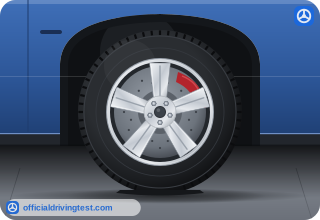
When should you replace your tires to reduce the possibility of hydroplaning?
- When the tires reach one year of age
- When the tread wear indicators are visible
- When the tires have gone completely flat
- When the sidewalls feel warm to the touch
Show answer
Correct answer: When the tread wear indicators are visible
The handbook says to replace tires once tread wear indicators are visible.
Source: West Virginia Driver's Licensing Handbook (Revised July 2026), page 63 · Open this page in the manual (Manual page 63)
-
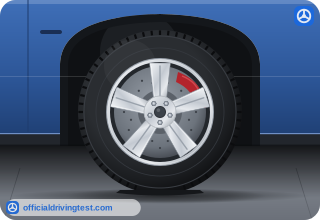
What can tires with deep treads do at normal highway speeds?
- Stop the car in half the distance on wet roads
- Remove the need to slow down during rainstorms
- Keep the tires from wearing out unevenly
- Prevent complete hydroplaning by letting water escape
Show answer
Correct answer: Prevent complete hydroplaning by letting water escape
Deep treads allow water to escape from under the tires and can prevent complete hydroplaning at normal highway speeds.
Source: West Virginia Driver's Licensing Handbook (Revised July 2026), page 63 · Open this page in the manual (Manual page 63)
-
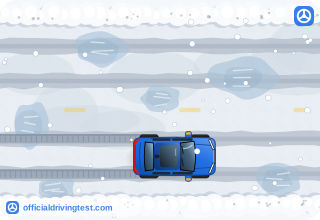
What does the handbook say about snow tires or chains on snow or ice?
- Together they allow you to drive at normal speeds on ice
- Chains allow normal speeds on ice but snow tires do not
- Snow tires allow normal speeds on ice but chains do not
- Neither lets you drive safely at normal speeds on snow or ice
Show answer
Correct answer: Neither lets you drive safely at normal speeds on snow or ice
Even with snow tires or chains you must slow down on snow or ice.
Source: West Virginia Driver's Licensing Handbook (Revised July 2026), page 63 · Open this page in the manual (Manual page 63)
-
As much as how many times the normal distance can it take to stop on snow or ice compared with dry pavement?
- 12 times
- 3 times
- 6 times
- 9 times
Show answer
Correct answer: 12 times
Stopping on snow or ice can take as much as 12 times the distance needed on dry pavement.
Source: West Virginia Driver's Licensing Handbook (Revised July 2026), page 63 · Open this page in the manual (Manual page 63)
-
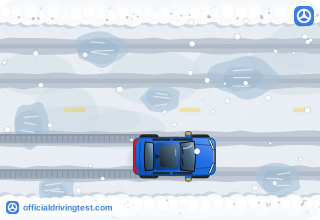
Where may there be ice or snow when all other pavement is clear?
- In tunnels
- On the shoulders
- On bridges or overpasses
- On straight rural roads
Show answer
Correct answer: On bridges or overpasses
Bridges and overpasses may still have ice or snow when the rest of the pavement is clear.
Source: West Virginia Driver's Licensing Handbook (Revised July 2026), page 63 · Open this page in the manual (Manual page 63)
-
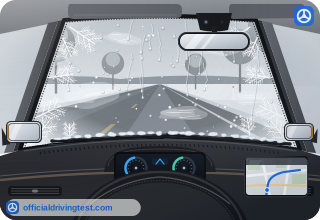
When may you start driving in winter weather?
- After the front windshield alone is clear
- As soon as the engine is warm
- After a small area is cleared on the driver's side
- Only after all windows are clear and completely defrosted
Show answer
Correct answer: Only after all windows are clear and completely defrosted
You should never start driving until all windows are clear of ice and snow and completely defrosted.
Source: West Virginia Driver's Licensing Handbook (Revised July 2026), page 63 · Open this page in the manual (Manual page 63)
4Part 416 questions
-
How should you apply the brakes when you stop or slow down on ice or packed snow?
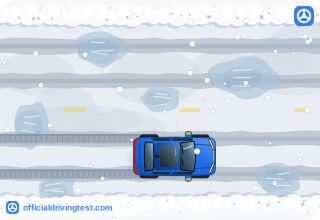
- Gently and smoothly
- Firmly and quickly
- With one hard push
- Only with the parking brake
Show answer
Correct answer: Gently and smoothly
On ice or packed snow you always apply the brakes gently and smoothly.
Source: West Virginia Driver's Licensing Handbook (Revised July 2026), page 64 · Open this page in the manual (Manual page 64)
-
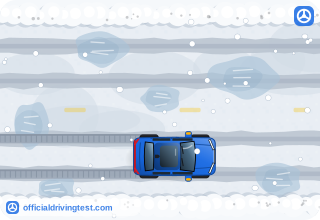
On ice or packed snow, what do you maintain in a vehicle equipped with anti-lock brakes?
- A shorter stopping distance than on dry pavement
- The ability to brake without slowing down
- The ability to steer while braking
- A grip that stays constant at any speed
Show answer
Correct answer: The ability to steer while braking
With anti-lock brakes you keep the ability to steer while braking.
Source: West Virginia Driver's Licensing Handbook (Revised July 2026), page 64 · Open this page in the manual (Manual page 64)
-
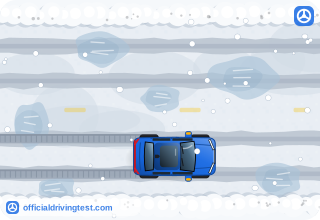
On ice or packed snow in a vehicle without anti-lock brakes, how can you steer while braking?
- Hold the brake pedal down as hard as you possibly can
- Pump the brakes, applying and releasing them several times
- Shift into neutral and coast until the car slows down
- Press the accelerator lightly while you keep braking
Show answer
Correct answer: Pump the brakes, applying and releasing them several times
Without anti-lock brakes you cannot steer unless you pump the brakes until the vehicle is under complete control.
Source: West Virginia Driver's Licensing Handbook (Revised July 2026), page 64 · Open this page in the manual (Manual page 64)
-
On ice or packed snow in a vehicle without anti-lock brakes, when should you release the brakes?
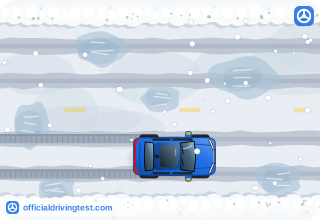
- At the first hint the wheels are slipping
- Only after the vehicle has stopped
- After the wheels have locked for a moment
- When the vehicle slows below 10 mph
Show answer
Correct answer: At the first hint the wheels are slipping
You should always release the brakes at the first hint that the wheels are slipping.
Source: West Virginia Driver's Licensing Handbook (Revised July 2026), page 64 · Open this page in the manual (Manual page 64)
-
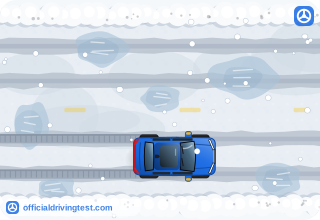
When starting on snow or ice, what should you do with the engine speed and acceleration?
- Use high engine speed and accelerate quickly to gain traction
- Keep engine speed low but accelerate quickly once moving
- Keep engine speed low and accelerate slowly and smoothly
- Use high engine speed to spin the wheels until they grip
Show answer
Correct answer: Keep engine speed low and accelerate slowly and smoothly
The handbook says to keep your engine speed low and accelerate slowly and smoothly when starting on snow or ice.
Source: West Virginia Driver's Licensing Handbook (Revised July 2026), page 64 · Open this page in the manual (Manual page 64)
-
If your vehicle has a manual transmission and you start on snow or ice, what should you do with the clutch?
- Release it all at once
- Let it out slowly
- Hold it down until the wheels spin
- Use it only to brake
Show answer
Correct answer: Let it out slowly
The clutch should be let out slowly when starting on snow or ice.
Source: West Virginia Driver's Licensing Handbook (Revised July 2026), page 64 · Open this page in the manual (Manual page 64)
-
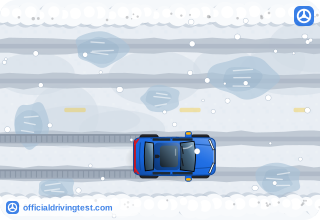
After you start on snow or ice, how can you learn how slippery the road is?
- Look at the color of the snow
- Accelerate quickly for a short distance
- Turn the wheel sharply from side to side
- Apply the brakes while driving slowly
Show answer
Correct answer: Apply the brakes while driving slowly
The handbook says to get the feel of the road by applying the brakes while driving slowly.
Source: West Virginia Driver's Licensing Handbook (Revised July 2026), page 64 · Open this page in the manual (Manual page 64)
-
What can crosswinds on the road be strong enough to do?
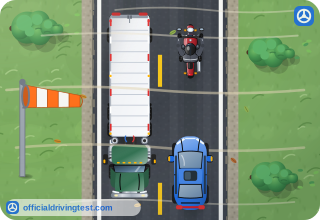
- Lift the front tires of the vehicle off the pavement
- Freeze wet pavement into a sheet of black ice quickly
- Force your vehicle into the oncoming lane or off the roadway
- Stall the engine and shut off your power steering
Show answer
Correct answer: Force your vehicle into the oncoming lane or off the roadway
Strong crosswinds can push a vehicle into the oncoming lane or off the road.
Source: West Virginia Driver's Licensing Handbook (Revised July 2026), page 64 · Open this page in the manual (Manual page 64)
-
Strong winds can do which of the following, according to the handbook?
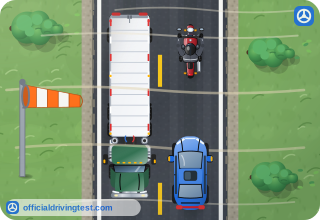
- Cause your tire pressure to drop sharply and quickly
- Down power lines and trees and blow debris into your path
- Lower the stopping distance of a vehicle on wet pavement
- Reduce the glare from other vehicles on the road
Show answer
Correct answer: Down power lines and trees and blow debris into your path
The handbook tells you to be alert for strong winds that can down power lines and trees and blow debris into your path.
Source: West Virginia Driver's Licensing Handbook (Revised July 2026), page 64 · Open this page in the manual (Manual page 64)
-
Which can produce conditions similar to fog, according to the handbook?
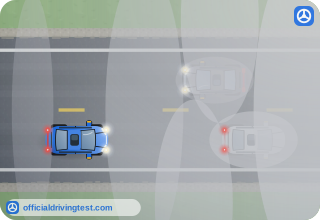
- Steam rising from a warm engine
- Dust from an unpaved shoulder
- Exhaust from heavy trucks
- Smoke from burning leaves
Show answer
Correct answer: Smoke from burning leaves
Smoke from factories, forest fires, and burning leaves can produce conditions similar to fog.
Source: West Virginia Driver's Licensing Handbook (Revised July 2026), page 64 · Open this page in the manual (Manual page 64)
-
If you must drive in fog or dense smoke, which headlights should you use?
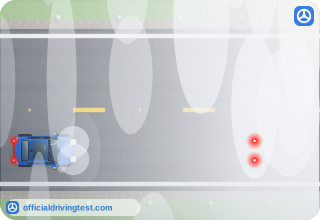
- Low-beam headlights
- High-beam headlights
- Parking lights only
- Hazard lights only
Show answer
Correct answer: Low-beam headlights
The handbook says to use your low-beam headlights in fog or dense smoke.
Source: West Virginia Driver's Licensing Handbook (Revised July 2026), page 64 · Open this page in the manual (Manual page 64)
-
If you must drive in fog or dense smoke, what should you use your windshield wipers for?
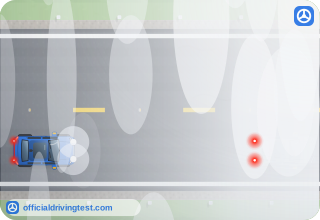
- To reduce glare from other vehicles
- To remove moisture
- To clear dust from the glass only
- To signal to following drivers
Show answer
Correct answer: To remove moisture
Windshield wipers are used to remove moisture from the glass in fog or dense smoke.
Source: West Virginia Driver's Licensing Handbook (Revised July 2026), page 64 · Open this page in the manual (Manual page 64)
-
Which of these is a road condition the handbook says to consider?
- Poorly marked or unmarked roads
- The volume of rush-hour traffic
- Worn tires and faulty brakes
- Fatigue of the driver at the wheel
Show answer
Correct answer: Poorly marked or unmarked roads
Road conditions include curves, hills, pavement width, multiple lanes, road surfaces, poorly marked or unmarked roads, shoulders, and drop-offs.
Source: West Virginia Driver's Licensing Handbook (Revised July 2026), page 64 · Open this page in the manual (Manual page 64)
-
What do road conditions primarily involve, according to the handbook?
- The weather on the day you drive
- The number of vehicles on the road
- The road's construction
- The mechanical condition of your vehicle
Show answer
Correct answer: The road's construction
Road conditions primarily involve how the road is built.
Source: West Virginia Driver's Licensing Handbook (Revised July 2026), page 64 · Open this page in the manual (Manual page 64)
-
What does the handbook say you should do to avoid a crash with the vehicle ahead of you, which may stop suddenly and without warning?
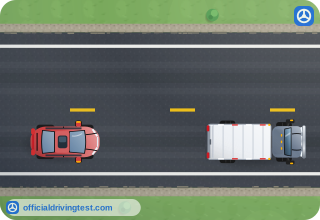
- Stay alert, anticipate a sudden stop and maintain a safe following distance
- Follow close behind so the other driver knows you are there
- Watch only the road far ahead and rely on the other driver's brake lights
- Slow down only after the vehicle ahead has actually begun to stop
Show answer
Correct answer: Stay alert, anticipate a sudden stop and maintain a safe following distance
The vehicle ahead may stop suddenly, so you should stay alert, expect a sudden stop and keep a safe following distance.
Source: West Virginia Driver's Licensing Handbook (Revised July 2026), page 66 · Open this page in the manual (Manual page 66)
-
What does the handbook say about exceeding the speed limit when you pass another vehicle?
- It is allowed on interstate highways only
- It is illegal
- It is allowed if the vehicle ahead is traveling slowly
- It is allowed when the passing zone is clear
Show answer
Correct answer: It is illegal
Going over the speed limit in order to pass is illegal, and if you must speed to pass you probably do not need to pass.
Source: West Virginia Driver's Licensing Handbook (Revised July 2026), page 66 · Open this page in the manual (Manual page 66)