West Virginia: Speed and space — Part 2 Practice Test
Questions in this part include: “How does a higher speed affect the time you have to react to a traffic situation?” · “If it is dark or raining, how many seconds should your following distance be at least?”
Independent educational site · not affiliated with any government agency or DMV
Ready? Test yourself
Answer to start, or tap Start below:
A school zone includes any street or highway abutting the school grounds and extending how far along the street or highway from the school grounds?
- Instant feedback with an explanation
- Every answer cites its source in the manual
- Your best score is saved on this device
- Keyboard: press 1 to 4 to answer and Enter for the next question
Questions are original and based on the official manual "West Virginia Driver's Licensing Handbook" (Revised July 2026), West Virginia Division of Motor Vehicles (DMV).
All 17 questions in this practice test
Take the test above first, then use this list to study. Tap “Show answer” to see the correct answer and explanation.
Show the questions and answersHide the questions
-
A school zone includes any street or highway abutting the school grounds and extending how far along the street or highway from the school grounds?
- 125 feet
- 75 feet
- 200 feet
- 250 feet
Show answer
Correct answer: 125 feet
The school zone covers school property plus the street or highway that abuts it, for 125 feet from the school grounds.
Source: West Virginia Driver's Licensing Handbook (Revised July 2026), page 42 · Open this page in the manual (Manual page 42)
-
How does a higher speed affect the time you have to react to a traffic situation?
- You have more time to react because you see farther ahead
- You have less time to spot hazards and judge other vehicles' speed
- You have the same time to react at any speed
- Your reaction time improves as you gain experience at speed
Show answer
Correct answer: You have less time to spot hazards and judge other vehicles' speed
The higher the speed, the less time you have to spot hazards, judge the speed of other vehicles, and act.
Source: West Virginia Driver's Licensing Handbook (Revised July 2026), page 42 · Open this page in the manual (Manual page 42)
-
When you drive at less than the normal speed of traffic, where should you drive?
- In the middle of the lane, away from both road edges
- In the left lane so faster traffic can pass on the right
- On the center line so drivers can see you clearly
- As close as possible to the right edge of the road
Show answer
Correct answer: As close as possible to the right edge of the road
A slower driver should keep as close as possible to the right edge of the road.
Source: West Virginia Driver's Licensing Handbook (Revised July 2026), page 43 · Open this page in the manual (Manual page 43)
-
You must drive slower than the designated speed on a road with one lane in each direction, and overtaking traffic has no clear lane for passing. What should you do?
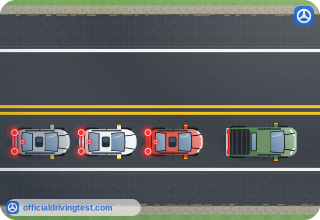
- Pull off at the first safe turnout to let faster traffic pass
- Keep driving in your lane and wave faster traffic around you
- Speed up slightly until the traffic behind you stops following
- Stop in your lane until all of the traffic behind you has passed
Show answer
Correct answer: Pull off at the first safe turnout to let faster traffic pass
Slow drivers should pull off at the first safe turnout so faster traffic can pass.
Source: West Virginia Driver's Licensing Handbook (Revised July 2026), page 43 · Open this page in the manual (Manual page 43)
-
According to the handbook, what causes most rear-end collisions?
- Following too closely
- Driving too slowly
- Faulty brake lights
- Changing lanes too often
Show answer
Correct answer: Following too closely
The handbook says following too closely causes most rear-end collisions.
Source: West Virginia Driver's Licensing Handbook (Revised July 2026), page 47 · Open this page in the manual (Manual page 47)
-
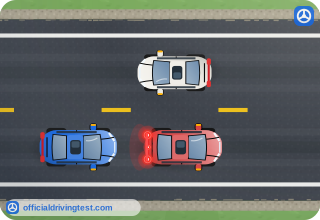
What is the space cushion ahead of your vehicle called?
- Stopping distance
- Reaction distance
- Following distance
- Braking distance
Show answer
Correct answer: Following distance
The space ahead of your vehicle, the space cushion, is called the following distance.
Source: West Virginia Driver's Licensing Handbook (Revised July 2026), page 47 · Open this page in the manual (Manual page 47)
-
What does the handbook call the best way to assure proper following distance?
- The one-to-two second rule
- The three-to-four second rule
- The five-to-six second rule
- The six-to-eight second rule
Show answer
Correct answer: The three-to-four second rule
The best way to assure proper following distance is the three-to-four second rule.
Source: West Virginia Driver's Licensing Handbook (Revised July 2026), page 47 · Open this page in the manual (Manual page 47)
-
In the following-distance count, what does it mean if you reach the same object before you finish saying "one thousand three"?
- You are following at a safe distance
- You are driving too far behind
- You are driving faster than traffic
- You are driving too closely
Show answer
Correct answer: You are driving too closely
Reaching the object before you finish the count means you are driving too closely.
Source: West Virginia Driver's Licensing Handbook (Revised July 2026), page 47 · Open this page in the manual (Manual page 47)
-
If it is dark or raining, how many seconds should your following distance be at least?
- Four seconds
- One second
- Two seconds
- Three seconds
Show answer
Correct answer: Four seconds
In the dark or in rain, the handbook says the following distance should be at least four seconds.
Source: West Virginia Driver's Licensing Handbook (Revised July 2026), page 47 · Open this page in the manual (Manual page 47)
-
If there is ice or snow, how many seconds should you stay behind the vehicle in front?
- At least three seconds
- At least four seconds
- At least six seconds
- At least five seconds
Show answer
Correct answer: At least six seconds
On ice or snow, stay at least six seconds behind the vehicle in front.
Source: West Virginia Driver's Licensing Handbook (Revised July 2026), page 47 · Open this page in the manual (Manual page 47)
-
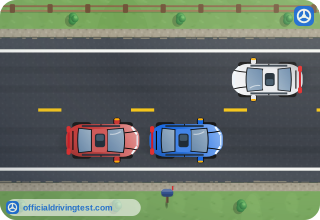
A vehicle is following you too closely. What does the handbook say you should do to warn the tailgater?
- Brake hard to make the driver back off
- Flash your high beams at the driver behind you
- Tap your brakes gently to flash the brake lights
- Turn on your hazard lights and keep driving
Show answer
Correct answer: Tap your brakes gently to flash the brake lights
Tapping your brakes gently flashes the brake lights and warns the tailgater.
Source: West Virginia Driver's Licensing Handbook (Revised July 2026), page 51 · Open this page in the manual (Manual page 51)
-
What can you do to encourage a tailgating vehicle to pass?
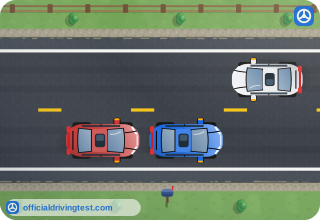
- Slow down
- Speed up
- Sound your horn
- Flash your high beams
Show answer
Correct answer: Slow down
The handbook says to slow down to encourage a tailgating vehicle to pass.
Source: West Virginia Driver's Licensing Handbook (Revised July 2026), page 51 · Open this page in the manual (Manual page 51)
-
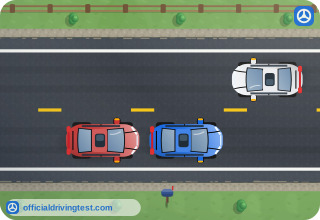
If tapping your brakes and slowing down do not stop a tailgater, what does the handbook say to do?
- Speed up until the vehicle falls back
- Brake hard so the driver must pass
- Change lanes repeatedly to shake the driver
- Pull over, stop and let the vehicle pass
Show answer
Correct answer: Pull over, stop and let the vehicle pass
If all else fails, you should pull over, stop and let the tailgating vehicle pass.
Source: West Virginia Driver's Licensing Handbook (Revised July 2026), page 51 · Open this page in the manual (Manual page 51)
-
What is a safe minimum following distance behind a motorcycle?
- One to two seconds
- Five to eight seconds
- Three to four seconds
- Ten seconds
Show answer
Correct answer: Three to four seconds
The handbook says it is wise to keep a safe minimum following distance of three to four seconds behind a motorcycle.
Source: West Virginia Driver's Licensing Handbook (Revised July 2026), page 51 · Open this page in the manual (Manual page 51)
-
Under which conditions should you increase your following distance behind a motorcycle?
- Only on interstate highways
- Only during daytime rush hour
- At night and in adverse weather
- Only when the motorcycle carries two riders
Show answer
Correct answer: At night and in adverse weather
The handbook says to increase the following distance time at night and under adverse weather conditions.
Source: West Virginia Driver's Licensing Handbook (Revised July 2026), page 51 · Open this page in the manual (Manual page 51)
-
A fully loaded tractor-trailer traveling 55 mph needs how many times the distance a vehicle needs to stop?
- Twice
- Three times
- Four times
- Five times
Show answer
Correct answer: Three times
A fully loaded tractor-trailer traveling 55 mph needs three times the distance a vehicle needs to stop.
Source: West Virginia Driver's Licensing Handbook (Revised July 2026), page 52 · Open this page in the manual (Manual page 52)
-
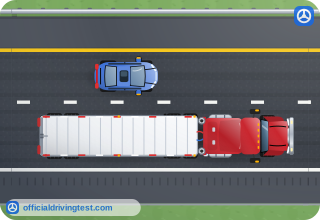
In dry conditions, how long should you wait after passing a truck before merging back to the right?
- One second
- Four seconds
- Two seconds
- Six seconds
Show answer
Correct answer: Two seconds
In dry conditions you use the two-second rule: after passing a truck, give two seconds before merging to the right.
Source: West Virginia Driver's Licensing Handbook (Revised July 2026), page 53 · Open this page in the manual (Manual page 53)