West Virginia: Speed and space — Part 3 Practice Test
Questions in this part include: “What kind of speed should you always drive on an interstate?” · “From about what speed do tires ride totally on top of the water, according to the handbook?”
Independent educational site · not affiliated with any government agency or DMV
Ready? Test yourself
Answer to start, or tap Start below:
What is the slowest speed the handbook says you should drive on an interstate unless weather or road conditions are bad or a lower speed has been posted?
- Instant feedback with an explanation
- Every answer cites its source in the manual
- Your best score is saved on this device
- Keyboard: press 1 to 4 to answer and Enter for the next question
Questions are original and based on the official manual "West Virginia Driver's Licensing Handbook" (Revised July 2026), West Virginia Division of Motor Vehicles (DMV).
All 16 questions in this practice test
Take the test above first, then use this list to study. Tap “Show answer” to see the correct answer and explanation.
Show the questions and answersHide the questions
-
In wet conditions, how much space should you give a truck?
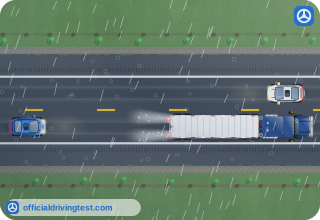
- Two seconds
- Two to three seconds at most
- At least four to six seconds
- At least ten seconds
Show answer
Correct answer: At least four to six seconds
In wet conditions you should give a truck at least four to six seconds of space.
Source: West Virginia Driver's Licensing Handbook (Revised July 2026), page 53 · Open this page in the manual (Manual page 53)
-
What is the slowest speed the handbook says you should drive on an interstate unless weather or road conditions are bad or a lower speed has been posted?
- 35 mph
- 55 mph
- 45 mph
- 65 mph
Show answer
Correct answer: 55 mph
You should not drive slower than 55 mph on an interstate unless conditions are bad or a lower speed is posted.
Source: West Virginia Driver's Licensing Handbook (Revised July 2026), page 59 · Open this page in the manual (Manual page 59)
-
What kind of speed should you always drive on an interstate?
- A speed that changes with passing vehicles
- A gradually increasing speed
- The speed of the fastest vehicle nearby
- A steady speed
Show answer
Correct answer: A steady speed
The handbook says to always drive at a steady speed.
Source: West Virginia Driver's Licensing Handbook (Revised July 2026), page 59 · Open this page in the manual (Manual page 59)
-
What is especially important when you encounter adverse conditions on an interstate?
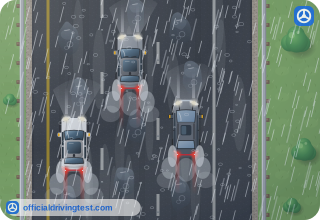
- Keeping an adequate following distance and adjusting your speed
- Driving in the left lane to stay clear of road spray ahead
- Keeping up with the fastest traffic on the road
- Using the shoulder to get around slower traffic
Show answer
Correct answer: Keeping an adequate following distance and adjusting your speed
In adverse conditions you should keep an adequate following distance and adjust your speed so a safe stop is possible.
Source: West Virginia Driver's Licensing Handbook (Revised July 2026), page 59 · Open this page in the manual (Manual page 59)
-
What does "over driving your headlights" mean?
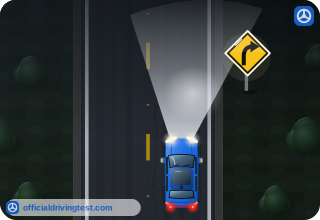
- Driving with high beams on while meeting oncoming traffic at night
- Driving with headlights that are aimed too high above the road
- Leaving your headlights on after the sun has already risen
- Driving too fast to stop safely in the area your headlights light
Show answer
Correct answer: Driving too fast to stop safely in the area your headlights light
It means your speed is too high to stop within the area your headlights clearly light.
Source: West Virginia Driver's Licensing Handbook (Revised July 2026), page 62 · Open this page in the manual (Manual page 62)
-
Why are wet roads especially dangerous at the start of a light rain?
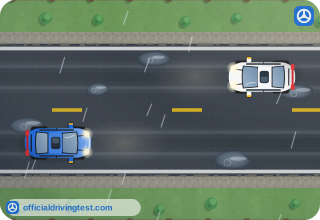
- Oil, dirt, and water form a slippery film on the road
- Rain freezes into a thin sheet of ice on the pavement
- Tires grip better, so drivers tend to speed up too much
- Deep standing water covers the entire road surface at once
Show answer
Correct answer: Oil, dirt, and water form a slippery film on the road
At the start of a light rain a mixture of oil, dirt, and water forms a slippery film, which makes contact on curves harder and increases stopping distance.
Source: West Virginia Driver's Licensing Handbook (Revised July 2026), page 63 · Open this page in the manual (Manual page 63)
-
In a standard passenger vehicle, at about what speed does partial hydroplaning occur?
- 25 mph
- 45 mph
- 35 mph
- 65 mph
Show answer
Correct answer: 35 mph
Partial hydroplaning occurs at about 35 mph in a standard passenger vehicle.
Source: West Virginia Driver's Licensing Handbook (Revised July 2026), page 63 · Open this page in the manual (Manual page 63)
-
From about what speed do tires ride totally on top of the water, according to the handbook?
- 45 mph
- 55 mph
- 65 mph
- 75 mph
Show answer
Correct answer: 55 mph
At 55 mph the tires ride totally on top of the water.
Source: West Virginia Driver's Licensing Handbook (Revised July 2026), page 63 · Open this page in the manual (Manual page 63)
-
In a severe rainstorm, what is no longer available once tires lose all contact with the road?
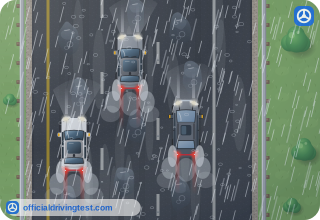
- Friction to brake, accelerate, or corner
- Steering response from the front tires only
- Traction on the rear wheels only
- Warning from the tread wear indicators
Show answer
Correct answer: Friction to brake, accelerate, or corner
When tires lose all contact with the road there is no friction to brake, accelerate, or corner.
Source: West Virginia Driver's Licensing Handbook (Revised July 2026), page 63 · Open this page in the manual (Manual page 63)
-
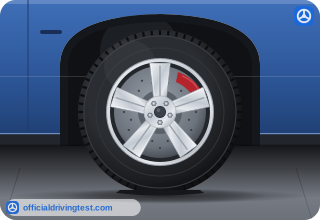
To reduce the possibility of hydroplaning, what should you do about your tires?
- Keep them slightly under-inflated for extra grip
- Replace them every year
- Keep them properly inflated
- Choose tires with no tread pattern
Show answer
Correct answer: Keep them properly inflated
The handbook lists keeping tires properly inflated as a way to reduce hydroplaning.
Source: West Virginia Driver's Licensing Handbook (Revised July 2026), page 63 · Open this page in the manual (Manual page 63)
-
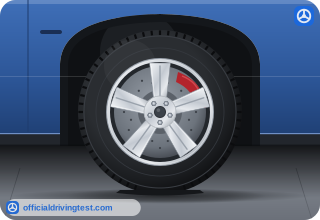
When should you replace your tires to reduce the possibility of hydroplaning?
- When the tires reach one year of age
- When the tread wear indicators are visible
- When the tires have gone completely flat
- When the sidewalls feel warm to the touch
Show answer
Correct answer: When the tread wear indicators are visible
The handbook says to replace tires once tread wear indicators are visible.
Source: West Virginia Driver's Licensing Handbook (Revised July 2026), page 63 · Open this page in the manual (Manual page 63)
-
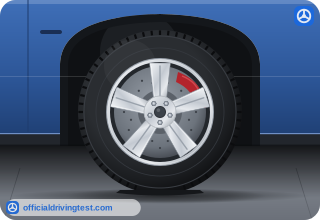
What can tires with deep treads do at normal highway speeds?
- Stop the car in half the distance on wet roads
- Remove the need to slow down during rainstorms
- Keep the tires from wearing out unevenly
- Prevent complete hydroplaning by letting water escape
Show answer
Correct answer: Prevent complete hydroplaning by letting water escape
Deep treads allow water to escape from under the tires and can prevent complete hydroplaning at normal highway speeds.
Source: West Virginia Driver's Licensing Handbook (Revised July 2026), page 63 · Open this page in the manual (Manual page 63)
-
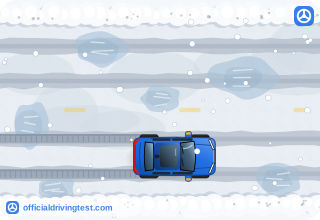
What does the handbook say about snow tires or chains on snow or ice?
- Together they allow you to drive at normal speeds on ice
- Chains allow normal speeds on ice but snow tires do not
- Snow tires allow normal speeds on ice but chains do not
- Neither lets you drive safely at normal speeds on snow or ice
Show answer
Correct answer: Neither lets you drive safely at normal speeds on snow or ice
Even with snow tires or chains you must slow down on snow or ice.
Source: West Virginia Driver's Licensing Handbook (Revised July 2026), page 63 · Open this page in the manual (Manual page 63)
-
As much as how many times the normal distance can it take to stop on snow or ice compared with dry pavement?
- 12 times
- 3 times
- 6 times
- 9 times
Show answer
Correct answer: 12 times
Stopping on snow or ice can take as much as 12 times the distance needed on dry pavement.
Source: West Virginia Driver's Licensing Handbook (Revised July 2026), page 63 · Open this page in the manual (Manual page 63)
-
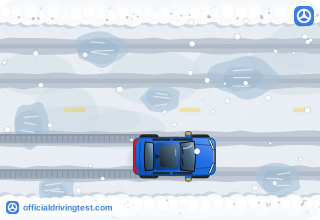
Where may there be ice or snow when all other pavement is clear?
- In tunnels
- On the shoulders
- On bridges or overpasses
- On straight rural roads
Show answer
Correct answer: On bridges or overpasses
Bridges and overpasses may still have ice or snow when the rest of the pavement is clear.
Source: West Virginia Driver's Licensing Handbook (Revised July 2026), page 63 · Open this page in the manual (Manual page 63)
-
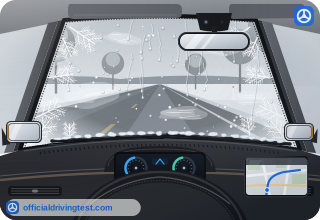
When may you start driving in winter weather?
- After the front windshield alone is clear
- As soon as the engine is warm
- After a small area is cleared on the driver's side
- Only after all windows are clear and completely defrosted
Show answer
Correct answer: Only after all windows are clear and completely defrosted
You should never start driving until all windows are clear of ice and snow and completely defrosted.
Source: West Virginia Driver's Licensing Handbook (Revised July 2026), page 63 · Open this page in the manual (Manual page 63)