West Virginia: Vehicle controls and equipment
Hand position, turn and hand signals, mirrors, headlights, brakes, tires, illegal equipment and the vehicle check before the road test. Split into 5 shorter tests so you're not stuck in one long quiz.
Independent educational site · not affiliated with any government agency or DMV
Choose a part
Vehicle controls and equipment — Part 1
Questions in this part include: “What must the applicant know about all of the vehicle’s safety equipment, including the parking/emergency brake?”
Vehicle controls and equipment — Part 2
Questions in this part include: “Which of these features must be fully functional on the test vehicle?”
Vehicle controls and equipment — Part 3
Questions in this part include: “When should you use your parking lights?”
Vehicle controls and equipment — Part 4
Questions in this part include: “When it begins to get dark, what does the handbook say it is the law to turn on?”
Vehicle controls and equipment — Part 5
Questions in this part include: “Because a vehicle has an anti-lock brake system (ABS), what should motorists not do, according to the handbook?”
Questions are original and based on the official manual "West Virginia Driver's Licensing Handbook" (Revised July 2026), West Virginia Division of Motor Vehicles (DMV).
All 87 Vehicle controls and equipment questions with answers
Choose a part above to take a practice test, or study every question and answer here.
Show the questions and answersHide the questions
1Part 118 questions
-
What must the applicant know about all of the vehicle’s safety equipment, including the parking/emergency brake?
- Its manufacturer and warranty terms
- Its repair history and installation date
- Its location and function
- Its replacement cost and expected lifespan
Show answer
Correct answer: Its location and function
The applicant must know the location and function of all safety equipment, including the parking/emergency brake.
Source: West Virginia Driver's Licensing Handbook (Revised July 2026), page 25 · Open this page in the manual (Manual page 25)
-
What is the result if the applicant cannot both locate and demonstrate the use of any of the vehicle safety equipment?
- An automatic failure on the road skills test
- A deduction of points, but the test continues
- A warning, followed by a second chance
- A requirement to retake only the knowledge test
Show answer
Correct answer: An automatic failure on the road skills test
Being unable to both locate and demonstrate the use of any safety equipment is an automatic failure on the road skills test.
Source: West Virginia Driver's Licensing Handbook (Revised July 2026), page 25 · Open this page in the manual (Manual page 25)
-
Which of these warning devices is listed as illegal equipment?
- A horn that works
- Sirens, bells, or whistles
- Hazard lights that work
- Turn signals that work
Show answer
Correct answer: Sirens, bells, or whistles
Sirens, bells, and whistles are illegal equipment on a vehicle.
Source: West Virginia Driver's Licensing Handbook (Revised July 2026), page 25 · Open this page in the manual (Manual page 25)
-
Which of these is listed as illegal equipment on a vehicle?
- A cutout or loud-sounding muffler
- Working tail lights
- A working defroster
- A working registration light
Show answer
Correct answer: A cutout or loud-sounding muffler
A cutout or loud-sounding muffler is illegal equipment.
Source: West Virginia Driver's Licensing Handbook (Revised July 2026), page 25 · Open this page in the manual (Manual page 25)
-
When are signs, posters, or stickers on the windshield or vehicle windows NOT illegal equipment?
- When they are smaller than a postcard
- When they are only on the passenger side windows
- When they are required or permitted by law
- When the driver can still see clearly through the windshield
Show answer
Correct answer: When they are required or permitted by law
Signs, posters, and stickers on the windshield or windows are illegal unless the law requires or permits them.
Source: West Virginia Driver's Licensing Handbook (Revised July 2026), page 25 · Open this page in the manual (Manual page 25)
-
What is the largest number of spotlights a vehicle may have without having illegal equipment?
- Two
- One
- Three
- Four
Show answer
Correct answer: One
More than one spotlight is listed as illegal equipment.
Source: West Virginia Driver's Licensing Handbook (Revised July 2026), page 25 · Open this page in the manual (Manual page 25)
-
What is the largest number of side cowl or fender lights a vehicle may have without having illegal equipment?
- One
- Three
- Four
- Two
Show answer
Correct answer: Two
More than two side cowl or fender lights is illegal equipment.
Source: West Virginia Driver's Licensing Handbook (Revised July 2026), page 25 · Open this page in the manual (Manual page 25)
-
What is the largest number of backup lights (not lit when going forward) a vehicle may have without having illegal equipment?
- One
- Three
- Two
- Four
Show answer
Correct answer: Two
More than two backup lights that do not show light when the vehicle goes forward is illegal equipment.
Source: West Virginia Driver's Licensing Handbook (Revised July 2026), page 25 · Open this page in the manual (Manual page 25)
-
A load on a passenger vehicle is illegal if it extends beyond the fender line on the left side. Beyond what distance past the fender line on the right side is it illegal?
- Six (6) inches
- Twelve (12) inches
- Eighteen (18) inches
- Twenty-four (24) inches
Show answer
Correct answer: Six (6) inches
Any load extending beyond the left fender line, or six inches beyond the right fender line, is illegal equipment.
Source: West Virginia Driver's Licensing Handbook (Revised July 2026), page 25 · Open this page in the manual (Manual page 25)
-
What type of glass must a motor vehicle be equipped with?
- Frosted glass
- Mirrored glass
- Plastic panels
- Safety glass
Show answer
Correct answer: Safety glass
Any motor vehicle not equipped with safety glass has illegal equipment.
Source: West Virginia Driver's Licensing Handbook (Revised July 2026), page 25 · Open this page in the manual (Manual page 25)
-
What is the lowest light transmission a window tint may have without being illegal equipment?
- 15 percent
- 35 percent
- 50 percent
- 70 percent
Show answer
Correct answer: 35 percent
Windows tinted to less than 35 percent light transmission are illegal equipment.
Source: West Virginia Driver's Licensing Handbook (Revised July 2026), page 25 · Open this page in the manual (Manual page 25)
-
Which windshield condition is listed as illegal equipment?
- A broken/cracked windshield
- A clean windshield
- A windshield with working wipers
- A windshield with a working defroster
Show answer
Correct answer: A broken/cracked windshield
A broken or cracked windshield is illegal equipment.
Source: West Virginia Driver's Licensing Handbook (Revised July 2026), page 25 · Open this page in the manual (Manual page 25)
-
Which condition of a vehicle’s body is listed as illegal equipment?
- Faded paint on the body
- A dirty body
- Holes in the body of the vehicle
- A body without a rear spoiler
Show answer
Correct answer: Holes in the body of the vehicle
Holes in the body of the vehicle are illegal equipment.
Source: West Virginia Driver's Licensing Handbook (Revised July 2026), page 25 · Open this page in the manual (Manual page 25)
-
Which of these lighting conditions is listed as illegal equipment?
- Brake lights that work
- Broken lenses on the vehicle
- Tail lights that work
- Headlights that work on high and low beams
Show answer
Correct answer: Broken lenses on the vehicle
Broken lenses on the vehicle are illegal equipment.
Source: West Virginia Driver's Licensing Handbook (Revised July 2026), page 25 · Open this page in the manual (Manual page 25)
-
Which condition of a vehicle’s doors and windows is listed as illegal equipment?
- Doors that open, close, and lock properly
- A window that rolls up and down
- A door with a working lock
- Any doors and windows that are not operational
Show answer
Correct answer: Any doors and windows that are not operational
Doors and windows that are not operational are illegal equipment.
Source: West Virginia Driver's Licensing Handbook (Revised July 2026), page 25 · Open this page in the manual (Manual page 25)
-
Which of these must you demonstrate proper use of during the vehicle check?
- Cruise control
- Air conditioning
- Defroster/heater
- Navigation system
Show answer
Correct answer: Defroster/heater
The defroster/heater is on the list of features whose proper use you must demonstrate.
Source: West Virginia Driver's Licensing Handbook (Revised July 2026), page 26 · Open this page in the manual (Manual page 26)
-
Which steering feature must you demonstrate proper use of during the vehicle check?
- Tilt (steering)
- Power seat memory
- Heated steering wheel
- Steering-wheel audio controls
Show answer
Correct answer: Tilt (steering)
Tilt (steering) is on the list of features whose proper use you must demonstrate.
Source: West Virginia Driver's Licensing Handbook (Revised July 2026), page 26 · Open this page in the manual (Manual page 26)
-
Which of these lighting controls must you demonstrate proper use of during the vehicle check?
- Fog lights mounted on the bumper
- Interior dome light
- Roof marker lights
- Headlights high/low beams
Show answer
Correct answer: Headlights high/low beams
Proper use of the headlights’ high and low beams is on the checklist of things you must demonstrate.
Source: West Virginia Driver's Licensing Handbook (Revised July 2026), page 26 · Open this page in the manual (Manual page 26)
2Part 218 questions
-
Which of these features must be fully functional on the test vehicle?
- Cruise control
- Exhaust system
- Heated seats
- Satellite radio
Show answer
Correct answer: Exhaust system
The exhaust system is on the list of features that must be fully functional.
Source: West Virginia Driver's Licensing Handbook (Revised July 2026), page 26 · Open this page in the manual (Manual page 26)
-
Which of these lights must be fully functional on the test vehicle?
- Registration/license plate light
- Fog lights
- Daytime running lights on the bumper
- The interior dome light
Show answer
Correct answer: Registration/license plate light
The registration/license plate light is on the list of features that must be fully functional.
Source: West Virginia Driver's Licensing Handbook (Revised July 2026), page 26 · Open this page in the manual (Manual page 26)
-
Which signals are you expected to use during the test where the law requires their use?
- Only directional light signals
- Only arm signals
- Only hazard light signals
- All arm or directional light signals
Show answer
Correct answer: All arm or directional light signals
You are expected to use all arm or directional light signals where the law requires them.
Source: West Virginia Driver's Licensing Handbook (Revised July 2026), page 26 · Open this page in the manual (Manual page 26)
-
When should you adjust the vehicle seat and rear view mirror?
- After the first turn
- Before driving
- Only if the examiner asks you to
- After you leave the testing center parking area
Show answer
Correct answer: Before driving
The handbook says to adjust the seat and rear view mirror before driving.
Source: West Virginia Driver's Licensing Handbook (Revised July 2026), page 26 · Open this page in the manual (Manual page 26)
-
What does proper seat adjustment assure?
- Better control of the vehicle
- A shorter stopping distance
- Better fuel economy
- Less glare from other vehicles
Show answer
Correct answer: Better control of the vehicle
A properly adjusted seat gives you better control of the vehicle.
Source: West Virginia Driver's Licensing Handbook (Revised July 2026), page 26 · Open this page in the manual (Manual page 26)
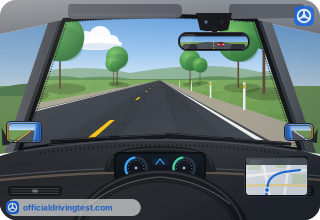
-
A properly adjusted rear view mirror helps you see the vehicle behind you when you must do what?
- Read road signs, check gauges, or tune the radio
- Speed up, pass, or merge onto a freeway
- Slow down, change lanes, or turn
- Start the engine, shift gears, or adjust the seat
Show answer
Correct answer: Slow down, change lanes, or turn
A properly adjusted rear view mirror helps you see the vehicle behind you when you slow down, change lanes, or turn.
Source: West Virginia Driver's Licensing Handbook (Revised July 2026), page 26 · Open this page in the manual (Manual page 26)
-
During an exercise, how is each failure to use, or improper use of, your turn signal scored?
- It is an automatic failure
- It is ignored if you finish the exercise
- It counts as a warning only
- It counts as an error
Show answer
Correct answer: It counts as an error
Each time you fail to use or improperly use your turn signal during an exercise, it counts as an error.
Source: West Virginia Driver's Licensing Handbook (Revised July 2026), page 27 · Open this page in the manual (Manual page 27)
-
During an exercise, when must you use the correct turn signal?
- Only when turning onto a public roadway after the exercise
- Only when backing into a space between the cones
- When turning, backing, and entering or exiting an area
- Only when the examiner directs you to signal
Show answer
Correct answer: When turning, backing, and entering or exiting an area
You must use the correct turn signal when turning, backing, and also to enter or exit an area.
Source: West Virginia Driver's Licensing Handbook (Revised July 2026), page 27 · Open this page in the manual (Manual page 27)
-
If your turn signal cancels automatically during an exercise, what should you do?
- Reactivate it when necessary
- Leave it off, because that is not counted as an error
- Pull over and ask the examiner to restart the exercise
- Stop and wait for the examiner to turn it on for you
Show answer
Correct answer: Reactivate it when necessary
If the signal cancels on its own, you must make sure to reactivate it when necessary.
Source: West Virginia Driver's Licensing Handbook (Revised July 2026), page 27 · Open this page in the manual (Manual page 27)
-
How should you time your turn signals during the road test?
- As early as possible, well before the turn
- Activate them at appropriate times, not too early or too late
- Only at the moment the vehicle starts to turn
- Only when other vehicles are close enough to see them
Show answer
Correct answer: Activate them at appropriate times, not too early or too late
You activate turn signals at appropriate times and do not signal too early or too late.
Source: West Virginia Driver's Licensing Handbook (Revised July 2026), page 31 · Open this page in the manual (Manual page 31)
-
Which of these is a time when the handbook says to use your turn signal?
- When you drive straight through an intersection
- When you continue in your lane on a straight road
- Before you enter or leave an interstate
- When you slow down on a road with no side streets
Show answer
Correct answer: Before you enter or leave an interstate
The handbook lists entering or leaving an interstate, along with changing lanes, turning, pulling away from the curb and pulling over.
Source: West Virginia Driver's Licensing Handbook (Revised July 2026), page 43 · Open this page in the manual (Manual page 43)
-
How far before you plan to turn should you signal, at a minimum?
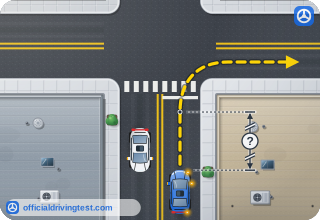
- 50 feet
- 100 feet
- 200 feet
- 300 feet
Show answer
Correct answer: 100 feet
The handbook says to signal at least 100 feet before you plan to turn.
Source: West Virginia Driver's Licensing Handbook (Revised July 2026), page 43 · Open this page in the manual (Manual page 43)
-
Why should you switch off your turn signals after completing a turn?
- Leaving them on for long can wear out the signal bulbs
- Leaving them on after a turn is a traffic violation that is ticketed
- Leaving them on keeps your brake lights from working correctly
- Driving with them on without intending to turn can create confusion
Show answer
Correct answer: Driving with them on without intending to turn can create confusion
A signal left flashing when you are not turning can confuse other drivers.
Source: West Virginia Driver's Licensing Handbook (Revised July 2026), page 43 · Open this page in the manual (Manual page 43)
-
Why should you not signal too soon if you plan to turn beyond an intersection?
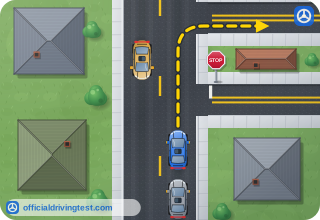
- Other drivers may think you are turning at the intersection and pull into your path
- Other drivers may think your signal is broken and ignore it completely
- The signal may wear out the bulbs before you reach the turn itself
- The vehicle behind you will then be allowed to pass you on the right
Show answer
Correct answer: Other drivers may think you are turning at the intersection and pull into your path
A signal given too early can make drivers believe you will turn at the intersection, and they may pull into your path.
Source: West Virginia Driver's Licensing Handbook (Revised July 2026), page 43 · Open this page in the manual (Manual page 43)
-
In the handbook's hand-signal pictures, what does a driver's arm pointing down mean?
- Right turn
- Left turn
- Slow or stop
- Passing
Show answer
Correct answer: Slow or stop
An arm pointing down is the hand signal for slow or stop.
Source: West Virginia Driver's Licensing Handbook (Revised July 2026), page 43 · Open this page in the manual (Manual page 43)
-
Which arm position is the hand signal for a right turn?
- Arm pointing down
- Arm pointing up
- Arm straight out
- Arm waving up and down
Show answer
Correct answer: Arm pointing up
An arm pointing up is the hand signal for a right turn.
Source: West Virginia Driver's Licensing Handbook (Revised July 2026), page 43 · Open this page in the manual (Manual page 43)
-
In the handbook's hand-signal pictures, what does a driver's arm held straight out mean?
- Right turn
- Slow or stop
- Pulling over to park
- Left turn
Show answer
Correct answer: Left turn
An arm held straight out is the hand signal for a left turn.
Source: West Virginia Driver's Licensing Handbook (Revised July 2026), page 43 · Open this page in the manual (Manual page 43)
-
Treating the steering wheel as the face of a clock, where does the handbook say your hands are best placed?
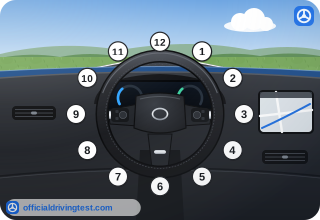
- Left hand at 8 o'clock and right hand at 4 o'clock
- Left hand at 10 o'clock and right hand at 2 o'clock
- Left hand at 9 o'clock and right hand at 3 o'clock
- Left hand at 6 o'clock and right hand at 12 o'clock
Show answer
Correct answer: Left hand at 8 o'clock and right hand at 4 o'clock
The handbook puts the left hand at about 8 o'clock and the right at 4 o'clock, which gives maximum control and reduces the chance a deploying air bag knocks your hands off.
Source: West Virginia Driver's Licensing Handbook (Revised July 2026), page 43 · Open this page in the manual (Manual page 43)
3Part 317 questions
-
Before backing, what should you do?
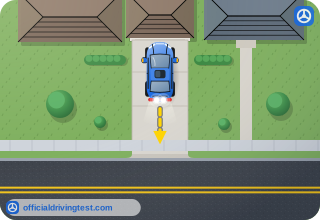
- Check only your mirrors and the rear window before you back up
- Sound your horn twice and then back up slowly into the lane
- Turn on your hazard lights and then back up slowly and steadily
- Check completely around your vehicle for people and obstacles
Show answer
Correct answer: Check completely around your vehicle for people and obstacles
The handbook says to check completely around your vehicle for people and obstacles before backing.
Source: West Virginia Driver's Licensing Handbook (Revised July 2026), page 45 · Open this page in the manual (Manual page 45)
-
While you are backing, what does the handbook say to do?
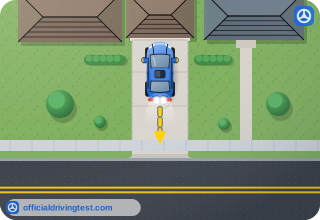
- Continue to look to the rear instead of depending on your mirror
- Watch your rear view mirror and glance back only for obstacles
- Rely on your side mirrors and look forward at the road
- Rely on your rear view mirror and back at normal speed
Show answer
Correct answer: Continue to look to the rear instead of depending on your mirror
You should keep looking to the rear while backing and not depend on your mirror.
Source: West Virginia Driver's Licensing Handbook (Revised July 2026), page 45 · Open this page in the manual (Manual page 45)
-
Within what distance of an approaching vehicle should you dim your headlights?
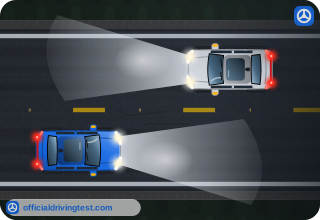
- 200 feet
- 500 feet
- 100 feet
- 1,000 feet
Show answer
Correct answer: 500 feet
When driving at night you should dim your headlights within 500 feet of an approaching vehicle.
Source: West Virginia Driver's Licensing Handbook (Revised July 2026), page 51 · Open this page in the manual (Manual page 51)
-
Within what distance of the vehicle in front of you should you dim your headlights?
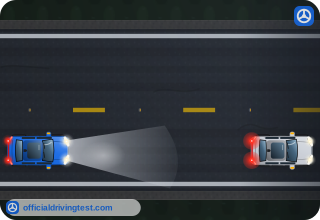
- 200 feet
- 100 feet
- 500 feet
- 1,000 feet
Show answer
Correct answer: 200 feet
When driving at night you should dim your headlights within 200 feet of the vehicle in front of you.
Source: West Virginia Driver's Licensing Handbook (Revised July 2026), page 51 · Open this page in the manual (Manual page 51)
-
What should you do with your headlights when driving on well-lit streets?
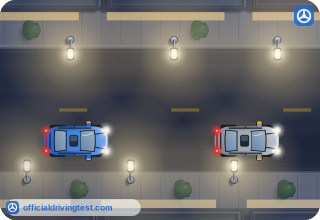
- Use your high beams
- Use only your parking lights
- Dim them
- Turn them off
Show answer
Correct answer: Dim them
The handbook says to dim your headlights when driving on well-lit streets.
Source: West Virginia Driver's Licensing Handbook (Revised July 2026), page 51 · Open this page in the manual (Manual page 51)
-
What type of headlight beams should you use when driving in fog?
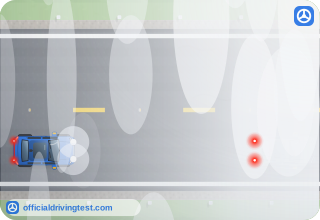
- High beams
- Low beams
- Parking lights only
- Hazard lights only
Show answer
Correct answer: Low beams
Low beams should be used in fog because high beams cause the light to be reflected back into your eyes.
Source: West Virginia Driver's Licensing Handbook (Revised July 2026), page 51 · Open this page in the manual (Manual page 51)
-
To avoid looking directly into the lights of oncoming vehicles, where should you look?
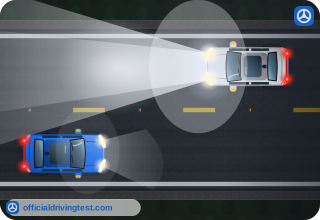
- Toward the left edge of the road
- At the center line
- Down at the dashboard
- Toward the right edge of the road
Show answer
Correct answer: Toward the right edge of the road
Looking toward the right edge of the road helps you avoid the glare of oncoming headlights.
Source: West Virginia Driver's Licensing Handbook (Revised July 2026), page 51 · Open this page in the manual (Manual page 51)
-
What should you do when facing the glare from the headlights of approaching vehicles?
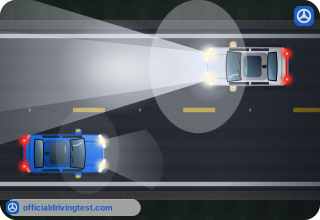
- Speed up to get past the glare
- Turn on your high beams too
- Look directly at the lights to judge distance
- Slow down
Show answer
Correct answer: Slow down
The handbook says to slow down when facing the glare from the headlights of approaching vehicles.
Source: West Virginia Driver's Licensing Handbook (Revised July 2026), page 51 · Open this page in the manual (Manual page 51)
-
At night, you should make sure that you can stop within:
- A distance of 100 feet
- The area lighted by your headlights
- Three seconds of following distance
- The distance to the next intersection
Show answer
Correct answer: The area lighted by your headlights
At night you should drive so that you can stop within the area your headlights light up.
Source: West Virginia Driver's Licensing Handbook (Revised July 2026), page 51 · Open this page in the manual (Manual page 51)
-
When should you use your parking lights?
- In fog or heavy rain
- When driving at dusk
- Only when you are parked
- When meeting another vehicle at night
Show answer
Correct answer: Only when you are parked
The handbook says to use your parking lights only when you are parked.
Source: West Virginia Driver's Licensing Handbook (Revised July 2026), page 51 · Open this page in the manual (Manual page 51)
-
During which period should you have your headlights on?
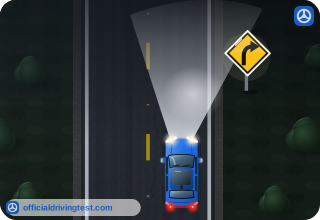
- From sunset to sunrise
- Only when it is completely dark
- Only between midnight and 5 a.m.
- Only when other vehicles have their lights on
Show answer
Correct answer: From sunset to sunrise
The handbook says to turn on your headlights from sunset to sunrise, and also during fog, smoke or rain.
Source: West Virginia Driver's Licensing Handbook (Revised July 2026), page 51 · Open this page in the manual (Manual page 51)
-
Your headlights should be on any time persons and vehicles cannot be seen clearly at what distance?
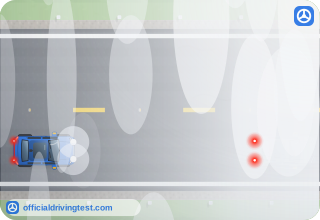
- 100 feet
- 500 feet
- 250 feet
- 1,000 feet
Show answer
Correct answer: 500 feet
Headlights should be on whenever persons and vehicles cannot be seen clearly at a distance of 500 feet.
Source: West Virginia Driver's Licensing Handbook (Revised July 2026), page 51 · Open this page in the manual (Manual page 51)
-
How should you keep your headlights and taillights?
- Turned on at all times
- Covered when parked
- Tinted to reduce glare
- Adjusted and cleaned
Show answer
Correct answer: Adjusted and cleaned
The handbook says to keep your headlights and taillights properly adjusted and cleaned.
Source: West Virginia Driver's Licensing Handbook (Revised July 2026), page 51 · Open this page in the manual (Manual page 51)
-
What must you do with your headlights during adverse conditions, according to the West Virginia State Code?
- Turn them off to reduce glare
- Use only your parking lights
- Turn them on
- Flash them at oncoming drivers
Show answer
Correct answer: Turn them on
West Virginia law requires headlights to be turned on during adverse conditions.
Source: West Virginia Driver's Licensing Handbook (Revised July 2026), page 59 · Open this page in the manual (Manual page 59)
-
Before you change lanes or drive away from the curb, what does the handbook say you should always do?
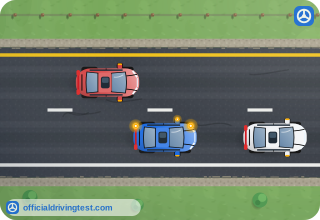
- Rely on your rear view mirror alone
- Brake lightly to warn the driver behind you
- Turn your head and look behind you for traffic
- Slow down to a crawl in your lane
Show answer
Correct answer: Turn your head and look behind you for traffic
You should turn your head and look behind you for traffic, and not become lazy by looking only in the rear view mirror.
Source: West Virginia Driver's Licensing Handbook (Revised July 2026), page 61 · Open this page in the manual (Manual page 61)
-
Which habit does the handbook call another bad habit related to laziness in checking for traffic?
- Driving too far from the curb
- Failing to signal
- Checking the mirrors too often
- Using the horn too much
Show answer
Correct answer: Failing to signal
The handbook says failing to signal is a related bad habit, and combined with laziness it could cause a serious crash.
Source: West Virginia Driver's Licensing Handbook (Revised July 2026), page 61 · Open this page in the manual (Manual page 61)
-
Driving east during sunrise or west during sunset could result in which condition?
- Too much natural light
- Too little natural light
- Too much artificial light
- A shortage of glare
Show answer
Correct answer: Too much natural light
The sun low in front of you can create a condition of too much natural light.
Source: West Virginia Driver's Licensing Handbook (Revised July 2026), page 62 · Open this page in the manual (Manual page 62)
4Part 417 questions
-
Which defensive actions does the handbook give for too much natural light?
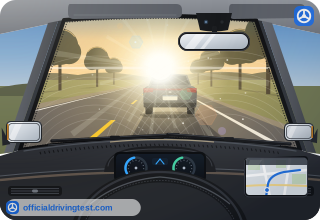
- Turn on high beams and keep your speed steady
- Look away from the road until the glare passes
- Use the sun visor, wear sunglasses, and reduce speed
- Switch to parking lights and drive in the center lane
Show answer
Correct answer: Use the sun visor, wear sunglasses, and reduce speed
The proper use of the sun visor, sunglasses, a lower speed, and more alertness are the defensive actions named.
Source: West Virginia Driver's Licensing Handbook (Revised July 2026), page 62 · Open this page in the manual (Manual page 62)
-
On bright days, sunglasses may be advisable to reduce the glare from which of these?
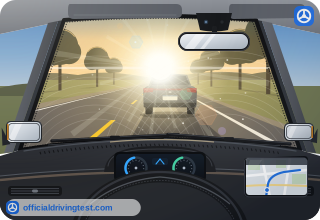
- Painted lane lines and overhead road signs
- Glass and chrome on other vehicles, or snow
- Wet pavement and standing puddles of water
- Your own dashboard instruments and mirrors
Show answer
Correct answer: Glass and chrome on other vehicles, or snow
Sunglasses can reduce the glare from glass and chrome on other vehicles and from snow.
Source: West Virginia Driver's Licensing Handbook (Revised July 2026), page 62 · Open this page in the manual (Manual page 62)
-
When it begins to get dark, what does the handbook say it is the law to turn on?
- Your parking lights, which are enough until full darkness
- Your hazard lights along with your parking lights
- Your high-beam headlights only
- Your headlights, not just your parking lights
Show answer
Correct answer: Your headlights, not just your parking lights
It is the law to turn on your headlights, and not just the parking lights, when it begins to get dark or when visibility is impaired.
Source: West Virginia Driver's Licensing Handbook (Revised July 2026), page 62 · Open this page in the manual (Manual page 62)
-
What does turning on your headlights a little early do, according to the handbook?
- It saves power for later in the trip
- It lets you skip using your low beams
- It helps other drivers see you
- It allows you to drive faster after dark
Show answer
Correct answer: It helps other drivers see you
Headlights turned on early make you easier for other drivers to see.
Source: West Virginia Driver's Licensing Handbook (Revised July 2026), page 62 · Open this page in the manual (Manual page 62)
-
What does the handbook say to do with your vehicle lighting system?
- Test it only at the yearly inspection
- Keep it clean and in proper repair
- Clean it only when the lights look dim
- Replace the bulbs every year
Show answer
Correct answer: Keep it clean and in proper repair
The handbook says to keep the vehicle lighting system clean and in proper repair.
Source: West Virginia Driver's Licensing Handbook (Revised July 2026), page 62 · Open this page in the manual (Manual page 62)
-
What does looking directly into oncoming headlights cause?
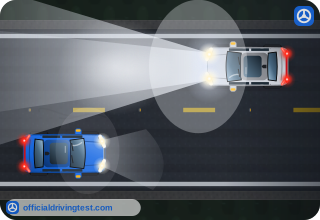
- Momentary blindness
- A longer stopping distance
- Permanent loss of night vision
- Dizziness lasting several minutes
Show answer
Correct answer: Momentary blindness
Looking directly into oncoming headlights causes momentary blindness.
Source: West Virginia Driver's Licensing Handbook (Revised July 2026), page 62 · Open this page in the manual (Manual page 62)
-
When meeting an oncoming vehicle at night, what does the handbook say to do?
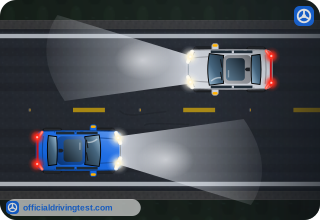
- Keep your speed and move toward the center line
- Slow down and keep to the right of your traffic lane
- Speed up to pass the vehicle quickly
- Stop in your lane until the vehicle has passed
Show answer
Correct answer: Slow down and keep to the right of your traffic lane
Slow down and stay to the right of your lane to reduce the effect of the glare.
Source: West Virginia Driver's Licensing Handbook (Revised July 2026), page 62 · Open this page in the manual (Manual page 62)
-
When meeting an oncoming vehicle at night, where should you look?
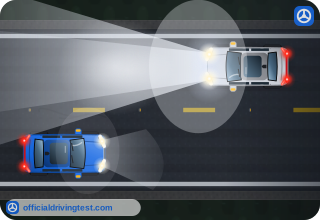
- Directly into the oncoming headlights
- At the center line of the road ahead
- Toward the left edge of the road ahead
- Well ahead, at the right edge of the road
Show answer
Correct answer: Well ahead, at the right edge of the road
You look well ahead toward the right edge of the road instead of into the oncoming lights.
Source: West Virginia Driver's Licensing Handbook (Revised July 2026), page 62 · Open this page in the manual (Manual page 62)
-
During periods of rain, which action does the handbook say is the law?
- Turn on your hazard lights
- Drive in the right lane only
- Stop until the rain ends
- Turn on your headlights
Show answer
Correct answer: Turn on your headlights
The handbook states that it is the law to turn on your headlights to increase your visibility in rain.
Source: West Virginia Driver's Licensing Handbook (Revised July 2026), page 63 · Open this page in the manual (Manual page 63)
-
How often does West Virginia require an inspection of all vehicles?
- Every year
- Every three years
- Every five years
- Every two years
Show answer
Correct answer: Every two years
West Virginia requires an inspection of all vehicles every two years to ensure they are in safe driving condition.
Source: West Virginia Driver's Licensing Handbook (Revised July 2026), page 64 · Open this page in the manual (Manual page 64)
-
Where must your vehicle be checked for the state inspection?
- At a station displaying a state inspection station sign
- At any repair shop that has an alignment lift
- At a regional office of the Division of Motor Vehicles
- By a law enforcement officer at the roadside
Show answer
Correct answer: At a station displaying a state inspection station sign
The vehicle must be checked at an inspection station that displays a state inspection station sign.
Source: West Virginia Driver's Licensing Handbook (Revised July 2026), page 64 · Open this page in the manual (Manual page 64)
-
What does the sticker placed on your windshield after your vehicle passes the state inspection show?
- The date of your last repair
- The registration number of the vehicle
- The month and year of your next inspection
- The month and year the vehicle was built
Show answer
Correct answer: The month and year of your next inspection
The sticker shows the month and year when your next inspection is due.
Source: West Virginia Driver's Licensing Handbook (Revised July 2026), page 64 · Open this page in the manual (Manual page 64)
-
What does West Virginia law say about the state inspection sticker on your windshield?
- You may remove it after six months
- It is against the law for you to remove it
- You may remove it when it fades
- You must remove it before each inspection
Show answer
Correct answer: It is against the law for you to remove it
The handbook states that it is against the law to remove the inspection sticker.
Source: West Virginia Driver's Licensing Handbook (Revised July 2026), page 64 · Open this page in the manual (Manual page 64)
-
Which is named as a common vehicle defect that causes crashes?
- Unusable seat belts
- Worn floor mats
- A faded paint finish
- A cracked radio antenna
Show answer
Correct answer: Unusable seat belts
Faulty tires, brakes, lights, wipers, defrosters, mufflers and exhaust system, horn, mirrors, and unusable seat belts are the common defects listed.
Source: West Virginia Driver's Licensing Handbook (Revised July 2026), page 65 · Open this page in the manual (Manual page 65)
-
What responsibility does the handbook say you have to the driver following you?
- To speed up whenever the driver behind comes too close
- To pull onto the shoulder so that the driver can go by
- To signal whenever you make a change in your driving pattern
- To flash your brake lights to tell the driver to back off
Show answer
Correct answer: To signal whenever you make a change in your driving pattern
A driver behind you can be affected by what you do, so you must signal any change in your driving pattern, especially before slowing or stopping suddenly.
Source: West Virginia Driver's Licensing Handbook (Revised July 2026), page 66 · Open this page in the manual (Manual page 66)
-
In a vehicle equipped with an anti-lock brake system (ABS), how should you brake in a quick stop?
- Pump the brake pedal repeatedly to keep the wheels from locking
- Press the brake gently and release it
- Push hard on the brake and keep steering
- Apply the brake lightly and steer only after you have stopped
Show answer
Correct answer: Push hard on the brake and keep steering
With ABS the driver keeps steering while pushing hard on the brake. Pumping the brake reduces the system's ability to stop quickly and safely.
Source: West Virginia Driver's Licensing Handbook (Revised July 2026), page 68 · Open this page in the manual (Manual page 68)
-
What is the anti-lock brake system (ABS) designed to prevent when a motorist must come to a quick stop?
- Tire wear
- Wheel lockup
- Engine stalling
- Brake fluid loss
Show answer
Correct answer: Wheel lockup
The ABS is designed to prevent the wheels from locking up in a quick stop.
Source: West Virginia Driver's Licensing Handbook (Revised July 2026), page 68 · Open this page in the manual (Manual page 68)
5Part 517 questions
-
Because a vehicle has an anti-lock brake system (ABS), what should motorists not do, according to the handbook?
- Steer while pushing hard on the brake
- Learn the vehicle's safety equipment features
- Use the brake in a sudden stop
- Take risks they otherwise would not
Show answer
Correct answer: Take risks they otherwise would not
ABS does not provide super brakes that stop a vehicle on a dime in all circumstances, so motorists should not take risks they otherwise would not.
Source: West Virginia Driver's Licensing Handbook (Revised July 2026), page 68 · Open this page in the manual (Manual page 68)
-
Before driving, you push the brake pedal down to test it. How far should the pedal go?
- Not more than halfway to the floor
- All the way down to the floor
- At least three-quarters of the way down
- Almost to the floor, then back up
Show answer
Correct answer: Not more than halfway to the floor
The brake pedal should not go more than halfway to the floor and should feel like it is hitting something hard.
Source: West Virginia Driver's Licensing Handbook (Revised July 2026), page 70 · Open this page in the manual (Manual page 70)
-
While you check your brakes before driving, the pedal feels spongy. What may be the cause?
- The parking brake may be set too firmly
- The tires may be underinflated
- Air bubbles may be in the brake line
- The battery may be low
Show answer
Correct answer: Air bubbles may be in the brake line
A spongy brake pedal may mean air bubbles in the brake line.
Source: West Virginia Driver's Licensing Handbook (Revised July 2026), page 70 · Open this page in the manual (Manual page 70)
-
You push the brake pedal down and count to 10, and the pedal keeps going down. What may this mean?
- The brake pedal is working normally
- You may have a leak in the braking system
- The parking brake needs adjustment
- The brake lights have failed
Show answer
Correct answer: You may have a leak in the braking system
A pedal that keeps sinking while held down can mean the braking system has a leak.
Source: West Virginia Driver's Licensing Handbook (Revised July 2026), page 70 · Open this page in the manual (Manual page 70)
-
You set the parking brake firmly. How can you tell that it needs adjustment?
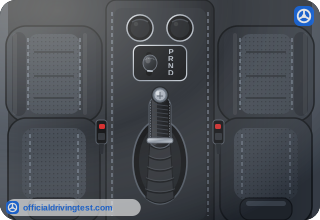
- The pedal feels like it is hitting something hard when pushed
- The vehicle does not move at all in drive or first gear
- The parking brake handle moves only halfway when you set it
- The vehicle moves easily in drive or first gear with the brake set
Show answer
Correct answer: The vehicle moves easily in drive or first gear with the brake set
A parking brake that is set firmly should hold the vehicle. If the vehicle moves easily in drive or first gear, the brake needs adjustment.
Source: West Virginia Driver's Licensing Handbook (Revised July 2026), page 70 · Open this page in the manual (Manual page 70)
-
How often should you check under your vehicle for signs of oil, coolant, brake fluid, or transmission leaks?
- Once a year
- Only when the engine overheats
- Frequently
- Only after a long trip
Show answer
Correct answer: Frequently
The handbook says to check under the vehicle frequently for signs of leaks.
Source: West Virginia Driver's Licensing Handbook (Revised July 2026), page 70 · Open this page in the manual (Manual page 70)
-
When should you check the radiator while looking under the hood?
- Only when it is cool
- Only while the engine is running
- Right after you shut off the engine
- Only while the warning light is on
Show answer
Correct answer: Only when it is cool
The radiator is one of the items to check under the hood, but only when it is cool.
Source: West Virginia Driver's Licensing Handbook (Revised July 2026), page 70 · Open this page in the manual (Manual page 70)
-
Which of these should you NOT do when checking under the hood?
- Check the engine oil
- Look at the belts and hoses
- Check the power steering
- Smoke or use any flames
Show answer
Correct answer: Smoke or use any flames
Smoking and open flames are dangerous near the engine, so the handbook says not to use them under the hood.
Source: West Virginia Driver's Licensing Handbook (Revised July 2026), page 70 · Open this page in the manual (Manual page 70)
-
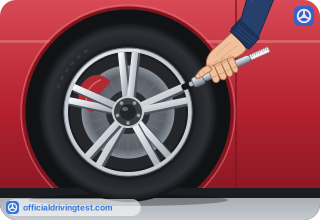
How often should you check your tire pressure with a gauge?
- Once a year
- Monthly
- Every day
- Only before long trips
Show answer
Correct answer: Monthly
The handbook says to check tire pressure with a gauge monthly.
Source: West Virginia Driver's Licensing Handbook (Revised July 2026), page 70 · Open this page in the manual (Manual page 70)
-
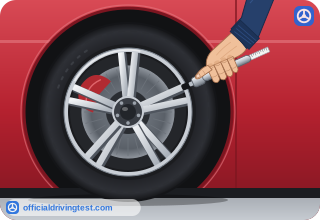
Where can you find the PSI number that shows the correct tire pressure for your vehicle?
- On a label inside the glove compartment
- On a sticker on the inside jamb of the car door
- On a plate under the hood next to the battery
- On the tire's valve stem cap
Show answer
Correct answer: On a sticker on the inside jamb of the car door
The sticker on the inside jamb of the car door shows the PSI number, which is the measurement for tire pressure.
Source: West Virginia Driver's Licensing Handbook (Revised July 2026), page 70 · Open this page in the manual (Manual page 70)
-
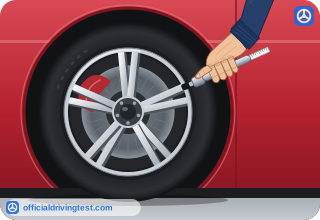
When should you check your tire pressure with a gauge?
- Right after a long highway drive
- When the tires are warm from driving
- Only after a rainstorm
- When the tires are cold
Show answer
Correct answer: When the tires are cold
The handbook says to make sure you check the pressure when the tires are cold.
Source: West Virginia Driver's Licensing Handbook (Revised July 2026), page 70 · Open this page in the manual (Manual page 70)
-
Your tire pressure gauge shows a number lower than the number on the door-jamb sticker. What should you do?
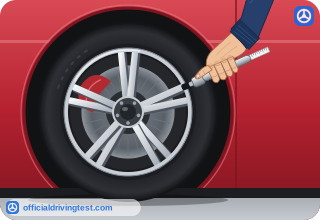
- Inflate the tires until the numbers match
- Let some air out of the tires and check again
- Drive on them until they warm up and recheck
- Replace the valve stem caps and drive on
Show answer
Correct answer: Inflate the tires until the numbers match
If the gauge reading is too low, the tires need air until they match the sticker.
Source: West Virginia Driver's Licensing Handbook (Revised July 2026), page 70 · Open this page in the manual (Manual page 70)
-
Your tire pressure gauge shows a number higher than the number on the door-jamb sticker. What should you do?
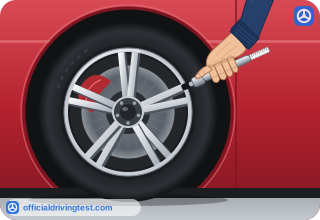
- Add more air to the tires
- Leave the tires as they are
- Let some air out of the tires
- Replace the tires with new ones
Show answer
Correct answer: Let some air out of the tires
If the gauge reading is too high, the handbook says to let some air out of the tires.
Source: West Virginia Driver's Licensing Handbook (Revised July 2026), page 70 · Open this page in the manual (Manual page 70)
-
In the penny tread test, you place Lincoln's head first into the deepest-looking groove and can see all of his head. What does this mean?
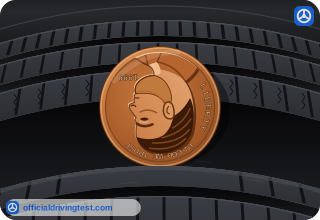
- The tires have the right amount of tread
- The tires are overinflated
- The tires are too cold to be checked
- The tires are too worn and should be replaced
Show answer
Correct answer: The tires are too worn and should be replaced
If all of Lincoln's head shows, the tread is too shallow and the tires should not be driven on.
Source: West Virginia Driver's Licensing Handbook (Revised July 2026), page 70 · Open this page in the manual (Manual page 70)
-
How often should you check all of your vehicle's exterior lights?
- Once a year
- Once a month
- Every week
- Only at the start of winter
Show answer
Correct answer: Once a month
The handbook says to check all exterior lights once a month.
Source: West Virginia Driver's Licensing Handbook (Revised July 2026), page 70 · Open this page in the manual (Manual page 70)
-
How often should you check your wiper blades, at a minimum?
- At least once a month
- Only when they stop working
- At least once a year
- Every time you fill the gas tank
Show answer
Correct answer: At least once a year
Wiper blades should be checked at least once a year, and the wiper fluid container kept full.
Source: West Virginia Driver's Licensing Handbook (Revised July 2026), page 70 · Open this page in the manual (Manual page 70)
-
What does the handbook say to make sure of regarding your interior warning devices?
- That all warning lights are working properly
- That the warning lights stay off while you drive
- That only the brake warning light works
- That the warning buzzers are muted
Show answer
Correct answer: That all warning lights are working properly
Before driving, you should confirm that all of the warning lights work.
Source: West Virginia Driver's Licensing Handbook (Revised July 2026), page 70 · Open this page in the manual (Manual page 70)