West Virginia: Pavement markings Practice Test
White and yellow lines, broken and solid lines, diamond lanes, center left-turn lanes, reversible lanes and stop lines.
Independent educational site · not affiliated with any government agency or DMV
Ready? Test yourself
Answer to start, or tap Start below:
What are pavement markings used for?
- Instant feedback with an explanation
- Every answer cites its source in the manual
- Your best score is saved on this device
- Keyboard: press 1 to 4 to answer and Enter for the next question
Questions are original and based on the official manual "West Virginia Driver's Licensing Handbook" (Revised July 2026), West Virginia Division of Motor Vehicles (DMV).
All 21 questions in this practice test
Take the test above first, then use this list to study. Tap “Show answer” to see the correct answer and explanation.
Show the questions and answersHide the questions
-
What are pavement markings used for?
- To measure vehicle speeds
- To mark the edge of every sidewalk
- To show where police officers may park
- To warn, regulate, and inform traffic
Show answer
Correct answer: To warn, regulate, and inform traffic
Pavement markings are used like highway signs to warn, regulate, and inform traffic.
Source: West Virginia Driver's Licensing Handbook (Revised July 2026), page 41 · Open this page in the manual (Manual page 41)
-
What do white lane lines separate?
- Traffic lanes moving in the same direction
- Traffic lanes moving in opposite directions
- Lanes for cars from lanes for pedestrians
- Parking spaces from the travel lanes
Show answer
Correct answer: Traffic lanes moving in the same direction
White lines separate traffic lanes moving in the same direction.
Source: West Virginia Driver's Licensing Handbook (Revised July 2026), page 41 · Open this page in the manual (Manual page 41)
-
What do yellow lane lines separate?
- Traffic lanes moving in the same direction
- Lanes for cars from lanes for buses
- Traffic lanes moving in the opposite direction
- Parking spaces from the travel lanes
Show answer
Correct answer: Traffic lanes moving in the opposite direction
Yellow lines separate traffic lanes moving in the opposite direction.
Source: West Virginia Driver's Licensing Handbook (Revised July 2026), page 41 · Open this page in the manual (Manual page 41)
-
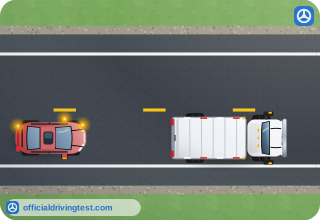
When may you pass if a broken yellow line is on your side of the road?
- Never, under any circumstances
- When it is safe
- Only when you are on a hill
- Only when you have stopped first
Show answer
Correct answer: When it is safe
A broken yellow line on your side means you may pass when it is safe.
Source: West Virginia Driver's Licensing Handbook (Revised July 2026), page 41 · Open this page in the manual (Manual page 41)
-
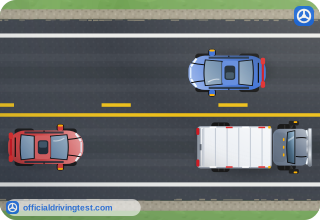
What must you do if a solid yellow line is on your side of the road?
- Pass only when it is safe
- Pass only if no vehicles are ahead
- Pass only at the posted speed limit
- You must not pass
Show answer
Correct answer: You must not pass
A solid yellow line on your side of the road means you must not pass.
Source: West Virginia Driver's Licensing Handbook (Revised July 2026), page 41 · Open this page in the manual (Manual page 41)
-
On which roads does a solid yellow line mark the left edge of the pavement?
- Interstates, one-way streets, and divided four-lane roads
- Two-lane roads that have no center line or edge lines
- Private driveways and parking lots
- Roads with a center left-turn lane
Show answer
Correct answer: Interstates, one-way streets, and divided four-lane roads
On interstates, one-way streets, and divided four-lane roads, a solid yellow line marks the left edge of the pavement.
Source: West Virginia Driver's Licensing Handbook (Revised July 2026), page 41 · Open this page in the manual (Manual page 41)
-
On roadways with more than one lane moving in one direction, how are the traffic lanes separated?
- By white diamond shapes
- By broken yellow lines
- By broken white lines
- By solid yellow lines
Show answer
Correct answer: By broken white lines
Lanes moving in the same direction are separated by broken white lines.
Source: West Virginia Driver's Licensing Handbook (Revised July 2026), page 41 · Open this page in the manual (Manual page 41)
-
How should you drive in relation to broken white lane lines?
- On the lines so that you can see both lanes at once
- Within the lines, never straddling them except when changing lanes
- Over the lines whenever the road ahead is clear of traffic
- Within the lines, except when passing a bicycle
Show answer
Correct answer: Within the lines, never straddling them except when changing lanes
You should drive within broken white lines and never straddle them, except when changing lanes.
Source: West Virginia Driver's Licensing Handbook (Revised July 2026), page 41 · Open this page in the manual (Manual page 41)
-
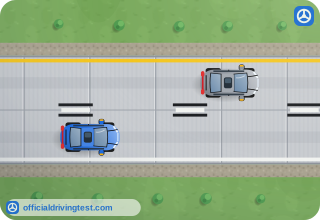
Why are broken black lines sometimes added next to broken white lines?
- To show that passing is not allowed
- To mark a lane for buses
- To warn of a railroad crossing
- To make the white easier to see
Show answer
Correct answer: To make the white easier to see
Broken black lines are sometimes added to make the white lines easier to see.
Source: West Virginia Driver's Licensing Handbook (Revised July 2026), page 41 · Open this page in the manual (Manual page 41)
-
What do solid white lines mark?
- The edge of the pavement
- The center of a two-way road
- A lane for buses and car pools
- A place where passing is allowed
Show answer
Correct answer: The edge of the pavement
Solid white lines mark the edge of the pavement and help you stay on the road at night or in bad weather.
Source: West Virginia Driver's Licensing Handbook (Revised July 2026), page 41 · Open this page in the manual (Manual page 41)
-
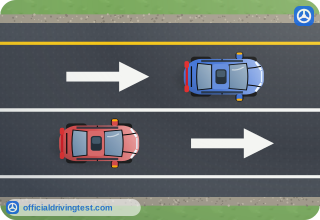
What should you do when solid white lines separate lanes of traffic moving in the same direction?
- Change lanes only when it is safe
- Change lanes only to pass a slower vehicle
- Do not change lanes
- Change lanes only at night
Show answer
Correct answer: Do not change lanes
Solid white lines between same-direction lanes mean do not change lanes.
Source: West Virginia Driver's Licensing Handbook (Revised July 2026), page 41 · Open this page in the manual (Manual page 41)
-
White diamond shapes painted in a lane inform drivers that the lane is designated for what?
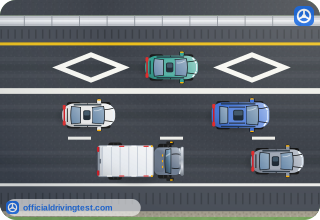
- Left turns from either direction
- Car pools, bicycles, or buses
- Emergency vehicles only
- Slow-moving vehicles only
Show answer
Correct answer: Car pools, bicycles, or buses
White diamond shapes mark a special purpose lane designated for car pools, bicycles, or buses.
Source: West Virginia Driver's Licensing Handbook (Revised July 2026), page 41 · Open this page in the manual (Manual page 41)
-
For what are center left-turn lanes reserved?
- Passing slower vehicles
- Left turns from one direction only
- Parking for short periods
- Left turns from either direction
Show answer
Correct answer: Left turns from either direction
Center left-turn lanes are reserved for left turns from either direction.
Source: West Virginia Driver's Licensing Handbook (Revised July 2026), page 41 · Open this page in the manual (Manual page 41)
-
Which use of a center left-turn lane is not allowed?
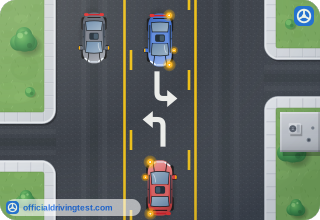
- Using it as a through or passing lane
- Waiting in it to turn left
- Turning left from it into a driveway
- Entering it to make a left turn
Show answer
Correct answer: Using it as a through or passing lane
Center left-turn lanes are not to be used as through or passing lanes.
Source: West Virginia Driver's Licensing Handbook (Revised July 2026), page 41 · Open this page in the manual (Manual page 41)
-
Which lines nearest the through lanes help you recognize a center left-turn lane?
- Solid white lines
- Broken white lines
- Solid yellow lines
- Double white lines
Show answer
Correct answer: Solid yellow lines
A center left-turn lane has solid yellow lines nearest the through lanes.
Source: West Virginia Driver's Licensing Handbook (Revised July 2026), page 41 · Open this page in the manual (Manual page 41)
-
How are reversible lanes marked?
- On both sides by a solid white edge line
- On both sides by a double yellow broken line
- On one side by a solid yellow line
- By white diamond shapes in the lane
Show answer
Correct answer: On both sides by a double yellow broken line
Lanes that reverse are marked on both sides by a double yellow broken line.
Source: West Virginia Driver's Licensing Handbook (Revised July 2026), page 41 · Open this page in the manual (Manual page 41)
-
When may a driver drive for any distance to the left of a yellow line?
- In a center left-turn lane
- When the road ahead is blocked
- In a school zone
- In a reversible lane
Show answer
Correct answer: In a reversible lane
Driving in a reversible lane is the only case where a driver may drive for any distance to the left of a yellow line.
Source: West Virginia Driver's Licensing Handbook (Revised July 2026), page 41 · Open this page in the manual (Manual page 41)
-
How are many pedestrian crosswalks marked?
- By solid white lines
- By broken yellow lines
- By solid yellow lines
- By white diamond shapes
Show answer
Correct answer: By solid white lines
Many pedestrian crosswalks are marked by solid white lines.
Source: West Virginia Driver's Licensing Handbook (Revised July 2026), page 41 · Open this page in the manual (Manual page 41)
-
Where are some crosswalks not marked?
- Especially on interstates
- Especially near railroad crossings
- Especially in residential areas
- Especially in work zones
Show answer
Correct answer: Especially in residential areas
Some crosswalks, especially in residential areas, are not marked.
Source: West Virginia Driver's Licensing Handbook (Revised July 2026), page 41 · Open this page in the manual (Manual page 41)
-
What must you not do at a crosswalk?
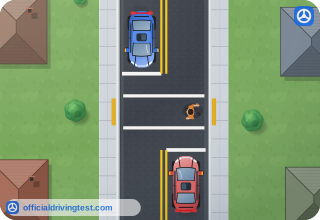
- Stop before it when a signal is red
- Block it with your car
- Wait behind it for pedestrians
- Pass through it when it is empty
Show answer
Correct answer: Block it with your car
You must not block a crosswalk with your car.
Source: West Virginia Driver's Licensing Handbook (Revised July 2026), page 41 · Open this page in the manual (Manual page 41)
-
What do wide white lines painted across traffic lanes at intersections mark?
- Where you may pass other vehicles
- Where lanes reverse
- The edge of the pavement
- Where you must stop your vehicle
Show answer
Correct answer: Where you must stop your vehicle
Wide white stop lines mark where you must stop at intersections, which keeps you out of the way of pedestrians and cross traffic.
Source: West Virginia Driver's Licensing Handbook (Revised July 2026), page 41 · Open this page in the manual (Manual page 41)