West Virginia: Vehicle controls and equipment — Part 3 Practice Test
Questions in this part include: “When should you use your parking lights?” · “What must you do with your headlights during adverse conditions, according to the West Virginia State Code?”
Independent educational site · not affiliated with any government agency or DMV
Ready? Test yourself
Answer to start, or tap Start below:
At night, you should make sure that you can stop within:
- Instant feedback with an explanation
- Every answer cites its source in the manual
- Your best score is saved on this device
- Keyboard: press 1 to 4 to answer and Enter for the next question
Questions are original and based on the official manual "West Virginia Driver's Licensing Handbook" (Revised July 2026), West Virginia Division of Motor Vehicles (DMV).
All 17 questions in this practice test
Take the test above first, then use this list to study. Tap “Show answer” to see the correct answer and explanation.
Show the questions and answersHide the questions
-
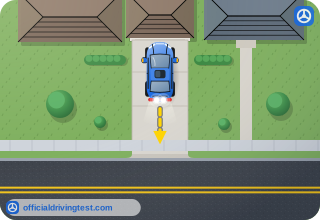
Before backing, what should you do?
- Check only your mirrors and the rear window before you back up
- Sound your horn twice and then back up slowly into the lane
- Turn on your hazard lights and then back up slowly and steadily
- Check completely around your vehicle for people and obstacles
Show answer
Correct answer: Check completely around your vehicle for people and obstacles
The handbook says to check completely around your vehicle for people and obstacles before backing.
Source: West Virginia Driver's Licensing Handbook (Revised July 2026), page 45 · Open this page in the manual (Manual page 45)
-
While you are backing, what does the handbook say to do?
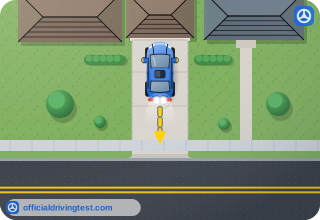
- Continue to look to the rear instead of depending on your mirror
- Watch your rear view mirror and glance back only for obstacles
- Rely on your side mirrors and look forward at the road
- Rely on your rear view mirror and back at normal speed
Show answer
Correct answer: Continue to look to the rear instead of depending on your mirror
You should keep looking to the rear while backing and not depend on your mirror.
Source: West Virginia Driver's Licensing Handbook (Revised July 2026), page 45 · Open this page in the manual (Manual page 45)
-
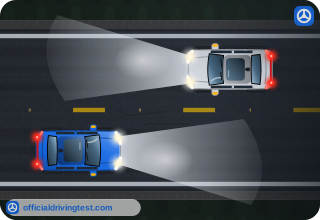
Within what distance of an approaching vehicle should you dim your headlights?
- 200 feet
- 500 feet
- 100 feet
- 1,000 feet
Show answer
Correct answer: 500 feet
When driving at night you should dim your headlights within 500 feet of an approaching vehicle.
Source: West Virginia Driver's Licensing Handbook (Revised July 2026), page 51 · Open this page in the manual (Manual page 51)
-
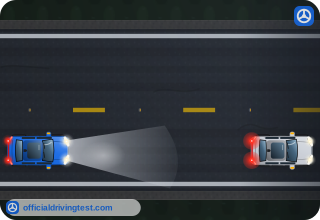
Within what distance of the vehicle in front of you should you dim your headlights?
- 200 feet
- 100 feet
- 500 feet
- 1,000 feet
Show answer
Correct answer: 200 feet
When driving at night you should dim your headlights within 200 feet of the vehicle in front of you.
Source: West Virginia Driver's Licensing Handbook (Revised July 2026), page 51 · Open this page in the manual (Manual page 51)
-
What should you do with your headlights when driving on well-lit streets?
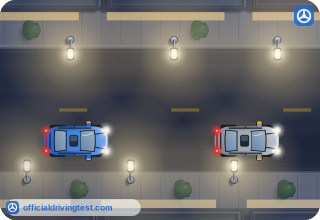
- Use your high beams
- Use only your parking lights
- Dim them
- Turn them off
Show answer
Correct answer: Dim them
The handbook says to dim your headlights when driving on well-lit streets.
Source: West Virginia Driver's Licensing Handbook (Revised July 2026), page 51 · Open this page in the manual (Manual page 51)
-
What type of headlight beams should you use when driving in fog?
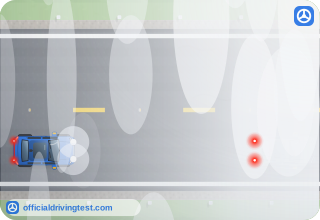
- High beams
- Low beams
- Parking lights only
- Hazard lights only
Show answer
Correct answer: Low beams
Low beams should be used in fog because high beams cause the light to be reflected back into your eyes.
Source: West Virginia Driver's Licensing Handbook (Revised July 2026), page 51 · Open this page in the manual (Manual page 51)
-
To avoid looking directly into the lights of oncoming vehicles, where should you look?
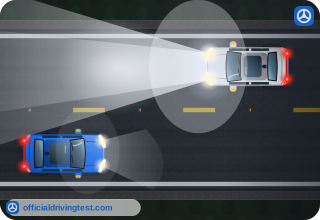
- Toward the left edge of the road
- At the center line
- Down at the dashboard
- Toward the right edge of the road
Show answer
Correct answer: Toward the right edge of the road
Looking toward the right edge of the road helps you avoid the glare of oncoming headlights.
Source: West Virginia Driver's Licensing Handbook (Revised July 2026), page 51 · Open this page in the manual (Manual page 51)
-
What should you do when facing the glare from the headlights of approaching vehicles?
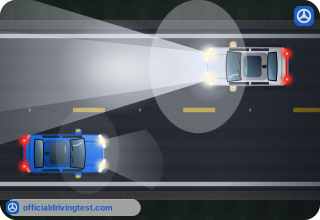
- Speed up to get past the glare
- Turn on your high beams too
- Look directly at the lights to judge distance
- Slow down
Show answer
Correct answer: Slow down
The handbook says to slow down when facing the glare from the headlights of approaching vehicles.
Source: West Virginia Driver's Licensing Handbook (Revised July 2026), page 51 · Open this page in the manual (Manual page 51)
-
At night, you should make sure that you can stop within:
- A distance of 100 feet
- The area lighted by your headlights
- Three seconds of following distance
- The distance to the next intersection
Show answer
Correct answer: The area lighted by your headlights
At night you should drive so that you can stop within the area your headlights light up.
Source: West Virginia Driver's Licensing Handbook (Revised July 2026), page 51 · Open this page in the manual (Manual page 51)
-
When should you use your parking lights?
- In fog or heavy rain
- When driving at dusk
- Only when you are parked
- When meeting another vehicle at night
Show answer
Correct answer: Only when you are parked
The handbook says to use your parking lights only when you are parked.
Source: West Virginia Driver's Licensing Handbook (Revised July 2026), page 51 · Open this page in the manual (Manual page 51)
-
During which period should you have your headlights on?
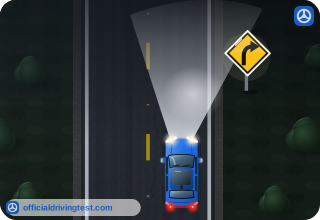
- From sunset to sunrise
- Only when it is completely dark
- Only between midnight and 5 a.m.
- Only when other vehicles have their lights on
Show answer
Correct answer: From sunset to sunrise
The handbook says to turn on your headlights from sunset to sunrise, and also during fog, smoke or rain.
Source: West Virginia Driver's Licensing Handbook (Revised July 2026), page 51 · Open this page in the manual (Manual page 51)
-
Your headlights should be on any time persons and vehicles cannot be seen clearly at what distance?
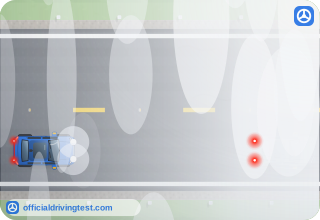
- 100 feet
- 500 feet
- 250 feet
- 1,000 feet
Show answer
Correct answer: 500 feet
Headlights should be on whenever persons and vehicles cannot be seen clearly at a distance of 500 feet.
Source: West Virginia Driver's Licensing Handbook (Revised July 2026), page 51 · Open this page in the manual (Manual page 51)
-
How should you keep your headlights and taillights?
- Turned on at all times
- Covered when parked
- Tinted to reduce glare
- Adjusted and cleaned
Show answer
Correct answer: Adjusted and cleaned
The handbook says to keep your headlights and taillights properly adjusted and cleaned.
Source: West Virginia Driver's Licensing Handbook (Revised July 2026), page 51 · Open this page in the manual (Manual page 51)
-
What must you do with your headlights during adverse conditions, according to the West Virginia State Code?
- Turn them off to reduce glare
- Use only your parking lights
- Turn them on
- Flash them at oncoming drivers
Show answer
Correct answer: Turn them on
West Virginia law requires headlights to be turned on during adverse conditions.
Source: West Virginia Driver's Licensing Handbook (Revised July 2026), page 59 · Open this page in the manual (Manual page 59)
-
Before you change lanes or drive away from the curb, what does the handbook say you should always do?
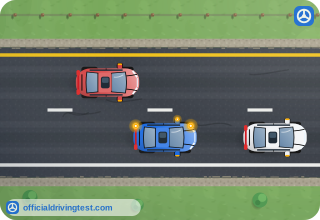
- Rely on your rear view mirror alone
- Brake lightly to warn the driver behind you
- Turn your head and look behind you for traffic
- Slow down to a crawl in your lane
Show answer
Correct answer: Turn your head and look behind you for traffic
You should turn your head and look behind you for traffic, and not become lazy by looking only in the rear view mirror.
Source: West Virginia Driver's Licensing Handbook (Revised July 2026), page 61 · Open this page in the manual (Manual page 61)
-
Which habit does the handbook call another bad habit related to laziness in checking for traffic?
- Driving too far from the curb
- Failing to signal
- Checking the mirrors too often
- Using the horn too much
Show answer
Correct answer: Failing to signal
The handbook says failing to signal is a related bad habit, and combined with laziness it could cause a serious crash.
Source: West Virginia Driver's Licensing Handbook (Revised July 2026), page 61 · Open this page in the manual (Manual page 61)
-
Driving east during sunrise or west during sunset could result in which condition?
- Too much natural light
- Too little natural light
- Too much artificial light
- A shortage of glare
Show answer
Correct answer: Too much natural light
The sun low in front of you can create a condition of too much natural light.
Source: West Virginia Driver's Licensing Handbook (Revised July 2026), page 62 · Open this page in the manual (Manual page 62)