West Virginia: Vehicle controls and equipment — Part 2 Practice Test
Questions in this part include: “Which of these features must be fully functional on the test vehicle?” · “If your turn signal cancels automatically during an exercise, what should you do?”
Independent educational site · not affiliated with any government agency or DMV
Ready? Test yourself
Answer to start, or tap Start below:
Which of these features must be fully functional on the test vehicle?
- Instant feedback with an explanation
- Every answer cites its source in the manual
- Your best score is saved on this device
- Keyboard: press 1 to 4 to answer and Enter for the next question
Questions are original and based on the official manual "West Virginia Driver's Licensing Handbook" (Revised July 2026), West Virginia Division of Motor Vehicles (DMV).
All 18 questions in this practice test
Take the test above first, then use this list to study. Tap “Show answer” to see the correct answer and explanation.
Show the questions and answersHide the questions
-
Which of these features must be fully functional on the test vehicle?
- Cruise control
- Exhaust system
- Heated seats
- Satellite radio
Show answer
Correct answer: Exhaust system
The exhaust system is on the list of features that must be fully functional.
Source: West Virginia Driver's Licensing Handbook (Revised July 2026), page 26 · Open this page in the manual (Manual page 26)
-
Which of these lights must be fully functional on the test vehicle?
- Registration/license plate light
- Fog lights
- Daytime running lights on the bumper
- The interior dome light
Show answer
Correct answer: Registration/license plate light
The registration/license plate light is on the list of features that must be fully functional.
Source: West Virginia Driver's Licensing Handbook (Revised July 2026), page 26 · Open this page in the manual (Manual page 26)
-
Which signals are you expected to use during the test where the law requires their use?
- Only directional light signals
- Only arm signals
- Only hazard light signals
- All arm or directional light signals
Show answer
Correct answer: All arm or directional light signals
You are expected to use all arm or directional light signals where the law requires them.
Source: West Virginia Driver's Licensing Handbook (Revised July 2026), page 26 · Open this page in the manual (Manual page 26)
-
When should you adjust the vehicle seat and rear view mirror?
- After the first turn
- Before driving
- Only if the examiner asks you to
- After you leave the testing center parking area
Show answer
Correct answer: Before driving
The handbook says to adjust the seat and rear view mirror before driving.
Source: West Virginia Driver's Licensing Handbook (Revised July 2026), page 26 · Open this page in the manual (Manual page 26)
-
What does proper seat adjustment assure?
- Better control of the vehicle
- A shorter stopping distance
- Better fuel economy
- Less glare from other vehicles
Show answer
Correct answer: Better control of the vehicle
A properly adjusted seat gives you better control of the vehicle.
Source: West Virginia Driver's Licensing Handbook (Revised July 2026), page 26 · Open this page in the manual (Manual page 26)
-
A properly adjusted rear view mirror helps you see the vehicle behind you when you must do what?
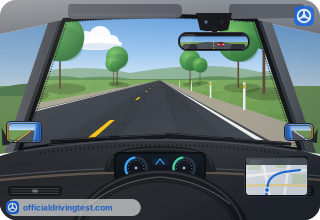
- Read road signs, check gauges, or tune the radio
- Speed up, pass, or merge onto a freeway
- Slow down, change lanes, or turn
- Start the engine, shift gears, or adjust the seat
Show answer
Correct answer: Slow down, change lanes, or turn
A properly adjusted rear view mirror helps you see the vehicle behind you when you slow down, change lanes, or turn.
Source: West Virginia Driver's Licensing Handbook (Revised July 2026), page 26 · Open this page in the manual (Manual page 26)
-
During an exercise, how is each failure to use, or improper use of, your turn signal scored?
- It is an automatic failure
- It is ignored if you finish the exercise
- It counts as a warning only
- It counts as an error
Show answer
Correct answer: It counts as an error
Each time you fail to use or improperly use your turn signal during an exercise, it counts as an error.
Source: West Virginia Driver's Licensing Handbook (Revised July 2026), page 27 · Open this page in the manual (Manual page 27)
-
During an exercise, when must you use the correct turn signal?
- Only when turning onto a public roadway after the exercise
- Only when backing into a space between the cones
- When turning, backing, and entering or exiting an area
- Only when the examiner directs you to signal
Show answer
Correct answer: When turning, backing, and entering or exiting an area
You must use the correct turn signal when turning, backing, and also to enter or exit an area.
Source: West Virginia Driver's Licensing Handbook (Revised July 2026), page 27 · Open this page in the manual (Manual page 27)
-
If your turn signal cancels automatically during an exercise, what should you do?
- Reactivate it when necessary
- Leave it off, because that is not counted as an error
- Pull over and ask the examiner to restart the exercise
- Stop and wait for the examiner to turn it on for you
Show answer
Correct answer: Reactivate it when necessary
If the signal cancels on its own, you must make sure to reactivate it when necessary.
Source: West Virginia Driver's Licensing Handbook (Revised July 2026), page 27 · Open this page in the manual (Manual page 27)
-
How should you time your turn signals during the road test?
- As early as possible, well before the turn
- Activate them at appropriate times, not too early or too late
- Only at the moment the vehicle starts to turn
- Only when other vehicles are close enough to see them
Show answer
Correct answer: Activate them at appropriate times, not too early or too late
You activate turn signals at appropriate times and do not signal too early or too late.
Source: West Virginia Driver's Licensing Handbook (Revised July 2026), page 31 · Open this page in the manual (Manual page 31)
-
Which of these is a time when the handbook says to use your turn signal?
- When you drive straight through an intersection
- When you continue in your lane on a straight road
- Before you enter or leave an interstate
- When you slow down on a road with no side streets
Show answer
Correct answer: Before you enter or leave an interstate
The handbook lists entering or leaving an interstate, along with changing lanes, turning, pulling away from the curb and pulling over.
Source: West Virginia Driver's Licensing Handbook (Revised July 2026), page 43 · Open this page in the manual (Manual page 43)
-
How far before you plan to turn should you signal, at a minimum?
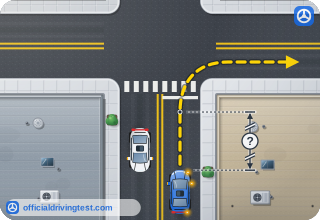
- 50 feet
- 100 feet
- 200 feet
- 300 feet
Show answer
Correct answer: 100 feet
The handbook says to signal at least 100 feet before you plan to turn.
Source: West Virginia Driver's Licensing Handbook (Revised July 2026), page 43 · Open this page in the manual (Manual page 43)
-
Why should you switch off your turn signals after completing a turn?
- Leaving them on for long can wear out the signal bulbs
- Leaving them on after a turn is a traffic violation that is ticketed
- Leaving them on keeps your brake lights from working correctly
- Driving with them on without intending to turn can create confusion
Show answer
Correct answer: Driving with them on without intending to turn can create confusion
A signal left flashing when you are not turning can confuse other drivers.
Source: West Virginia Driver's Licensing Handbook (Revised July 2026), page 43 · Open this page in the manual (Manual page 43)
-
Why should you not signal too soon if you plan to turn beyond an intersection?
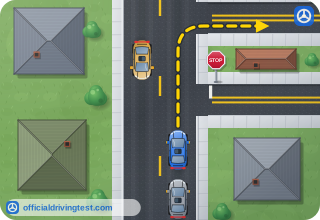
- Other drivers may think you are turning at the intersection and pull into your path
- Other drivers may think your signal is broken and ignore it completely
- The signal may wear out the bulbs before you reach the turn itself
- The vehicle behind you will then be allowed to pass you on the right
Show answer
Correct answer: Other drivers may think you are turning at the intersection and pull into your path
A signal given too early can make drivers believe you will turn at the intersection, and they may pull into your path.
Source: West Virginia Driver's Licensing Handbook (Revised July 2026), page 43 · Open this page in the manual (Manual page 43)
-
In the handbook's hand-signal pictures, what does a driver's arm pointing down mean?
- Right turn
- Left turn
- Slow or stop
- Passing
Show answer
Correct answer: Slow or stop
An arm pointing down is the hand signal for slow or stop.
Source: West Virginia Driver's Licensing Handbook (Revised July 2026), page 43 · Open this page in the manual (Manual page 43)
-
Which arm position is the hand signal for a right turn?
- Arm pointing down
- Arm pointing up
- Arm straight out
- Arm waving up and down
Show answer
Correct answer: Arm pointing up
An arm pointing up is the hand signal for a right turn.
Source: West Virginia Driver's Licensing Handbook (Revised July 2026), page 43 · Open this page in the manual (Manual page 43)
-
In the handbook's hand-signal pictures, what does a driver's arm held straight out mean?
- Right turn
- Slow or stop
- Pulling over to park
- Left turn
Show answer
Correct answer: Left turn
An arm held straight out is the hand signal for a left turn.
Source: West Virginia Driver's Licensing Handbook (Revised July 2026), page 43 · Open this page in the manual (Manual page 43)
-
Treating the steering wheel as the face of a clock, where does the handbook say your hands are best placed?
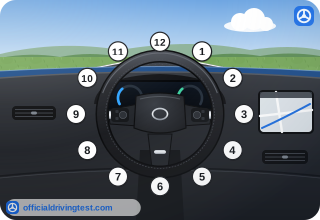
- Left hand at 8 o'clock and right hand at 4 o'clock
- Left hand at 10 o'clock and right hand at 2 o'clock
- Left hand at 9 o'clock and right hand at 3 o'clock
- Left hand at 6 o'clock and right hand at 12 o'clock
Show answer
Correct answer: Left hand at 8 o'clock and right hand at 4 o'clock
The handbook puts the left hand at about 8 o'clock and the right at 4 o'clock, which gives maximum control and reduces the chance a deploying air bag knocks your hands off.
Source: West Virginia Driver's Licensing Handbook (Revised July 2026), page 43 · Open this page in the manual (Manual page 43)