West Virginia: Vehicle controls and equipment — Part 4 Practice Test
Questions in this part include: “When it begins to get dark, what does the handbook say it is the law to turn on?” · “What does the sticker placed on your windshield after your vehicle passes the state inspection show?”
Independent educational site · not affiliated with any government agency or DMV
Ready? Test yourself
Answer to start, or tap Start below:
When it begins to get dark, what does the handbook say it is the law to turn on?
- Instant feedback with an explanation
- Every answer cites its source in the manual
- Your best score is saved on this device
- Keyboard: press 1 to 4 to answer and Enter for the next question
Questions are original and based on the official manual "West Virginia Driver's Licensing Handbook" (Revised July 2026), West Virginia Division of Motor Vehicles (DMV).
All 17 questions in this practice test
Take the test above first, then use this list to study. Tap “Show answer” to see the correct answer and explanation.
Show the questions and answersHide the questions
-
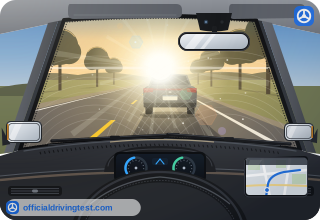
Which defensive actions does the handbook give for too much natural light?
- Turn on high beams and keep your speed steady
- Look away from the road until the glare passes
- Use the sun visor, wear sunglasses, and reduce speed
- Switch to parking lights and drive in the center lane
Show answer
Correct answer: Use the sun visor, wear sunglasses, and reduce speed
The proper use of the sun visor, sunglasses, a lower speed, and more alertness are the defensive actions named.
Source: West Virginia Driver's Licensing Handbook (Revised July 2026), page 62 · Open this page in the manual (Manual page 62)
-
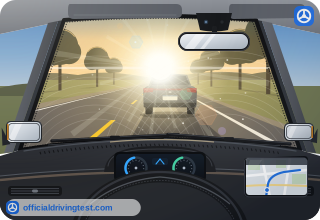
On bright days, sunglasses may be advisable to reduce the glare from which of these?
- Painted lane lines and overhead road signs
- Glass and chrome on other vehicles, or snow
- Wet pavement and standing puddles of water
- Your own dashboard instruments and mirrors
Show answer
Correct answer: Glass and chrome on other vehicles, or snow
Sunglasses can reduce the glare from glass and chrome on other vehicles and from snow.
Source: West Virginia Driver's Licensing Handbook (Revised July 2026), page 62 · Open this page in the manual (Manual page 62)
-
When it begins to get dark, what does the handbook say it is the law to turn on?
- Your parking lights, which are enough until full darkness
- Your hazard lights along with your parking lights
- Your high-beam headlights only
- Your headlights, not just your parking lights
Show answer
Correct answer: Your headlights, not just your parking lights
It is the law to turn on your headlights, and not just the parking lights, when it begins to get dark or when visibility is impaired.
Source: West Virginia Driver's Licensing Handbook (Revised July 2026), page 62 · Open this page in the manual (Manual page 62)
-
What does turning on your headlights a little early do, according to the handbook?
- It saves power for later in the trip
- It lets you skip using your low beams
- It helps other drivers see you
- It allows you to drive faster after dark
Show answer
Correct answer: It helps other drivers see you
Headlights turned on early make you easier for other drivers to see.
Source: West Virginia Driver's Licensing Handbook (Revised July 2026), page 62 · Open this page in the manual (Manual page 62)
-
What does the handbook say to do with your vehicle lighting system?
- Test it only at the yearly inspection
- Keep it clean and in proper repair
- Clean it only when the lights look dim
- Replace the bulbs every year
Show answer
Correct answer: Keep it clean and in proper repair
The handbook says to keep the vehicle lighting system clean and in proper repair.
Source: West Virginia Driver's Licensing Handbook (Revised July 2026), page 62 · Open this page in the manual (Manual page 62)
-
What does looking directly into oncoming headlights cause?
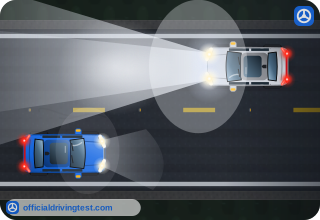
- Momentary blindness
- A longer stopping distance
- Permanent loss of night vision
- Dizziness lasting several minutes
Show answer
Correct answer: Momentary blindness
Looking directly into oncoming headlights causes momentary blindness.
Source: West Virginia Driver's Licensing Handbook (Revised July 2026), page 62 · Open this page in the manual (Manual page 62)
-
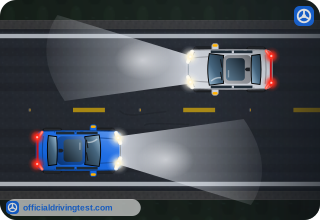
When meeting an oncoming vehicle at night, what does the handbook say to do?
- Keep your speed and move toward the center line
- Slow down and keep to the right of your traffic lane
- Speed up to pass the vehicle quickly
- Stop in your lane until the vehicle has passed
Show answer
Correct answer: Slow down and keep to the right of your traffic lane
Slow down and stay to the right of your lane to reduce the effect of the glare.
Source: West Virginia Driver's Licensing Handbook (Revised July 2026), page 62 · Open this page in the manual (Manual page 62)
-
When meeting an oncoming vehicle at night, where should you look?
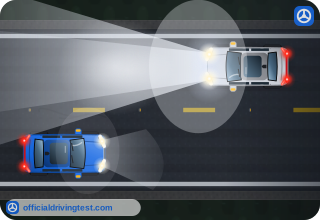
- Directly into the oncoming headlights
- At the center line of the road ahead
- Toward the left edge of the road ahead
- Well ahead, at the right edge of the road
Show answer
Correct answer: Well ahead, at the right edge of the road
You look well ahead toward the right edge of the road instead of into the oncoming lights.
Source: West Virginia Driver's Licensing Handbook (Revised July 2026), page 62 · Open this page in the manual (Manual page 62)
-
During periods of rain, which action does the handbook say is the law?
- Turn on your hazard lights
- Drive in the right lane only
- Stop until the rain ends
- Turn on your headlights
Show answer
Correct answer: Turn on your headlights
The handbook states that it is the law to turn on your headlights to increase your visibility in rain.
Source: West Virginia Driver's Licensing Handbook (Revised July 2026), page 63 · Open this page in the manual (Manual page 63)
-
How often does West Virginia require an inspection of all vehicles?
- Every year
- Every three years
- Every five years
- Every two years
Show answer
Correct answer: Every two years
West Virginia requires an inspection of all vehicles every two years to ensure they are in safe driving condition.
Source: West Virginia Driver's Licensing Handbook (Revised July 2026), page 64 · Open this page in the manual (Manual page 64)
-
Where must your vehicle be checked for the state inspection?
- At a station displaying a state inspection station sign
- At any repair shop that has an alignment lift
- At a regional office of the Division of Motor Vehicles
- By a law enforcement officer at the roadside
Show answer
Correct answer: At a station displaying a state inspection station sign
The vehicle must be checked at an inspection station that displays a state inspection station sign.
Source: West Virginia Driver's Licensing Handbook (Revised July 2026), page 64 · Open this page in the manual (Manual page 64)
-
What does the sticker placed on your windshield after your vehicle passes the state inspection show?
- The date of your last repair
- The registration number of the vehicle
- The month and year of your next inspection
- The month and year the vehicle was built
Show answer
Correct answer: The month and year of your next inspection
The sticker shows the month and year when your next inspection is due.
Source: West Virginia Driver's Licensing Handbook (Revised July 2026), page 64 · Open this page in the manual (Manual page 64)
-
What does West Virginia law say about the state inspection sticker on your windshield?
- You may remove it after six months
- It is against the law for you to remove it
- You may remove it when it fades
- You must remove it before each inspection
Show answer
Correct answer: It is against the law for you to remove it
The handbook states that it is against the law to remove the inspection sticker.
Source: West Virginia Driver's Licensing Handbook (Revised July 2026), page 64 · Open this page in the manual (Manual page 64)
-
Which is named as a common vehicle defect that causes crashes?
- Unusable seat belts
- Worn floor mats
- A faded paint finish
- A cracked radio antenna
Show answer
Correct answer: Unusable seat belts
Faulty tires, brakes, lights, wipers, defrosters, mufflers and exhaust system, horn, mirrors, and unusable seat belts are the common defects listed.
Source: West Virginia Driver's Licensing Handbook (Revised July 2026), page 65 · Open this page in the manual (Manual page 65)
-
What responsibility does the handbook say you have to the driver following you?
- To speed up whenever the driver behind comes too close
- To pull onto the shoulder so that the driver can go by
- To signal whenever you make a change in your driving pattern
- To flash your brake lights to tell the driver to back off
Show answer
Correct answer: To signal whenever you make a change in your driving pattern
A driver behind you can be affected by what you do, so you must signal any change in your driving pattern, especially before slowing or stopping suddenly.
Source: West Virginia Driver's Licensing Handbook (Revised July 2026), page 66 · Open this page in the manual (Manual page 66)
-
In a vehicle equipped with an anti-lock brake system (ABS), how should you brake in a quick stop?
- Pump the brake pedal repeatedly to keep the wheels from locking
- Press the brake gently and release it
- Push hard on the brake and keep steering
- Apply the brake lightly and steer only after you have stopped
Show answer
Correct answer: Push hard on the brake and keep steering
With ABS the driver keeps steering while pushing hard on the brake. Pumping the brake reduces the system's ability to stop quickly and safely.
Source: West Virginia Driver's Licensing Handbook (Revised July 2026), page 68 · Open this page in the manual (Manual page 68)
-
What is the anti-lock brake system (ABS) designed to prevent when a motorist must come to a quick stop?
- Tire wear
- Wheel lockup
- Engine stalling
- Brake fluid loss
Show answer
Correct answer: Wheel lockup
The ABS is designed to prevent the wheels from locking up in a quick stop.
Source: West Virginia Driver's Licensing Handbook (Revised July 2026), page 68 · Open this page in the manual (Manual page 68)