West Virginia: Right-of-way, turning and passing — Part 4 Practice Test
Questions in this part include: “Which of these must be true before you pass?” · “Passing is prohibited within how many feet of an intersection?”
Independent educational site · not affiliated with any government agency or DMV
Ready? Test yourself
Answer to start, or tap Start below:
Which of these must be true before you pass?
- Instant feedback with an explanation
- Every answer cites its source in the manual
- Your best score is saved on this device
- Keyboard: press 1 to 4 to answer and Enter for the next question
Questions are original and based on the official manual "West Virginia Driver's Licensing Handbook" (Revised July 2026), West Virginia Division of Motor Vehicles (DMV).
All 17 questions in this practice test
Take the test above first, then use this list to study. Tap “Show answer” to see the correct answer and explanation.
Show the questions and answersHide the questions
-
Which is a condition that must be met before you can pass safely?
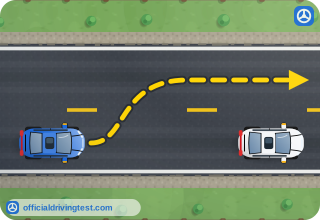
- You can return to your lane before meeting oncoming traffic
- You can exceed the speed limit by at least 10 mph
- The driver ahead has slowed to let you by
- Your vehicle is at least as large as the one ahead
Show answer
Correct answer: You can return to your lane before meeting oncoming traffic
You cannot pass safely unless you can return to your lane before meeting oncoming traffic.
Source: West Virginia Driver's Licensing Handbook (Revised July 2026), page 48 · Open this page in the manual (Manual page 48)
-
You cannot pass safely unless which of these is true?
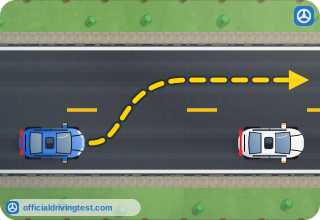
- The vehicle ahead has its turn signal on
- You are driving in the lane closest to the center line
- Your vehicle is capable of the speed necessary to pass
- The road ahead has at least two lanes in each direction
Show answer
Correct answer: Your vehicle is capable of the speed necessary to pass
You cannot pass safely unless your vehicle is capable of the speed necessary to pass.
Source: West Virginia Driver's Licensing Handbook (Revised July 2026), page 48 · Open this page in the manual (Manual page 48)
-
Which of these must be true before you pass?
- The vehicle ahead is traveling below the speed limit
- You can see far enough ahead
- You have signaled for at least one full minute
- A vehicle is behind you and ready to pass as well
Show answer
Correct answer: You can see far enough ahead
You cannot pass safely unless you can see far enough ahead.
Source: West Virginia Driver's Licensing Handbook (Revised July 2026), page 48 · Open this page in the manual (Manual page 48)
-
Which of these is a place where passing is prohibited?
- On a straight road where you can see far ahead
- In a marked passing zone with no oncoming traffic in sight
- Where a lane is designated for passing
- On a curve or hill, or anywhere you cannot see oncoming traffic
Show answer
Correct answer: On a curve or hill, or anywhere you cannot see oncoming traffic
Passing is prohibited on a curve or hill or at any place where you cannot see oncoming traffic.
Source: West Virginia Driver's Licensing Handbook (Revised July 2026), page 48 · Open this page in the manual (Manual page 48)
-
Passing is prohibited within how many feet of an intersection?
- 100 feet
- 25 feet
- 50 feet
- 200 feet
Show answer
Correct answer: 100 feet
Passing is prohibited within 100 feet of an intersection.
Source: West Virginia Driver's Licensing Handbook (Revised July 2026), page 48 · Open this page in the manual (Manual page 48)
-
You are entering a public street from a driveway. What must you do?
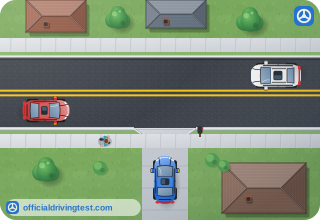
- Yield to traffic already on the roadway
- Speed up to merge ahead of traffic
- Enter first, since traffic on the street can slow down
- Yield only to vehicles approaching from your left
Show answer
Correct answer: Yield to traffic already on the roadway
Drivers entering a public street or highway from an alley, private road or driveway must yield to traffic already on the roadway.
Source: West Virginia Driver's Licensing Handbook (Revised July 2026), page 49 · Open this page in the manual (Manual page 49)
-
You reach an uncontrolled intersection or a four-way stop intersection at the same time as another vehicle. Which driver should you yield to?
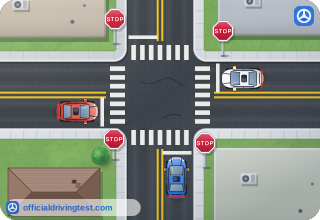
- The driver on your left
- The driver going straight ahead
- The driver on your right
- The driver in the larger vehicle
Show answer
Correct answer: The driver on your right
When two vehicles reach an uncontrolled or four-way stop intersection at the same time, the driver on the right has the right-of-way.
Source: West Virginia Driver's Licensing Handbook (Revised July 2026), page 49 · Open this page in the manual (Manual page 49)
-
What should you do at an intersection with a yield sign?
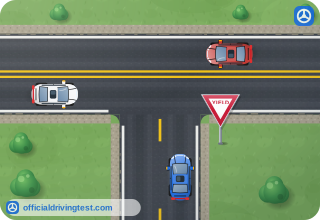
- Come to a complete stop, then drive through ahead of all approaching traffic
- Slow down, then yield to vehicles in the intersection and to approaching traffic
- Keep your speed and let vehicles in the intersection yield to you
- Slow down and go first if the intersection looks clear of other vehicles
Show answer
Correct answer: Slow down, then yield to vehicles in the intersection and to approaching traffic
At a yield sign you slow down before the intersection, then give the right-of-way to any vehicle in it and to approaching traffic.
Source: West Virginia Driver's Licensing Handbook (Revised July 2026), page 49 · Open this page in the manual (Manual page 49)
-
When you make a left turn, you must yield the right-of-way to whom?
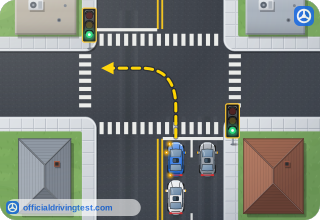
- Traffic approaching from behind
- Vehicles waiting in the right lane
- Nobody, if you have signaled
- Oncoming traffic
Show answer
Correct answer: Oncoming traffic
A driver turning left must yield the right-of-way to oncoming traffic.
Source: West Virginia Driver's Licensing Handbook (Revised July 2026), page 49 · Open this page in the manual (Manual page 49)
-
Yielding to vehicles in a funeral procession is:
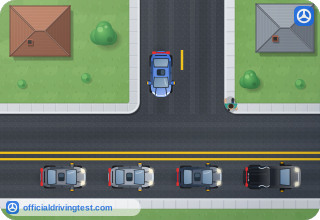
- Required by law at every intersection
- Required by law only on expressways
- A courtesy, though not required by law
- Required by law only at traffic signals
Show answer
Correct answer: A courtesy, though not required by law
The handbook says that yielding to a funeral procession is a courtesy and is not required by law.
Source: West Virginia Driver's Licensing Handbook (Revised July 2026), page 49 · Open this page in the manual (Manual page 49)
-
Once the lead vehicle of a funeral procession has cleared an intersection, who has the right-of-way?
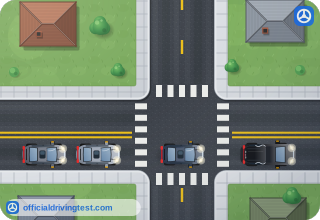
- The rest of the procession
- Cross traffic that was waiting
- Whichever driver enters the intersection first
- Oncoming traffic
Show answer
Correct answer: The rest of the procession
After the lead vehicle has cleared the intersection, the rest of the procession has the right-of-way.
Source: West Virginia Driver's Licensing Handbook (Revised July 2026), page 49 · Open this page in the manual (Manual page 49)
-
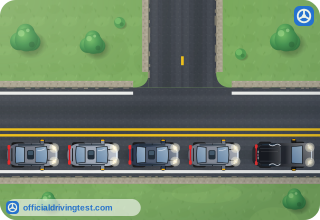
Where does the handbook say you may pass a funeral procession?
- At an intersection
- On an expressway
- On a bridge
- In a school zone
Show answer
Correct answer: On an expressway
The handbook says you may pass a funeral procession on an expressway, but you must not cut in or out of it.
Source: West Virginia Driver's Licensing Handbook (Revised July 2026), page 49 · Open this page in the manual (Manual page 49)
-
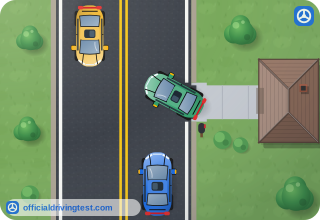
If another driver does not follow the right-of-way rules, what does the handbook say you should do?
- Insist on your right-of-way
- Honk until the driver yields
- Give the right-of-way
- Follow closely to show the mistake
Show answer
Correct answer: Give the right-of-way
Safety comes before right-of-way, so you give the right-of-way even when the other driver does not follow the rules.
Source: West Virginia Driver's Licensing Handbook (Revised July 2026), page 49 · Open this page in the manual (Manual page 49)
-
Passing is prohibited within how many feet of a bridge, viaduct, tunnel, or underpass?
- 50 feet
- 200 feet
- 100 feet
- 500 feet
Show answer
Correct answer: 100 feet
You may not pass within 100 feet of a bridge, viaduct, tunnel, or underpass.
Source: West Virginia Driver's Licensing Handbook (Revised July 2026), page 49 · Open this page in the manual (Manual page 49)
-
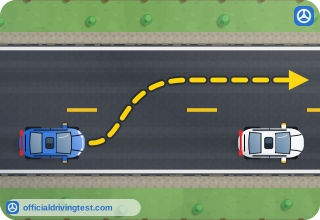
You are in a passing zone and want to pass. When is passing still prohibited?
- When the vehicle ahead is a pickup truck or a van
- When it is daytime and the road surface is dry
- When the vehicle ahead is under the posted speed limit
- When an approaching vehicle is within your passing area
Show answer
Correct answer: When an approaching vehicle is within your passing area
Passing is prohibited when an oncoming vehicle is within the area you need to pass.
Source: West Virginia Driver's Licensing Handbook (Revised July 2026), page 49 · Open this page in the manual (Manual page 49)
-
Regardless of traffic, what must you do at a stop sign or red light, even when making a right turn?
- Slow down and turn if no cross traffic is present
- Yield only to vehicles on the cross street
- Stop only when other vehicles are following you
- Come to a complete stop
Show answer
Correct answer: Come to a complete stop
You must come to a complete stop at a stop sign or red light, even for a right turn, even when there is no cross traffic.
Source: West Virginia Driver's Licensing Handbook (Revised July 2026), page 61 · Open this page in the manual (Manual page 61)
-
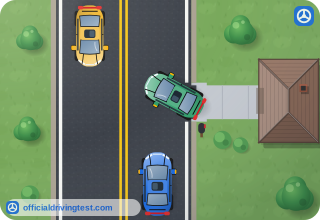
Another vehicle can approach at an angle at intersections, driveways, and entrances and exits to parking lots. What does the handbook say to do in these locations?
- Assume the other driver will yield and keep your speed
- Sound your horn and drive through without slowing
- Stop completely and wait for the other driver to pass
- Learn the traffic laws and obey signs and signals
Show answer
Correct answer: Learn the traffic laws and obey signs and signals
At places where vehicles can come at an angle, you should know the traffic laws and obey the signs and signals that control traffic there.
Source: West Virginia Driver's Licensing Handbook (Revised July 2026), page 66 · Open this page in the manual (Manual page 66)