West Virginia: Right-of-way, turning and passing — Part 3 Practice Test
Questions in this part include: “Why should you not turn your wheels to the left while waiting to turn left?” · “If no sign prohibits a turn on red, traffic facing a red signal may make a left turn in which situation?”
Independent educational site · not affiliated with any government agency or DMV
Ready? Test yourself
Answer to start, or tap Start below:
Why should you not turn your wheels to the left while waiting to turn left?
- Instant feedback with an explanation
- Every answer cites its source in the manual
- Your best score is saved on this device
- Keyboard: press 1 to 4 to answer and Enter for the next question
Questions are original and based on the official manual "West Virginia Driver's Licensing Handbook" (Revised July 2026), West Virginia Division of Motor Vehicles (DMV).
All 17 questions in this practice test
Take the test above first, then use this list to study. Tap “Show answer” to see the correct answer and explanation.
Show the questions and answersHide the questions
-
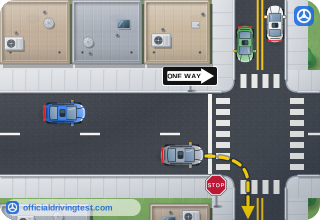
Where should you always finish a turn?
- In whichever lane has the least traffic
- In the lane you can reach with the least steering
- In the proper lane
- In the first lane that is open when you finish
Show answer
Correct answer: In the proper lane
The handbook says to always finish turning in the proper lane.
Source: West Virginia Driver's Licensing Handbook (Revised July 2026), page 44 · Open this page in the manual (Manual page 44)
-
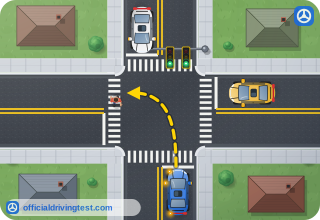
When turning left, what should you do if oncoming traffic is about to reach the intersection at about the same time as you?
- Turn first, since you have already signaled
- Stop until it is safe for you to turn
- Speed up to finish the turn ahead of it
- Flash your headlights and turn quickly
Show answer
Correct answer: Stop until it is safe for you to turn
If traffic in the opposite lane will reach the intersection at about the same time, stop until it is safe to turn.
Source: West Virginia Driver's Licensing Handbook (Revised July 2026), page 44 · Open this page in the manual (Manual page 44)
-
Why should you not turn your wheels to the left while waiting to turn left?
- The vehicle could roll backward into the vehicle behind you
- It would tell other drivers you plan to go straight ahead
- The steering system can be damaged while the vehicle is stopped
- A bump from behind could push your vehicle into oncoming traffic
Show answer
Correct answer: A bump from behind could push your vehicle into oncoming traffic
With the wheels turned left, a bump from behind could push your vehicle into oncoming traffic.
Source: West Virginia Driver's Licensing Handbook (Revised July 2026), page 44 · Open this page in the manual (Manual page 44)
-
At an intersection with no sign prohibiting a turn on red, what may traffic facing a red signal do before turning right?
- Come to a complete stop, yield to pedestrians and traffic, then turn
- Slow to a rolling stop and turn if no cross traffic is visible
- Wait for the signal to turn green before turning right
- Yield only to pedestrians, since cross traffic must yield to you
Show answer
Correct answer: Come to a complete stop, yield to pedestrians and traffic, then turn
Traffic facing a red signal may turn right only after a complete stop and after yielding to pedestrians and traffic.
Source: West Virginia Driver's Licensing Handbook (Revised July 2026), page 44 · Open this page in the manual (Manual page 44)
-
If no sign prohibits a turn on red, traffic facing a red signal may make a left turn in which situation?
- From a two-way street onto a one-way street
- From a one-way street onto a two-way street
- From a one-way street onto a one-way street
- From a two-way street onto a two-way street
Show answer
Correct answer: From a one-way street onto a one-way street
The turn-on-red rule also applies to left turns from a one-way street to a one-way street.
Source: West Virginia Driver's Licensing Handbook (Revised July 2026), page 44 · Open this page in the manual (Manual page 44)
-
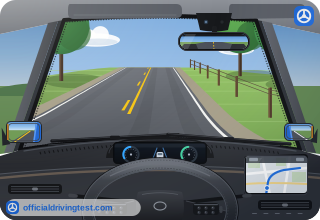
It is against the law to turn your vehicle around near the crest of a hill where you cannot be seen by another vehicle approaching within how many feet in either direction?
- 100 feet
- 500 feet
- 200 feet
- 300 feet
Show answer
Correct answer: 500 feet
Turning around is unlawful near a hill crest where you cannot be seen by a vehicle approaching within 500 feet in either direction.
Source: West Virginia Driver's Licensing Handbook (Revised July 2026), page 45 · Open this page in the manual (Manual page 45)
-
It is not advisable to back up while in a traffic lane, except for what purpose?
- Backing up to turn around on a narrow road
- Backing up to reach a turn you have missed
- Backing into a parallel parking space
- Backing away from a vehicle that is too close in front
Show answer
Correct answer: Backing into a parallel parking space
Backing in a traffic lane is not advisable except to back into a parallel parking space.
Source: West Virginia Driver's Licensing Handbook (Revised July 2026), page 45 · Open this page in the manual (Manual page 45)
-
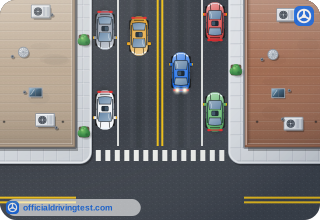
Where does the handbook say you should never back?
- Into a parallel parking space
- Across other traffic lanes or through an intersection
- Slowly into the proper traffic lane
- Into a space after checking around your vehicle
Show answer
Correct answer: Across other traffic lanes or through an intersection
The handbook says never to back across other traffic lanes or through an intersection.
Source: West Virginia Driver's Licensing Handbook (Revised July 2026), page 45 · Open this page in the manual (Manual page 45)
-
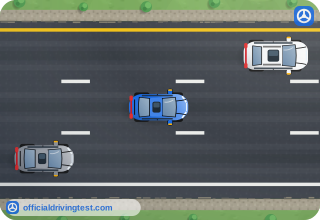
Before changing lanes, why do you make a head check by looking over your left or right shoulder?
- To confirm that your turn signal is flashing
- To make sure no one is in your blind spot
- To check the speed of the vehicle behind you
- To see whether the next lane is wider
Show answer
Correct answer: To make sure no one is in your blind spot
A head check over the shoulder makes sure no one is in your blind spot.
Source: West Virginia Driver's Licensing Handbook (Revised July 2026), page 48 · Open this page in the manual (Manual page 48)
-
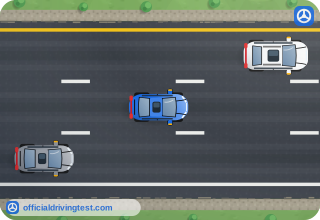
Besides checking your mirrors and your blind spot, what should you check for before changing lanes?
- Whether a police vehicle is behind the next vehicle
- Whether the next lane has a lower speed limit
- Pedestrians waiting to cross in the next lane
- Other drivers who may also be moving into the same lane
Show answer
Correct answer: Other drivers who may also be moving into the same lane
The handbook says to check for other drivers who may also be moving into the same lane.
Source: West Virginia Driver's Licensing Handbook (Revised July 2026), page 48 · Open this page in the manual (Manual page 48)
-
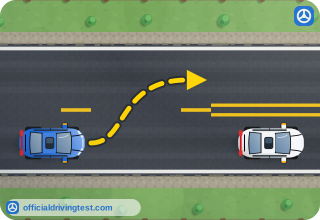
Before you pass on a two-lane highway, what must you make sure of?
- That the driver ahead has signaled that it is safe to pass
- That you are in the left lane and traveling above the posted limit
- That you are in a passing zone and observing the three-to-four second rule
- That the vehicle ahead is slower than the posted speed limit
Show answer
Correct answer: That you are in a passing zone and observing the three-to-four second rule
The first passing step is to make sure you are in a passing zone and keeping the three-to-four second following distance.
Source: West Virginia Driver's Licensing Handbook (Revised July 2026), page 48 · Open this page in the manual (Manual page 48)
-
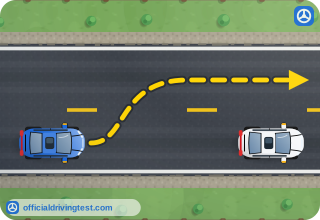
If you have to speed to pass, what does the handbook say that probably means?
- You should flash your headlights
- You probably do not need to pass
- You should pass only at night
- You should pass on the right side
Show answer
Correct answer: You probably do not need to pass
If you have to speed to pass, you probably do not need to pass.
Source: West Virginia Driver's Licensing Handbook (Revised July 2026), page 48 · Open this page in the manual (Manual page 48)
-
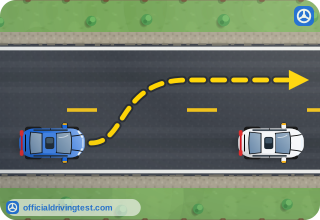
Which of these are dangers in the passing area that you should check for before you pass?
- A wide shoulder, a rest area, or a long straight stretch
- A fresh pavement patch, a parked truck, or a billboard
- A mile marker, a guardrail, or a roadside stand
- A narrow bridge, side road, or curve
Show answer
Correct answer: A narrow bridge, side road, or curve
Before passing you check ahead, to the rear and to the side for dangers such as a narrow bridge, side road, or curve.
Source: West Virginia Driver's Licensing Handbook (Revised July 2026), page 48 · Open this page in the manual (Manual page 48)
-
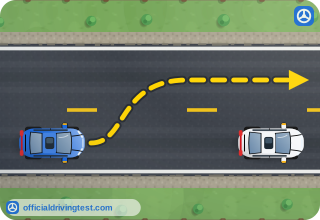
When you move left to pass on a two-lane highway, what does the handbook say to do to alert the driver ahead?
- Sound your horn
- Tap your brake pedal twice
- Turn on your hazard lights
- Wave your arm out the window
Show answer
Correct answer: Sound your horn
Once clear, you move left and sound your horn to alert the driver ahead that you are passing.
Source: West Virginia Driver's Licensing Handbook (Revised July 2026), page 48 · Open this page in the manual (Manual page 48)
-
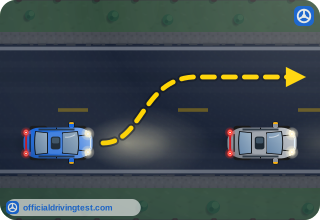
At night, what else can you do to signal that you are about to pass?
- Turn off your headlights
- Turn on your hazard lights
- Blink your headlights
- Sound your horn continuously
Show answer
Correct answer: Blink your headlights
At night you can also blink your headlights to signal that you are about to pass.
Source: West Virginia Driver's Licensing Handbook (Revised July 2026), page 48 · Open this page in the manual (Manual page 48)
-
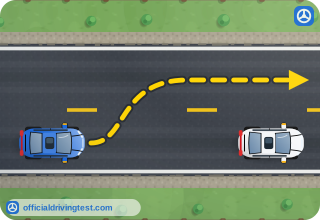
When should you signal and return to the proper lane after passing?
- As soon as your front bumper passes the other vehicle's rear bumper
- When both headlights of the passed vehicle show in your rear view mirror
- When the vehicle you passed signals that you may move over
- As soon as your vehicle is even with the other vehicle's front bumper
Show answer
Correct answer: When both headlights of the passed vehicle show in your rear view mirror
You return to the proper lane when you see the front of the vehicle you passed, both headlights, in your rear view mirror.
Source: West Virginia Driver's Licensing Handbook (Revised July 2026), page 48 · Open this page in the manual (Manual page 48)
-
When is passing on the right permissible?
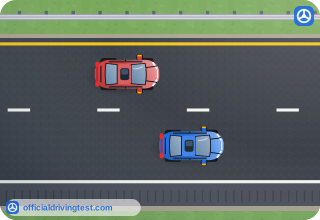
- Whenever the vehicle ahead is traveling slowly
- Whenever the road has a wide right shoulder
- When the driver ahead waves you by
- Only where there is a lane designated for passing
Show answer
Correct answer: Only where there is a lane designated for passing
Passing on the right is not permissible unless there is a lane designated for passing.
Source: West Virginia Driver's Licensing Handbook (Revised July 2026), page 48 · Open this page in the manual (Manual page 48)