West Virginia: Right-of-way, turning and passing — Part 2 Practice Test
Questions in this part include: “When should you cancel your turn signal after a lane change?” · “Where may a driver turn right on red?”
Independent educational site · not affiliated with any government agency or DMV
Ready? Test yourself
Answer to start, or tap Start below:
When should you cancel your turn signal after a lane change?
- Instant feedback with an explanation
- Every answer cites its source in the manual
- Your best score is saved on this device
- Keyboard: press 1 to 4 to answer and Enter for the next question
Questions are original and based on the official manual "West Virginia Driver's Licensing Handbook" (Revised July 2026), West Virginia Division of Motor Vehicles (DMV).
All 17 questions in this practice test
Take the test above first, then use this list to study. Tap “Show answer” to see the correct answer and explanation.
Show the questions and answersHide the questions
-
During the multiple lane portions of the test, which lane changes may you be asked to make?
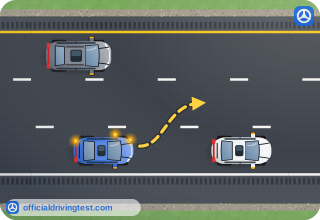
- Only a lane change to the left, never to the right
- Only to the right
- One to the left and one to the right
- Two to the left
Show answer
Correct answer: One to the left and one to the right
You may be asked to make a lane change to the left and a lane change to the right.
Source: West Virginia Driver's Licensing Handbook (Revised July 2026), page 30 · Open this page in the manual (Manual page 30)
-
Before changing lanes, how should you check your blind spots?
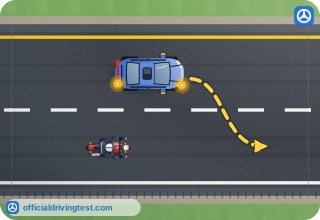
- By looking over your shoulder (head check)
- By looking only in the rear view mirror
- By looking only in your side mirrors
- By asking the examiner whether it is clear
Show answer
Correct answer: By looking over your shoulder (head check)
You check your blind spots by looking over your shoulder, a head check, after checking your mirrors.
Source: West Virginia Driver's Licensing Handbook (Revised July 2026), page 30 · Open this page in the manual (Manual page 30)
-
When should you cancel your turn signal after a lane change?
- Before you begin moving into the new lane
- After driving one full block
- When the examiner tells you to
- Upon completion of the lane change
Show answer
Correct answer: Upon completion of the lane change
You cancel the turn signal upon completion of the lane change and then check traffic.
Source: West Virginia Driver's Licensing Handbook (Revised July 2026), page 30 · Open this page in the manual (Manual page 30)
-
When should you check traffic and mirrors in relation to an intersection, turn, or lane change?
- Only before
- Only before and during
- Only before and after
- Before, during, and after
Show answer
Correct answer: Before, during, and after
You check traffic and mirrors before, during, and after an intersection, turn, or lane change.
Source: West Virginia Driver's Licensing Handbook (Revised July 2026), page 30 · Open this page in the manual (Manual page 30)
-
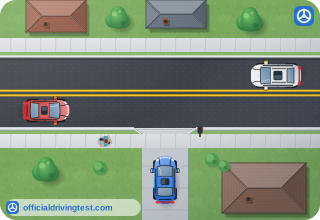
Where should you watch for hazards by searching left and right?
- Only at intersections that have traffic signals or stop signs along the test route and nowhere else
- At intersections, driveways, store entrances, railroad tracks, or any other areas where traffic intersects
- At bridges, tunnels, and other places where the roadway narrows
- Only on residential streets and in school zones on the test route
Show answer
Correct answer: At intersections, driveways, store entrances, railroad tracks, or any other areas where traffic intersects
You search left and right for hazards wherever traffic intersects, such as intersections, driveways, store entrances, and railroad tracks.
Source: West Virginia Driver's Licensing Handbook (Revised July 2026), page 30 · Open this page in the manual (Manual page 30)
-
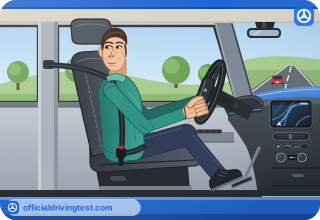
Besides a lane change, when is a head check necessary?
- When braking
- When stopping at a red signal
- When merging
- When driving straight on a quiet road
Show answer
Correct answer: When merging
A head check is made when necessary, such as for a lane change or merging.
Source: West Virginia Driver's Licensing Handbook (Revised July 2026), page 31 · Open this page in the manual (Manual page 31)
-
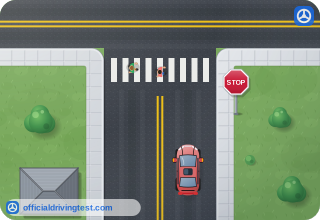
At a stop sign, where must you stop when there is a marked or unmarked crosswalk?
- Just past the crosswalk, whether it is marked or not
- Behind the crosswalk, whether it is marked or not
- On the crosswalk so that you can see cross traffic
- Beside the crosswalk, as close to the curb as you can
Show answer
Correct answer: Behind the crosswalk, whether it is marked or not
At a stop sign you must stop behind any marked or unmarked crosswalk.
Source: West Virginia Driver's Licensing Handbook (Revised July 2026), page 34 · Open this page in the manual (Manual page 34)
-
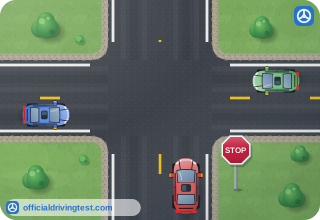
If there are no pavement markings or crosswalks at a stop sign, where must you stop?
- In the middle of the intersection
- At the far side of the intersection
- Next to the sign, wherever the car can fit
- Before entering the intersection
Show answer
Correct answer: Before entering the intersection
Without markings or crosswalks, you must stop before entering the intersection.
Source: West Virginia Driver's Licensing Handbook (Revised July 2026), page 34 · Open this page in the manual (Manual page 34)
-
After you have stopped completely at a stop sign, what must you do before moving again?
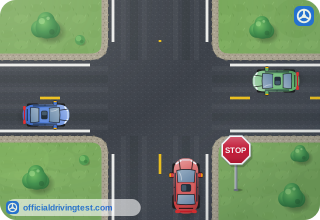
- Give the right-of-way to pedestrians and all cross traffic
- Give the right-of-way only to vehicles on your right
- Honk your horn to warn the cross traffic
- Wait ten seconds, then move ahead if you wish
Show answer
Correct answer: Give the right-of-way to pedestrians and all cross traffic
A stop sign requires you to give the right-of-way to pedestrians and to all cross traffic before you move again.
Source: West Virginia Driver's Licensing Handbook (Revised July 2026), page 34 · Open this page in the manual (Manual page 34)
-
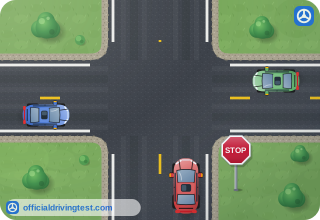
At a stop sign, where should you stop?
- At a place where you are hidden from cross traffic
- At the spot closest to the edge of the traffic lane
- At a place where you can see traffic coming from all directions
- At a place where you can see only the traffic on your left
Show answer
Correct answer: At a place where you can see traffic coming from all directions
The handbook says to stop at a place where you can see traffic coming from all directions.
Source: West Virginia Driver's Licensing Handbook (Revised July 2026), page 34 · Open this page in the manual (Manual page 34)
-
What must you never use a turning lane to do?
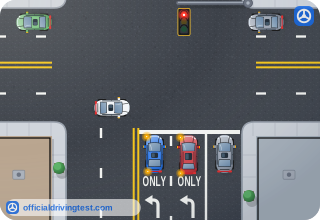
- Turn left onto a cross street
- Wait for traffic to clear
- Slow down before a turn
- Overtake and pass other vehicles
Show answer
Correct answer: Overtake and pass other vehicles
The handbook says never use a turning lane to overtake and pass other vehicles.
Source: West Virginia Driver's Licensing Handbook (Revised July 2026), page 35 · Open this page in the manual (Manual page 35)
-
A driver facing a circular green indication wants to turn left. What must the driver do?
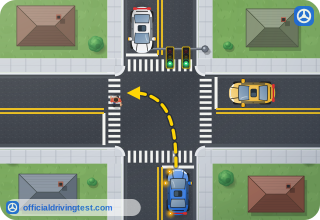
- Stop and wait for a green arrow
- Yield to oncoming vehicles
- Turn ahead of oncoming vehicles
- Turn only after the light turns yellow
Show answer
Correct answer: Yield to oncoming vehicles
A driver turning left on a circular green must yield to oncoming vehicles.
Source: West Virginia Driver's Licensing Handbook (Revised July 2026), page 39 · Open this page in the manual (Manual page 39)
-
Where may a driver turn right on red?
- Only at intersections of one-way streets
- At the intersection of two-way streets
- Only at intersections with a green arrow
- Only at intersections with a stop line
Show answer
Correct answer: At the intersection of two-way streets
A driver may turn right on red at the intersection of two-way streets.
Source: West Virginia Driver's Licensing Handbook (Revised July 2026), page 39 · Open this page in the manual (Manual page 39)
-
What must a driver do before making a permitted turn on red?
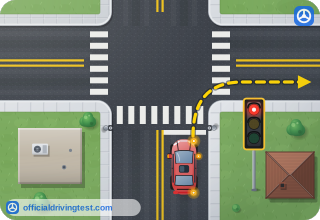
- Wait for the cross traffic to clear the street
- Wait until the signal has been red for a full cycle
- Signal and move ahead of the other traffic
- Yield to all other traffic and pedestrians
Show answer
Correct answer: Yield to all other traffic and pedestrians
Turns on red may be made only after yielding to all other traffic and pedestrians, and if no sign prohibits them.
Source: West Virginia Driver's Licensing Handbook (Revised July 2026), page 39 · Open this page in the manual (Manual page 39)
-
When should you decide to make a turn?
- Just as you reach the intersection
- Ahead of time, not at the last moment
- When the vehicle ahead of you begins to turn
- As soon as the traffic signal changes
Show answer
Correct answer: Ahead of time, not at the last moment
You should prepare for a turn and not decide to turn at the last moment.
Source: West Virginia Driver's Licensing Handbook (Revised July 2026), page 44 · Open this page in the manual (Manual page 44)
-
Before entering the turning lane, what does the handbook say you should do?
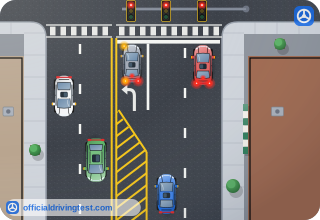
- Sound your horn, brake firmly, and check only your rear view mirror
- Slow to a stop, turn your wheels, and check only the side mirror
- Move to the center of the road, slow down, and check only ahead
- Signal, check your mirrors, and glance over the proper shoulder
Show answer
Correct answer: Signal, check your mirrors, and glance over the proper shoulder
Before entering the turning lane you signal, look in the mirrors, and check the blind spot over the proper shoulder.
Source: West Virginia Driver's Licensing Handbook (Revised July 2026), page 44 · Open this page in the manual (Manual page 44)
-
What should you do about your speed when making a turn?
- Slow down before the turn and do not brake while turning
- Brake steadily during the turn to keep your speed low
- Speed up once you start the turn to clear the intersection
- Hold your speed until the middle of the turn, then brake
Show answer
Correct answer: Slow down before the turn and do not brake while turning
Slow down before making a turn, and do not brake while turning.
Source: West Virginia Driver's Licensing Handbook (Revised July 2026), page 44 · Open this page in the manual (Manual page 44)