West Virginia: Right-of-way, turning and passing — Part 1 Practice Test
Questions in this part include: “In the handbook’s definitions, what is right-of-way?” · “What should you keep checking in your mirror during a turn?”
Independent educational site · not affiliated with any government agency or DMV
Ready? Test yourself
Answer to start, or tap Start below:
In the handbook’s definitions, what is right-of-way?
- Instant feedback with an explanation
- Every answer cites its source in the manual
- Your best score is saved on this device
- Keyboard: press 1 to 4 to answer and Enter for the next question
Questions are original and based on the official manual "West Virginia Driver's Licensing Handbook" (Revised July 2026), West Virginia Division of Motor Vehicles (DMV).
All 18 questions in this practice test
Take the test above first, then use this list to study. Tap “Show answer” to see the correct answer and explanation.
Show the questions and answersHide the questions
-
In the handbook’s definitions, what is an intersection?
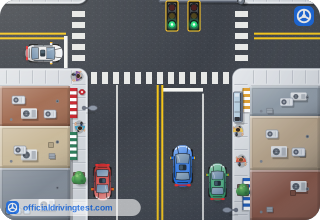
- The area common to two or more highways that meet at or near right angles
- The area where a driveway, alley, or parking lot meets a highway or street
- Only the area where one highway crosses another exactly at right angles
- Only the area where two roadways meet at a traffic signal or stop sign
Show answer
Correct answer: The area common to two or more highways that meet at or near right angles
An intersection is the area common to two or more highways that meet at or near right angles, whether or not one crosses the other.
Source: West Virginia Driver's Licensing Handbook (Revised July 2026)
-
In the handbook’s definitions, what is merging traffic?
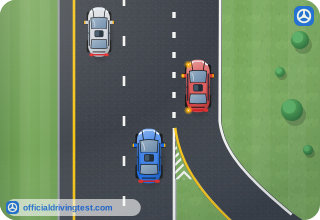
- Vehicles entering moving lanes of traffic from adjacent lanes on the left or right
- Vehicles entering moving lanes of traffic only from a ramp on the right
- Vehicles leaving the highway by an exit ramp
- Vehicles stopped on the shoulder waiting to re-enter traffic
Show answer
Correct answer: Vehicles entering moving lanes of traffic from adjacent lanes on the left or right
Merging traffic means vehicles entering moving lanes of traffic from adjacent lanes on the left or right.
Source: West Virginia Driver's Licensing Handbook (Revised July 2026)
-
In the handbook’s definitions, what is right-of-way?
- The legal duty to stop at every intersection
- The right to use any lane of the highway at any time
- The right to drive at the posted speed limit in all conditions
- The privilege of the immediate use of the highway
Show answer
Correct answer: The privilege of the immediate use of the highway
Right-of-way is the privilege of the immediate use of the highway.
Source: West Virginia Driver's Licensing Handbook (Revised July 2026)
-
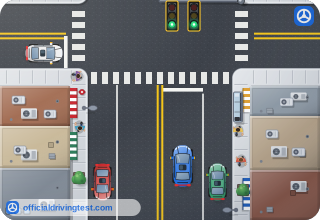
As you approach a turn during the road test, what should you check?
- Only the traffic ahead of you
- Traffic in all directions
- Only oncoming traffic
- Only the traffic behind you
Show answer
Correct answer: Traffic in all directions
As you approach a turn you should check traffic in all directions.
Source: West Virginia Driver's Licensing Handbook (Revised July 2026), page 29 · Open this page in the manual (Manual page 29)
-
How should you brake as you approach a turn during the road test?
- Quickly and firmly
- Lightly and repeatedly
- Only after you have entered the turn
- Smoothly and evenly
Show answer
Correct answer: Smoothly and evenly
You should brake smoothly and evenly as you approach a turn.
Source: West Virginia Driver's Licensing Handbook (Revised July 2026), page 29 · Open this page in the manual (Manual page 29)
-
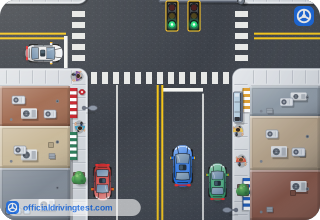
If you must stop before making a turn because of traffic, signals, or signs, where should you stop?
- Over the stop line so you can see cross traffic
- At the far edge of the intersection, past the crosswalk
- Behind the stop line, crosswalk, or stop sign
- Wherever the vehicle ahead of you stops
Show answer
Correct answer: Behind the stop line, crosswalk, or stop sign
You should come to a smooth, complete stop without skidding behind the stop line, crosswalk, or stop sign.
Source: West Virginia Driver's Licensing Handbook (Revised July 2026), page 29 · Open this page in the manual (Manual page 29)
-
If you stop before a turn, where should you keep the front wheels aimed?
- Toward the direction of the turn
- Toward the curb
- Toward the center line
- Straight ahead
Show answer
Correct answer: Straight ahead
While stopped before a turn, the front wheels stay aimed straight ahead.
Source: West Virginia Driver's Licensing Handbook (Revised July 2026), page 29 · Open this page in the manual (Manual page 29)
-
What should you do with your hands while making a turn during the road test?
- Keep one hand on the steering wheel and the other on the shift lever
- Keep both hands on the steering wheel
- Keep one hand on the wheel and use the other to signal throughout the turn
- Hold the wheel with your left hand only
Show answer
Correct answer: Keep both hands on the steering wheel
You keep both hands on the steering wheel during the turn.
Source: West Virginia Driver's Licensing Handbook (Revised July 2026), page 29 · Open this page in the manual (Manual page 29)
-
How should you accelerate during a turn?
- Smoothly and evenly
- Sharply, to clear the intersection quickly
- Not at all, until the turn is complete
- In short bursts, to stay in the lane
Show answer
Correct answer: Smoothly and evenly
You should maintain smooth, even acceleration through the turn.
Source: West Virginia Driver's Licensing Handbook (Revised July 2026), page 29 · Open this page in the manual (Manual page 29)
-
When making a turn, to whom should you always yield?
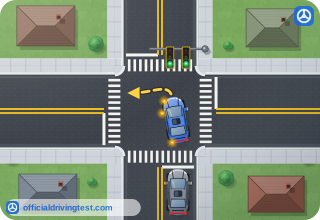
- Only pedestrians in a marked crosswalk
- Only oncoming vehicles
- Pedestrians and other traffic
- No one, if you have a green signal
Show answer
Correct answer: Pedestrians and other traffic
You must always yield to pedestrians and other traffic when turning.
Source: West Virginia Driver's Licensing Handbook (Revised July 2026), page 29 · Open this page in the manual (Manual page 29)
-
What should you keep checking in your mirror during a turn?
- That the vehicle behind you has its headlights turned on
- That the vehicle does not hit anything on the inside of the turn
- That the vehicle behind you is signaling to turn
- That your tires are straight in the lane
Show answer
Correct answer: That the vehicle does not hit anything on the inside of the turn
You keep checking your mirror to make sure the vehicle does not hit anything on the inside of the turn.
Source: West Virginia Driver's Licensing Handbook (Revised July 2026), page 29 · Open this page in the manual (Manual page 29)
-
Which of these should you NOT do while turning?
- Maintain smooth, even acceleration
- Keep the vehicle in the proper lane for the turn
- Keep checking your mirror
- Move into oncoming traffic or drive over the curb
Show answer
Correct answer: Move into oncoming traffic or drive over the curb
You must not move into oncoming traffic or drive over the curb during a turn.
Source: West Virginia Driver's Licensing Handbook (Revised July 2026), page 29 · Open this page in the manual (Manual page 29)
-
After completing a turn, what should you make sure of?
- That you finish in whichever lane is open and your turn signal is still on
- That you stop for a moment at the end of the turn and then cancel your signal
- That you finish in the correct lane and your turn signal has cancelled
- That you finish in the lane nearest the center line and your signal is on
Show answer
Correct answer: That you finish in the correct lane and your turn signal has cancelled
After a turn you should finish in the correct lane and be sure your turn signal has cancelled.
Source: West Virginia Driver's Licensing Handbook (Revised July 2026), page 29 · Open this page in the manual (Manual page 29)
-
After a turn, which lane should you move into when it is safe to do so (if not already there)?
- The right-most lane
- The left-most lane
- The center lane
- The lane with the fastest traffic
Show answer
Correct answer: The right-most lane
After the turn, you should move into the right-most lane when it is safe to do so.
Source: West Virginia Driver's Licensing Handbook (Revised July 2026), page 29 · Open this page in the manual (Manual page 29)
-
What should you do with your lane position as you approach an intersection?
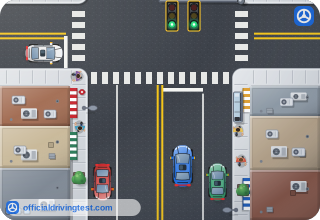
- Move toward the center line
- Change to the fastest lane
- Move toward the curb to look for cross traffic
- Maintain it
Show answer
Correct answer: Maintain it
As you approach an intersection you brake smoothly and evenly and maintain lane position.
Source: West Virginia Driver's Licensing Handbook (Revised July 2026), page 29 · Open this page in the manual (Manual page 29)
-
When driving through an intersection, what should you do about any pedestrians or traffic in the intersection?
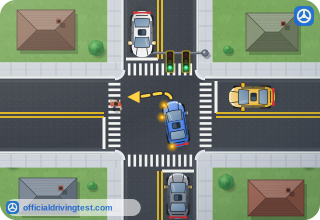
- Maintain your speed and sound your horn
- Slow down and yield to them
- Speed up to clear the intersection
- Stop and wait for the examiner’s direction
Show answer
Correct answer: Slow down and yield to them
Through an intersection you slow down and yield to any pedestrians or traffic in it.
Source: West Virginia Driver's Licensing Handbook (Revised July 2026), page 29 · Open this page in the manual (Manual page 29)
-
Which of these should you NOT do while proceeding through an intersection?
- Change lanes
- Slow down
- Yield to pedestrians in the intersection
- Check traffic in all directions
Show answer
Correct answer: Change lanes
You must not change lanes while proceeding through an intersection.
Source: West Virginia Driver's Licensing Handbook (Revised July 2026), page 29 · Open this page in the manual (Manual page 29)
-
Once through an intersection, what should you continue checking?
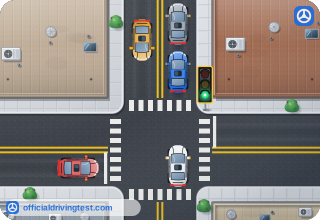
- Only the signal you just passed
- Only the traffic ahead of you
- Your mirrors and the traffic behind you
- Only the cross traffic on your left
Show answer
Correct answer: Your mirrors and the traffic behind you
After the intersection you continue checking mirrors and traffic behind you.
Source: West Virginia Driver's Licensing Handbook (Revised July 2026), page 29 · Open this page in the manual (Manual page 29)