West Virginia: Right-of-way, turning and passing
Who yields at intersections, turns and U-turns, changing lanes, and where passing is prohibited. Split into 4 shorter tests so you're not stuck in one long quiz.
Independent educational site · not affiliated with any government agency or DMV
Choose a part
Right-of-way, turning and passing — Part 1
Questions in this part include: “In the handbook’s definitions, what is right-of-way?”
Right-of-way, turning and passing — Part 2
Questions in this part include: “When should you cancel your turn signal after a lane change?”
Right-of-way, turning and passing — Part 3
Questions in this part include: “Why should you not turn your wheels to the left while waiting to turn left?”
Right-of-way, turning and passing — Part 4
Questions in this part include: “Which of these must be true before you pass?”
Questions are original and based on the official manual "West Virginia Driver's Licensing Handbook" (Revised July 2026), West Virginia Division of Motor Vehicles (DMV).
All 69 Right-of-way, turning and passing questions with answers
Choose a part above to take a practice test, or study every question and answer here.
Show the questions and answersHide the questions
1Part 118 questions
-
In the handbook’s definitions, what is an intersection?
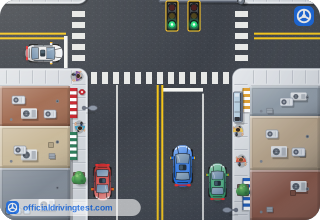
- The area common to two or more highways that meet at or near right angles
- The area where a driveway, alley, or parking lot meets a highway or street
- Only the area where one highway crosses another exactly at right angles
- Only the area where two roadways meet at a traffic signal or stop sign
Show answer
Correct answer: The area common to two or more highways that meet at or near right angles
An intersection is the area common to two or more highways that meet at or near right angles, whether or not one crosses the other.
Source: West Virginia Driver's Licensing Handbook (Revised July 2026)
-
In the handbook’s definitions, what is merging traffic?
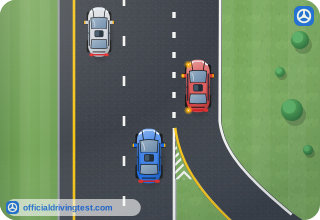
- Vehicles entering moving lanes of traffic from adjacent lanes on the left or right
- Vehicles entering moving lanes of traffic only from a ramp on the right
- Vehicles leaving the highway by an exit ramp
- Vehicles stopped on the shoulder waiting to re-enter traffic
Show answer
Correct answer: Vehicles entering moving lanes of traffic from adjacent lanes on the left or right
Merging traffic means vehicles entering moving lanes of traffic from adjacent lanes on the left or right.
Source: West Virginia Driver's Licensing Handbook (Revised July 2026)
-
In the handbook’s definitions, what is right-of-way?
- The legal duty to stop at every intersection
- The right to use any lane of the highway at any time
- The right to drive at the posted speed limit in all conditions
- The privilege of the immediate use of the highway
Show answer
Correct answer: The privilege of the immediate use of the highway
Right-of-way is the privilege of the immediate use of the highway.
Source: West Virginia Driver's Licensing Handbook (Revised July 2026)
-
As you approach a turn during the road test, what should you check?
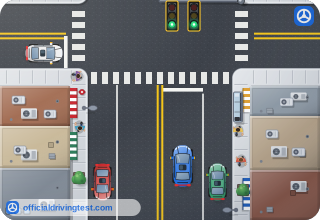
- Only the traffic ahead of you
- Traffic in all directions
- Only oncoming traffic
- Only the traffic behind you
Show answer
Correct answer: Traffic in all directions
As you approach a turn you should check traffic in all directions.
Source: West Virginia Driver's Licensing Handbook (Revised July 2026), page 29 · Open this page in the manual (Manual page 29)
-
How should you brake as you approach a turn during the road test?
- Quickly and firmly
- Lightly and repeatedly
- Only after you have entered the turn
- Smoothly and evenly
Show answer
Correct answer: Smoothly and evenly
You should brake smoothly and evenly as you approach a turn.
Source: West Virginia Driver's Licensing Handbook (Revised July 2026), page 29 · Open this page in the manual (Manual page 29)
-
If you must stop before making a turn because of traffic, signals, or signs, where should you stop?
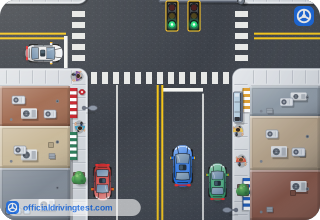
- Over the stop line so you can see cross traffic
- At the far edge of the intersection, past the crosswalk
- Behind the stop line, crosswalk, or stop sign
- Wherever the vehicle ahead of you stops
Show answer
Correct answer: Behind the stop line, crosswalk, or stop sign
You should come to a smooth, complete stop without skidding behind the stop line, crosswalk, or stop sign.
Source: West Virginia Driver's Licensing Handbook (Revised July 2026), page 29 · Open this page in the manual (Manual page 29)
-
If you stop before a turn, where should you keep the front wheels aimed?
- Toward the direction of the turn
- Toward the curb
- Toward the center line
- Straight ahead
Show answer
Correct answer: Straight ahead
While stopped before a turn, the front wheels stay aimed straight ahead.
Source: West Virginia Driver's Licensing Handbook (Revised July 2026), page 29 · Open this page in the manual (Manual page 29)
-
What should you do with your hands while making a turn during the road test?
- Keep one hand on the steering wheel and the other on the shift lever
- Keep both hands on the steering wheel
- Keep one hand on the wheel and use the other to signal throughout the turn
- Hold the wheel with your left hand only
Show answer
Correct answer: Keep both hands on the steering wheel
You keep both hands on the steering wheel during the turn.
Source: West Virginia Driver's Licensing Handbook (Revised July 2026), page 29 · Open this page in the manual (Manual page 29)
-
How should you accelerate during a turn?
- Smoothly and evenly
- Sharply, to clear the intersection quickly
- Not at all, until the turn is complete
- In short bursts, to stay in the lane
Show answer
Correct answer: Smoothly and evenly
You should maintain smooth, even acceleration through the turn.
Source: West Virginia Driver's Licensing Handbook (Revised July 2026), page 29 · Open this page in the manual (Manual page 29)
-
When making a turn, to whom should you always yield?
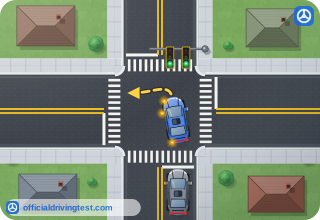
- Only pedestrians in a marked crosswalk
- Only oncoming vehicles
- Pedestrians and other traffic
- No one, if you have a green signal
Show answer
Correct answer: Pedestrians and other traffic
You must always yield to pedestrians and other traffic when turning.
Source: West Virginia Driver's Licensing Handbook (Revised July 2026), page 29 · Open this page in the manual (Manual page 29)
-
What should you keep checking in your mirror during a turn?
- That the vehicle behind you has its headlights turned on
- That the vehicle does not hit anything on the inside of the turn
- That the vehicle behind you is signaling to turn
- That your tires are straight in the lane
Show answer
Correct answer: That the vehicle does not hit anything on the inside of the turn
You keep checking your mirror to make sure the vehicle does not hit anything on the inside of the turn.
Source: West Virginia Driver's Licensing Handbook (Revised July 2026), page 29 · Open this page in the manual (Manual page 29)
-
Which of these should you NOT do while turning?
- Maintain smooth, even acceleration
- Keep the vehicle in the proper lane for the turn
- Keep checking your mirror
- Move into oncoming traffic or drive over the curb
Show answer
Correct answer: Move into oncoming traffic or drive over the curb
You must not move into oncoming traffic or drive over the curb during a turn.
Source: West Virginia Driver's Licensing Handbook (Revised July 2026), page 29 · Open this page in the manual (Manual page 29)
-
After completing a turn, what should you make sure of?
- That you finish in whichever lane is open and your turn signal is still on
- That you stop for a moment at the end of the turn and then cancel your signal
- That you finish in the correct lane and your turn signal has cancelled
- That you finish in the lane nearest the center line and your signal is on
Show answer
Correct answer: That you finish in the correct lane and your turn signal has cancelled
After a turn you should finish in the correct lane and be sure your turn signal has cancelled.
Source: West Virginia Driver's Licensing Handbook (Revised July 2026), page 29 · Open this page in the manual (Manual page 29)
-
After a turn, which lane should you move into when it is safe to do so (if not already there)?
- The right-most lane
- The left-most lane
- The center lane
- The lane with the fastest traffic
Show answer
Correct answer: The right-most lane
After the turn, you should move into the right-most lane when it is safe to do so.
Source: West Virginia Driver's Licensing Handbook (Revised July 2026), page 29 · Open this page in the manual (Manual page 29)
-
What should you do with your lane position as you approach an intersection?
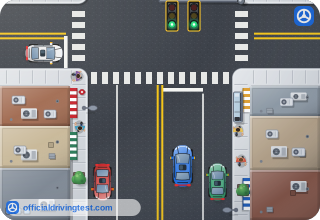
- Move toward the center line
- Change to the fastest lane
- Move toward the curb to look for cross traffic
- Maintain it
Show answer
Correct answer: Maintain it
As you approach an intersection you brake smoothly and evenly and maintain lane position.
Source: West Virginia Driver's Licensing Handbook (Revised July 2026), page 29 · Open this page in the manual (Manual page 29)
-
When driving through an intersection, what should you do about any pedestrians or traffic in the intersection?
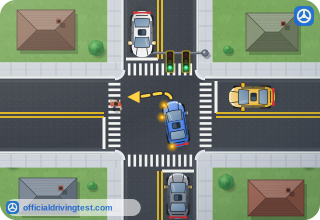
- Maintain your speed and sound your horn
- Slow down and yield to them
- Speed up to clear the intersection
- Stop and wait for the examiner’s direction
Show answer
Correct answer: Slow down and yield to them
Through an intersection you slow down and yield to any pedestrians or traffic in it.
Source: West Virginia Driver's Licensing Handbook (Revised July 2026), page 29 · Open this page in the manual (Manual page 29)
-
Which of these should you NOT do while proceeding through an intersection?
- Change lanes
- Slow down
- Yield to pedestrians in the intersection
- Check traffic in all directions
Show answer
Correct answer: Change lanes
You must not change lanes while proceeding through an intersection.
Source: West Virginia Driver's Licensing Handbook (Revised July 2026), page 29 · Open this page in the manual (Manual page 29)
-
Once through an intersection, what should you continue checking?
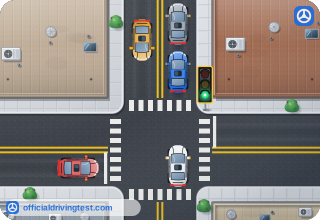
- Only the signal you just passed
- Only the traffic ahead of you
- Your mirrors and the traffic behind you
- Only the cross traffic on your left
Show answer
Correct answer: Your mirrors and the traffic behind you
After the intersection you continue checking mirrors and traffic behind you.
Source: West Virginia Driver's Licensing Handbook (Revised July 2026), page 29 · Open this page in the manual (Manual page 29)
2Part 217 questions
-
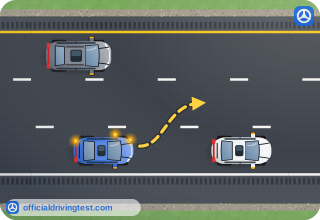
During the multiple lane portions of the test, which lane changes may you be asked to make?
- Only a lane change to the left, never to the right
- Only to the right
- One to the left and one to the right
- Two to the left
Show answer
Correct answer: One to the left and one to the right
You may be asked to make a lane change to the left and a lane change to the right.
Source: West Virginia Driver's Licensing Handbook (Revised July 2026), page 30 · Open this page in the manual (Manual page 30)
-
Before changing lanes, how should you check your blind spots?
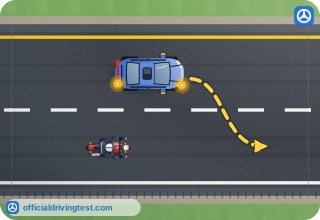
- By looking over your shoulder (head check)
- By looking only in the rear view mirror
- By looking only in your side mirrors
- By asking the examiner whether it is clear
Show answer
Correct answer: By looking over your shoulder (head check)
You check your blind spots by looking over your shoulder, a head check, after checking your mirrors.
Source: West Virginia Driver's Licensing Handbook (Revised July 2026), page 30 · Open this page in the manual (Manual page 30)
-
When should you cancel your turn signal after a lane change?
- Before you begin moving into the new lane
- After driving one full block
- When the examiner tells you to
- Upon completion of the lane change
Show answer
Correct answer: Upon completion of the lane change
You cancel the turn signal upon completion of the lane change and then check traffic.
Source: West Virginia Driver's Licensing Handbook (Revised July 2026), page 30 · Open this page in the manual (Manual page 30)
-
When should you check traffic and mirrors in relation to an intersection, turn, or lane change?
- Only before
- Only before and during
- Only before and after
- Before, during, and after
Show answer
Correct answer: Before, during, and after
You check traffic and mirrors before, during, and after an intersection, turn, or lane change.
Source: West Virginia Driver's Licensing Handbook (Revised July 2026), page 30 · Open this page in the manual (Manual page 30)
-
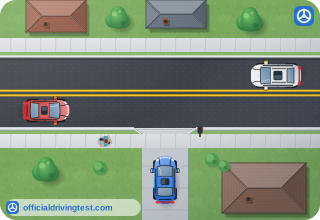
Where should you watch for hazards by searching left and right?
- Only at intersections that have traffic signals or stop signs along the test route and nowhere else
- At intersections, driveways, store entrances, railroad tracks, or any other areas where traffic intersects
- At bridges, tunnels, and other places where the roadway narrows
- Only on residential streets and in school zones on the test route
Show answer
Correct answer: At intersections, driveways, store entrances, railroad tracks, or any other areas where traffic intersects
You search left and right for hazards wherever traffic intersects, such as intersections, driveways, store entrances, and railroad tracks.
Source: West Virginia Driver's Licensing Handbook (Revised July 2026), page 30 · Open this page in the manual (Manual page 30)
-
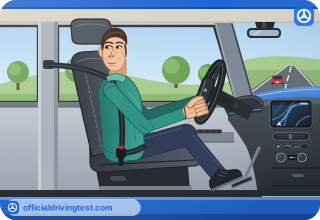
Besides a lane change, when is a head check necessary?
- When braking
- When stopping at a red signal
- When merging
- When driving straight on a quiet road
Show answer
Correct answer: When merging
A head check is made when necessary, such as for a lane change or merging.
Source: West Virginia Driver's Licensing Handbook (Revised July 2026), page 31 · Open this page in the manual (Manual page 31)
-
At a stop sign, where must you stop when there is a marked or unmarked crosswalk?
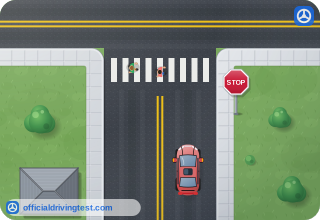
- Just past the crosswalk, whether it is marked or not
- Behind the crosswalk, whether it is marked or not
- On the crosswalk so that you can see cross traffic
- Beside the crosswalk, as close to the curb as you can
Show answer
Correct answer: Behind the crosswalk, whether it is marked or not
At a stop sign you must stop behind any marked or unmarked crosswalk.
Source: West Virginia Driver's Licensing Handbook (Revised July 2026), page 34 · Open this page in the manual (Manual page 34)
-
If there are no pavement markings or crosswalks at a stop sign, where must you stop?
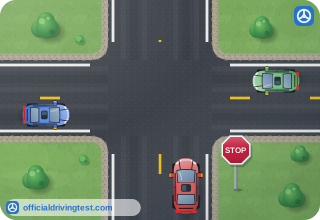
- In the middle of the intersection
- At the far side of the intersection
- Next to the sign, wherever the car can fit
- Before entering the intersection
Show answer
Correct answer: Before entering the intersection
Without markings or crosswalks, you must stop before entering the intersection.
Source: West Virginia Driver's Licensing Handbook (Revised July 2026), page 34 · Open this page in the manual (Manual page 34)
-
After you have stopped completely at a stop sign, what must you do before moving again?
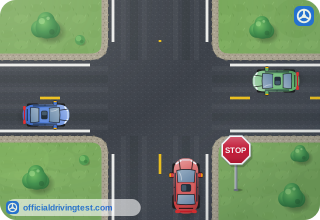
- Give the right-of-way to pedestrians and all cross traffic
- Give the right-of-way only to vehicles on your right
- Honk your horn to warn the cross traffic
- Wait ten seconds, then move ahead if you wish
Show answer
Correct answer: Give the right-of-way to pedestrians and all cross traffic
A stop sign requires you to give the right-of-way to pedestrians and to all cross traffic before you move again.
Source: West Virginia Driver's Licensing Handbook (Revised July 2026), page 34 · Open this page in the manual (Manual page 34)
-
At a stop sign, where should you stop?
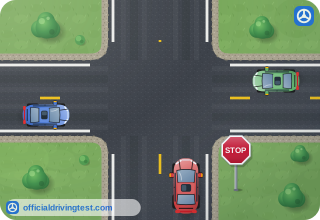
- At a place where you are hidden from cross traffic
- At the spot closest to the edge of the traffic lane
- At a place where you can see traffic coming from all directions
- At a place where you can see only the traffic on your left
Show answer
Correct answer: At a place where you can see traffic coming from all directions
The handbook says to stop at a place where you can see traffic coming from all directions.
Source: West Virginia Driver's Licensing Handbook (Revised July 2026), page 34 · Open this page in the manual (Manual page 34)
-
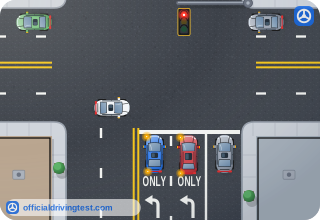
What must you never use a turning lane to do?
- Turn left onto a cross street
- Wait for traffic to clear
- Slow down before a turn
- Overtake and pass other vehicles
Show answer
Correct answer: Overtake and pass other vehicles
The handbook says never use a turning lane to overtake and pass other vehicles.
Source: West Virginia Driver's Licensing Handbook (Revised July 2026), page 35 · Open this page in the manual (Manual page 35)
-
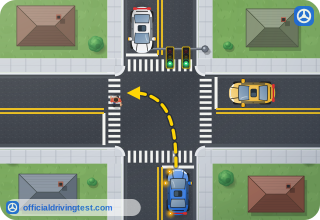
A driver facing a circular green indication wants to turn left. What must the driver do?
- Stop and wait for a green arrow
- Yield to oncoming vehicles
- Turn ahead of oncoming vehicles
- Turn only after the light turns yellow
Show answer
Correct answer: Yield to oncoming vehicles
A driver turning left on a circular green must yield to oncoming vehicles.
Source: West Virginia Driver's Licensing Handbook (Revised July 2026), page 39 · Open this page in the manual (Manual page 39)
-
Where may a driver turn right on red?
- Only at intersections of one-way streets
- At the intersection of two-way streets
- Only at intersections with a green arrow
- Only at intersections with a stop line
Show answer
Correct answer: At the intersection of two-way streets
A driver may turn right on red at the intersection of two-way streets.
Source: West Virginia Driver's Licensing Handbook (Revised July 2026), page 39 · Open this page in the manual (Manual page 39)
-
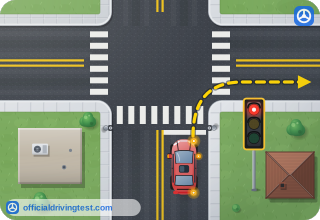
What must a driver do before making a permitted turn on red?
- Wait for the cross traffic to clear the street
- Wait until the signal has been red for a full cycle
- Signal and move ahead of the other traffic
- Yield to all other traffic and pedestrians
Show answer
Correct answer: Yield to all other traffic and pedestrians
Turns on red may be made only after yielding to all other traffic and pedestrians, and if no sign prohibits them.
Source: West Virginia Driver's Licensing Handbook (Revised July 2026), page 39 · Open this page in the manual (Manual page 39)
-
When should you decide to make a turn?
- Just as you reach the intersection
- Ahead of time, not at the last moment
- When the vehicle ahead of you begins to turn
- As soon as the traffic signal changes
Show answer
Correct answer: Ahead of time, not at the last moment
You should prepare for a turn and not decide to turn at the last moment.
Source: West Virginia Driver's Licensing Handbook (Revised July 2026), page 44 · Open this page in the manual (Manual page 44)
-
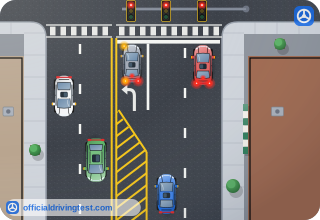
Before entering the turning lane, what does the handbook say you should do?
- Sound your horn, brake firmly, and check only your rear view mirror
- Slow to a stop, turn your wheels, and check only the side mirror
- Move to the center of the road, slow down, and check only ahead
- Signal, check your mirrors, and glance over the proper shoulder
Show answer
Correct answer: Signal, check your mirrors, and glance over the proper shoulder
Before entering the turning lane you signal, look in the mirrors, and check the blind spot over the proper shoulder.
Source: West Virginia Driver's Licensing Handbook (Revised July 2026), page 44 · Open this page in the manual (Manual page 44)
-
What should you do about your speed when making a turn?
- Slow down before the turn and do not brake while turning
- Brake steadily during the turn to keep your speed low
- Speed up once you start the turn to clear the intersection
- Hold your speed until the middle of the turn, then brake
Show answer
Correct answer: Slow down before the turn and do not brake while turning
Slow down before making a turn, and do not brake while turning.
Source: West Virginia Driver's Licensing Handbook (Revised July 2026), page 44 · Open this page in the manual (Manual page 44)
3Part 317 questions
-
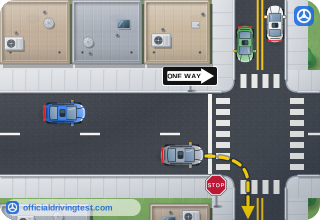
Where should you always finish a turn?
- In whichever lane has the least traffic
- In the lane you can reach with the least steering
- In the proper lane
- In the first lane that is open when you finish
Show answer
Correct answer: In the proper lane
The handbook says to always finish turning in the proper lane.
Source: West Virginia Driver's Licensing Handbook (Revised July 2026), page 44 · Open this page in the manual (Manual page 44)
-
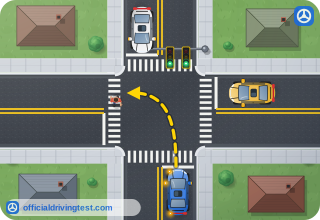
When turning left, what should you do if oncoming traffic is about to reach the intersection at about the same time as you?
- Turn first, since you have already signaled
- Stop until it is safe for you to turn
- Speed up to finish the turn ahead of it
- Flash your headlights and turn quickly
Show answer
Correct answer: Stop until it is safe for you to turn
If traffic in the opposite lane will reach the intersection at about the same time, stop until it is safe to turn.
Source: West Virginia Driver's Licensing Handbook (Revised July 2026), page 44 · Open this page in the manual (Manual page 44)
-
Why should you not turn your wheels to the left while waiting to turn left?
- The vehicle could roll backward into the vehicle behind you
- It would tell other drivers you plan to go straight ahead
- The steering system can be damaged while the vehicle is stopped
- A bump from behind could push your vehicle into oncoming traffic
Show answer
Correct answer: A bump from behind could push your vehicle into oncoming traffic
With the wheels turned left, a bump from behind could push your vehicle into oncoming traffic.
Source: West Virginia Driver's Licensing Handbook (Revised July 2026), page 44 · Open this page in the manual (Manual page 44)
-
At an intersection with no sign prohibiting a turn on red, what may traffic facing a red signal do before turning right?
- Come to a complete stop, yield to pedestrians and traffic, then turn
- Slow to a rolling stop and turn if no cross traffic is visible
- Wait for the signal to turn green before turning right
- Yield only to pedestrians, since cross traffic must yield to you
Show answer
Correct answer: Come to a complete stop, yield to pedestrians and traffic, then turn
Traffic facing a red signal may turn right only after a complete stop and after yielding to pedestrians and traffic.
Source: West Virginia Driver's Licensing Handbook (Revised July 2026), page 44 · Open this page in the manual (Manual page 44)
-
If no sign prohibits a turn on red, traffic facing a red signal may make a left turn in which situation?
- From a two-way street onto a one-way street
- From a one-way street onto a two-way street
- From a one-way street onto a one-way street
- From a two-way street onto a two-way street
Show answer
Correct answer: From a one-way street onto a one-way street
The turn-on-red rule also applies to left turns from a one-way street to a one-way street.
Source: West Virginia Driver's Licensing Handbook (Revised July 2026), page 44 · Open this page in the manual (Manual page 44)
-
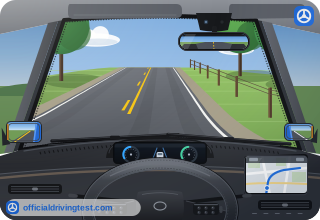
It is against the law to turn your vehicle around near the crest of a hill where you cannot be seen by another vehicle approaching within how many feet in either direction?
- 100 feet
- 500 feet
- 200 feet
- 300 feet
Show answer
Correct answer: 500 feet
Turning around is unlawful near a hill crest where you cannot be seen by a vehicle approaching within 500 feet in either direction.
Source: West Virginia Driver's Licensing Handbook (Revised July 2026), page 45 · Open this page in the manual (Manual page 45)
-
It is not advisable to back up while in a traffic lane, except for what purpose?
- Backing up to turn around on a narrow road
- Backing up to reach a turn you have missed
- Backing into a parallel parking space
- Backing away from a vehicle that is too close in front
Show answer
Correct answer: Backing into a parallel parking space
Backing in a traffic lane is not advisable except to back into a parallel parking space.
Source: West Virginia Driver's Licensing Handbook (Revised July 2026), page 45 · Open this page in the manual (Manual page 45)
-
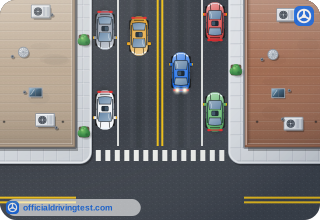
Where does the handbook say you should never back?
- Into a parallel parking space
- Across other traffic lanes or through an intersection
- Slowly into the proper traffic lane
- Into a space after checking around your vehicle
Show answer
Correct answer: Across other traffic lanes or through an intersection
The handbook says never to back across other traffic lanes or through an intersection.
Source: West Virginia Driver's Licensing Handbook (Revised July 2026), page 45 · Open this page in the manual (Manual page 45)
-
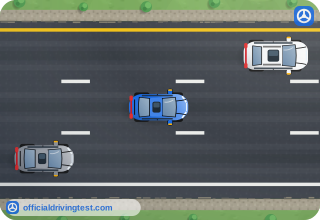
Before changing lanes, why do you make a head check by looking over your left or right shoulder?
- To confirm that your turn signal is flashing
- To make sure no one is in your blind spot
- To check the speed of the vehicle behind you
- To see whether the next lane is wider
Show answer
Correct answer: To make sure no one is in your blind spot
A head check over the shoulder makes sure no one is in your blind spot.
Source: West Virginia Driver's Licensing Handbook (Revised July 2026), page 48 · Open this page in the manual (Manual page 48)
-
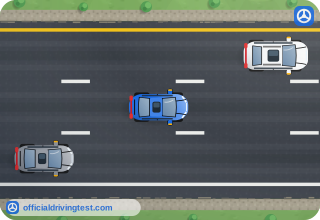
Besides checking your mirrors and your blind spot, what should you check for before changing lanes?
- Whether a police vehicle is behind the next vehicle
- Whether the next lane has a lower speed limit
- Pedestrians waiting to cross in the next lane
- Other drivers who may also be moving into the same lane
Show answer
Correct answer: Other drivers who may also be moving into the same lane
The handbook says to check for other drivers who may also be moving into the same lane.
Source: West Virginia Driver's Licensing Handbook (Revised July 2026), page 48 · Open this page in the manual (Manual page 48)
-
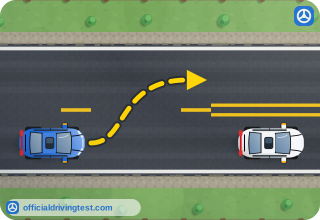
Before you pass on a two-lane highway, what must you make sure of?
- That the driver ahead has signaled that it is safe to pass
- That you are in the left lane and traveling above the posted limit
- That you are in a passing zone and observing the three-to-four second rule
- That the vehicle ahead is slower than the posted speed limit
Show answer
Correct answer: That you are in a passing zone and observing the three-to-four second rule
The first passing step is to make sure you are in a passing zone and keeping the three-to-four second following distance.
Source: West Virginia Driver's Licensing Handbook (Revised July 2026), page 48 · Open this page in the manual (Manual page 48)
-
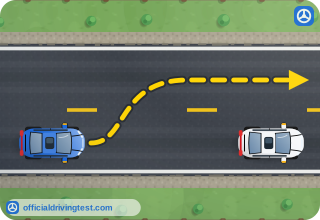
If you have to speed to pass, what does the handbook say that probably means?
- You should flash your headlights
- You probably do not need to pass
- You should pass only at night
- You should pass on the right side
Show answer
Correct answer: You probably do not need to pass
If you have to speed to pass, you probably do not need to pass.
Source: West Virginia Driver's Licensing Handbook (Revised July 2026), page 48 · Open this page in the manual (Manual page 48)
-
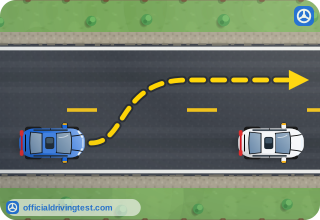
Which of these are dangers in the passing area that you should check for before you pass?
- A wide shoulder, a rest area, or a long straight stretch
- A fresh pavement patch, a parked truck, or a billboard
- A mile marker, a guardrail, or a roadside stand
- A narrow bridge, side road, or curve
Show answer
Correct answer: A narrow bridge, side road, or curve
Before passing you check ahead, to the rear and to the side for dangers such as a narrow bridge, side road, or curve.
Source: West Virginia Driver's Licensing Handbook (Revised July 2026), page 48 · Open this page in the manual (Manual page 48)
-
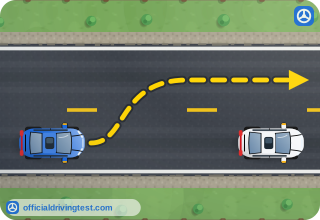
When you move left to pass on a two-lane highway, what does the handbook say to do to alert the driver ahead?
- Sound your horn
- Tap your brake pedal twice
- Turn on your hazard lights
- Wave your arm out the window
Show answer
Correct answer: Sound your horn
Once clear, you move left and sound your horn to alert the driver ahead that you are passing.
Source: West Virginia Driver's Licensing Handbook (Revised July 2026), page 48 · Open this page in the manual (Manual page 48)
-
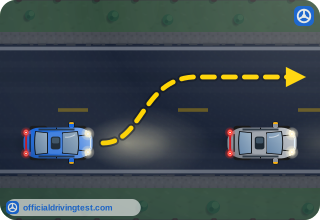
At night, what else can you do to signal that you are about to pass?
- Turn off your headlights
- Turn on your hazard lights
- Blink your headlights
- Sound your horn continuously
Show answer
Correct answer: Blink your headlights
At night you can also blink your headlights to signal that you are about to pass.
Source: West Virginia Driver's Licensing Handbook (Revised July 2026), page 48 · Open this page in the manual (Manual page 48)
-
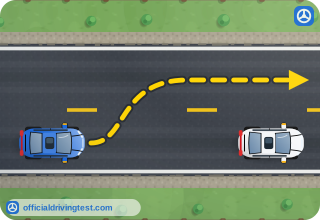
When should you signal and return to the proper lane after passing?
- As soon as your front bumper passes the other vehicle's rear bumper
- When both headlights of the passed vehicle show in your rear view mirror
- When the vehicle you passed signals that you may move over
- As soon as your vehicle is even with the other vehicle's front bumper
Show answer
Correct answer: When both headlights of the passed vehicle show in your rear view mirror
You return to the proper lane when you see the front of the vehicle you passed, both headlights, in your rear view mirror.
Source: West Virginia Driver's Licensing Handbook (Revised July 2026), page 48 · Open this page in the manual (Manual page 48)
-
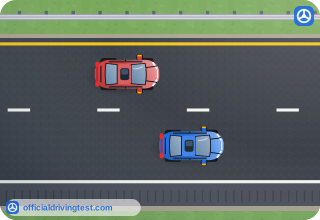
When is passing on the right permissible?
- Whenever the vehicle ahead is traveling slowly
- Whenever the road has a wide right shoulder
- When the driver ahead waves you by
- Only where there is a lane designated for passing
Show answer
Correct answer: Only where there is a lane designated for passing
Passing on the right is not permissible unless there is a lane designated for passing.
Source: West Virginia Driver's Licensing Handbook (Revised July 2026), page 48 · Open this page in the manual (Manual page 48)
4Part 417 questions
-
Which is a condition that must be met before you can pass safely?
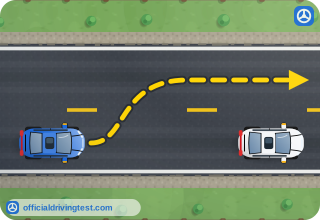
- You can return to your lane before meeting oncoming traffic
- You can exceed the speed limit by at least 10 mph
- The driver ahead has slowed to let you by
- Your vehicle is at least as large as the one ahead
Show answer
Correct answer: You can return to your lane before meeting oncoming traffic
You cannot pass safely unless you can return to your lane before meeting oncoming traffic.
Source: West Virginia Driver's Licensing Handbook (Revised July 2026), page 48 · Open this page in the manual (Manual page 48)
-
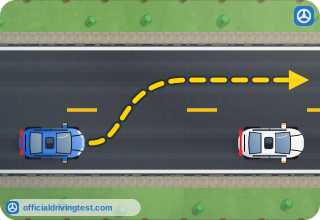
You cannot pass safely unless which of these is true?
- The vehicle ahead has its turn signal on
- You are driving in the lane closest to the center line
- Your vehicle is capable of the speed necessary to pass
- The road ahead has at least two lanes in each direction
Show answer
Correct answer: Your vehicle is capable of the speed necessary to pass
You cannot pass safely unless your vehicle is capable of the speed necessary to pass.
Source: West Virginia Driver's Licensing Handbook (Revised July 2026), page 48 · Open this page in the manual (Manual page 48)
-
Which of these must be true before you pass?
- The vehicle ahead is traveling below the speed limit
- You can see far enough ahead
- You have signaled for at least one full minute
- A vehicle is behind you and ready to pass as well
Show answer
Correct answer: You can see far enough ahead
You cannot pass safely unless you can see far enough ahead.
Source: West Virginia Driver's Licensing Handbook (Revised July 2026), page 48 · Open this page in the manual (Manual page 48)
-
Which of these is a place where passing is prohibited?
- On a straight road where you can see far ahead
- In a marked passing zone with no oncoming traffic in sight
- Where a lane is designated for passing
- On a curve or hill, or anywhere you cannot see oncoming traffic
Show answer
Correct answer: On a curve or hill, or anywhere you cannot see oncoming traffic
Passing is prohibited on a curve or hill or at any place where you cannot see oncoming traffic.
Source: West Virginia Driver's Licensing Handbook (Revised July 2026), page 48 · Open this page in the manual (Manual page 48)
-
Passing is prohibited within how many feet of an intersection?
- 100 feet
- 25 feet
- 50 feet
- 200 feet
Show answer
Correct answer: 100 feet
Passing is prohibited within 100 feet of an intersection.
Source: West Virginia Driver's Licensing Handbook (Revised July 2026), page 48 · Open this page in the manual (Manual page 48)
-
You are entering a public street from a driveway. What must you do?
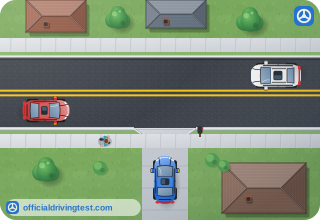
- Yield to traffic already on the roadway
- Speed up to merge ahead of traffic
- Enter first, since traffic on the street can slow down
- Yield only to vehicles approaching from your left
Show answer
Correct answer: Yield to traffic already on the roadway
Drivers entering a public street or highway from an alley, private road or driveway must yield to traffic already on the roadway.
Source: West Virginia Driver's Licensing Handbook (Revised July 2026), page 49 · Open this page in the manual (Manual page 49)
-
You reach an uncontrolled intersection or a four-way stop intersection at the same time as another vehicle. Which driver should you yield to?
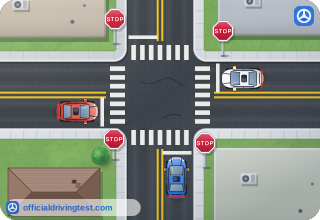
- The driver on your left
- The driver going straight ahead
- The driver on your right
- The driver in the larger vehicle
Show answer
Correct answer: The driver on your right
When two vehicles reach an uncontrolled or four-way stop intersection at the same time, the driver on the right has the right-of-way.
Source: West Virginia Driver's Licensing Handbook (Revised July 2026), page 49 · Open this page in the manual (Manual page 49)
-
What should you do at an intersection with a yield sign?
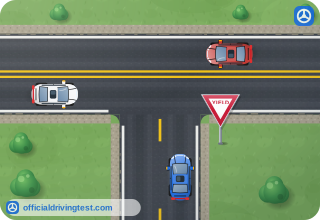
- Come to a complete stop, then drive through ahead of all approaching traffic
- Slow down, then yield to vehicles in the intersection and to approaching traffic
- Keep your speed and let vehicles in the intersection yield to you
- Slow down and go first if the intersection looks clear of other vehicles
Show answer
Correct answer: Slow down, then yield to vehicles in the intersection and to approaching traffic
At a yield sign you slow down before the intersection, then give the right-of-way to any vehicle in it and to approaching traffic.
Source: West Virginia Driver's Licensing Handbook (Revised July 2026), page 49 · Open this page in the manual (Manual page 49)
-
When you make a left turn, you must yield the right-of-way to whom?
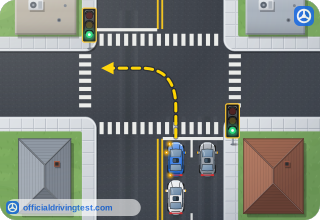
- Traffic approaching from behind
- Vehicles waiting in the right lane
- Nobody, if you have signaled
- Oncoming traffic
Show answer
Correct answer: Oncoming traffic
A driver turning left must yield the right-of-way to oncoming traffic.
Source: West Virginia Driver's Licensing Handbook (Revised July 2026), page 49 · Open this page in the manual (Manual page 49)
-
Yielding to vehicles in a funeral procession is:
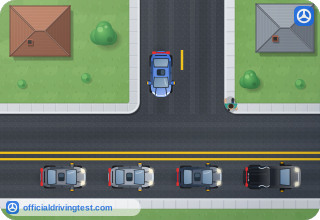
- Required by law at every intersection
- Required by law only on expressways
- A courtesy, though not required by law
- Required by law only at traffic signals
Show answer
Correct answer: A courtesy, though not required by law
The handbook says that yielding to a funeral procession is a courtesy and is not required by law.
Source: West Virginia Driver's Licensing Handbook (Revised July 2026), page 49 · Open this page in the manual (Manual page 49)
-
Once the lead vehicle of a funeral procession has cleared an intersection, who has the right-of-way?
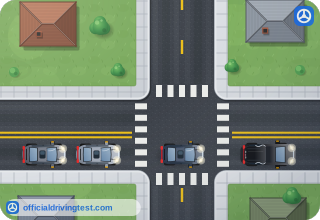
- The rest of the procession
- Cross traffic that was waiting
- Whichever driver enters the intersection first
- Oncoming traffic
Show answer
Correct answer: The rest of the procession
After the lead vehicle has cleared the intersection, the rest of the procession has the right-of-way.
Source: West Virginia Driver's Licensing Handbook (Revised July 2026), page 49 · Open this page in the manual (Manual page 49)
-
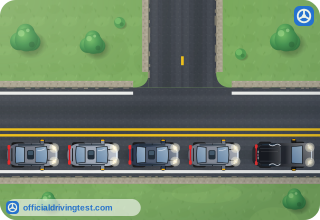
Where does the handbook say you may pass a funeral procession?
- At an intersection
- On an expressway
- On a bridge
- In a school zone
Show answer
Correct answer: On an expressway
The handbook says you may pass a funeral procession on an expressway, but you must not cut in or out of it.
Source: West Virginia Driver's Licensing Handbook (Revised July 2026), page 49 · Open this page in the manual (Manual page 49)
-
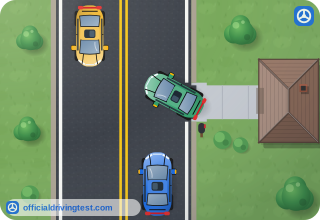
If another driver does not follow the right-of-way rules, what does the handbook say you should do?
- Insist on your right-of-way
- Honk until the driver yields
- Give the right-of-way
- Follow closely to show the mistake
Show answer
Correct answer: Give the right-of-way
Safety comes before right-of-way, so you give the right-of-way even when the other driver does not follow the rules.
Source: West Virginia Driver's Licensing Handbook (Revised July 2026), page 49 · Open this page in the manual (Manual page 49)
-
Passing is prohibited within how many feet of a bridge, viaduct, tunnel, or underpass?
- 50 feet
- 200 feet
- 100 feet
- 500 feet
Show answer
Correct answer: 100 feet
You may not pass within 100 feet of a bridge, viaduct, tunnel, or underpass.
Source: West Virginia Driver's Licensing Handbook (Revised July 2026), page 49 · Open this page in the manual (Manual page 49)
-
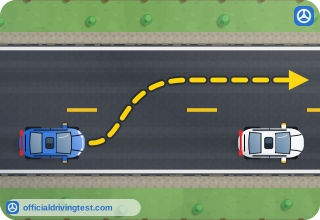
You are in a passing zone and want to pass. When is passing still prohibited?
- When the vehicle ahead is a pickup truck or a van
- When it is daytime and the road surface is dry
- When the vehicle ahead is under the posted speed limit
- When an approaching vehicle is within your passing area
Show answer
Correct answer: When an approaching vehicle is within your passing area
Passing is prohibited when an oncoming vehicle is within the area you need to pass.
Source: West Virginia Driver's Licensing Handbook (Revised July 2026), page 49 · Open this page in the manual (Manual page 49)
-
Regardless of traffic, what must you do at a stop sign or red light, even when making a right turn?
- Slow down and turn if no cross traffic is present
- Yield only to vehicles on the cross street
- Stop only when other vehicles are following you
- Come to a complete stop
Show answer
Correct answer: Come to a complete stop
You must come to a complete stop at a stop sign or red light, even for a right turn, even when there is no cross traffic.
Source: West Virginia Driver's Licensing Handbook (Revised July 2026), page 61 · Open this page in the manual (Manual page 61)
-
Another vehicle can approach at an angle at intersections, driveways, and entrances and exits to parking lots. What does the handbook say to do in these locations?
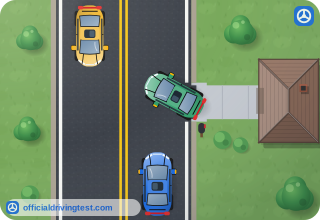
- Assume the other driver will yield and keep your speed
- Sound your horn and drive through without slowing
- Stop completely and wait for the other driver to pass
- Learn the traffic laws and obey signs and signals
Show answer
Correct answer: Learn the traffic laws and obey signs and signals
At places where vehicles can come at an angle, you should know the traffic laws and obey the signs and signals that control traffic there.
Source: West Virginia Driver's Licensing Handbook (Revised July 2026), page 66 · Open this page in the manual (Manual page 66)