Washington: Sharing the road — Part 5 Practice Test
Questions in this part include: “How should bicycles position themselves on sharrow markings?” · “In which counties is driving allowed on ocean beaches?”
Independent educational site · not affiliated with any government agency or DMV
Ready? Test yourself
Answer to start, or tap Start below:
How should bicycles position themselves on sharrow markings?
- Instant feedback with an explanation
- Every answer cites its source in the manual
- Your best score is saved on this device
- Keyboard: press 1 to 4 to answer and Enter for the next question
Questions are original and based on the official manual "Washington Driver Guide" (© 2025), Washington State Department of Licensing (DOL).
All 16 questions in this practice test
Take the test above first, then use this list to study. Tap “Show answer” to see the correct answer and explanation.
Show the questions and answersHide the questions
-
How should bicycles position themselves on sharrow markings?
- In line with the markings, riding in the direction the arrow points
- Along the right edge of the lane, away from the markings
- Against the direction in which the arrow is pointing
- On the sidewalk next to the lane with the markings
Show answer
Correct answer: In line with the markings, riding in the direction the arrow points
Bicyclists line up with the sharrow markings and follow the direction of the arrow.
Source: Washington Driver Guide (© 2025), page 139 · Open this page in the manual (Manual page 139)
-
At a bicycle box, who crosses the intersection first when the light turns green?
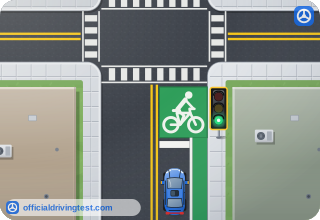
- Bicyclists
- Vehicles waiting behind the white line
- Whichever road user arrived first
- Vehicles that are turning right
Show answer
Correct answer: Bicyclists
Bicyclists go first on green and continue into the bike lane across the intersection.
Source: Washington Driver Guide (© 2025), page 140 · Open this page in the manual (Manual page 140)
-
What rule applies to turning right on red near a bicycle box?
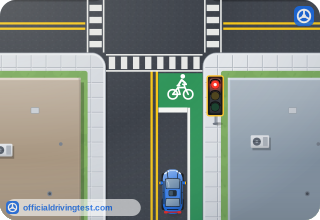
- You may turn if you stop and then yield to bicyclists
- You may turn if no bicyclist is in the box
- You can’t turn right on red there
- You may turn only from the bike lane
Show answer
Correct answer: You can’t turn right on red there
Turning right on red is not allowed near a bicycle box.
Source: Washington Driver Guide (© 2025), page 140 · Open this page in the manual (Manual page 140)
-
Where should you stay while a bicycle box in front of you is occupied?
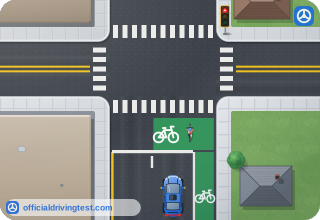
- Beside the bicyclists in the box
- Behind the white line
- On the far side of the intersection
- In the bike lane
Show answer
Correct answer: Behind the white line
You wait behind the white line until the bicycle box is clear.
Source: Washington Driver Guide (© 2025), page 140 · Open this page in the manual (Manual page 140)
-
Where should bicyclists position themselves at an intersection with a bicycle box?
- Behind vehicles
- Beside the curb behind the last car
- In the crosswalk
- In front of vehicles
Show answer
Correct answer: In front of vehicles
At an intersection with a bicycle box, cyclists wait ahead of the vehicles.
Source: Washington Driver Guide (© 2025), page 140 · Open this page in the manual (Manual page 140)
-
Washington State Ferries are part of the state’s highway network. What does that mean for drivers?
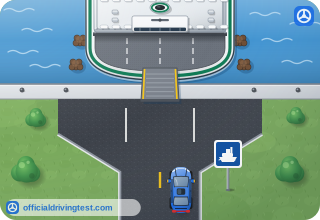
- Only the ferry system’s own rules apply
- All rules of the road apply
- Speed limits do not apply
- Only rules posted at the terminal apply
Show answer
Correct answer: All rules of the road apply
As part of the highway network, all rules of the road apply on the ferries.
Source: Washington Driver Guide (© 2025), page 152 · Open this page in the manual (Manual page 152)
-
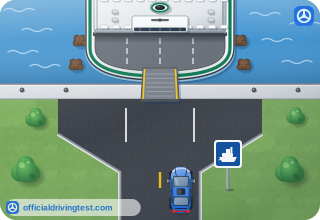
As you approach a ferry terminal, where should you pull up?
- Beside the line, in any open lane
- At the front, if your vehicle is small
- On the shoulder, away from the line
- Behind other vehicles already in line
Show answer
Correct answer: Behind other vehicles already in line
You pull up behind the vehicles already in line in the designated ferry lane.
Source: Washington Driver Guide (© 2025), page 152 · Open this page in the manual (Manual page 152)
-
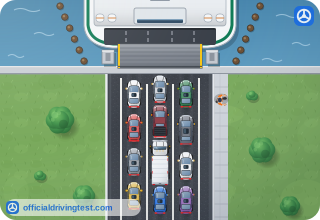
What is ferry line-cutting?
- Allowed when the line is very long
- Allowed when terminal staff are busy
- A traffic offense that can lead to a fine
- A courtesy violation with no penalty
Show answer
Correct answer: A traffic offense that can lead to a fine
Cutting into a ferry line is a traffic offense, and you can be fined for it.
Source: Washington Driver Guide (© 2025), page 152 · Open this page in the manual (Manual page 152)
-
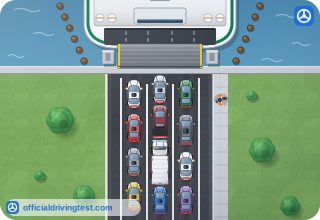
Which road users receive priority loading on most ferries?
- Bicyclists
- Motorcyclists
- Commercial trucks
- Drivers pulling trailers
Show answer
Correct answer: Bicyclists
On most ferries, bicyclists get priority when loading.
Source: Washington Driver Guide (© 2025), page 152 · Open this page in the manual (Manual page 152)
-
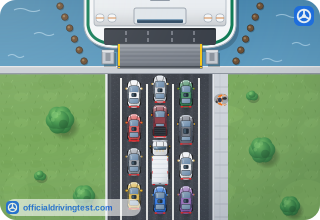
Where is the bicycle waiting area on most ferries?
- Behind the last car in line
- In the middle of the holding lane
- Beside the vehicle entrance only
- In front of motor vehicles
Show answer
Correct answer: In front of motor vehicles
Bicyclists have a waiting area in front of the motor vehicles.
Source: Washington Driver Guide (© 2025), page 152 · Open this page in the manual (Manual page 152)
-
What may bicyclists do in a ferry holding lane?
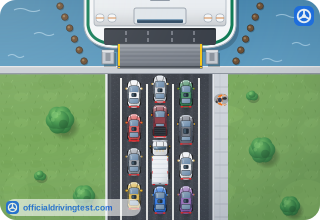
- Wait in line behind the last vehicle
- Proceed past vehicles waiting in the lane
- Ride only on the sidewalk
- Pass only when a ferry worker waves them on
Show answer
Correct answer: Proceed past vehicles waiting in the lane
Bicyclists can go ahead past vehicles waiting in the ferry holding lane.
Source: Washington Driver Guide (© 2025), page 152 · Open this page in the manual (Manual page 152)
-
In which counties is driving allowed on ocean beaches?
- Grays Harbor and Pacific counties
- King and Pierce counties
- Clallam and Jefferson counties
- Whatcom and Skagit counties
Show answer
Correct answer: Grays Harbor and Pacific counties
Driving on ocean beaches is allowed only in Grays Harbor and Pacific counties.
Source: Washington Driver Guide (© 2025), page 152 · Open this page in the manual (Manual page 152)
-
Who has the right-of-way at all times on an ocean beach where driving is allowed?
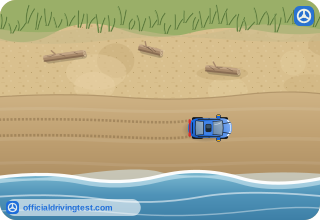
- Vehicles traveling toward the water
- Pedestrians and bicyclists
- The vehicle that arrived first
- Vehicles on hard-packed sand
Show answer
Correct answer: Pedestrians and bicyclists
On the beach, pedestrians and bicyclists always have the right-of-way.
Source: Washington Driver Guide (© 2025), page 152 · Open this page in the manual (Manual page 152)
-
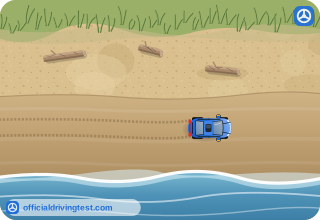
How is an ocean beach where driving is allowed treated under the law?
- As private land where traffic laws do not apply
- As a park where only posted signs apply
- As a county road where only local rules apply
- As a state highway, so all driving laws apply
Show answer
Correct answer: As a state highway, so all driving laws apply
All driving laws apply on the beach because it counts as a state highway.
Source: Washington Driver Guide (© 2025), page 152 · Open this page in the manual (Manual page 152)
-
How may you enter an ocean beach with your vehicle?
- Through any gap in the dunes
- From any road end near the water
- Only through marked beach approaches
- Only where no signs are posted
Show answer
Correct answer: Only through marked beach approaches
You may enter the beach only through marked beach approaches.
Source: Washington Driver Guide (© 2025), page 152 · Open this page in the manual (Manual page 152)
-
On what surface may you drive on an ocean beach?
- Only hard-packed sand
- Soft, dry sand
- Any sand with no signs posted
- Wet sand near the waterline only
Show answer
Correct answer: Only hard-packed sand
You may drive only on hard-packed sand.
Source: Washington Driver Guide (© 2025), page 152 · Open this page in the manual (Manual page 152)