Washington: Sharing the road — Part 1 Practice Test
Questions in this part include: “Which example of a smart, safe habit does the guide give for new drivers to make automatic?” · “How does the guide describe road rage?”
Independent educational site · not affiliated with any government agency or DMV
Ready? Test yourself
Answer to start, or tap Start below:
Which example of a smart, safe habit does the guide give for new drivers to make automatic?
- Instant feedback with an explanation
- Every answer cites its source in the manual
- Your best score is saved on this device
- Keyboard: press 1 to 4 to answer and Enter for the next question
Questions are original and based on the official manual "Washington Driver Guide" (© 2025), Washington State Department of Licensing (DOL).
All 17 questions in this practice test
Take the test above first, then use this list to study. Tap “Show answer” to see the correct answer and explanation.
Show the questions and answersHide the questions
-
How can you stay out of another vehicle’s blind zone?
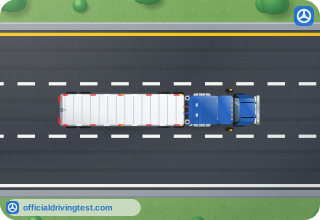
- Speed up or slow down so the driver can clearly see you
- Match its speed and stay alongside it
- Move up close behind its rear bumper and stay there
- Flash your headlights while staying beside it
Show answer
Correct answer: Speed up or slow down so the driver can clearly see you
The guide says to do your best to stay out of other vehicles’ blind zones by changing your speed so the driver can see you.
Source: Washington Driver Guide (© 2025), page 64 · Open this page in the manual (Manual page 64)
-
What are the large blind zones around buses, motor homes, and commercial motor vehicles sometimes called?
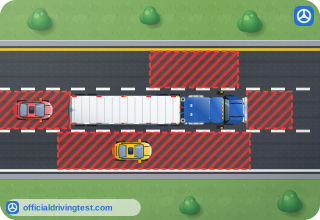
- Dead zones
- Safe zones
- No zones
- Clear zones
Show answer
Correct answer: No zones
Large vehicles have bigger blind zones, sometimes called no zones, because there should be no vehicles traveling in them.
Source: Washington Driver Guide (© 2025), page 64 · Open this page in the manual (Manual page 64)
-
If you cannot see the mirrors of a large vehicle, what does that mean?
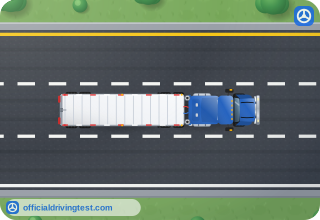
- The vehicle is too far away to matter
- The driver cannot see you
- The driver can see you in a camera
- The driver’s mirrors are set wrong
Show answer
Correct answer: The driver cannot see you
If you can’t see a large vehicle’s mirrors, its driver can’t see you.
Source: Washington Driver Guide (© 2025), page 64 · Open this page in the manual (Manual page 64)
-
Which example of a smart, safe habit does the guide give for new drivers to make automatic?
- Always looking over your shoulder to check your blind zones
- Checking your odometer reading every time you stop the vehicle
- Keeping both hands at the bottom of the steering wheel at all times
- Turning on your hazard lights whenever traffic gets heavy
Show answer
Correct answer: Always looking over your shoulder to check your blind zones
The guide names always looking over your shoulder to check blind zones as a habit to build until it is automatic. Automatic habits free you to focus on the changing driving environment.
Source: Washington Driver Guide (© 2025), page 68 · Open this page in the manual (Manual page 68)
-
How does the guide classify aggressive driving?
- As a matter of personal choice with no legal consequences
- As a traffic offense
- As an offense only when it causes a crash
- As a problem for insurance companies only
Show answer
Correct answer: As a traffic offense
The guide states that aggressive driving is a traffic offense.
Source: Washington Driver Guide (© 2025), page 77 · Open this page in the manual (Manual page 77)
-
Which behavior is associated with aggressive driving?
- Failing to obey traffic control devices
- Using proper signaling
- Making safe lane changes
- Leaving extra space around your vehicle
Show answer
Correct answer: Failing to obey traffic control devices
The guide lists failing to obey traffic control devices among behaviors associated with aggressive driving.
Source: Washington Driver Guide (© 2025), page 77 · Open this page in the manual (Manual page 77)
-
What does the guide advise when other drivers behave aggressively?
- Speed up to stay ahead of them
- Flash your headlights to warn them
- Do not take it personally, and be patient and forgiving
- Stay close behind them to note their plate number
Show answer
Correct answer: Do not take it personally, and be patient and forgiving
The guide says to concentrate on what you are doing and to be patient and forgiving of other road users.
Source: Washington Driver Guide (© 2025), page 78 · Open this page in the manual (Manual page 78)
-
To whom can penalties for street racing apply?
- Only the drivers who are actively racing on the road
- Drivers and anyone else who instigates or assists with it
- Only the registered owners of the vehicles involved
- Only drivers who are younger than 21 years of age
Show answer
Correct answer: Drivers and anyone else who instigates or assists with it
The guide says street racing penalties can apply to drivers and anyone else who instigates or assists.
Source: Washington Driver Guide (© 2025), page 78 · Open this page in the manual (Manual page 78)
-
What can guilty participants in street racing face?
- A warning letter and a driving class only
- Fines only, with no jail time
- A longer wait before they may renew their license
- Fines, jail time, and having their vehicle impounded
Show answer
Correct answer: Fines, jail time, and having their vehicle impounded
The guide says guilty participants can face fines, jail time, and impoundment of their vehicle.
Source: Washington Driver Guide (© 2025), page 78 · Open this page in the manual (Manual page 78)
-
How does the guide describe road rage?
- As a criminal offense
- As a traffic offense only
- As a civil matter
- As a minor infraction
Show answer
Correct answer: As a criminal offense
The guide states that road rage is a criminal offense.
Source: Washington Driver Guide (© 2025), page 78 · Open this page in the manual (Manual page 78)
-
What is road rage?
- Any disagreement between two drivers about who has the right of way at an intersection
- Honking the horn once or twice to warn another driver of a danger on the road ahead
- An angry response on the road that leads to violent behavior with a vehicle or other weapon
- Driving faster than the rest of traffic for a short distance on a freeway
Show answer
Correct answer: An angry response on the road that leads to violent behavior with a vehicle or other weapon
The guide defines road rage as an angry response to an event on the road that leads to violent behavior with a vehicle or other weapon.
Source: Washington Driver Guide (© 2025), page 78 · Open this page in the manual (Manual page 78)
-
Which of these can contribute to road rage?
- Leaving home with plenty of time
- Tight schedules
- Keeping safe space margins around your vehicle
- Showing grace to other people
Show answer
Correct answer: Tight schedules
The guide lists stress, tight schedules, traffic, and non-driving frustrations as contributors to road rage.
Source: Washington Driver Guide (© 2025), page 78 · Open this page in the manual (Manual page 78)
-
Which of these might show that you are having feelings of road rage?
- Leaving extra space behind the vehicle ahead of you in traffic
- Taking a deep breath and moving out of the way of an angry driver
- Keeping your eyes on the road while driving at a safe speed
- Passing traffic and then slowing down to teach the other driver a lesson
Show answer
Correct answer: Passing traffic and then slowing down to teach the other driver a lesson
The guide lists passing traffic and then slowing down to teach the other driver a lesson as a sign of road rage feelings.
Source: Washington Driver Guide (© 2025), page 79 · Open this page in the manual (Manual page 79)
-
When you see other drivers acting or reacting in anger, what does the guide say to do?
- Distance yourself from the situation physically and mentally
- Use hand gestures to show the other driver your disapproval
- Honk your horn to let them know that they are being unsafe
- Speed up to get away from them as quickly as you can
Show answer
Correct answer: Distance yourself from the situation physically and mentally
The guide says to distance yourself from the situation physically and mentally, and to avoid aggressive speeding, honking, or hand gestures.
Source: Washington Driver Guide (© 2025), page 79 · Open this page in the manual (Manual page 79)
-
If you feel you are being followed or harassed by another driver, where does the guide say to drive?
- Home, and park in your driveway
- To a quiet, empty road
- To an area where there are other people and open businesses
- To the shoulder, where you wait for the driver to pass
Show answer
Correct answer: To an area where there are other people and open businesses
The guide says to drive to an area with other people and open businesses, and to call the police if necessary.
Source: Washington Driver Guide (© 2025), page 79 · Open this page in the manual (Manual page 79)
-
What does the guide say about conflict with other road users?
- Avoid conflict regardless of fault
- Stand up to other drivers who are at fault
- Avoid conflict only when you are at fault
- Correct other drivers’ mistakes when you see them
Show answer
Correct answer: Avoid conflict regardless of fault
The guide lists avoiding conflict regardless of fault as part of respectful, responsible driver behavior.
Source: Washington Driver Guide (© 2025), page 89 · Open this page in the manual (Manual page 89)
-
On a school bus, what do the yellow lights mean?
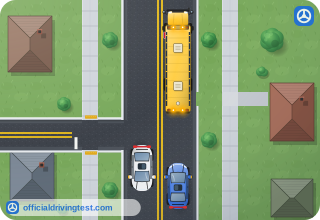
- Children are crossing
- Stop immediately
- Caution or slow down
- Pass when it is safe
Show answer
Correct answer: Caution or slow down
School bus lights work like traffic signals: red means stop and yellow means caution or slow down.
Source: Washington Driver Guide (© 2025), page 94 · Open this page in the manual (Manual page 94)