Washington: Speed and space — Part 1 Practice Test
Questions in this part include: “Why should you avoid unnecessary firm or emergency braking?” · “Which of these is a time when the guide says it is essential to look for vehicles and cyclists behind you?”
Independent educational site · not affiliated with any government agency or DMV
Ready? Test yourself
Answer to start, or tap Start below:
Why should you avoid unnecessary firm or emergency braking?
- Instant feedback with an explanation
- Every answer cites its source in the manual
- Your best score is saved on this device
- Keyboard: press 1 to 4 to answer and Enter for the next question
Questions are original and based on the official manual "Washington Driver Guide" (© 2025), Washington State Department of Licensing (DOL).
All 18 questions in this practice test
Take the test above first, then use this list to study. Tap “Show answer” to see the correct answer and explanation.
Show the questions and answersHide the questions
-
Why should you avoid unnecessary firm or emergency braking?
- It could surprise those behind you who expected a smooth stop
- It turns off the antilock brakes for several seconds
- It is illegal in every driving situation
- It shifts the weight of the vehicle toward the rear
Show answer
Correct answer: It could surprise those behind you who expected a smooth stop
Drivers behind you may be anticipating a smooth stop, so needless hard braking can catch them off guard.
Source: Washington Driver Guide (© 2025), page 59 · Open this page in the manual (Manual page 59)
-
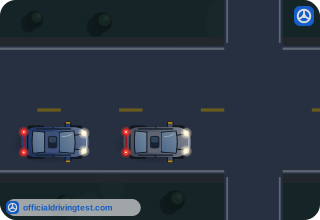
When driving at night, within what distance should you be able to stop?
- Within the length of one car
- Inside the lit area created by your headlights
- Before you reach the next intersection
- Within the area lit by the vehicle ahead of you
Show answer
Correct answer: Inside the lit area created by your headlights
At night, you should reduce speed and increase following distance so you can stop inside the area your headlights light up.
Source: Washington Driver Guide (© 2025), page 70 · Open this page in the manual (Manual page 70)
-
What does scanning involve in addition to using your eyes to check your surroundings?
- Moving your head, neck, and body
- Using only your mirrors
- Keeping your eyes fixed on the vehicle ahead
- Turning on your headlights
Show answer
Correct answer: Moving your head, neck, and body
The guide says scanning also involves moving your head, neck, and body to see as much as possible around your vehicle.
Source: Washington Driver Guide (© 2025), page 87 · Open this page in the manual (Manual page 87)
-
What does visual searching mean?
- Looking only at the road directly ahead of your vehicle
- Checking your instrument panel and gauges regularly
- Using your eyes to actively check your surroundings
- Looking around for a legal place to park the vehicle
Show answer
Correct answer: Using your eyes to actively check your surroundings
The guide defines visual searching as using your eyes to actively check your surroundings.
Source: Washington Driver Guide (© 2025), page 87 · Open this page in the manual (Manual page 87)
-
What should the speed you travel at allow you to do?
- Keep up with the fastest traffic
- Search and scan effectively
- Pass slower vehicles quickly
- Avoid using your mirrors
Show answer
Correct answer: Search and scan effectively
The guide says to travel at a speed that supports your ability to search and scan effectively.
Source: Washington Driver Guide (© 2025), page 88 · Open this page in the manual (Manual page 88)
-
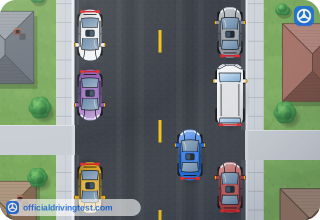
When you scan to the front, what should you look for in, under, and around parked vehicles?
- Only license plates and bumpers
- Open windows and unlocked doors
- Brake lights and license plates
- Feet, wheels, shadows, and movement
Show answer
Correct answer: Feet, wheels, shadows, and movement
The guide says to watch for feet, wheels, shadows, and movement in, under, and around parked vehicles.
Source: Washington Driver Guide (© 2025), page 88 · Open this page in the manual (Manual page 88)
-
What does looking ahead help you avoid?
- Last-minute braking or sudden turning or swerving
- Needing to use your turn signals before every turn
- Having to scan to the side at intersections
- Having to check behind you before you slow down
Show answer
Correct answer: Last-minute braking or sudden turning or swerving
The guide says to look ahead to avoid last-minute braking or the need to turn or swerve suddenly.
Source: Washington Driver Guide (© 2025), page 88 · Open this page in the manual (Manual page 88)
-
When you scan to the front, which of these should you also pay attention to?
- Only the vehicle directly in front of you in your lane
- Only the lane you are driving in at that moment
- What is happening beyond the vehicle in front of you
- Only the traffic signals and signs along the road
Show answer
Correct answer: What is happening beyond the vehicle in front of you
The guide says to watch what is happening beyond the vehicle in front of you, not just the vehicle itself.
Source: Washington Driver Guide (© 2025), page 88 · Open this page in the manual (Manual page 88)
-
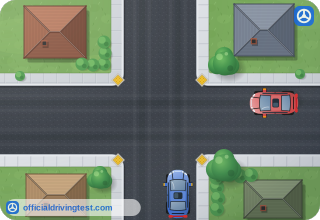
When foliage or other objects block your view to the sides, what should you watch for?
- Signs and signals that are hidden behind the foliage
- The brake lights of the vehicles that are ahead of you
- Changes in the color of the traffic signals ahead of you
- Movement that may show hazards or people planning to cross
Show answer
Correct answer: Movement that may show hazards or people planning to cross
The guide says to watch for movement to spot hazards and people who could be planning to cross the road.
Source: Washington Driver Guide (© 2025), page 88 · Open this page in the manual (Manual page 88)
-
Which of these is a time when the guide says it is essential to look for vehicles and cyclists behind you?
- When you are parked with the engine off
- When you are parked and waiting with the doors locked
- When you turn across a bicycle lane
- When you leave your vehicle to check a tire
Show answer
Correct answer: When you turn across a bicycle lane
The guide lists changing lanes, turning across a bicycle lane, slowing down, backing up, and driving down a long or steep hill.
Source: Washington Driver Guide (© 2025), page 88 · Open this page in the manual (Manual page 88)
-
When should you check traffic behind you more often?
- When traffic is light
- When traffic is heavy
- When the road is empty
- When you are parked
Show answer
Correct answer: When traffic is heavy
The guide says to check more often when traffic is heavy so you have time to react to someone following too closely or coming up too fast.
Source: Washington Driver Guide (© 2025), page 89 · Open this page in the manual (Manual page 89)
-
According to the guide, what uses more fuel?
- Driving smoothly
- Driving at a steady speed
- Keeping your tires properly inflated
- Speeding or braking hard
Show answer
Correct answer: Speeding or braking hard
The guide advises driving smoothly because speeding or braking hard uses more fuel.
Source: Washington Driver Guide (© 2025), page 90 · Open this page in the manual (Manual page 90)
-
May you exceed the speed limit when using the left lane to pass?
- Yes, but only by 5 mph
- No, follow speed limit laws even then
- Yes, if you return to the right lane soon
- Yes, if the traffic around you is speeding
Show answer
Correct answer: No, follow speed limit laws even then
Speed limit laws apply even when you use the left lane to pass.
Source: Washington Driver Guide (© 2025), page 108 · Open this page in the manual (Manual page 108)
-
Automated traffic safety cameras automatically record images if you exceed the speed limit where?
- On any road with a curve
- In a school zone
- In a construction zone with no workers present
- On the freeway ramp
Show answer
Correct answer: In a school zone
These cameras record drivers who exceed the speed limit in a school zone.
Source: Washington Driver Guide (© 2025), page 115 · Open this page in the manual (Manual page 115)
-
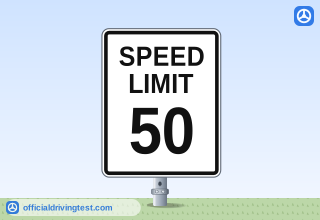
What does the maximum speed limit on a speed limit sign assume?
- Ideal conditions
- Heavy traffic
- Wet road surfaces
- Daytime driving only
Show answer
Correct answer: Ideal conditions
The maximum posted speed is for ideal conditions, so you must slow down when conditions are worse.
Source: Washington Driver Guide (© 2025), page 114 · Open this page in the manual (Manual page 114)
-
Can you get a ticket even if you are driving under the posted speed limit?
- No, driving at or under the posted limit is always lawful
- Yes, but only in a school zone or work zone
- No, unless the road is a freeway with a minimum speed
- Yes, if you are traveling too fast for road conditions
Show answer
Correct answer: Yes, if you are traveling too fast for road conditions
You can be ticketed for going too fast for conditions such as a slippery road or fog, even under the posted limit.
Source: Washington Driver Guide (© 2025), page 114 · Open this page in the manual (Manual page 114)
-
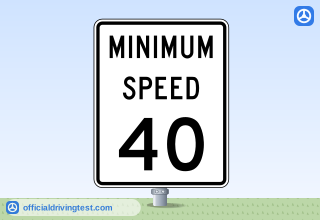
Why do some roads have minimum speed limits?
- So that you can save fuel on long trips
- So that you are not a hazard to other drivers
- So that traffic cameras can measure vehicle speeds
- So that you are not passed by faster vehicles
Show answer
Correct answer: So that you are not a hazard to other drivers
On roads with a minimum speed limit you must travel at least that fast so you do not endanger other drivers.
Source: Washington Driver Guide (© 2025), page 114 · Open this page in the manual (Manual page 114)
-
What is the speed limit on an ocean beach where driving is allowed?
- 15 mph
- 20 mph
- 25 mph
- 35 mph
Show answer
Correct answer: 25 mph
The beach speed limit is 25 mph.
Source: Washington Driver Guide (© 2025), page 152 · Open this page in the manual (Manual page 152)