Washington: Sharing the road — Part 4 Practice Test
Questions in this part include: “How are bicyclists in crosswalks considered?” · “What marks agricultural and farm vehicles designed to go 25 mph or less?”
Independent educational site · not affiliated with any government agency or DMV
Ready? Test yourself
Answer to start, or tap Start below:
How are bicyclists in crosswalks considered?
- Instant feedback with an explanation
- Every answer cites its source in the manual
- Your best score is saved on this device
- Keyboard: press 1 to 4 to answer and Enter for the next question
Questions are original and based on the official manual "Washington Driver Guide" (© 2025), Washington State Department of Licensing (DOL).
All 16 questions in this practice test
Take the test above first, then use this list to study. Tap “Show answer” to see the correct answer and explanation.
Show the questions and answersHide the questions
-
How are bicyclists in crosswalks considered?
- As motor vehicles
- As motorcycles
- As slow-moving vehicles
- As pedestrians
Show answer
Correct answer: As pedestrians
Bicyclists in crosswalks are considered pedestrians, and you must yield to them in marked and unmarked crosswalks.
Source: Washington Driver Guide (© 2025), page 103 · Open this page in the manual (Manual page 103)
-
How should you pass a bicyclist on a road with one lane in each direction?
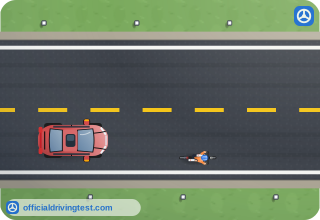
- Move onto the shoulder to the right of the bicyclist
- Stay in your lane and sound your horn
- Move into the other lane when there isn't any oncoming traffic
- Stay in your lane and pass on the bicyclist's right
Show answer
Correct answer: Move into the other lane when there isn't any oncoming traffic
With one lane each way, you move into the other lane only when there isn't any oncoming traffic.
Source: Washington Driver Guide (© 2025), page 103 · Open this page in the manual (Manual page 103)
-
When passing a bicyclist, how much space must you leave between the bicyclist and the widest part of your vehicle?
- At least 1 foot
- At least 3 feet
- At least 6 feet
- At least 10 feet
Show answer
Correct answer: At least 3 feet
Leave at least 3 feet between the bicyclist and the widest part of your vehicle.
Source: Washington Driver Guide (© 2025), page 103 · Open this page in the manual (Manual page 103)
-
On which side of a bicyclist should you pass?
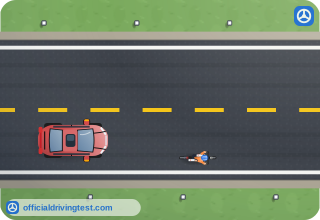
- The right side, passing slowly
- The right side, passing quickly
- Either side, as soon as you can
- The left side, passing slowly
Show answer
Correct answer: The left side, passing slowly
Pass slowly on the bicyclist's left side.
Source: Washington Driver Guide (© 2025), page 103 · Open this page in the manual (Manual page 103)
-
When may you return to your lane after passing a bicyclist?
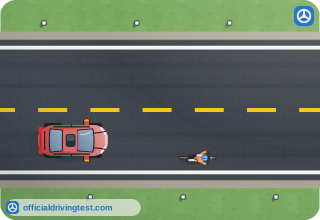
- Only after you are clear of the bicyclist
- As soon as your front bumper passes the bicycle
- As soon as the bicyclist's handlebars are beside you
- After you flash your headlights
Show answer
Correct answer: Only after you are clear of the bicyclist
Moving over too soon could put the bicyclist in danger, so make sure you are clear first.
Source: Washington Driver Guide (© 2025), page 103 · Open this page in the manual (Manual page 103)
-
You are going to turn right and a bicyclist is ahead of you. What should you not do?
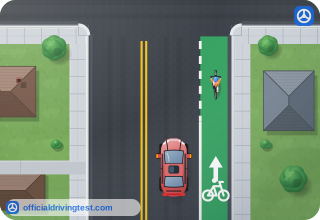
- Slow down well before the turn begins
- Use your turn signal before the turn
- Pass the bicyclist just before the turn
- Check your blind zone before turning
Show answer
Correct answer: Pass the bicyclist just before the turn
If you are going to turn right, do not pass a bicyclist just before the turn.
Source: Washington Driver Guide (© 2025), page 103 · Open this page in the manual (Manual page 103)
-
How are bicycle lanes typically marked?
- Painted yellow, with dashed white lines and a bicycle symbol
- Painted green, with solid white lines and a bicycle symbol
- Painted red, with solid yellow lines and a bicycle symbol
- Painted blue, with a double white line and a bicycle symbol
Show answer
Correct answer: Painted green, with solid white lines and a bicycle symbol
Bicycle lanes are typically painted green, use solid white lines, and have a bicycle symbol.
Source: Washington Driver Guide (© 2025), page 104 · Open this page in the manual (Manual page 104)
-
Bike lane markings vary in length. How should you drive?
- As though the lane ends where the paint ends
- As though the lane is only for turning
- As though bicyclists will leave the lane
- As though the markings continue
Show answer
Correct answer: As though the markings continue
Although bike lane markings vary in length, drive as though they continue.
Source: Washington Driver Guide (© 2025), page 104 · Open this page in the manual (Manual page 104)
-
When may you drive in a bicycle lane?
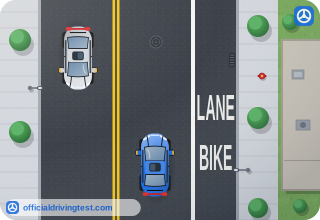
- Only when turning or crossing it to park near the curb
- When traffic in the other lanes is stopped or moving slowly
- When you need to pass a slow vehicle on the right
- Whenever no bicyclist is in sight and you are hurrying
Show answer
Correct answer: Only when turning or crossing it to park near the curb
Drive in bicycle lanes only when turning or crossing the lane to park near the curb.
Source: Washington Driver Guide (© 2025), page 104 · Open this page in the manual (Manual page 104)
-
What should you do after you park and before you open your door?
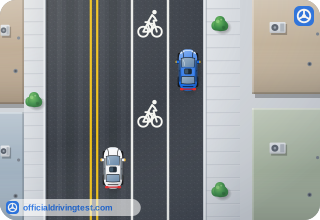
- Sound your horn to warn passing bicyclists
- Turn on your hazard lights
- Look carefully in all directions for a bicyclist
- Wait for bicyclists to ring their bells
Show answer
Correct answer: Look carefully in all directions for a bicyclist
Look carefully in all directions for a bicyclist after you park and before opening your door.
Source: Washington Driver Guide (© 2025), page 104 · Open this page in the manual (Manual page 104)
-
What marks agricultural and farm vehicles designed to go 25 mph or less?
- A flashing blue light on top
- A square white sign on the back
- A triangle sign or emblem on the back
- A red flag on the left front
Show answer
Correct answer: A triangle sign or emblem on the back
Agricultural and farm vehicles designed to go 25 mph or less have a triangle sign or emblem on the back.
Source: Washington Driver Guide (© 2025), page 106 · Open this page in the manual (Manual page 106)
-
How far must you move over to pass an agricultural vehicle when there are two lanes in your direction?
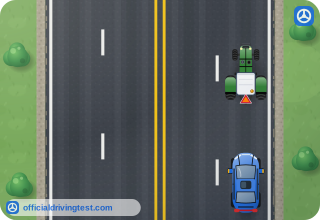
- Half a lane
- One full lane
- Two full lanes
- Onto the shoulder
Show answer
Correct answer: One full lane
With two lanes in the same direction, move over one full lane to pass an agricultural vehicle.
Source: Washington Driver Guide (© 2025), page 106 · Open this page in the manual (Manual page 106)
-
As you pass an agricultural vehicle, how much space should there be between it and the widest part of your vehicle?
- At least 1 foot
- At least 6 feet
- At least 10 feet
- At least 3 feet
Show answer
Correct answer: At least 3 feet
There should be at least 3 feet between the widest part of your vehicle and the agricultural vehicle.
Source: Washington Driver Guide (© 2025), page 106 · Open this page in the manual (Manual page 106)
-
How can bicycles navigate a roundabout?
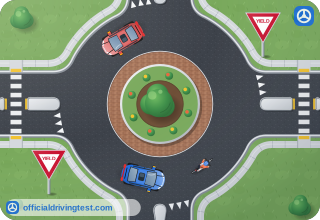
- Only as a vehicle, in the middle of the lane
- As a pedestrian or as a vehicle, by their own choice
- Only as a pedestrian, using the crosswalks
- Only on the sidewalk or the truck apron
Show answer
Correct answer: As a pedestrian or as a vehicle, by their own choice
Bicyclists decide whether to go through the roundabout as a pedestrian or as a vehicle.
Source: Washington Driver Guide (© 2025), page 127 · Open this page in the manual (Manual page 127)
-
When traveling as a vehicle in a roundabout, where should bicyclists ride to increase their visibility to drivers?
- Along the right edge of the lane
- In the middle of the lane
- On the truck apron
- Next to the central island
Show answer
Correct answer: In the middle of the lane
Riding in the middle of the lane makes bicyclists easier for drivers to see.
Source: Washington Driver Guide (© 2025), page 127 · Open this page in the manual (Manual page 127)
-
How much space should you give when passing a bicycle in a lane marked with sharrows?
- At least 1 foot
- At least 5 feet
- At least 3 feet
- At least 10 feet
Show answer
Correct answer: At least 3 feet
On sharrows you watch for riders, drive slowly, and give at least 3 feet when passing.
Source: Washington Driver Guide (© 2025), page 139 · Open this page in the manual (Manual page 139)