Washington: Sharing the road — Part 2 Practice Test
Questions in this part include: “What happens to fines for anyone who passes a stopped school bus?” · “How far does it take a loaded truck with properly adjusted brakes, traveling at 55 mph, to come to a complete stop?”
Independent educational site · not affiliated with any government agency or DMV
Ready? Test yourself
Answer to start, or tap Start below:
What happens to fines for anyone who passes a stopped school bus?
- Instant feedback with an explanation
- Every answer cites its source in the manual
- Your best score is saved on this device
- Keyboard: press 1 to 4 to answer and Enter for the next question
Questions are original and based on the official manual "Washington Driver Guide" (© 2025), Washington State Department of Licensing (DOL).
All 16 questions in this practice test
Take the test above first, then use this list to study. Tap “Show answer” to see the correct answer and explanation.
Show the questions and answersHide the questions
-
What happens to fines for anyone who passes a stopped school bus?
- They are tripled
- They are doubled
- They are waived for a first offense
- They are the same as for any other violation
Show answer
Correct answer: They are doubled
Fines are doubled for anyone who passes a stopped school bus.
Source: Washington Driver Guide (© 2025), page 95 · Open this page in the manual (Manual page 95)
-
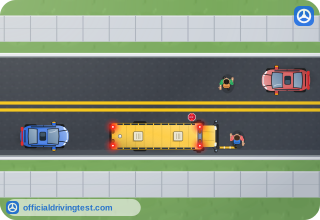
You are traveling in the same direction as a school bus that is flashing red lights with its stop sign extended. What must you do?
- Slow down and pass with caution
- Pass only on the left side
- Continue if no children are visible
- Stop
Show answer
Correct answer: Stop
All drivers traveling in the same direction as the bus must stop when the red lights flash and the stop sign is extended.
Source: Washington Driver Guide (© 2025), page 95 · Open this page in the manual (Manual page 95)
-
You have stopped behind a school bus. When may you go?
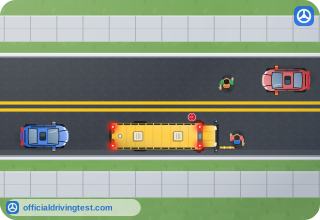
- Once the lights stop flashing, the sign is retracted, and the arm returns to the bumper
- As soon as the last child has stepped away from the bus and onto the shoulder
- As soon as the yellow lights come on, even if the stop sign is still extended
- After waiting 30 seconds, whether or not the lights are still flashing
Show answer
Correct answer: Once the lights stop flashing, the sign is retracted, and the arm returns to the bumper
You may go after the lights stop flashing, the sign is retracted, and the metal arm returns to the front bumper of the bus.
Source: Washington Driver Guide (© 2025), page 95 · Open this page in the manual (Manual page 95)
-
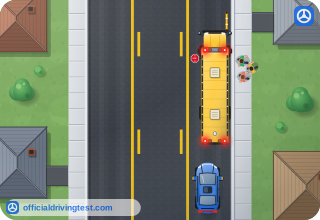
May you use a center turn lane to pass a school bus that has its red lights flashing?
- Yes, if no children are in the road
- Yes, if you slow to the speed limit
- No, drivers in all turn lanes must stop
- Yes, but only on a two-lane road
Show answer
Correct answer: No, drivers in all turn lanes must stop
A center turn lane is not a way around the bus: drivers in all turn lanes must stop.
Source: Washington Driver Guide (© 2025), page 95 · Open this page in the manual (Manual page 95)
-
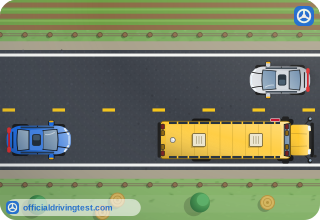
After a school bus's red lights have stopped flashing, what should you do?
- Speed up to make up lost time
- Continue to watch for children
- Assume all children are on the bus
- Stop watching the bus
Show answer
Correct answer: Continue to watch for children
Keep watching for children even after the red lights have stopped flashing.
Source: Washington Driver Guide (© 2025), page 95 · Open this page in the manual (Manual page 95)
-
You are on a 2-lane road, approaching a school bus from the opposite direction. Its red lights are flashing and its stop sign is extended. What must you do?
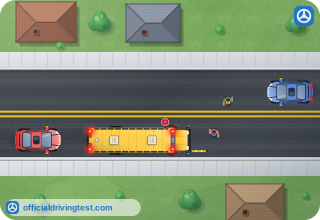
- Continue, because you are traveling in the opposite direction
- Slow down and continue past the bus
- Stop only if children are crossing the road
- Stop, because all vehicles must stop on a 2-lane road
Show answer
Correct answer: Stop, because all vehicles must stop on a 2-lane road
On a 2-lane road all vehicles must stop, including those coming from the opposite direction.
Source: Washington Driver Guide (© 2025), page 96 · Open this page in the manual (Manual page 96)
-
On a multilane road, which drivers must stop when a school bus flashes its red lights and extends its stop sign?
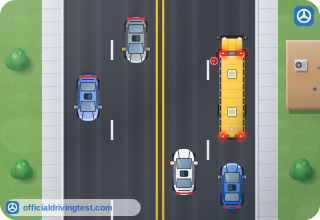
- Drivers traveling behind the bus
- Only drivers in the same lane as the bus
- Only drivers who are turning
- Only drivers traveling faster than the speed limit
Show answer
Correct answer: Drivers traveling behind the bus
On a multilane road, drivers traveling behind the bus must stop when the red lights flash and the stop sign extends.
Source: Washington Driver Guide (© 2025), page 97 · Open this page in the manual (Manual page 97)
-
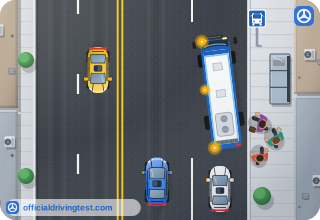
What must you do when a transit vehicle traveling in your direction has signaled and is pulling back onto the roadway?
- Speed up and pass it
- Honk to warn it
- Yield to it
- Move into the left lane
Show answer
Correct answer: Yield to it
You must yield to a transit vehicle that has signaled and is pulling back onto the roadway.
Source: Washington Driver Guide (© 2025), page 98 · Open this page in the manual (Manual page 98)
-
How should you adjust your following distance when following a large vehicle?
- Close enough that no vehicle can cut in between
- So you have a wide view of the roadway ahead
- Close enough to save fuel by drafting behind it
- The same as behind a small car
Show answer
Correct answer: So you have a wide view of the roadway ahead
Adjust your following distance behind large vehicles so you have a wide view of the road ahead.
Source: Washington Driver Guide (© 2025), page 98 · Open this page in the manual (Manual page 98)
-
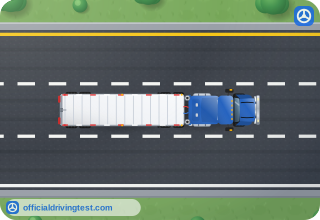
You are near a large vehicle and cannot see the driver's mirrors. What does that mean?
- The driver can see you in the rearview mirror
- The driver is about to brake
- You are in the safest place to pass
- The driver can't see you
Show answer
Correct answer: The driver can't see you
If you can't see a large vehicle's mirrors, the driver can't see you.
Source: Washington Driver Guide (© 2025), page 98 · Open this page in the manual (Manual page 98)
-
How far does it take a loaded truck with properly adjusted brakes, traveling at 55 mph, to come to a complete stop?
- 450 feet
- 250 feet
- 650 feet
- 900 feet
Show answer
Correct answer: 450 feet
Such a truck needs 450 feet to stop, so cutting in front of it without enough space is dangerous.
Source: Washington Driver Guide (© 2025), page 98 · Open this page in the manual (Manual page 98)
-
Before merging in front of a large vehicle, what should you wait to see in your rearview mirror?
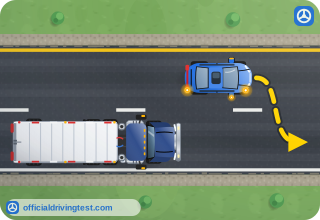
- Its entire front bumper
- Its turn signal flashing
- Both of its headlights
- The driver's face clearly
Show answer
Correct answer: Both of its headlights
When entering traffic ahead of a large vehicle, wait until you can clearly see both of its headlights in your mirror.
Source: Washington Driver Guide (© 2025), page 99 · Open this page in the manual (Manual page 99)
-
How much space do large vehicles need in a roundabout?
- 1 lane
- 2 lanes
- 3 lanes
- The whole roundabout
Show answer
Correct answer: 2 lanes
Large vehicles may need more than one lane to turn and need 2 lanes of space in a roundabout.
Source: Washington Driver Guide (© 2025), page 99 · Open this page in the manual (Manual page 99)
-
What should you do while the driver of a large vehicle is making a turn?
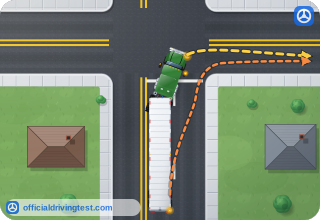
- Pass quickly on the side away from the turn
- Pass on the inside of the turn
- Move alongside to let the driver see you
- Wait until the turn is complete before moving ahead
Show answer
Correct answer: Wait until the turn is complete before moving ahead
Passing a turning large vehicle is a frequent cause of collisions, so be patient and wait until the turn is finished.
Source: Washington Driver Guide (© 2025), page 99 · Open this page in the manual (Manual page 99)
-
What should you do about vehicles with signs indicating they carry hazardous materials?
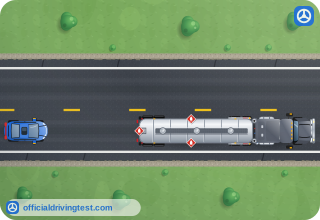
- Avoid driving near them when possible
- Follow them closely so the driver can see you
- Stay alongside them to keep them in view
- Pass them as quickly as you can
Show answer
Correct answer: Avoid driving near them when possible
Be aware of vehicles carrying hazardous materials and avoid driving near them when you can.
Source: Washington Driver Guide (© 2025), page 99 · Open this page in the manual (Manual page 99)
-
Where should you be prepared to encounter slow large vehicles on long, steep grades?
- In the left lane
- On the shoulder
- In the right lane
- In the center turn lane
Show answer
Correct answer: In the right lane
Large vehicles travel slowly up and down steep roads, so expect slow vehicles in the right lane.
Source: Washington Driver Guide (© 2025), page 99 · Open this page in the manual (Manual page 99)