Washington: Sharing the road — Part 3 Practice Test
Questions in this part include: “How do the rights and responsibilities of motorcyclists compare with those of other road users?” · “What is true of the turn signals on some motorcycles?”
Independent educational site · not affiliated with any government agency or DMV
Ready? Test yourself
Answer to start, or tap Start below:
How do the rights and responsibilities of motorcyclists compare with those of other road users?
- Instant feedback with an explanation
- Every answer cites its source in the manual
- Your best score is saved on this device
- Keyboard: press 1 to 4 to answer and Enter for the next question
Questions are original and based on the official manual "Washington Driver Guide" (© 2025), Washington State Department of Licensing (DOL).
All 16 questions in this practice test
Take the test above first, then use this list to study. Tap “Show answer” to see the correct answer and explanation.
Show the questions and answersHide the questions
-
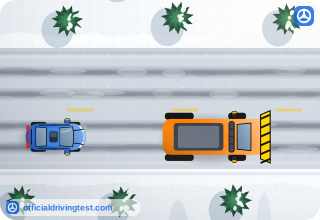
What can snowplows do that reduces visibility for drivers following too closely?
- Drop sand and gravel that damages the windshields of cars behind
- Force snow up and off the road, causing blizzard-like conditions
- Lower their blades without warning into the traffic behind them
- Throw up a thick cloud of road salt that coats windshields
Show answer
Correct answer: Force snow up and off the road, causing blizzard-like conditions
Snowplows can force snow up and off the road, causing blizzard-like conditions behind them.
Source: Washington Driver Guide (© 2025), page 100 · Open this page in the manual (Manual page 100)
-
How do the rights and responsibilities of motorcyclists compare with those of other road users?
- Motorcyclists have more rights but fewer responsibilities
- Motorcyclists have fewer rights but more responsibilities
- Motorcyclists have extra right-of-way in traffic
- They are the same
Show answer
Correct answer: They are the same
Motorcyclists have the same rights and responsibilities as other road users and obey the same traffic laws.
Source: Washington Driver Guide (© 2025), page 100 · Open this page in the manual (Manual page 100)
-
When should you allow even more following room behind a motorcycle?
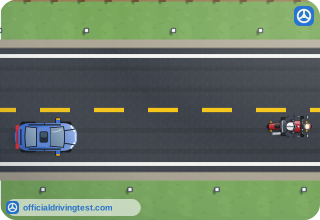
- When it's raining or the road surface is slick
- Only at night on a dry highway
- When the motorcycle is in the left lane
- On straight, dry roads
Show answer
Correct answer: When it's raining or the road surface is slick
Weather and slippery surfaces are serious problems for motorcyclists, so allow extra room when it is raining or the surface is slick.
Source: Washington Driver Guide (© 2025), page 100 · Open this page in the manual (Manual page 100)
-
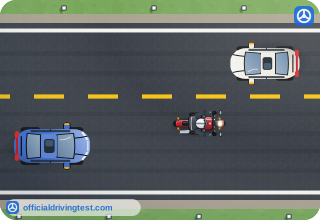
A motorcyclist is riding far to one side of a wide lane. May you move into the same lane alongside the motorcyclist?
- Yes, if the lane is wide enough
- Yes, if you pass slowly
- No, never, even if the lane is wide
- Yes, if the motorcyclist signals you
Show answer
Correct answer: No, never, even if the lane is wide
Never move into the same lane alongside a motorcyclist, even if the lane is wide.
Source: Washington Driver Guide (© 2025), page 101 · Open this page in the manual (Manual page 101)
-
Why do motorcyclists constantly change position within their lane?
- To save fuel by reducing wind resistance in heavy traffic
- To see and be seen, and to avoid objects in the road
- To signal to other drivers that they intend to pass
- To keep their tires warm and improve their grip
Show answer
Correct answer: To see and be seen, and to avoid objects in the road
Motorcyclists shift within the lane so they can see and be seen and to avoid objects in the road.
Source: Washington Driver Guide (© 2025), page 101 · Open this page in the manual (Manual page 101)
-
If you are turning right, how does the guide say to check for motorcycles?
- Look right, look left, then look right again
- Look only in the right-side mirror
- Look at the rearview mirror, then turn
- Look left, look right, then look left again
Show answer
Correct answer: Look left, look right, then look left again
Looking twice can save a life: when turning right, look left, then right, then left again.
Source: Washington Driver Guide (© 2025), page 101 · Open this page in the manual (Manual page 101)
-
How can you make sure your blind zone is clear of motorcyclists?
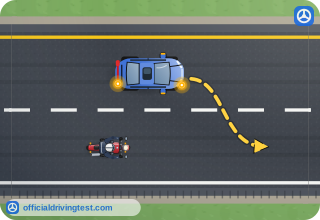
- Do an over-the-shoulder check
- Rely on your side mirrors only
- Sound your horn
- Flash your headlights
Show answer
Correct answer: Do an over-the-shoulder check
Motorcyclists are often hidden in blind zones, so do an over-the-shoulder check.
Source: Washington Driver Guide (© 2025), page 101 · Open this page in the manual (Manual page 101)
-
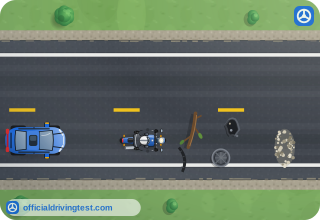
What should you do about bumpy road surfaces and irregularities that can force a motorcyclist to change speed or lane position?
- Assume the motorcyclist will keep a straight line
- Honk to warn the motorcyclist of the hazard
- Anticipate changes the motorcyclist might need to make
- Move into the motorcyclist's lane to help
Show answer
Correct answer: Anticipate changes the motorcyclist might need to make
Gravel, potholes and similar surfaces can force a motorcyclist to change speed or position, so expect such changes.
Source: Washington Driver Guide (© 2025), page 101 · Open this page in the manual (Manual page 101)
-
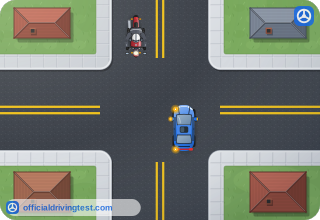
What might drivers turning in front of an oncoming motorcycle misjudge?
- The width of the lane
- The speed of the motorcycle
- The engine size of the motorcycle
- The distance to the next intersection
Show answer
Correct answer: The speed of the motorcycle
Drivers turning in front of an oncoming motorcycle might not see it and could misjudge its speed.
Source: Washington Driver Guide (© 2025), page 101 · Open this page in the manual (Manual page 101)
-
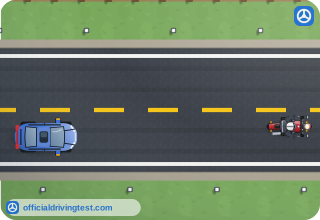
Why might a motorcycle's brake light not come on when it slows down?
- The rider has switched off the brake light to save power
- The brake light works only when the headlight is off
- Motorcycle brake lights flash only at night
- The rider might slow using the throttle, not the brakes
Show answer
Correct answer: The rider might slow using the throttle, not the brakes
Motorcyclists might slow down using the throttle and not their brakes, so brake lights would not be visible.
Source: Washington Driver Guide (© 2025), page 102 · Open this page in the manual (Manual page 102)
-
What is true of the turn signals on some motorcycles?
- They don't turn off automatically
- They turn off only when the rider brakes
- They cannot be seen from behind
- They turn off after five seconds
Show answer
Correct answer: They don't turn off automatically
Some motorcycles have turn signals that do not turn off automatically, so stay alert beside a motorcycle.
Source: Washington Driver Guide (© 2025), page 102 · Open this page in the manual (Manual page 102)
-
What should you give motorcyclists regarding your turn signals and brake lights?
- A sudden signal so they react quickly
- A signal only after you start to turn
- Plenty of time to notice them
- Nothing, because they watch other lights
Show answer
Correct answer: Plenty of time to notice them
Give motorcyclists plenty of time to notice your turn signals and brake lights.
Source: Washington Driver Guide (© 2025), page 102 · Open this page in the manual (Manual page 102)
-
What rights, duties, and responsibilities do bicyclists have?
- Only the rights of pedestrians
- The same as a vehicle driver
- The rights but not the duties of a driver
- Fewer rights than a vehicle driver
Show answer
Correct answer: The same as a vehicle driver
Bicyclists have the same rights, duties, and responsibilities as a vehicle driver.
Source: Washington Driver Guide (© 2025), page 102 · Open this page in the manual (Manual page 102)
-
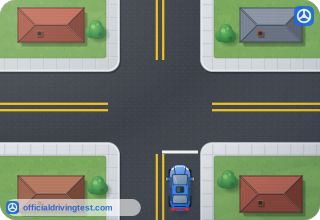
When turning a corner or pulling into a driveway, where should you watch for bicyclists?
- Only in the bike lane next to the curb
- Only in the center turn lane of the road
- Only behind you in your own lane
- In the crosswalk or on the sidewalk
Show answer
Correct answer: In the crosswalk or on the sidewalk
Watch for bicyclists who are in the crosswalk or on the sidewalk when turning a corner or entering a driveway.
Source: Washington Driver Guide (© 2025), page 103 · Open this page in the manual (Manual page 103)
-
How should you treat a bicyclist at an intersection?
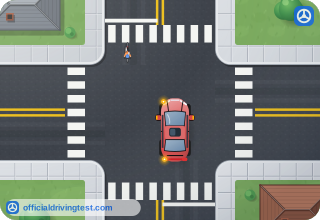
- Yield as you would to a vehicle
- Expect the bicyclist to yield because bikes are smaller
- Yield only if the bicyclist is in a bike lane
- Yield only if the bicyclist signals
Show answer
Correct answer: Yield as you would to a vehicle
At intersections you yield to bicyclists as you would to a vehicle.
Source: Washington Driver Guide (© 2025), page 103 · Open this page in the manual (Manual page 103)
-
When you are driving behind a bicyclist, how much space must you leave at least?
- 1 foot
- 3 feet
- 5 feet
- 10 feet
Show answer
Correct answer: 3 feet
Leave at least 3 feet of space when driving behind a bicyclist.
Source: Washington Driver Guide (© 2025), page 103 · Open this page in the manual (Manual page 103)