Washington: Sharing the road
School buses, transit buses, large vehicles, motorcycles, bicyclists and agricultural vehicles. Split into 5 shorter tests so you're not stuck in one long quiz.
Independent educational site · not affiliated with any government agency or DMV
Choose a part
Sharing the road — Part 1
Questions in this part include: “Which example of a smart, safe habit does the guide give for new drivers to make automatic?”
Sharing the road — Part 2
Questions in this part include: “What happens to fines for anyone who passes a stopped school bus?”
Sharing the road — Part 3
Questions in this part include: “How do the rights and responsibilities of motorcyclists compare with those of other road users?”
Sharing the road — Part 4
Questions in this part include: “How are bicyclists in crosswalks considered?”
Sharing the road — Part 5
Questions in this part include: “How should bicycles position themselves on sharrow markings?”
Questions are original and based on the official manual "Washington Driver Guide" (© 2025), Washington State Department of Licensing (DOL).
All 81 Sharing the road questions with answers
Choose a part above to take a practice test, or study every question and answer here.
Show the questions and answersHide the questions
1Part 117 questions
-
How can you stay out of another vehicle’s blind zone?
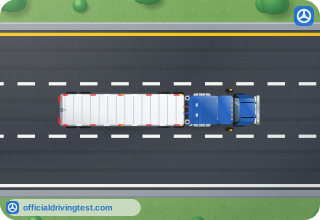
- Speed up or slow down so the driver can clearly see you
- Match its speed and stay alongside it
- Move up close behind its rear bumper and stay there
- Flash your headlights while staying beside it
Show answer
Correct answer: Speed up or slow down so the driver can clearly see you
The guide says to do your best to stay out of other vehicles’ blind zones by changing your speed so the driver can see you.
Source: Washington Driver Guide (© 2025), page 64 · Open this page in the manual (Manual page 64)
-
What are the large blind zones around buses, motor homes, and commercial motor vehicles sometimes called?
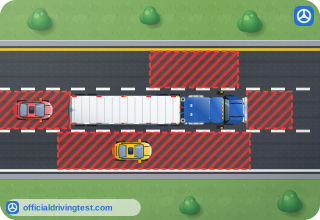
- Dead zones
- Safe zones
- No zones
- Clear zones
Show answer
Correct answer: No zones
Large vehicles have bigger blind zones, sometimes called no zones, because there should be no vehicles traveling in them.
Source: Washington Driver Guide (© 2025), page 64 · Open this page in the manual (Manual page 64)
-
If you cannot see the mirrors of a large vehicle, what does that mean?
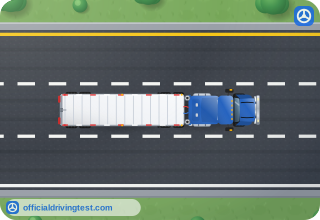
- The vehicle is too far away to matter
- The driver cannot see you
- The driver can see you in a camera
- The driver’s mirrors are set wrong
Show answer
Correct answer: The driver cannot see you
If you can’t see a large vehicle’s mirrors, its driver can’t see you.
Source: Washington Driver Guide (© 2025), page 64 · Open this page in the manual (Manual page 64)
-
Which example of a smart, safe habit does the guide give for new drivers to make automatic?
- Always looking over your shoulder to check your blind zones
- Checking your odometer reading every time you stop the vehicle
- Keeping both hands at the bottom of the steering wheel at all times
- Turning on your hazard lights whenever traffic gets heavy
Show answer
Correct answer: Always looking over your shoulder to check your blind zones
The guide names always looking over your shoulder to check blind zones as a habit to build until it is automatic. Automatic habits free you to focus on the changing driving environment.
Source: Washington Driver Guide (© 2025), page 68 · Open this page in the manual (Manual page 68)
-
How does the guide classify aggressive driving?
- As a matter of personal choice with no legal consequences
- As a traffic offense
- As an offense only when it causes a crash
- As a problem for insurance companies only
Show answer
Correct answer: As a traffic offense
The guide states that aggressive driving is a traffic offense.
Source: Washington Driver Guide (© 2025), page 77 · Open this page in the manual (Manual page 77)
-
Which behavior is associated with aggressive driving?
- Failing to obey traffic control devices
- Using proper signaling
- Making safe lane changes
- Leaving extra space around your vehicle
Show answer
Correct answer: Failing to obey traffic control devices
The guide lists failing to obey traffic control devices among behaviors associated with aggressive driving.
Source: Washington Driver Guide (© 2025), page 77 · Open this page in the manual (Manual page 77)
-
What does the guide advise when other drivers behave aggressively?
- Speed up to stay ahead of them
- Flash your headlights to warn them
- Do not take it personally, and be patient and forgiving
- Stay close behind them to note their plate number
Show answer
Correct answer: Do not take it personally, and be patient and forgiving
The guide says to concentrate on what you are doing and to be patient and forgiving of other road users.
Source: Washington Driver Guide (© 2025), page 78 · Open this page in the manual (Manual page 78)
-
To whom can penalties for street racing apply?
- Only the drivers who are actively racing on the road
- Drivers and anyone else who instigates or assists with it
- Only the registered owners of the vehicles involved
- Only drivers who are younger than 21 years of age
Show answer
Correct answer: Drivers and anyone else who instigates or assists with it
The guide says street racing penalties can apply to drivers and anyone else who instigates or assists.
Source: Washington Driver Guide (© 2025), page 78 · Open this page in the manual (Manual page 78)
-
What can guilty participants in street racing face?
- A warning letter and a driving class only
- Fines only, with no jail time
- A longer wait before they may renew their license
- Fines, jail time, and having their vehicle impounded
Show answer
Correct answer: Fines, jail time, and having their vehicle impounded
The guide says guilty participants can face fines, jail time, and impoundment of their vehicle.
Source: Washington Driver Guide (© 2025), page 78 · Open this page in the manual (Manual page 78)
-
How does the guide describe road rage?
- As a criminal offense
- As a traffic offense only
- As a civil matter
- As a minor infraction
Show answer
Correct answer: As a criminal offense
The guide states that road rage is a criminal offense.
Source: Washington Driver Guide (© 2025), page 78 · Open this page in the manual (Manual page 78)
-
What is road rage?
- Any disagreement between two drivers about who has the right of way at an intersection
- Honking the horn once or twice to warn another driver of a danger on the road ahead
- An angry response on the road that leads to violent behavior with a vehicle or other weapon
- Driving faster than the rest of traffic for a short distance on a freeway
Show answer
Correct answer: An angry response on the road that leads to violent behavior with a vehicle or other weapon
The guide defines road rage as an angry response to an event on the road that leads to violent behavior with a vehicle or other weapon.
Source: Washington Driver Guide (© 2025), page 78 · Open this page in the manual (Manual page 78)
-
Which of these can contribute to road rage?
- Leaving home with plenty of time
- Tight schedules
- Keeping safe space margins around your vehicle
- Showing grace to other people
Show answer
Correct answer: Tight schedules
The guide lists stress, tight schedules, traffic, and non-driving frustrations as contributors to road rage.
Source: Washington Driver Guide (© 2025), page 78 · Open this page in the manual (Manual page 78)
-
Which of these might show that you are having feelings of road rage?
- Leaving extra space behind the vehicle ahead of you in traffic
- Taking a deep breath and moving out of the way of an angry driver
- Keeping your eyes on the road while driving at a safe speed
- Passing traffic and then slowing down to teach the other driver a lesson
Show answer
Correct answer: Passing traffic and then slowing down to teach the other driver a lesson
The guide lists passing traffic and then slowing down to teach the other driver a lesson as a sign of road rage feelings.
Source: Washington Driver Guide (© 2025), page 79 · Open this page in the manual (Manual page 79)
-
When you see other drivers acting or reacting in anger, what does the guide say to do?
- Distance yourself from the situation physically and mentally
- Use hand gestures to show the other driver your disapproval
- Honk your horn to let them know that they are being unsafe
- Speed up to get away from them as quickly as you can
Show answer
Correct answer: Distance yourself from the situation physically and mentally
The guide says to distance yourself from the situation physically and mentally, and to avoid aggressive speeding, honking, or hand gestures.
Source: Washington Driver Guide (© 2025), page 79 · Open this page in the manual (Manual page 79)
-
If you feel you are being followed or harassed by another driver, where does the guide say to drive?
- Home, and park in your driveway
- To a quiet, empty road
- To an area where there are other people and open businesses
- To the shoulder, where you wait for the driver to pass
Show answer
Correct answer: To an area where there are other people and open businesses
The guide says to drive to an area with other people and open businesses, and to call the police if necessary.
Source: Washington Driver Guide (© 2025), page 79 · Open this page in the manual (Manual page 79)
-
What does the guide say about conflict with other road users?
- Avoid conflict regardless of fault
- Stand up to other drivers who are at fault
- Avoid conflict only when you are at fault
- Correct other drivers’ mistakes when you see them
Show answer
Correct answer: Avoid conflict regardless of fault
The guide lists avoiding conflict regardless of fault as part of respectful, responsible driver behavior.
Source: Washington Driver Guide (© 2025), page 89 · Open this page in the manual (Manual page 89)
-
On a school bus, what do the yellow lights mean?
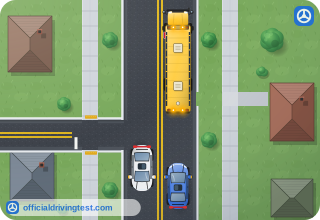
- Children are crossing
- Stop immediately
- Caution or slow down
- Pass when it is safe
Show answer
Correct answer: Caution or slow down
School bus lights work like traffic signals: red means stop and yellow means caution or slow down.
Source: Washington Driver Guide (© 2025), page 94 · Open this page in the manual (Manual page 94)
2Part 216 questions
-
What happens to fines for anyone who passes a stopped school bus?
- They are tripled
- They are doubled
- They are waived for a first offense
- They are the same as for any other violation
Show answer
Correct answer: They are doubled
Fines are doubled for anyone who passes a stopped school bus.
Source: Washington Driver Guide (© 2025), page 95 · Open this page in the manual (Manual page 95)
-
You are traveling in the same direction as a school bus that is flashing red lights with its stop sign extended. What must you do?
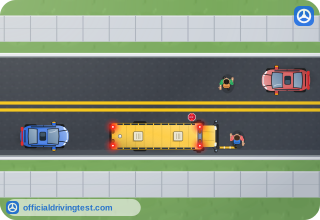
- Slow down and pass with caution
- Pass only on the left side
- Continue if no children are visible
- Stop
Show answer
Correct answer: Stop
All drivers traveling in the same direction as the bus must stop when the red lights flash and the stop sign is extended.
Source: Washington Driver Guide (© 2025), page 95 · Open this page in the manual (Manual page 95)
-
You have stopped behind a school bus. When may you go?
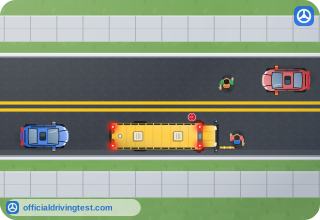
- Once the lights stop flashing, the sign is retracted, and the arm returns to the bumper
- As soon as the last child has stepped away from the bus and onto the shoulder
- As soon as the yellow lights come on, even if the stop sign is still extended
- After waiting 30 seconds, whether or not the lights are still flashing
Show answer
Correct answer: Once the lights stop flashing, the sign is retracted, and the arm returns to the bumper
You may go after the lights stop flashing, the sign is retracted, and the metal arm returns to the front bumper of the bus.
Source: Washington Driver Guide (© 2025), page 95 · Open this page in the manual (Manual page 95)
-
May you use a center turn lane to pass a school bus that has its red lights flashing?
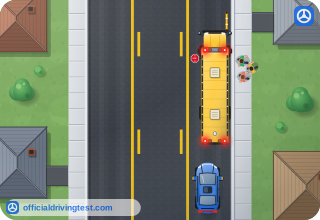
- Yes, if no children are in the road
- Yes, if you slow to the speed limit
- No, drivers in all turn lanes must stop
- Yes, but only on a two-lane road
Show answer
Correct answer: No, drivers in all turn lanes must stop
A center turn lane is not a way around the bus: drivers in all turn lanes must stop.
Source: Washington Driver Guide (© 2025), page 95 · Open this page in the manual (Manual page 95)
-
After a school bus's red lights have stopped flashing, what should you do?
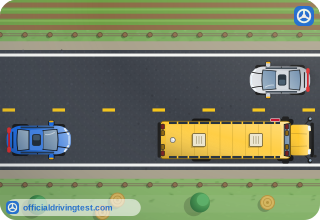
- Speed up to make up lost time
- Continue to watch for children
- Assume all children are on the bus
- Stop watching the bus
Show answer
Correct answer: Continue to watch for children
Keep watching for children even after the red lights have stopped flashing.
Source: Washington Driver Guide (© 2025), page 95 · Open this page in the manual (Manual page 95)
-
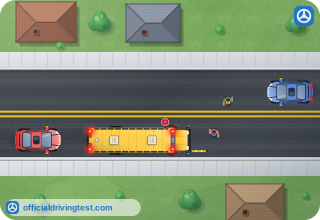
You are on a 2-lane road, approaching a school bus from the opposite direction. Its red lights are flashing and its stop sign is extended. What must you do?
- Continue, because you are traveling in the opposite direction
- Slow down and continue past the bus
- Stop only if children are crossing the road
- Stop, because all vehicles must stop on a 2-lane road
Show answer
Correct answer: Stop, because all vehicles must stop on a 2-lane road
On a 2-lane road all vehicles must stop, including those coming from the opposite direction.
Source: Washington Driver Guide (© 2025), page 96 · Open this page in the manual (Manual page 96)
-
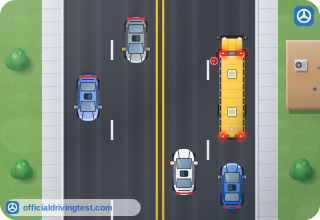
On a multilane road, which drivers must stop when a school bus flashes its red lights and extends its stop sign?
- Drivers traveling behind the bus
- Only drivers in the same lane as the bus
- Only drivers who are turning
- Only drivers traveling faster than the speed limit
Show answer
Correct answer: Drivers traveling behind the bus
On a multilane road, drivers traveling behind the bus must stop when the red lights flash and the stop sign extends.
Source: Washington Driver Guide (© 2025), page 97 · Open this page in the manual (Manual page 97)
-
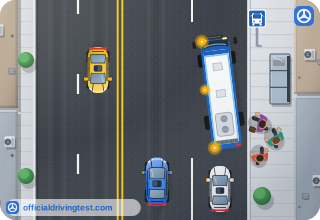
What must you do when a transit vehicle traveling in your direction has signaled and is pulling back onto the roadway?
- Speed up and pass it
- Honk to warn it
- Yield to it
- Move into the left lane
Show answer
Correct answer: Yield to it
You must yield to a transit vehicle that has signaled and is pulling back onto the roadway.
Source: Washington Driver Guide (© 2025), page 98 · Open this page in the manual (Manual page 98)
-
How should you adjust your following distance when following a large vehicle?
- Close enough that no vehicle can cut in between
- So you have a wide view of the roadway ahead
- Close enough to save fuel by drafting behind it
- The same as behind a small car
Show answer
Correct answer: So you have a wide view of the roadway ahead
Adjust your following distance behind large vehicles so you have a wide view of the road ahead.
Source: Washington Driver Guide (© 2025), page 98 · Open this page in the manual (Manual page 98)
-
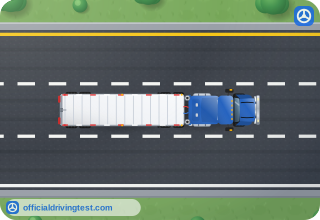
You are near a large vehicle and cannot see the driver's mirrors. What does that mean?
- The driver can see you in the rearview mirror
- The driver is about to brake
- You are in the safest place to pass
- The driver can't see you
Show answer
Correct answer: The driver can't see you
If you can't see a large vehicle's mirrors, the driver can't see you.
Source: Washington Driver Guide (© 2025), page 98 · Open this page in the manual (Manual page 98)
-
How far does it take a loaded truck with properly adjusted brakes, traveling at 55 mph, to come to a complete stop?
- 450 feet
- 250 feet
- 650 feet
- 900 feet
Show answer
Correct answer: 450 feet
Such a truck needs 450 feet to stop, so cutting in front of it without enough space is dangerous.
Source: Washington Driver Guide (© 2025), page 98 · Open this page in the manual (Manual page 98)
-
Before merging in front of a large vehicle, what should you wait to see in your rearview mirror?
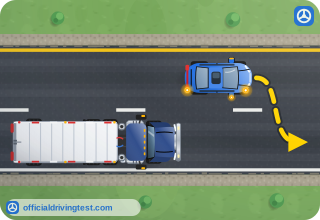
- Its entire front bumper
- Its turn signal flashing
- Both of its headlights
- The driver's face clearly
Show answer
Correct answer: Both of its headlights
When entering traffic ahead of a large vehicle, wait until you can clearly see both of its headlights in your mirror.
Source: Washington Driver Guide (© 2025), page 99 · Open this page in the manual (Manual page 99)
-
How much space do large vehicles need in a roundabout?
- 1 lane
- 2 lanes
- 3 lanes
- The whole roundabout
Show answer
Correct answer: 2 lanes
Large vehicles may need more than one lane to turn and need 2 lanes of space in a roundabout.
Source: Washington Driver Guide (© 2025), page 99 · Open this page in the manual (Manual page 99)
-
What should you do while the driver of a large vehicle is making a turn?
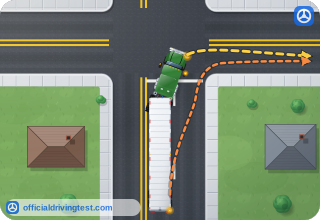
- Pass quickly on the side away from the turn
- Pass on the inside of the turn
- Move alongside to let the driver see you
- Wait until the turn is complete before moving ahead
Show answer
Correct answer: Wait until the turn is complete before moving ahead
Passing a turning large vehicle is a frequent cause of collisions, so be patient and wait until the turn is finished.
Source: Washington Driver Guide (© 2025), page 99 · Open this page in the manual (Manual page 99)
-
What should you do about vehicles with signs indicating they carry hazardous materials?
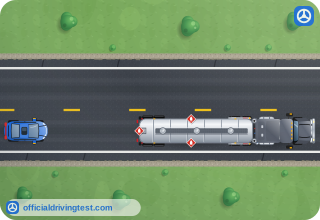
- Avoid driving near them when possible
- Follow them closely so the driver can see you
- Stay alongside them to keep them in view
- Pass them as quickly as you can
Show answer
Correct answer: Avoid driving near them when possible
Be aware of vehicles carrying hazardous materials and avoid driving near them when you can.
Source: Washington Driver Guide (© 2025), page 99 · Open this page in the manual (Manual page 99)
-
Where should you be prepared to encounter slow large vehicles on long, steep grades?
- In the left lane
- On the shoulder
- In the right lane
- In the center turn lane
Show answer
Correct answer: In the right lane
Large vehicles travel slowly up and down steep roads, so expect slow vehicles in the right lane.
Source: Washington Driver Guide (© 2025), page 99 · Open this page in the manual (Manual page 99)
3Part 316 questions
-
What can snowplows do that reduces visibility for drivers following too closely?
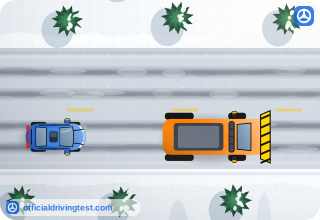
- Drop sand and gravel that damages the windshields of cars behind
- Force snow up and off the road, causing blizzard-like conditions
- Lower their blades without warning into the traffic behind them
- Throw up a thick cloud of road salt that coats windshields
Show answer
Correct answer: Force snow up and off the road, causing blizzard-like conditions
Snowplows can force snow up and off the road, causing blizzard-like conditions behind them.
Source: Washington Driver Guide (© 2025), page 100 · Open this page in the manual (Manual page 100)
-
How do the rights and responsibilities of motorcyclists compare with those of other road users?
- Motorcyclists have more rights but fewer responsibilities
- Motorcyclists have fewer rights but more responsibilities
- Motorcyclists have extra right-of-way in traffic
- They are the same
Show answer
Correct answer: They are the same
Motorcyclists have the same rights and responsibilities as other road users and obey the same traffic laws.
Source: Washington Driver Guide (© 2025), page 100 · Open this page in the manual (Manual page 100)
-
When should you allow even more following room behind a motorcycle?
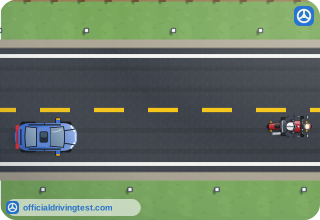
- When it's raining or the road surface is slick
- Only at night on a dry highway
- When the motorcycle is in the left lane
- On straight, dry roads
Show answer
Correct answer: When it's raining or the road surface is slick
Weather and slippery surfaces are serious problems for motorcyclists, so allow extra room when it is raining or the surface is slick.
Source: Washington Driver Guide (© 2025), page 100 · Open this page in the manual (Manual page 100)
-
A motorcyclist is riding far to one side of a wide lane. May you move into the same lane alongside the motorcyclist?
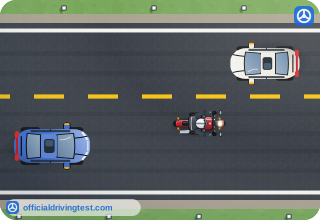
- Yes, if the lane is wide enough
- Yes, if you pass slowly
- No, never, even if the lane is wide
- Yes, if the motorcyclist signals you
Show answer
Correct answer: No, never, even if the lane is wide
Never move into the same lane alongside a motorcyclist, even if the lane is wide.
Source: Washington Driver Guide (© 2025), page 101 · Open this page in the manual (Manual page 101)
-
Why do motorcyclists constantly change position within their lane?
- To save fuel by reducing wind resistance in heavy traffic
- To see and be seen, and to avoid objects in the road
- To signal to other drivers that they intend to pass
- To keep their tires warm and improve their grip
Show answer
Correct answer: To see and be seen, and to avoid objects in the road
Motorcyclists shift within the lane so they can see and be seen and to avoid objects in the road.
Source: Washington Driver Guide (© 2025), page 101 · Open this page in the manual (Manual page 101)
-
If you are turning right, how does the guide say to check for motorcycles?
- Look right, look left, then look right again
- Look only in the right-side mirror
- Look at the rearview mirror, then turn
- Look left, look right, then look left again
Show answer
Correct answer: Look left, look right, then look left again
Looking twice can save a life: when turning right, look left, then right, then left again.
Source: Washington Driver Guide (© 2025), page 101 · Open this page in the manual (Manual page 101)
-
How can you make sure your blind zone is clear of motorcyclists?
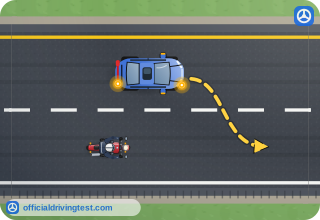
- Do an over-the-shoulder check
- Rely on your side mirrors only
- Sound your horn
- Flash your headlights
Show answer
Correct answer: Do an over-the-shoulder check
Motorcyclists are often hidden in blind zones, so do an over-the-shoulder check.
Source: Washington Driver Guide (© 2025), page 101 · Open this page in the manual (Manual page 101)
-
What should you do about bumpy road surfaces and irregularities that can force a motorcyclist to change speed or lane position?
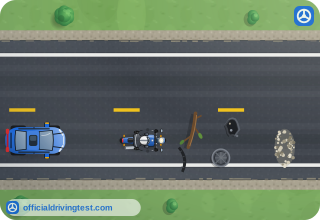
- Assume the motorcyclist will keep a straight line
- Honk to warn the motorcyclist of the hazard
- Anticipate changes the motorcyclist might need to make
- Move into the motorcyclist's lane to help
Show answer
Correct answer: Anticipate changes the motorcyclist might need to make
Gravel, potholes and similar surfaces can force a motorcyclist to change speed or position, so expect such changes.
Source: Washington Driver Guide (© 2025), page 101 · Open this page in the manual (Manual page 101)
-
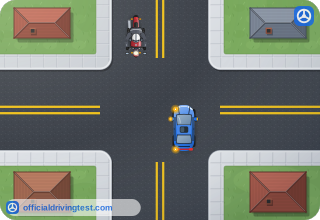
What might drivers turning in front of an oncoming motorcycle misjudge?
- The width of the lane
- The speed of the motorcycle
- The engine size of the motorcycle
- The distance to the next intersection
Show answer
Correct answer: The speed of the motorcycle
Drivers turning in front of an oncoming motorcycle might not see it and could misjudge its speed.
Source: Washington Driver Guide (© 2025), page 101 · Open this page in the manual (Manual page 101)
-
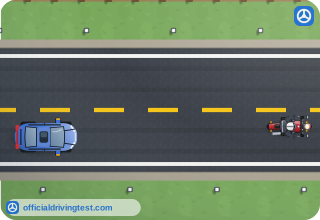
Why might a motorcycle's brake light not come on when it slows down?
- The rider has switched off the brake light to save power
- The brake light works only when the headlight is off
- Motorcycle brake lights flash only at night
- The rider might slow using the throttle, not the brakes
Show answer
Correct answer: The rider might slow using the throttle, not the brakes
Motorcyclists might slow down using the throttle and not their brakes, so brake lights would not be visible.
Source: Washington Driver Guide (© 2025), page 102 · Open this page in the manual (Manual page 102)
-
What is true of the turn signals on some motorcycles?
- They don't turn off automatically
- They turn off only when the rider brakes
- They cannot be seen from behind
- They turn off after five seconds
Show answer
Correct answer: They don't turn off automatically
Some motorcycles have turn signals that do not turn off automatically, so stay alert beside a motorcycle.
Source: Washington Driver Guide (© 2025), page 102 · Open this page in the manual (Manual page 102)
-
What should you give motorcyclists regarding your turn signals and brake lights?
- A sudden signal so they react quickly
- A signal only after you start to turn
- Plenty of time to notice them
- Nothing, because they watch other lights
Show answer
Correct answer: Plenty of time to notice them
Give motorcyclists plenty of time to notice your turn signals and brake lights.
Source: Washington Driver Guide (© 2025), page 102 · Open this page in the manual (Manual page 102)
-
What rights, duties, and responsibilities do bicyclists have?
- Only the rights of pedestrians
- The same as a vehicle driver
- The rights but not the duties of a driver
- Fewer rights than a vehicle driver
Show answer
Correct answer: The same as a vehicle driver
Bicyclists have the same rights, duties, and responsibilities as a vehicle driver.
Source: Washington Driver Guide (© 2025), page 102 · Open this page in the manual (Manual page 102)
-
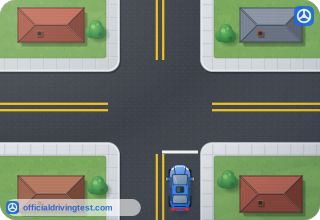
When turning a corner or pulling into a driveway, where should you watch for bicyclists?
- Only in the bike lane next to the curb
- Only in the center turn lane of the road
- Only behind you in your own lane
- In the crosswalk or on the sidewalk
Show answer
Correct answer: In the crosswalk or on the sidewalk
Watch for bicyclists who are in the crosswalk or on the sidewalk when turning a corner or entering a driveway.
Source: Washington Driver Guide (© 2025), page 103 · Open this page in the manual (Manual page 103)
-
How should you treat a bicyclist at an intersection?
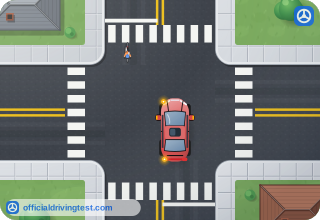
- Yield as you would to a vehicle
- Expect the bicyclist to yield because bikes are smaller
- Yield only if the bicyclist is in a bike lane
- Yield only if the bicyclist signals
Show answer
Correct answer: Yield as you would to a vehicle
At intersections you yield to bicyclists as you would to a vehicle.
Source: Washington Driver Guide (© 2025), page 103 · Open this page in the manual (Manual page 103)
-
When you are driving behind a bicyclist, how much space must you leave at least?
- 1 foot
- 3 feet
- 5 feet
- 10 feet
Show answer
Correct answer: 3 feet
Leave at least 3 feet of space when driving behind a bicyclist.
Source: Washington Driver Guide (© 2025), page 103 · Open this page in the manual (Manual page 103)
4Part 416 questions
-
How are bicyclists in crosswalks considered?
- As motor vehicles
- As motorcycles
- As slow-moving vehicles
- As pedestrians
Show answer
Correct answer: As pedestrians
Bicyclists in crosswalks are considered pedestrians, and you must yield to them in marked and unmarked crosswalks.
Source: Washington Driver Guide (© 2025), page 103 · Open this page in the manual (Manual page 103)
-
How should you pass a bicyclist on a road with one lane in each direction?
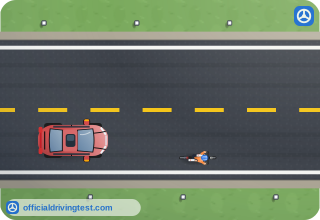
- Move onto the shoulder to the right of the bicyclist
- Stay in your lane and sound your horn
- Move into the other lane when there isn't any oncoming traffic
- Stay in your lane and pass on the bicyclist's right
Show answer
Correct answer: Move into the other lane when there isn't any oncoming traffic
With one lane each way, you move into the other lane only when there isn't any oncoming traffic.
Source: Washington Driver Guide (© 2025), page 103 · Open this page in the manual (Manual page 103)
-
When passing a bicyclist, how much space must you leave between the bicyclist and the widest part of your vehicle?
- At least 1 foot
- At least 3 feet
- At least 6 feet
- At least 10 feet
Show answer
Correct answer: At least 3 feet
Leave at least 3 feet between the bicyclist and the widest part of your vehicle.
Source: Washington Driver Guide (© 2025), page 103 · Open this page in the manual (Manual page 103)
-
On which side of a bicyclist should you pass?
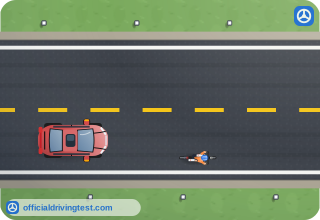
- The right side, passing slowly
- The right side, passing quickly
- Either side, as soon as you can
- The left side, passing slowly
Show answer
Correct answer: The left side, passing slowly
Pass slowly on the bicyclist's left side.
Source: Washington Driver Guide (© 2025), page 103 · Open this page in the manual (Manual page 103)
-
When may you return to your lane after passing a bicyclist?
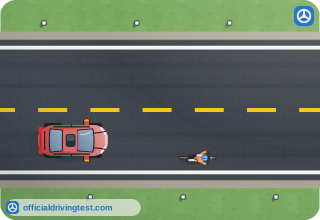
- Only after you are clear of the bicyclist
- As soon as your front bumper passes the bicycle
- As soon as the bicyclist's handlebars are beside you
- After you flash your headlights
Show answer
Correct answer: Only after you are clear of the bicyclist
Moving over too soon could put the bicyclist in danger, so make sure you are clear first.
Source: Washington Driver Guide (© 2025), page 103 · Open this page in the manual (Manual page 103)
-
You are going to turn right and a bicyclist is ahead of you. What should you not do?
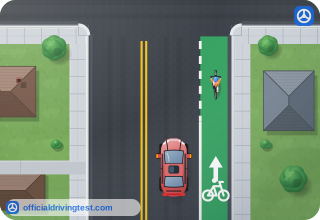
- Slow down well before the turn begins
- Use your turn signal before the turn
- Pass the bicyclist just before the turn
- Check your blind zone before turning
Show answer
Correct answer: Pass the bicyclist just before the turn
If you are going to turn right, do not pass a bicyclist just before the turn.
Source: Washington Driver Guide (© 2025), page 103 · Open this page in the manual (Manual page 103)
-
How are bicycle lanes typically marked?
- Painted yellow, with dashed white lines and a bicycle symbol
- Painted green, with solid white lines and a bicycle symbol
- Painted red, with solid yellow lines and a bicycle symbol
- Painted blue, with a double white line and a bicycle symbol
Show answer
Correct answer: Painted green, with solid white lines and a bicycle symbol
Bicycle lanes are typically painted green, use solid white lines, and have a bicycle symbol.
Source: Washington Driver Guide (© 2025), page 104 · Open this page in the manual (Manual page 104)
-
Bike lane markings vary in length. How should you drive?
- As though the lane ends where the paint ends
- As though the lane is only for turning
- As though bicyclists will leave the lane
- As though the markings continue
Show answer
Correct answer: As though the markings continue
Although bike lane markings vary in length, drive as though they continue.
Source: Washington Driver Guide (© 2025), page 104 · Open this page in the manual (Manual page 104)
-
When may you drive in a bicycle lane?
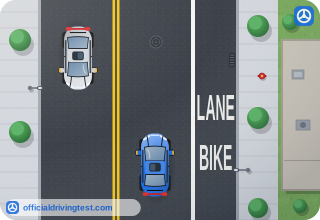
- Only when turning or crossing it to park near the curb
- When traffic in the other lanes is stopped or moving slowly
- When you need to pass a slow vehicle on the right
- Whenever no bicyclist is in sight and you are hurrying
Show answer
Correct answer: Only when turning or crossing it to park near the curb
Drive in bicycle lanes only when turning or crossing the lane to park near the curb.
Source: Washington Driver Guide (© 2025), page 104 · Open this page in the manual (Manual page 104)
-
What should you do after you park and before you open your door?
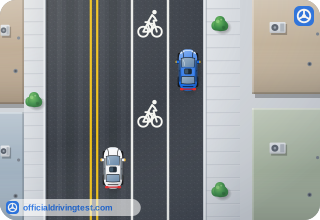
- Sound your horn to warn passing bicyclists
- Turn on your hazard lights
- Look carefully in all directions for a bicyclist
- Wait for bicyclists to ring their bells
Show answer
Correct answer: Look carefully in all directions for a bicyclist
Look carefully in all directions for a bicyclist after you park and before opening your door.
Source: Washington Driver Guide (© 2025), page 104 · Open this page in the manual (Manual page 104)
-
What marks agricultural and farm vehicles designed to go 25 mph or less?
- A flashing blue light on top
- A square white sign on the back
- A triangle sign or emblem on the back
- A red flag on the left front
Show answer
Correct answer: A triangle sign or emblem on the back
Agricultural and farm vehicles designed to go 25 mph or less have a triangle sign or emblem on the back.
Source: Washington Driver Guide (© 2025), page 106 · Open this page in the manual (Manual page 106)
-
How far must you move over to pass an agricultural vehicle when there are two lanes in your direction?
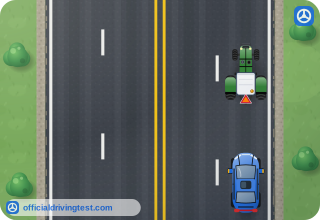
- Half a lane
- One full lane
- Two full lanes
- Onto the shoulder
Show answer
Correct answer: One full lane
With two lanes in the same direction, move over one full lane to pass an agricultural vehicle.
Source: Washington Driver Guide (© 2025), page 106 · Open this page in the manual (Manual page 106)
-
As you pass an agricultural vehicle, how much space should there be between it and the widest part of your vehicle?
- At least 1 foot
- At least 6 feet
- At least 10 feet
- At least 3 feet
Show answer
Correct answer: At least 3 feet
There should be at least 3 feet between the widest part of your vehicle and the agricultural vehicle.
Source: Washington Driver Guide (© 2025), page 106 · Open this page in the manual (Manual page 106)
-
How can bicycles navigate a roundabout?
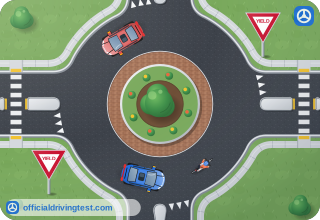
- Only as a vehicle, in the middle of the lane
- As a pedestrian or as a vehicle, by their own choice
- Only as a pedestrian, using the crosswalks
- Only on the sidewalk or the truck apron
Show answer
Correct answer: As a pedestrian or as a vehicle, by their own choice
Bicyclists decide whether to go through the roundabout as a pedestrian or as a vehicle.
Source: Washington Driver Guide (© 2025), page 127 · Open this page in the manual (Manual page 127)
-
When traveling as a vehicle in a roundabout, where should bicyclists ride to increase their visibility to drivers?
- Along the right edge of the lane
- In the middle of the lane
- On the truck apron
- Next to the central island
Show answer
Correct answer: In the middle of the lane
Riding in the middle of the lane makes bicyclists easier for drivers to see.
Source: Washington Driver Guide (© 2025), page 127 · Open this page in the manual (Manual page 127)
-
How much space should you give when passing a bicycle in a lane marked with sharrows?
- At least 1 foot
- At least 5 feet
- At least 3 feet
- At least 10 feet
Show answer
Correct answer: At least 3 feet
On sharrows you watch for riders, drive slowly, and give at least 3 feet when passing.
Source: Washington Driver Guide (© 2025), page 139 · Open this page in the manual (Manual page 139)
5Part 516 questions
-
How should bicycles position themselves on sharrow markings?
- In line with the markings, riding in the direction the arrow points
- Along the right edge of the lane, away from the markings
- Against the direction in which the arrow is pointing
- On the sidewalk next to the lane with the markings
Show answer
Correct answer: In line with the markings, riding in the direction the arrow points
Bicyclists line up with the sharrow markings and follow the direction of the arrow.
Source: Washington Driver Guide (© 2025), page 139 · Open this page in the manual (Manual page 139)
-
At a bicycle box, who crosses the intersection first when the light turns green?
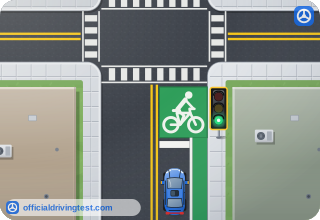
- Bicyclists
- Vehicles waiting behind the white line
- Whichever road user arrived first
- Vehicles that are turning right
Show answer
Correct answer: Bicyclists
Bicyclists go first on green and continue into the bike lane across the intersection.
Source: Washington Driver Guide (© 2025), page 140 · Open this page in the manual (Manual page 140)
-
What rule applies to turning right on red near a bicycle box?
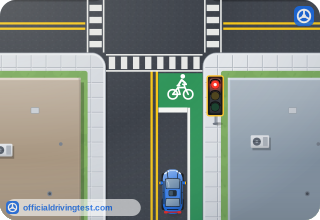
- You may turn if you stop and then yield to bicyclists
- You may turn if no bicyclist is in the box
- You can’t turn right on red there
- You may turn only from the bike lane
Show answer
Correct answer: You can’t turn right on red there
Turning right on red is not allowed near a bicycle box.
Source: Washington Driver Guide (© 2025), page 140 · Open this page in the manual (Manual page 140)
-
Where should you stay while a bicycle box in front of you is occupied?
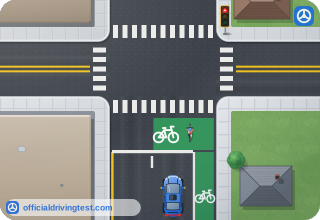
- Beside the bicyclists in the box
- Behind the white line
- On the far side of the intersection
- In the bike lane
Show answer
Correct answer: Behind the white line
You wait behind the white line until the bicycle box is clear.
Source: Washington Driver Guide (© 2025), page 140 · Open this page in the manual (Manual page 140)
-
Where should bicyclists position themselves at an intersection with a bicycle box?
- Behind vehicles
- Beside the curb behind the last car
- In the crosswalk
- In front of vehicles
Show answer
Correct answer: In front of vehicles
At an intersection with a bicycle box, cyclists wait ahead of the vehicles.
Source: Washington Driver Guide (© 2025), page 140 · Open this page in the manual (Manual page 140)
-
Washington State Ferries are part of the state’s highway network. What does that mean for drivers?
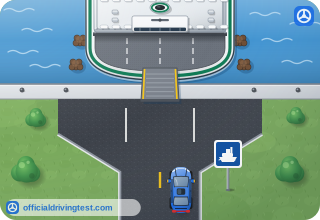
- Only the ferry system’s own rules apply
- All rules of the road apply
- Speed limits do not apply
- Only rules posted at the terminal apply
Show answer
Correct answer: All rules of the road apply
As part of the highway network, all rules of the road apply on the ferries.
Source: Washington Driver Guide (© 2025), page 152 · Open this page in the manual (Manual page 152)
-
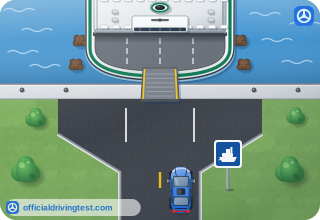
As you approach a ferry terminal, where should you pull up?
- Beside the line, in any open lane
- At the front, if your vehicle is small
- On the shoulder, away from the line
- Behind other vehicles already in line
Show answer
Correct answer: Behind other vehicles already in line
You pull up behind the vehicles already in line in the designated ferry lane.
Source: Washington Driver Guide (© 2025), page 152 · Open this page in the manual (Manual page 152)
-
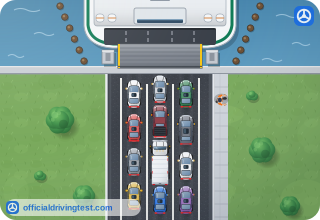
What is ferry line-cutting?
- Allowed when the line is very long
- Allowed when terminal staff are busy
- A traffic offense that can lead to a fine
- A courtesy violation with no penalty
Show answer
Correct answer: A traffic offense that can lead to a fine
Cutting into a ferry line is a traffic offense, and you can be fined for it.
Source: Washington Driver Guide (© 2025), page 152 · Open this page in the manual (Manual page 152)
-
Which road users receive priority loading on most ferries?
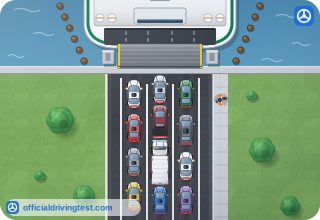
- Bicyclists
- Motorcyclists
- Commercial trucks
- Drivers pulling trailers
Show answer
Correct answer: Bicyclists
On most ferries, bicyclists get priority when loading.
Source: Washington Driver Guide (© 2025), page 152 · Open this page in the manual (Manual page 152)
-
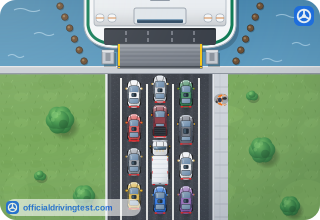
Where is the bicycle waiting area on most ferries?
- Behind the last car in line
- In the middle of the holding lane
- Beside the vehicle entrance only
- In front of motor vehicles
Show answer
Correct answer: In front of motor vehicles
Bicyclists have a waiting area in front of the motor vehicles.
Source: Washington Driver Guide (© 2025), page 152 · Open this page in the manual (Manual page 152)
-
What may bicyclists do in a ferry holding lane?
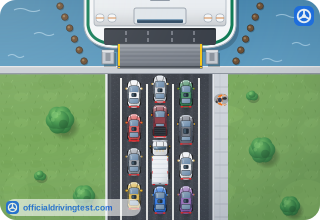
- Wait in line behind the last vehicle
- Proceed past vehicles waiting in the lane
- Ride only on the sidewalk
- Pass only when a ferry worker waves them on
Show answer
Correct answer: Proceed past vehicles waiting in the lane
Bicyclists can go ahead past vehicles waiting in the ferry holding lane.
Source: Washington Driver Guide (© 2025), page 152 · Open this page in the manual (Manual page 152)
-
In which counties is driving allowed on ocean beaches?
- Grays Harbor and Pacific counties
- King and Pierce counties
- Clallam and Jefferson counties
- Whatcom and Skagit counties
Show answer
Correct answer: Grays Harbor and Pacific counties
Driving on ocean beaches is allowed only in Grays Harbor and Pacific counties.
Source: Washington Driver Guide (© 2025), page 152 · Open this page in the manual (Manual page 152)
-
Who has the right-of-way at all times on an ocean beach where driving is allowed?
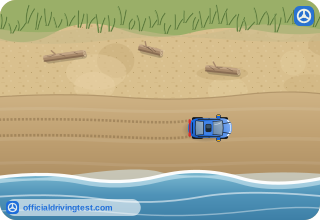
- Vehicles traveling toward the water
- Pedestrians and bicyclists
- The vehicle that arrived first
- Vehicles on hard-packed sand
Show answer
Correct answer: Pedestrians and bicyclists
On the beach, pedestrians and bicyclists always have the right-of-way.
Source: Washington Driver Guide (© 2025), page 152 · Open this page in the manual (Manual page 152)
-
How is an ocean beach where driving is allowed treated under the law?
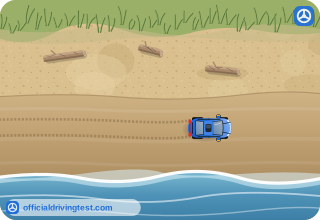
- As private land where traffic laws do not apply
- As a park where only posted signs apply
- As a county road where only local rules apply
- As a state highway, so all driving laws apply
Show answer
Correct answer: As a state highway, so all driving laws apply
All driving laws apply on the beach because it counts as a state highway.
Source: Washington Driver Guide (© 2025), page 152 · Open this page in the manual (Manual page 152)
-
How may you enter an ocean beach with your vehicle?
- Through any gap in the dunes
- From any road end near the water
- Only through marked beach approaches
- Only where no signs are posted
Show answer
Correct answer: Only through marked beach approaches
You may enter the beach only through marked beach approaches.
Source: Washington Driver Guide (© 2025), page 152 · Open this page in the manual (Manual page 152)
-
On what surface may you drive on an ocean beach?
- Only hard-packed sand
- Soft, dry sand
- Any sand with no signs posted
- Wet sand near the waterline only
Show answer
Correct answer: Only hard-packed sand
You may drive only on hard-packed sand.
Source: Washington Driver Guide (© 2025), page 152 · Open this page in the manual (Manual page 152)