Vermont: Vehicle controls and equipment — Part 5 Practice Test
Questions in this part include: “What must be true of the speedometer and odometer in your vehicle?” · “What must be done if your vehicle is supposed to have a catalytic converter and it is not present or it fails?”
Independent educational site · not affiliated with any government agency or DMV
Ready? Test yourself
- Instant feedback with an explanation
- Every answer cites its source in the manual
- Your best score is saved on this device
- Keyboard: press 1 to 4 to answer and Enter for the next question
Questions are original and based on the official manual "Vermont Driver's Manual" (2025 edition (VN-007 07/2024)), Vermont Department of Motor Vehicles.
All 18 questions in this practice test
Take the test above first, then use this list to study. Tap “Show answer” to see the correct answer and explanation.
Show the questions and answersHide the questions
-
What must be true of the speedometer and odometer in your vehicle?
- They must work properly, but only the speedometer must be visible
- They must work properly and be where the driver can see them
- They must be replaced at every annual inspection
- They must be reset to zero when the vehicle is sold
Show answer
Correct answer: They must work properly and be where the driver can see them
Both instruments have to work and be placed where the driver can see them.
Source: Vermont Driver's Manual (2025 edition (VN-007 07/2024)), page 61 · Open this page in the manual (Manual page 61)
-
What does federal law state about the numbers on an odometer?
- They must be reset when the vehicle is sold
- They must be changed every year at inspection
- They must be hidden from other drivers
- They must not be altered
Show answer
Correct answer: They must not be altered
Federal law forbids altering the numbers on an odometer.
Source: Vermont Driver's Manual (2025 edition (VN-007 07/2024)), page 61 · Open this page in the manual (Manual page 61)
-
When a vehicle is sold, who must sign an odometer statement?
- The seller and the purchaser
- Only the seller
- Only the purchaser
- The inspection mechanic and the seller
Show answer
Correct answer: The seller and the purchaser
An odometer statement has to be signed by both the seller and the purchaser.
Source: Vermont Driver's Manual (2025 edition (VN-007 07/2024)), page 61 · Open this page in the manual (Manual page 61)
-
A driver has to be able to see clearly in which directions?

- To the front of the vehicle only
- To the sides of the vehicle only
- To the front and sides of the vehicle
- Through the rear window only
Show answer
Correct answer: To the front and sides of the vehicle
Nothing should be in the way of the driver's clear view to the front and sides.
Source: Vermont Driver's Manual (2025 edition (VN-007 07/2024)), page 61 · Open this page in the manual (Manual page 61)
-
Which two items must your vehicle have, according to the manual?
- A rearview mirror and a horn
- A backup camera and a rearview mirror
- A horn and a backup camera
- A radio and a horn
Show answer
Correct answer: A rearview mirror and a horn
The manual states you must have a rearview mirror and a horn.
Source: Vermont Driver's Manual (2025 edition (VN-007 07/2024)), page 61 · Open this page in the manual (Manual page 61)
-
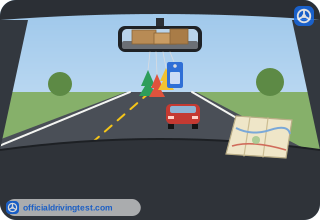
What does the law say about objects hanging from the rearview mirror or sun visors?
- Only small objects may hang from them
- Only lightweight objects may hang from them
- There shall not be anything hanging from them
- Objects may hang from the sun visors but not the mirror
Show answer
Correct answer: There shall not be anything hanging from them
The law bars anything from hanging from either the rearview mirror or the sun visors.
Source: Vermont Driver's Manual (2025 edition (VN-007 07/2024)), page 61 · Open this page in the manual (Manual page 61)
-
What is checked about the catalytic converter during the annual inspection?
- That it has been replaced within the last year
- That it is present on the vehicle
- That it is the same brand as the original
- That it was installed by a licensed mechanic
Show answer
Correct answer: That it is present on the vehicle
The inspection checks that a catalytic converter is present on vehicles that should have one.
Source: Vermont Driver's Manual (2025 edition (VN-007 07/2024)), page 61 · Open this page in the manual (Manual page 61)
-
Which of these is against federal and state law?
- Replacing a catalytic converter that has failed
- Having the gas cap examined at inspection
- Using the On Board Diagnostic system to find problems
- Disconnecting your vehicle's catalytic converter
Show answer
Correct answer: Disconnecting your vehicle's catalytic converter
Disconnecting a catalytic converter, or having a mechanic disconnect or tamper with it, is against federal and state law.
Source: Vermont Driver's Manual (2025 edition (VN-007 07/2024)), page 61 · Open this page in the manual (Manual page 61)
-
What must be done if your vehicle is supposed to have a catalytic converter and it is not present or it fails?
- It may be disconnected by a mechanic
- It may stay until the next annual inspection
- It must be inspected again in six months
- It must be replaced
Show answer
Correct answer: It must be replaced
A missing or failed catalytic converter has to be replaced.
Source: Vermont Driver's Manual (2025 edition (VN-007 07/2024)), page 61 · Open this page in the manual (Manual page 61)
-
What is examined during the annual inspection because gas can evaporate and cause air pollution?
- The vehicle's air filter
- The vehicle's gas cap
- The vehicle's oil cap
- The vehicle's fuel gauge
Show answer
Correct answer: The vehicle's gas cap
The gas cap is examined to make sure it is in good condition, since evaporating gas pollutes the air.
Source: Vermont Driver's Manual (2025 edition (VN-007 07/2024)), page 61 · Open this page in the manual (Manual page 61)
-
During the annual inspection, the On Board Diagnostic computer system (OBD) is checked to make sure what is working properly?
- The vehicle's braking and brake fluid system
- The vehicle's headlight and tail light system
- The vehicle's emissions control system
- The vehicle's steering and front end system
Show answer
Correct answer: The vehicle's emissions control system
The OBD is checked to confirm the emissions control system works, and it can pinpoint specific problem areas.
Source: Vermont Driver's Manual (2025 edition (VN-007 07/2024)), page 61 · Open this page in the manual (Manual page 61)
-
Which driving habit does the manual say conserves fuel?
- Making fast starts to reach your speed quickly
- Weaving in and out of traffic to keep moving
- Braking hard at the last possible moment
- Accelerating smoothly from a stop and braking softly
Show answer
Correct answer: Accelerating smoothly from a stop and braking softly
Smooth acceleration and soft braking conserve fuel, while fast starts, weaving and hard braking waste it.
Source: Vermont Driver's Manual (2025 edition (VN-007 07/2024)), page 68 · Open this page in the manual (Manual page 68)
-
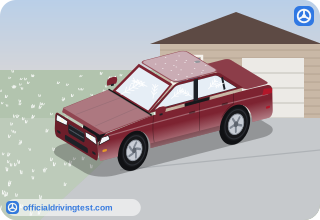
In winter weather, what does the manual say to do before starting the engine?
- Let the engine idle for 10 minutes
- Remove snow and ice from the windows
- Turn on the air conditioner
- Rev the engine to warm it faster
Show answer
Correct answer: Remove snow and ice from the windows
The manual says to remove snow and ice from the windows before starting the engine in winter weather.
Source: Vermont Driver's Manual (2025 edition (VN-007 07/2024)), page 68 · Open this page in the manual (Manual page 68)
-
The manual says to limit stationary warm-ups to how long when possible?
- 5 seconds
- 30 seconds
- 2 minutes
- 5 minutes
Show answer
Correct answer: 30 seconds
The manual advises limiting stationary warm-ups to 30 seconds when possible; driving slowly to moderately is the most efficient way to warm up.
Source: Vermont Driver's Manual (2025 edition (VN-007 07/2024)), page 68 · Open this page in the manual (Manual page 68)
-
If you are parked in town, idling for more than how long uses more fuel than shutting off and restarting?
- 1 minute
- 2 minutes
- 5 minutes
- 10 seconds
Show answer
Correct answer: 10 seconds
In town, idling for more than 10 seconds uses more fuel than turning the engine off and restarting it.
Source: Vermont Driver's Manual (2025 edition (VN-007 07/2024)), page 68 · Open this page in the manual (Manual page 68)
-
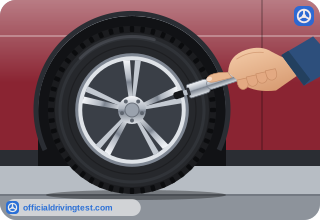
Where can you find a vehicle's recommended tire pressure, according to the manual?
- On the placard in the driver's side door jam and in the owner's manual
- On the inspection sticker and on the registration certificate
- Under the hood, on the battery
- On the dashboard next to the odometer
Show answer
Correct answer: On the placard in the driver's side door jam and in the owner's manual
The manual says the recommended pressure is on the placard in the driver's side door jam and in the vehicle owner's manual.
Source: Vermont Driver's Manual (2025 edition (VN-007 07/2024)), page 68 · Open this page in the manual (Manual page 68)
-
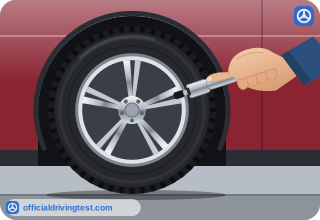
What do under-inflated tires do, according to the manual?
- Reduce rolling resistance, improve fuel economy and wear more rapidly
- Improve fuel economy but wear more rapidly
- Increase rolling resistance, reduce fuel economy and wear more rapidly
- Increase rolling resistance but wear more slowly
Show answer
Correct answer: Increase rolling resistance, reduce fuel economy and wear more rapidly
Under-inflated tires have more rolling resistance, which lowers fuel economy, and they wear out faster.
Source: Vermont Driver's Manual (2025 edition (VN-007 07/2024)), page 69 · Open this page in the manual (Manual page 69)
-
The manual says not to drive with the windows open unless you keep your speed under what?
- 30 mph
- 40 mph
- 60 mph
- 50 mph
Show answer
Correct answer: 50 mph
Open windows at highway speeds add aerodynamic drag and lower fuel economy, so the manual says to stay under 50 mph if you drive with them open.
Source: Vermont Driver's Manual (2025 edition (VN-007 07/2024)), page 69 · Open this page in the manual (Manual page 69)