Vermont: Vehicle controls and equipment — Part 1 Practice Test
Questions in this part include: “Who is responsible for the safe operating condition of the vehicle used in the road test?” · “Safety belts and defrosters are required in which models of road test vehicles?”
Independent educational site · not affiliated with any government agency or DMV
Ready? Test yourself
- Instant feedback with an explanation
- Every answer cites its source in the manual
- Your best score is saved on this device
- Keyboard: press 1 to 4 to answer and Enter for the next question
Questions are original and based on the official manual "Vermont Driver's Manual" (2025 edition (VN-007 07/2024)), Vermont Department of Motor Vehicles.
All 18 questions in this practice test
Take the test above first, then use this list to study. Tap “Show answer” to see the correct answer and explanation.
Show the questions and answersHide the questions
-
Who is responsible for the safe operating condition of the vehicle used in the road test?
- The operator
- The examiner
- The vehicle inspector
- The DMV
Show answer
Correct answer: The operator
The safe operating condition of the vehicle is the responsibility of the operator.
Source: Vermont Driver's Manual (2025 edition (VN-007 07/2024)), page 19 · Open this page in the manual (Manual page 19)
-
Which of these is listed as proper equipment that must be in good mechanical condition in a road test vehicle?
- Air conditioning
- Exhaust system
- A GPS unit
- A backup camera
Show answer
Correct answer: Exhaust system
The list of required equipment includes the exhaust system, among others such as headlights, horn and brakes.
Source: Vermont Driver's Manual (2025 edition (VN-007 07/2024)), page 19 · Open this page in the manual (Manual page 19)
-
Directional signals are required equipment on a road test vehicle manufactured or assembled after which date?
- January 1, 1945
- January 1, 1964
- January 1, 1975
- January 1, 1955
Show answer
Correct answer: January 1, 1955
A vehicle made or assembled after January 1, 1955 must have directional signals.
Source: Vermont Driver's Manual (2025 edition (VN-007 07/2024)), page 19 · Open this page in the manual (Manual page 19)
-
Safety belts and defrosters are required in which models of road test vehicles?
- 1964 and later models
- 1955 and later models
- 1974 and later models
- 1984 and later models
Show answer
Correct answer: 1964 and later models
Safety belts and defrosters are required in 1964 and later models.
Source: Vermont Driver's Manual (2025 edition (VN-007 07/2024)), page 19 · Open this page in the manual (Manual page 19)
-
How well must the emergency/parking brake of a road test vehicle hold the vehicle?
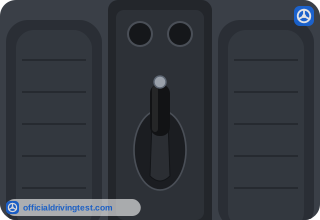
- On a level surface for at least one minute
- In neutral on any grade, uphill or downhill
- In gear on a hill facing downhill only
- In neutral only when headed uphill
Show answer
Correct answer: In neutral on any grade, uphill or downhill
The brake must hold the vehicle in neutral on any grade it is operated on, headed uphill or downhill.
Source: Vermont Driver's Manual (2025 edition (VN-007 07/2024)), page 19 · Open this page in the manual (Manual page 19)
-
What does the manual say about tinting of the front windows of a road test vehicle?
- Any tint is allowed if the vehicle is inspected
- Tint is allowed on the driver’s window only
- Tint is allowed if a parent signs a form
- Illegal tinting is not allowed
Show answer
Correct answer: Illegal tinting is not allowed
Illegal tinting of the front windows of the vehicle is not allowed.
Source: Vermont Driver's Manual (2025 edition (VN-007 07/2024)), page 19 · Open this page in the manual (Manual page 19)
-
If you look at the steering wheel as the face of a clock, which hand positions does the manual recommend?
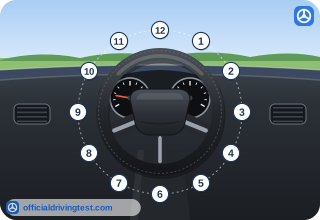
- 10 and 2 or 11 and 1
- 12 and 6 or 1 and 7
- 6 and 12 or 5 and 7
- 9 and 3 or 8 and 4
Show answer
Correct answer: 9 and 3 or 8 and 4
The manual recommends holding the wheel at 9 and 3 or at 8 and 4.
Source: Vermont Driver's Manual (2025 edition (VN-007 07/2024)), page 25 · Open this page in the manual (Manual page 25)
-
Which steering method does the manual say to use for turning?
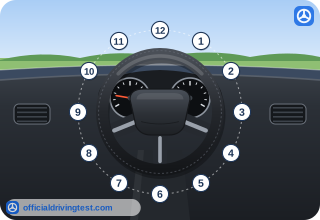
- Hand over hand steering
- One-handed steering at the top of the wheel
- Palm-of-the-hand steering on the rim
- Hand-sliding steering with one hand
Show answer
Correct answer: Hand over hand steering
The manual tells new drivers to use hand over hand steering when turning.
Source: Vermont Driver's Manual (2025 edition (VN-007 07/2024)), page 25 · Open this page in the manual (Manual page 25)
-
Which of these should you do before you drive your vehicle?
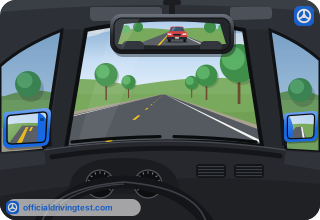
- Turn off the headlights to save the battery
- Unlock the doors so passengers can leave quickly
- Test the foot and parking/emergency brakes
- Remove the safety belt until you are moving
Show answer
Correct answer: Test the foot and parking/emergency brakes
Testing the foot brake and the parking/emergency brake is one of the readiness steps listed before driving.
Source: Vermont Driver's Manual (2025 edition (VN-007 07/2024)), page 25 · Open this page in the manual (Manual page 25)
-
Before you drive your vehicle, what should you do with the doors?
- Leave them unlocked
- Lock them
- Leave them slightly open
- Lock only the driver's door
Show answer
Correct answer: Lock them
Locking the doors is one of the readiness steps to do before driving.
Source: Vermont Driver's Manual (2025 edition (VN-007 07/2024)), page 25 · Open this page in the manual (Manual page 25)
-
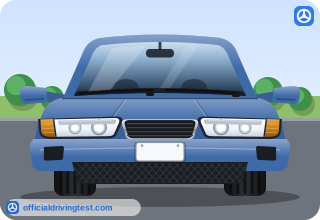
Before you drive your vehicle, what should you do with the headlights?
- Turn them off
- Set them to high beam
- Wipe them with a cloth
- Turn them on
Show answer
Correct answer: Turn them on
Turning on the headlights is one of the readiness steps to do before driving.
Source: Vermont Driver's Manual (2025 edition (VN-007 07/2024)), page 25 · Open this page in the manual (Manual page 25)
-
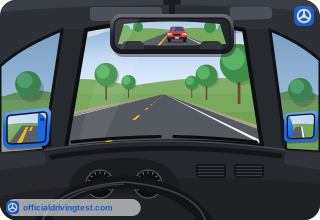
Before you drive your vehicle, which mirrors should you adjust?
- Only the rear view mirror
- Only the side mirrors
- All mirrors
- None, since mirrors are used only when backing
Show answer
Correct answer: All mirrors
The readiness list says to adjust all mirrors before driving.
Source: Vermont Driver's Manual (2025 edition (VN-007 07/2024)), page 25 · Open this page in the manual (Manual page 25)
-
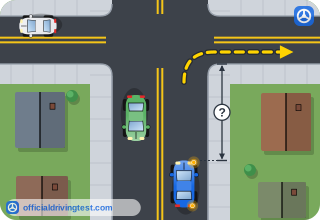
How far before making a turn or changing lanes must a driver use a turn signal, according to the law?
- Not less than 25 feet
- Not less than 50 feet
- Not less than 100 feet
- Not less than 300 feet
Show answer
Correct answer: Not less than 100 feet
The law requires a turn signal at least 100 feet before a turn or lane change.
Source: Vermont Driver's Manual (2025 edition (VN-007 07/2024)), page 26 · Open this page in the manual (Manual page 26)
-
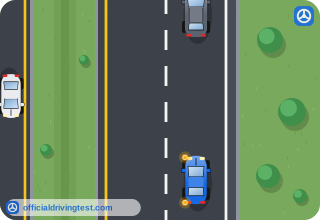
How many seconds before a turn or lane change does the manual say to signal?
- One to two seconds
- Three to five seconds
- Six to eight seconds
- Ten to twelve seconds
Show answer
Correct answer: Three to five seconds
Signaling three to five seconds ahead meets the requirement of signaling at least 100 feet before.
Source: Vermont Driver's Manual (2025 edition (VN-007 07/2024)), page 26 · Open this page in the manual (Manual page 26)
-
What does applying your brakes tell the vehicles behind you?
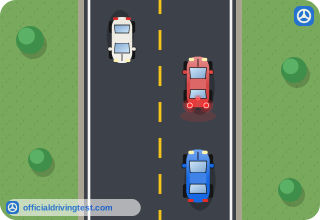
- That you are planning to turn left
- That you are planning to change lanes
- That you are about to speed up
- That you are planning to slow down or stop
Show answer
Correct answer: That you are planning to slow down or stop
Braking lets following drivers know you plan to slow down or stop.
Source: Vermont Driver's Manual (2025 edition (VN-007 07/2024)), page 26 · Open this page in the manual (Manual page 26)
-
What must you do if your vehicle's directional lights or brake lights are not working?
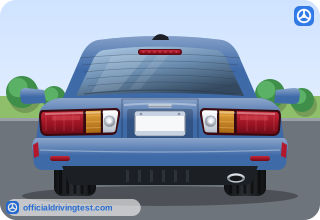
- Use hand signals to show you plan to stop or turn
- Drive only on roads with no other traffic
- Honk the horn before every stop or turn
- Keep the headlights flashing while you drive
Show answer
Correct answer: Use hand signals to show you plan to stop or turn
With broken signal or brake lights, you must use hand signals to tell others you plan to stop or turn.
Source: Vermont Driver's Manual (2025 edition (VN-007 07/2024)), page 26 · Open this page in the manual (Manual page 26)
-
How soon must directional lights or brake lights that do not work be fixed?
- Within one week
- Before the next inspection
- Immediately
- Within thirty days
Show answer
Correct answer: Immediately
Directional lights and brake lights that do not work must be fixed immediately.
Source: Vermont Driver's Manual (2025 edition (VN-007 07/2024)), page 26 · Open this page in the manual (Manual page 26)
-
What do anti-lock brakes allow you to do?
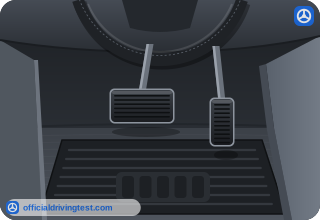
- Brake and steer at the same time
- Stop in the same distance on ice as on dry pavement
- Pump the brakes without any risk
- Drive faster on slippery roads
Show answer
Correct answer: Brake and steer at the same time
The manual calls anti-lock brakes a safety breakthrough because they let you brake and steer at the same time.
Source: Vermont Driver's Manual (2025 edition (VN-007 07/2024)), page 48 · Open this page in the manual (Manual page 48)